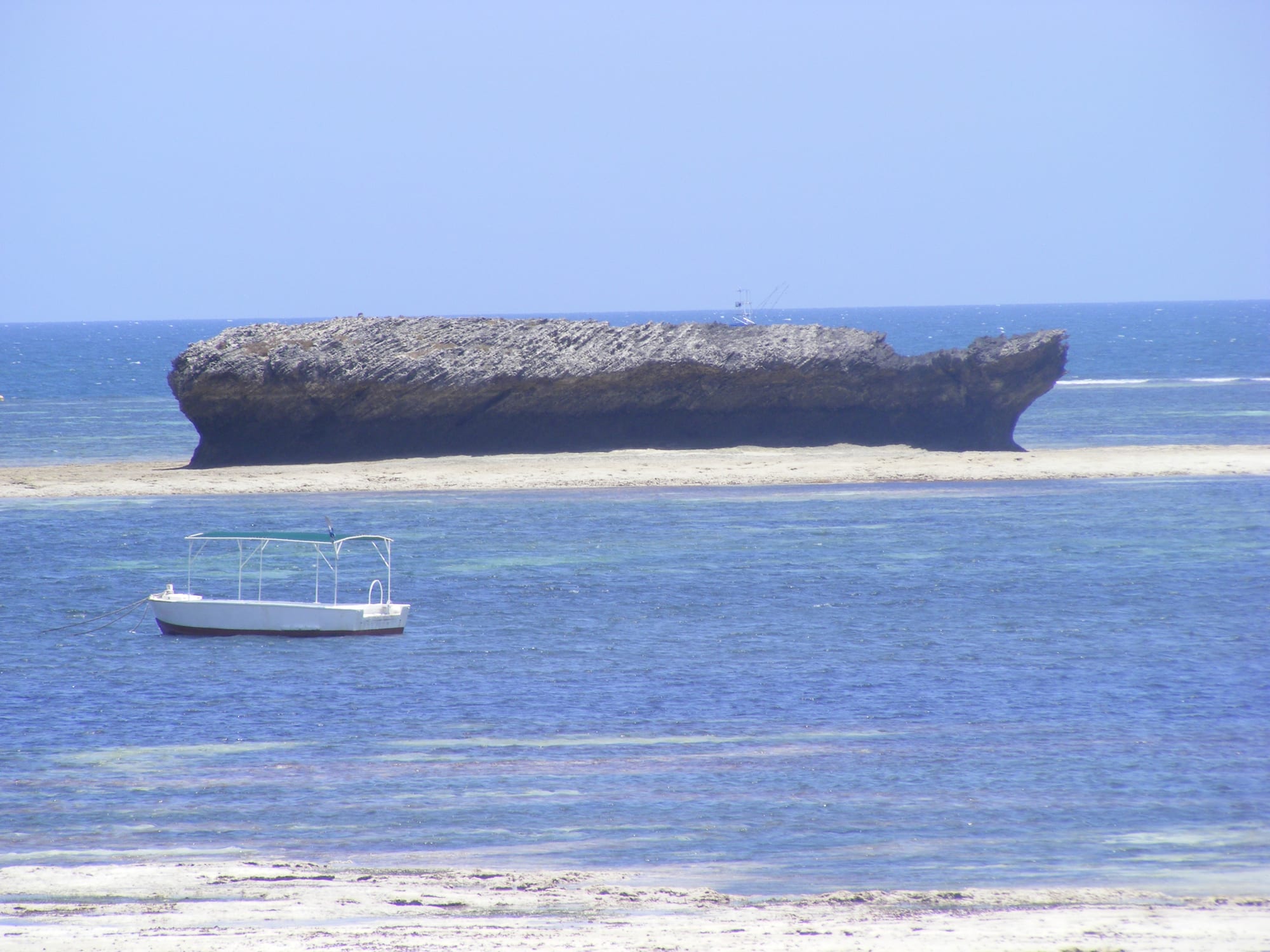
A flat coral rock island rising from pale shallow water off a sandbar, with a small white boat moored in the foreground

Mombasa & the Coast, Kenya

Watamu

Coral outcrops and shallow reef water off the beaches of Watamu. (ian 1602 / Wikimedia Commons · CC BY-SA 2.0)

A fishing village turned small beach resort on Kenya's north coast, south of Malindi, set on a series of white bays studded with coral outcrops. One of Kenya's oldest marine national parks protects the reef offshore, the mangroves of Mida Creek lie behind the village, and the Arabuko-Sokoke forest and the ruined Swahili town of Gedi are a short way inland.

Neighbourhoods

  • Watamu village
    • Local life
    • Markets
    • Best for food

    The working centre of the place, a grid of sandy streets with shops, a mosque, small cafés, fishermen's boats drawn up on the sand and the co-operative that sells the day's catch. Guesthouses here are far cheaper than on the beach and the village stays busy in the evening.

    Open in Maps
  • The beach road and the bays
    • First-time visitors
    • Beaches
    • Diving and snorkelling

    A ribbon of hotels, villas and dive centres strung behind the bays south of the village, with gates opening straight onto white sand and reef-sheltered water. It is quiet, low-rise and spread out, with restaurants scattered along the road rather than clustered.

    Open in Maps
  • Mida Creek and Dabaso
    • Quiet and residential
    • Birdwatching
    • Walks

    The inland side, where a wide tidal creek runs back among mangroves a few kilometres from the sea. Villages here live from fishing, crab farming and community tourism, and a boardwalk leads out over the mangroves to the water.

    Open in Maps

Things to do

The reef and the creek

  • Watamu Marine National Parkpark

    One of Kenya's first marine parks, gazetted in 1968, protecting coral gardens, lagoons and reef fish in the bays offshore, with snorkelling and diving from the beach.

    Open in Maps
  • Mida Creekattraction

    A tidal inlet of mangrove forest and sand flats behind the village, part of a UNESCO biosphere reserve and known for waders, including migrant birds that winter here.

    Open in Maps
  • Turtle conservation in Watamuattraction

    A long-running local marine conservation programme that pays fishermen for turtles caught by accident so that they can be released, and protects the nests of green, hawksbill and olive ridley turtles on the park's beaches.

    Open in Maps

Forests and ruins

  • Gedi Ruinslandmark

    The overgrown remains of a Swahili town abandoned in the 17th century, with a palace, mosques, pillar tombs and house walls under tall forest, added to the UNESCO World Heritage list in 2024.

    Open in Maps
  • Arabuko Sokoke Forestpark

    The largest surviving fragment of coastal forest in East Africa, some 420 square kilometres inland from the village, home to the golden-rumped elephant shrew, Sokoke scops owl and other species found almost nowhere else.

    Open in Maps

Short trips from the village

  • Malindineighborhood

    The old coastal town to the north, with its marine park, the pillar left by Vasco da Gama's fleet and a long-established Italian community.

    Open in Maps
  • Malindi Airporttransit hub

    The nearest airfield, about 18 kilometres up the road from Watamu, handling domestic flights and cleared for international operations.

    Open in Maps
  • Sabaki Riverattraction

    The river that reaches the sea north of Malindi, where its mouth spreads into sandbars, dunes and pools that draw large numbers of waterbirds.

    Open in Maps
  • Kilifineighborhood

    A town on a broad creek crossed by a high bridge, down the coast road towards Mombasa, known for its sheltered water and the ruins at Mnarani above the inlet.

    Open in Maps

Eat and drink

Long-standing places and food districts in Watamu. Hours, ratings and directions come from your maps app, always current.

Coast classics

  • Fish landed at the villagerestaurant

    Reef fish, crab, prawns, squid and octopus bought from the boats and cooked simply — grilled over charcoal or in a coconut and tamarind sauce with rice.

    Open in Maps
  • Swahili cafés in the villagecafe

    Small local kitchens serving mahamri and mbaazi at breakfast, pilau and beans at midday, and chai at any hour, at a fraction of beach-hotel prices.

    Open in Maps
  • Italian kitchens along the beach roadrestaurant

    Decades of Italian visitors to this stretch of coast have left pizzerias, pasta and gelato among the hotels behind the bays.

    Open in Maps

Markets and the creek

  • Watamu village marketmarket

    A small produce market for mangoes, coconuts, cassava, limes and greens, with fish sold separately near the landing beach.

    Open in Maps
  • Dabaso crab shack and creek kitchensrestaurant

    Community-run eating places out on the mangrove boardwalks of Mida Creek, known for mud crab cooked in coconut.

    Open in Maps

Experience Watamu

History

The bays at Watamu were a small Giriama and Swahili fishing settlement for centuries, in the shadow of far larger neighbours. A few kilometres inland stood Gedi, a walled Swahili town of coral-rag houses, mosques and a palace that flourished from the 11th or 12th century, traded with the wider Indian Ocean and was abandoned in the 17th century for reasons still argued over — water, raids from the north, or shifting trade. Its ruins, swallowed by forest, became one of the best-known archaeological sites on the East African coast and were added to the UNESCO World Heritage list in 2024.

The colonial period brought sisal and the coast road but changed the village little. What transformed Watamu was the sea itself: in 1968 Kenya gazetted the marine national park over the reefs and lagoons offshore, one of the country's first marine parks and created in the same year as Malindi's, and the reef became the reason to come. Small hotels went up along the bays from the 1970s, many of them built or run by Italians who had begun holidaying at nearby Malindi.

Since then Watamu has grown as a low-rise, low-key resort with a strong conservation streak — turtle protection, mangrove replanting and community tourism in the creek villages sit alongside the hotels. Tourism here fell sharply during the travel warnings of the mid-2010s and again in 2020, and the slow recovery, along with pressure on the forest and the reef, shapes local debate.

Culture & Customs

Watamu sits on the line between the Swahili coast and Mijikenda country. The village is mostly Muslim, with the call to prayer marking the day, while the surrounding farmland is Giriama, one of the nine Mijikenda peoples whose sacred kaya groves in the coastal forest, eleven of them listed by UNESCO in 2008, are still tended by elders. Both traditions treat the forest as more than scenery.

Conservation has become part of local identity in a way it is not in every beach town. Fishermen work with the turtle project that buys back accidentally caught turtles for release, creek communities run the mangrove boardwalk and crab farming themselves, and forest guides from villages around Arabuko-Sokoke make a living from birdwatchers who come for species found nowhere else. Plenty of friction remains over fishing rules and park boundaries.

The Italian presence, decades old and shared with Malindi, shows in menus, in the languages spoken in the hotels and in a small resident community. Away from that, the manners are those of the coast: modest dress in the village, greetings before business, patience with a slow afternoon, and bargaining done in a friendly register. Taarab and Giriama drumming appear at weddings, and Eid brings the village out in new clothes.

Daily Life

Watamu is a small town rather than a city — about 30,000 people in 2020, in the settlement and the surrounding wards of Kilifi County, and the figures swell and shrink with the tourist season. Fishing remains the base: boats go out before dawn, the catch is sold at the landing site and through a co-operative, and hotels buy much of it. Tourism provides the wages that matter, from hotel and dive-centre work to guiding, boat crews, curio stalls and construction.

Behind the beach, households farm maize, cassava, coconuts and cashews, and in the creek villages crab farming and beekeeping have grown as alternatives to cutting mangroves. Income is highly seasonal, with April and May, when the rains come and hotels close, the hard months of the year. Young people leave for Malindi, Mombasa or Nairobi when work runs out.

Days follow the tide as much as the clock: low water brings people onto the flats to fish, glean and walk, and the village fills again in the cool of the evening. Water supply, waste, the pressure of new building on the shoreline and the long-running question of who benefits from the parks are the recurring local issues.

Food

Watamu eats what the boats bring in, cooked in the Swahili manner: fish and octopus grilled over charcoal, prawns and crab in coconut sauce, and mchuzi wa samaki, a spiced coconut fish curry, with wali wa nazi — rice cooked in coconut milk — or chapati. Mud crab from Mida Creek is the local speciality, farmed by the creek villages and cooked simply with coconut and lime.

Everyday food away from the hotels is Kenyan and Giriama: ugali with sukuma wiki or beans, githeri, cassava and roasted maize from a brazier. Breakfast is mahamri, coconut-milk buns scented with cardamom, with mbaazi, pigeon peas in coconut, and strong milky chai. Street snacks include mishkaki skewers, viazi karai and samosas, and pilau or biryani mark weddings and Eid.

Fruit is a serious matter here — mangoes in their season, passion fruit, tamarind, custard apples, and coconuts drunk from the husk and then scraped for their flesh. The Italian presence adds pizza, pasta and espresso along the beach road, and mnazi, tapped palm wine, remains the traditional drink of the Mijikenda countryside, with Tusker the standard beer in the hotels.

Planning tools

Budget

Watamu is quieter and a little cheaper than Diani, but the gap between the beach and the village is just as wide. Hotel rooms, dive packages and boat trips are priced internationally and peak at Christmas and in August, while village guesthouses, matatus and local cafés cost very little. Marine park and Gedi entry fees are extra.

Daily Budget Midrange
USD 95–230 (beach hotel, restaurant meals, a snorkelling or creek trip)
Daily Budget Shoestring
USD 30–60 (village guesthouse, local cafés, matatus and tuk-tuks)

Agree boat and tuk-tuk fares in advance, and budget for the marine park fee, which is charged per person per day.

Best Time to Visit

December to March brings hot, calm weather and the clearest water for snorkelling and diving, and whale sharks are among the larger animals recorded in the marine park. July to October is breezier and cooler. April and May are the wettest months, when the sea is churned up and some hotels close. Seaweed washes ashore in places at times through the year.

Suggested Number of Days

Three or four days suit the bays and the reef. Five to seven allow for the creek, the forest and the ruins inland at a slow pace. Tides govern snorkelling, boat trips and the creek boardwalk, so a little slack in the plan helps.

First Visit
3–4 days
With Surroundings
5–7 days

Transportation

Tuk-tuks and motorbike taxis (boda bodas) are the way to move between the village, the hotels and the turn-off on the main road; matatus run up and down the Mombasa–Malindi highway. Distances within Watamu are small but the bays are spread out, and hotels arrange cars with drivers for the forest, Gedi and Malindi.

Tuk-tuk fares are agreed before setting off, and after dark a hotel-arranged ride is easier to find than a passing one.

Airport & Station Connections

Malindi Airport, about 18 kilometres north, takes domestic flights and is roughly half an hour away by road. Mombasa's Moi International Airport is around two hours' drive down the coast road, and the Standard Gauge Railway from Nairobi reaches Mombasa. Matatus and buses run along the highway and drop passengers at the Watamu junction.

Walkability

The village itself is small, flat and easily walked, and the beaches can be walked for long stretches at low tide. The hotels, however, are spread over several kilometres of beach road with sandy verges and little lighting, so moving between them means a tuk-tuk. Paths to the creek and the forest need proper shoes.

Safety

Watamu is a small and comparatively quiet resort, with petty theft, beach sellers and occasional break-ins the usual concerns rather than violent crime. The reef makes the bays calm, but currents run strongly in the channels between the coral heads and at the mouth of Mida Creek on a falling tide. Malaria is present along the whole coast, and the sun here is fierce.

Avoid walking on beaches or in Mombasa's old town after dark, use malaria prophylaxis, and stay away from the northern Lamu and Tana River border areas. Check current official travel advice before travelling.

Climate

Hot and humid all year, with seasons defined by rain and monsoon wind rather than temperature. April and May carry the long rains, November the shorter ones, and the rest of the year is mostly dry with high humidity.

Summer
December–March is hot and humid, around 30–33°C, with calm, clear water
Winter
June–September is slightly cooler, around 27–29°C, with a steady breeze and a rougher sea

Local Customs

The village is largely Muslim and Giriama and Swahili families make up most of the population, so swimwear stays on the beach and shoulders and knees are covered away from it. Greetings come before requests, and a few words of Kiswahili are welcomed. Ramadan changes eating hours in the village, and people, boats and houses should not be photographed without asking.

Tipping is modest but usual, bargaining is normal for crafts and boat trips, and alcohol is served at hotels and beach restaurants rather than in the village.

Common Payment Methods

The currency is the Kenyan shilling, and mobile money (M-Pesa) handles most local payments. Hotels, dive centres and larger restaurants take cards; the village market, tuk-tuks and boat crews want cash. ATMs are few in Watamu itself, with more in Malindi, and park fees are sometimes quoted in US dollars.