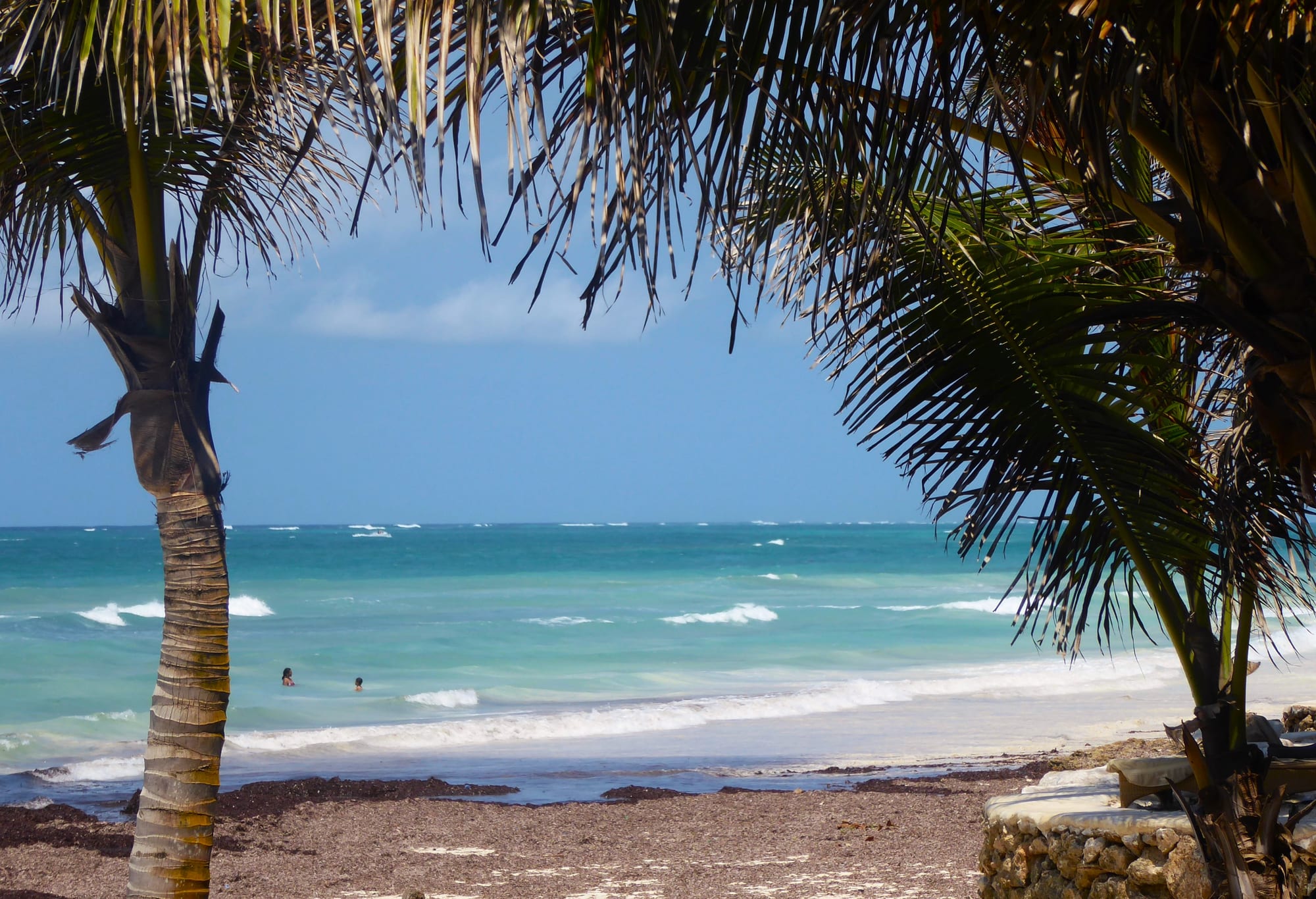
Palm fronds framing turquoise water breaking over a reef, with white sand and low coral rock in the foreground

Mombasa & the Coast, Kenya

Diani Beach

The reef-protected shallows and palm-backed sand of Diani Beach, on Kenya's south coast. (Bingar1234 / Wikimedia Commons · CC BY-SA 4.0)

A resort strip on Kenya's south coast, about an hour from Mombasa across the Likoni ferry, where a long white-sand beach lies behind a coral reef and palms. Hotels, dive centres and kitesurfing schools line a single beach road behind the sand, the market town of Ukunda sits inland on the highway, and the forested Shimba Hills rise a short drive away.

Neighbourhoods

  • The beach road
    • First-time visitors
    • Beaches
    • Best for food

    A single road runs parallel to the sand for much of the strip, with hotels and guesthouses on the seaward side and restaurants, dive shops, supermarkets and craft stalls on the other. Almost everything a visitor needs is along it, and tuk-tuks and motorbike taxis shuttle up and down all day.

    Open in Maps
  • Galu and the southern strip
    • Quiet and residential
    • Beaches
    • Kitesurfing

    South of the main hotel cluster the beach widens and the buildings thin out into villas, small lodges and kitesurfing schools. It is the quieter end of the shore, with long stretches of open sand at low tide and less traffic on the road behind.

    Open in Maps
  • Ukunda
    • Local life
    • Markets
    • Close to public transport

    The working town on the Mombasa–Lunga Lunga highway a couple of kilometres inland, where the beach road begins. Matatus, market stalls, banks, butcheries and cheap Swahili cafés serve the people who work on the coast, and the airstrip is on its edge.

    Open in Maps
  • Tiwi
    • Quiet and residential
    • Beaches

    A smaller beach a short way north towards the ferry, reached by side roads off the highway. Development is sparser than at Diani, with cottages and campsites among the palms and rock pools exposed at low tide.

    Open in Maps

Things to do

The shore and the reef

  • Colobus monkeys of the coastal forestattraction

    Troops of Angola colobus, the black-and-white monkeys of the East African coastal forest, live in the trees behind the beach road and are often seen crossing overhead.

    Open in Maps
  • Ukunda Airporttransit hub

    The regional airport on the edge of Ukunda, unofficially known as Diani airport, serving Diani, Ukunda, Tiwi and Msambweni by light aircraft.

    Open in Maps

Forests and wildlife

  • Colobus Conservationattraction

    A rehabilitation centre and orphanage for Angola colobus on the Diani Beach Road, which leads informative walks to spot the wild primates of the south coast forest.

    Open in Maps
  • Shimba Hills National Reservepark

    Coastal rainforest, woodland and grassland on a low range inland, holding some 700 elephants and Kenya's only population of sable antelope, and important for rare plants, birds and butterflies.

    Open in Maps
  • Mwaluganje Elephant Sanctuarypark

    A community-owned sanctuary of about 40 square kilometres on the northern edge of the Shimba Hills, formed in the early 1990s along an old elephant route between the coast and Tsavo.

    Open in Maps

Swahili and Mijikenda heritage

  • Kongo Mosquelandmark

    A sixteenth-century coral-stone mosque at the mouth of the Mwachema, or Kongo, river at the northern end of the strip, the last ancient Swahili structure left in Diani.

    Open in Maps
  • Kaya Kinondoattraction

    A sacred Digo forest grove of about 30 hectares, one of the Mijikenda kayas; eleven of them were inscribed together as the Sacred Mijikenda Kaya Forests World Heritage Site in 2008. Visits are guided and follow the elders' rules on dress, conduct and photography.

    Open in Maps

Short trips from the beach

  • Kisite-Mpunguti Marine National Parkpark

    A marine park established in 1978 around four small coral islands near the Tanzanian border, reached by dhow from Shimoni and known for snorkelling and for the dolphins in the channel.

    Open in Maps
  • Wasini Islandattraction

    A small car-free island off Shimoni with a village, coral-rag gardens and a boardwalk over the mangroves, usually visited on the same boat trip as the marine park.

    Open in Maps
  • Likonitransit hub

    The mainland side of the ferry across Mombasa's harbour entrance, the crossing that connects the whole south coast with the island city.

    Open in Maps
  • Mombasaneighborhood

    Kenya's port city north of the ferry, with Fort Jesus, the Old Town's carved doors and lanes, and the main markets of the coast.

    Open in Maps

Eat and drink

Long-standing places and food districts in Diani Beach. Hours, ratings and directions come from your maps app, always current.

Coast classics

  • Grilled fish and coconut curriesrestaurant

    The staple of the strip — reef fish, prawns, crab and octopus grilled or cooked in coconut sauce, usually with rice, chapati or ugali.

    Open in Maps
  • Mishkaki and street grillsrestaurant

    Skewers of marinated beef or goat cooked over charcoal at roadside stands in Ukunda in the evening, eaten with kachumbari salad.

    Open in Maps
  • Mahamri and chaicafe

    Lightly sweet coconut-milk buns, often with mbaazi (pigeon peas in coconut), the standard coastal breakfast in the town's small cafés.

    Open in Maps

Markets and food streets

  • Ukunda marketmarket

    The inland town's produce market, with mangoes, cassava, coconuts, cashews and fish brought up from the landing sites.

    Open in Maps
  • The beach road restaurantsneighborhood

    A long ribbon of Swahili, Italian, Indian and international kitchens behind the sand, ranging from plastic-chair cafés to hotel dining rooms.

    Open in Maps

Experience Diani Beach

History

The coast south of Mombasa has been Digo country for centuries, part of the Mijikenda world of farming villages whose ritual centres were the kaya, forest groves cleared and fortified by the ancestors and still protected by elders. The sea traffic of the Swahili city-states touched this shore too: the coral-stone mosque at the mouth of the Mwachema river, known as the Kongo Mosque, marks a settlement here long before Europeans arrived, and Portuguese, Omani and later Zanzibari power passed along the coast without leaving much behind on the sand.

Under British rule the south coast was farming and fishing country, with coconut, cashew and sisal on the ridges behind the beach and trade running through Mombasa after the Uganda Railway reached it in the 1890s. The beach itself only became valuable when package tourism arrived: from the middle of the twentieth century hotels went up along the strip, an airstrip was built at Ukunda, and Diani grew into one of the best-known resorts on the Indian Ocean.

Tourism has since risen and fallen with events far away. Attacks and unrest elsewhere in Kenya, travel warnings in the mid-2010s, and the shutdown of 2020 each emptied the hotels for a season, and each time the strip has come back. Ukunda has grown quickly behind the beach, and land ownership on the coast — who holds the title to the shore, and who works on it — remains a live argument in Kwale County politics.

Culture & Customs

Diani is two places overlapping. On the sand it is an international resort of divers, kitesurfers, Italian and German package guests and Nairobi families on holiday. Inland it is a Digo and Swahili town where Friday prayers empty the streets, women wear the buibui or the printed kanga, and the day is measured by the heat.

Most people on this stretch of coast are Muslim, and the Islamic calendar shapes the year: Ramadan quietens the daytime and fills the evenings, and Eid brings new clothes, visiting and feasting. Digo tradition sits alongside it, above all in the kaya groves, which are treated as sacred ground rather than as parks — shoes, dress and behaviour there follow the elders' rules, and the forests are among the reasons the coastal woodland has survived at all.

Music on the coast means taarab at weddings, with its Arab and Indian melodies, and chakacha drumming and dance at Digo celebrations. Craft stalls sell wood carving, kiondo baskets and kanga cloth printed with proverbs. Visitors are expected to cover up away from the beach, to greet people before asking anything, and to accept that bargaining, in a friendly register, is part of nearly every transaction on the strip.

Daily Life

The permanent population is concentrated not on the beach but in Ukunda, the highway town a short way inland, whose urban population was 77,686 at the 2019 census and has grown fast in the past two decades. The beach road itself is a working corridor: hotel and restaurant staff, dive instructors, boat crews, guides, taxi and tuk-tuk drivers, security guards and sellers of carvings and fruit.

Almost all of the local economy depends on tourism, directly or at one remove, which makes the low season and any downturn painfully visible — staff laid off, trade at its thinnest in April and May, and young men working the beach for whatever commission a day brings. Fishing, coconut and cashew farming, and small trade in Ukunda make up the rest, and many households rely on remittances from relatives working in Mombasa or the Gulf.

The rhythm is coastal: early starts before the heat, a slow middle of the day, and a long evening when the town comes back to life, the grills are lit and the beach road fills with tuk-tuks. Water and electricity supply, road safety on the highway, land disputes and the seasonal arrival of seaweed on the sand are the recurring local complaints.

Food

Diani eats the Swahili coastal kitchen: coconut in almost everything, rice with spices from the Indian Ocean trade, and whatever the boats bring in. Reef fish, prawns, crab, squid and octopus are grilled over charcoal or stewed in coconut sauce, and served with wali wa nazi (coconut rice), chapati or ugali, the stiff maize staple of the whole country. Mchuzi wa samaki, fish in a spiced coconut curry, is the standard plate of the coast.

Breakfast is mahamri, lightly sweet fried buns made with coconut milk and cardamom, often eaten with mbaazi — pigeon peas simmered in coconut. Street food means mishkaki, skewers of marinated beef or goat over charcoal, viazi karai, potatoes fried in spiced batter, and mahindi choma, roasted maize sold from a brazier. Pilau and biryani are the dishes of weddings and Eid. Mangoes, cashews, passion fruit and tamarind come from the farms behind the beach, and coconut water is drunk straight from the husk.

The strip adds another layer: decades of European visitors have left Italian kitchens turning out pasta and wood-fired pizza, along with Indian restaurants and hotel buffets. Chai, boiled strong with milk and sugar, is drunk all day; fresh juices are everywhere; mnazi, tapped palm wine, is the traditional local brew, and Tusker is the standard beer.

Planning tools

Budget

Diani has two price levels side by side. Beach hotels, dive courses and boat trips are charged at international rates and rise steeply over Christmas and in August, while guesthouses in Ukunda, matatus, tuk-tuks and local cafés a few hundred metres inland cost a fraction of that. Park and marine-park fees are extra and usually payable in dollars.

Daily Budget Midrange
USD 95–230 (beach hotel, restaurant meals, a boat trip or a day in the Shimba Hills)
Daily Budget Shoestring
USD 30–60 (guesthouse in Ukunda, local cafés, matatus and tuk-tuks)

Agree tuk-tuk, boat and taxi fares before setting off, and budget separately for reserve and marine-park entry fees.

Best Time to Visit

December to March is hot, calm and clear, the main beach and snorkelling season. July to October is a little cooler and breezier, which suits kitesurfing and game viewing inland. April and May bring the heaviest rain and are the quietest weeks on the strip, and seaweed can wash up on the sand at times through the year.

Suggested Number of Days

Three or four days suit a stay on the strip itself. A week allows for the forests and hills inland and a boat trip along the southern coast. Diving courses and poor weather in the long rains both add time.

First Visit
3–4 days
With Surroundings
5–7 days

Transportation

Everything on the strip is strung along one road, worked by shared tuk-tuks, motorbike taxis (boda bodas) and matatus running between the beach and Ukunda. Matatus and buses on the highway link Ukunda with the Likoni ferry and points south. Hotels arrange cars with drivers for trips inland, and a hire car is only really useful for the reserves.

Tuk-tuks are shared by default and cost more when hired alone; fares are agreed in advance rather than metered.

Airport & Station Connections

Most visitors fly into Mombasa's Moi International Airport, about 35 kilometres north, and drive down through the Likoni ferry, which can add an hour at busy times. Light aircraft from Nairobi and the safari parks land at the Ukunda airstrip on the edge of town, a few minutes from the beach. Buses and matatus from Mombasa run along the highway all day.

Walkability

The beach itself is walkable for kilometres at low tide, and clusters of shops and restaurants are easy to reach on foot from nearby hotels. The strip as a whole is long and the beach road has narrow verges, fast traffic and little lighting, so most movement between hotels is by tuk-tuk. Walking on the sand after dark is not advised.

Safety

Diani is a heavily touristed strip and serious crime against visitors is uncommon, but beach touts and persistent sellers are a constant, and thefts from beaches, hotel rooms and parked cars do happen. The sea is protected by the reef and generally calm, though currents run in the channels and around the river mouth. Malaria is present along the whole coast, and monkeys will take unattended food.

Avoid walking on beaches or in Mombasa's old town after dark, use malaria prophylaxis, and stay away from the northern Lamu and Tana River border areas. Check current official travel advice before travelling.

Climate

Hot and humid all year at sea level, with the seasons set by rain and by the monsoon winds rather than by temperature. The long rains fall in April and May, the short rains around November, and humidity is high throughout.

Summer
December–March is hot and humid, around 30–33°C, with calm seas and the clearest water
Winter
June–September is a little cooler, around 29°C, with a steady breeze and rougher water

Local Customs

This is a Muslim part of Kenya and the Digo are the main local community, so swimwear belongs on the beach and covered shoulders and knees are expected in Ukunda, in villages and at the kaya forests. Greetings matter: a handshake and a few words of Kiswahili — jambo, karibu, asante — are appreciated. Ramadan changes eating hours in town. Photographing people, and sacred groves, requires permission.

Tipping is customary but modest, alcohol is served in hotels and on the strip rather than in town, and bargaining is normal for crafts, tuk-tuks and boat trips.

Common Payment Methods

The currency is the Kenyan shilling. Mobile money (M-Pesa) is used for almost everything locally, cards work in hotels, dive centres and larger restaurants, and cash is needed for tuk-tuks, markets and small cafés. ATMs are in Ukunda and along the beach road, and some park fees and hotel rates are quoted in US dollars.