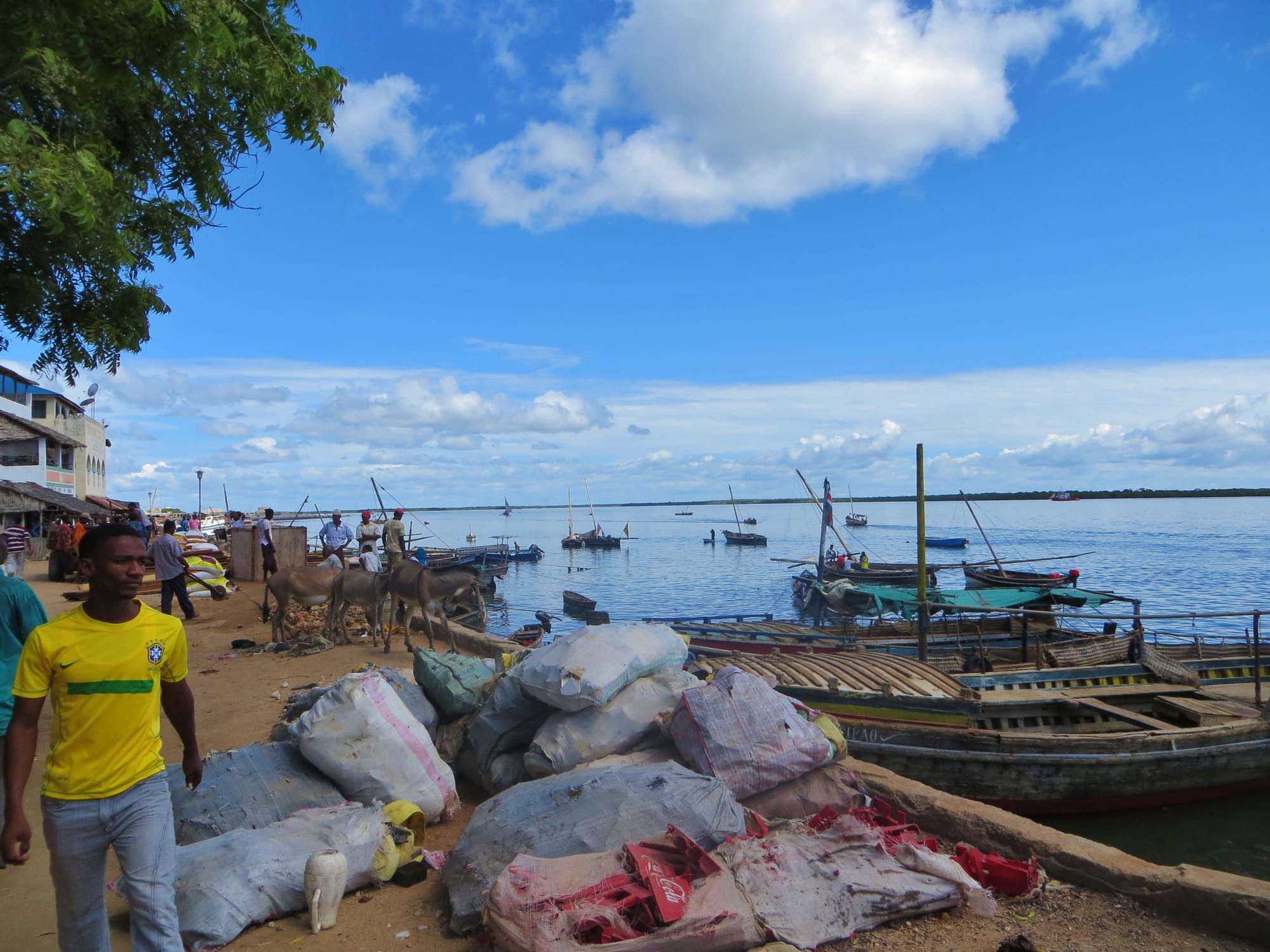
Wooden dhows and small boats moored along a town seafront, with donkeys and people on the shore under a blue sky

Mombasa & the Coast, Kenya

Lamu

Dhows, small boats and donkeys along the seafront of Lamu town. (FredD / Wikimedia Commons · CC BY-SA 3.0)

A Swahili town on an island off Kenya's northern coast, inhabited since at least the 14th century and listed by UNESCO as the best-preserved Swahili settlement in East Africa. Coral-stone houses with carved doors line lanes too narrow for cars, donkeys and dhows do the carrying, and the quieter village of Shela and its dunes lie along the shore.

Neighbourhoods

  • The old town and the seafront
    • First-time visitors
    • Historic district
    • Local life

    The heart of Lamu — a grid of narrow lanes behind a waterfront promenade of shops, offices and jetties. Coral-stone houses with carved doors, inner courtyards and roof terraces stand a few paces apart, and almost everything — museums, the fort, the market, the mosques — is within a ten-minute walk.

    Open in Maps
  • Shela
    • Beaches
    • Quiet and residential
    • Walks

    A village about three kilometres down the shore, reached on foot along the water at low tide or by boat. Restored Swahili houses and small hotels sit behind a long open beach and a belt of high dunes, and it is quieter and more expensive than the town.

    Open in Maps
  • Manda Island
    • Quiet and residential
    • Close to public transport

    The island across the channel, where the airport sits and boats meet every flight. Away from the airstrip it is thinly settled, with mangroves, a few lodges and the ruined Swahili town of Takwa on a creek on its southern side.

    Open in Maps

Things to do

Museums and the old town

  • Lamu Museummuseum

    The main museum of Swahili culture on the seafront, with displays on dhows, the town's history and the ceremonial siwa horn of Lamu.

    Open in Maps
  • Lamu Fortlandmark

    A squat stone fort begun in the early 19th century beside the main square, later used as a prison and now holding exhibitions and a library.

    Open in Maps
  • Swahili House Museummuseum

    A restored 18th-century coral-stone house near the fort, furnished to show how a Lamu merchant family lived, with its courtyard, plaster niches and carved bed.

    Open in Maps
  • German Post Office Museummuseum

    The building used by the German post office of 1888–91, the first on the East African coast, now a small museum of that episode in the town's trading history.

    Open in Maps

The shore and the water

  • Shelaneighborhood

    The village along the shore from town, with a long beach, a belt of high sand dunes behind it and the 19th-century Friday mosque with a conical minaret.

    Open in Maps
  • Manda Airporttransit hub

    The airstrip on Manda Island where flights from Nairobi and Mombasa land, connected to the town by a short boat crossing.

    Open in Maps

Short trips by boat

  • Takwa Ruinslandmark

    The remains of a Swahili town founded around 1500 and abandoned around 1700 on Manda Island, with a mosque, tombs and house walls among the mangroves.

    Open in Maps
  • Pate Islandattraction

    The largest island of the archipelago, north-east of Lamu, with the old rival town of Pate, the village of Siyu and its fort, and the ruins of Shanga.

    Open in Maps

Seasonal events

  • Lamu Cultural Festivalusually the last week of August

    Several days of dhow races, traditional dancing and crafts such as kofia embroidery along the seafront, held since 2000.

  • Maulidimoves with the Islamic calendar

    The celebration of the Prophet's birthday, centred on the Riyadha Mosque, drawing pilgrims from across East Africa and beyond for recitation, processions, donkey races and swimming contests.

  • Ramadan and Eidmoves with the Islamic calendar

    Daytime fasting quietens the lanes and the evenings fill with food and visiting, with new clothes and feasting at Eid.

Eat and drink

Long-standing places and food districts in Lamu. Hours, ratings and directions come from your maps app, always current.

Swahili classics

  • Seafront cafés and fish grillsrestaurant

    Small kitchens along the waterfront serving whatever the boats brought in — reef fish, kingfish, crab and prawns, grilled or in coconut sauce with rice.

    Open in Maps
  • Mahamri and mbaazi stallscafe

    The standard Lamu breakfast, sold early from small counters in the lanes — coconut-milk buns with pigeon peas simmered in coconut, and strong spiced tea.

    Open in Maps
  • Lamu marketmarket

    The covered produce market behind the seafront, with fish, mangoes, limes, coconuts, cassava and the spices that go into pilau and biryani.

    Open in Maps

Shela

  • Shela village restaurantsneighborhood

    A handful of small restaurants and hotel terraces behind the beach, mixing Swahili seafood with Italian and other European cooking for long-staying visitors.

    Open in Maps

Experience Lamu

History

Lamu was one of the Swahili towns strung along the East African coast, trading mangrove poles, ivory, tortoiseshell and slaves with Arabia, Persia and India and receiving cloth, ceramics and Islam in return. Settlement on the island goes back at least to the 14th century, and for a long time Lamu was the lesser rival of Pate and of Manda, whose towns eventually failed; the ruins of Takwa on Manda stand for that older order.

In 1652 an Omani fleet helped the northern towns against the Portuguese, and Lamu spent the following centuries under a system of town elders with shifting allegiances to Pate, Oman and finally Zanzibar. The town's high point came in the 18th and 19th centuries, when victory over Pate at Shela in 1813 left Lamu dominant and the money from trade built the tall coral-stone houses, carved doors and plaster interiors that survive today. The fort beside the square was built between 1813 and 1821 with Omani assistance.

The abolition of the slave trade and the rise of Mombasa's port and railway left Lamu behind, and the town's isolation preserved it. A German post office, the first on the East African coast, operated here from 1888 to 1891 before Britain took over the coast. In 2001 UNESCO listed Lamu Old Town as the oldest and best-preserved Swahili settlement in East Africa. Since 2014 attacks on the county's mainland have hurt tourism, and the deep-water port at Manda Bay, the cornerstone of the LAPSSET corridor and in operation since 2021, is the biggest change the archipelago has seen in centuries.

Culture & Customs

Lamu's culture is Swahili in its most concentrated form. The town is almost entirely Muslim, with 23 mosques on the island, and the religious calendar sets the rhythm of the year. Maulidi, the celebration of the Prophet's birthday, is centred on the Riyadha Mosque and draws pilgrims from across East Africa and beyond for recitation, processions, dhow and donkey races and swimming contests.

The local dialect, Kiamu, is prized for its poetry: Lamu is a centre of the Swahili verse tradition of utenzi and of sung poetry, and craftsmanship runs in families — the carved doors and furniture, plasterwork, silver jewellery and the building of dhows in the yards along the shore. Taarab music, with its Arab and Indian roots, is played at weddings, and henna, kanzu and kofia for men, buibui and kanga for women, remain ordinary daily wear.

Etiquette is conservative and easily met: cover up in the lanes, greet before asking, remove shoes at a threshold, ask before photographing anyone. Donkeys are part of the social fabric rather than a curiosity, being the only practical transport for goods, and the town's donkey sanctuary treats them free of charge. Visitors who stay a while notice how much of life happens on the baraza, the stone bench beside every front door.

Daily Life

Lamu town holds most of the island's people, with smaller settlements at Shela, Matondoni, Kipungani and elsewhere; Lamu County as a whole had 143,920 residents at the 2019 census, the smallest population of any Kenyan county. Households are often large and extended, and many families have relatives in Mombasa, Nairobi or the Gulf. Fishing is the oldest livelihood, with mangrove cutting, boat building, small trade and farming on the mainland alongside it; tourism has been the other pillar since the 1970s, employing guides, boat crews, cooks and house staff.

The day starts before dawn with the call to prayer and the boats going out, fills the lanes with school uniforms and handcarts by mid-morning, empties in the afternoon heat and revives after sunset, when the seafront becomes the town's living room. Donkeys, not vehicles, carry building sand, water and luggage, and the rubbish, water and sanitation of a dense historic town are perpetual municipal problems.

Recent years have been difficult. Attacks on the county mainland from 2014 collapsed visitor numbers for several seasons and recovery has been slow. The new port and the transport corridor planned inland promise jobs but have raised arguments over land, fishing grounds and what large-scale development will do to a small island whose value rests on being unchanged.

Food

Lamu's cooking is Swahili coastal food at its richest: coconut, rice, fish and the spices of the Indian Ocean trade. Fish curry in coconut sauce, prawns, crab and octopus, and grilled kingfish are everyday eating, served with wali wa nazi (coconut rice), chapati or ugali. Pilau, rice cooked with cumin, cloves and cardamom, and biryani are the dishes of weddings, Maulidi and Eid, and the local version of biryani is a point of pride.

Breakfast means mahamri, lightly sweet fried buns made with coconut milk and cardamom, eaten with mbaazi — pigeon peas simmered in coconut — followed by strong chai. Street snacks include viazi karai, potatoes in spiced batter, mishkaki skewers and samosas, and sweets run to kaimati, small syrup-soaked dumplings, halwa brought from the Omani tradition, and kashata made with coconut and sesame.

Limes, mangoes, tamarind and coconut in every form come from the island and the mainland farms, and fresh juices are drunk all day. Coconut water is sold from the husk, and mnazi, the tapped palm wine of the coast, is the traditional drink, though this is a Muslim town and alcohol is confined to a few hotels.

Planning tools

Budget

Lamu has a wide spread. Simple guesthouses in the old town, market food and shared boats cost very little, while restored Swahili houses in Shela, private dhow charters and the flight from Nairobi push a stay to international prices. Christmas, August and the festivals are the expensive weeks; the long rains are the cheapest.

Daily Budget Midrange
USD 95–230 (restored house or small hotel, restaurant meals, a dhow trip)
Daily Budget Shoestring
USD 30–60 (guesthouse in the old town, local cafés, shared boats)

Agree the price of a boat, a dhow day or a guide before setting off, and carry enough cash, as card acceptance is limited.

Best Time to Visit

December to March is hot, dry and calm, with the clearest water for dhow trips. July to October is a little cooler with a stronger breeze, and the cultural festival is usually held in the last week of August. April and May bring the long rains, when the sea is rough, some hotels close and prices fall. Maulidi moves through the year with the Islamic calendar.

Suggested Number of Days

Two or three days are enough for the town itself, which is small and walkable. Four to six suit a slower stay taking in the rest of the island and the wider archipelago by boat. Sailing times depend on the tide, so allowing extra is sensible.

First Visit
2–3 days
With Surroundings
4–6 days

Transportation

There are no cars in the old town. People walk, ride donkeys or take boats, and goods move by handcart and donkey. Motorboats run constantly between the town, Manda Island and Shela, and dhows are hired by the day for sailing and fishing. A road runs along the island to Matondoni and the northern villages, used by motorbikes.

Boat fares are per trip and often shared; the walk along the shore to Shela is only possible around low tide.

Airport & Station Connections

Almost all visitors fly. Flights from Nairobi take about an hour and a half and land at Manda Airport across the channel, from where boats meet arrivals for the ten-minute crossing to the town jetty. There are also flights from Mombasa and Malindi. Buses run up the mainland road to the Mokowe jetty, but the flight is the usual choice.

Walkability

The old town is entirely walkable and can only be walked: the lanes are one to three metres wide, paved in coral stone, often stepped and shaded by tall houses. Everything in the centre is within a few minutes of the seafront, and Shela is about three kilometres along the shore. Donkeys, handcarts and puddles after rain are the obstacles.

Safety

The island and the archipelago's visitor areas are calm, with pickpocketing and occasional theft the main risks, and the town is quiet after dark. Lamu County's mainland north of the island, and the districts towards the Somali border, are a different matter: attacks there since 2014 have led governments to advise against travel to parts of the county, and security checks around the jetties and airport are routine. Malaria is present, and sea conditions in the channel can be rough in the windy months.

Avoid walking on beaches or in Mombasa's old town after dark, use malaria prophylaxis, and stay away from the northern Lamu and Tana River border areas. Check current official travel advice before travelling.

Climate

Hot and humid all year, governed by the monsoon winds: the kaskazi blows from the north-east from about December to March, and the kusi from the south from about June to September. The long rains fall in April and May, with shorter rain around November.

Summer
December–March is hot and humid, around 30–33°C, with calm seas
Winter
June–September is a little cooler, around 27–29°C, with a steady breeze and choppier water

Local Customs

Lamu is a conservative Muslim town and dress is the first thing noticed: shoulders and knees covered for everyone in the lanes, and swimwear kept to the beaches at Shela and Manda. Greetings come before business, and a little Kiswahili goes a long way. Friday prayers and Ramadan reshape the day, and photographs of people, especially women, need permission.

Alcohol is served in a few hotels rather than in the town, shoes come off at the threshold of a house or mosque, and non-Muslims are generally not admitted to the mosques.

Common Payment Methods

The currency is the Kenyan shilling, and mobile money (M-Pesa) is used for most local payments. Cards are taken by hotels and the larger restaurants but not in the market or by boat crews, and there are only a few ATMs on the seafront, so bringing cash is wise.