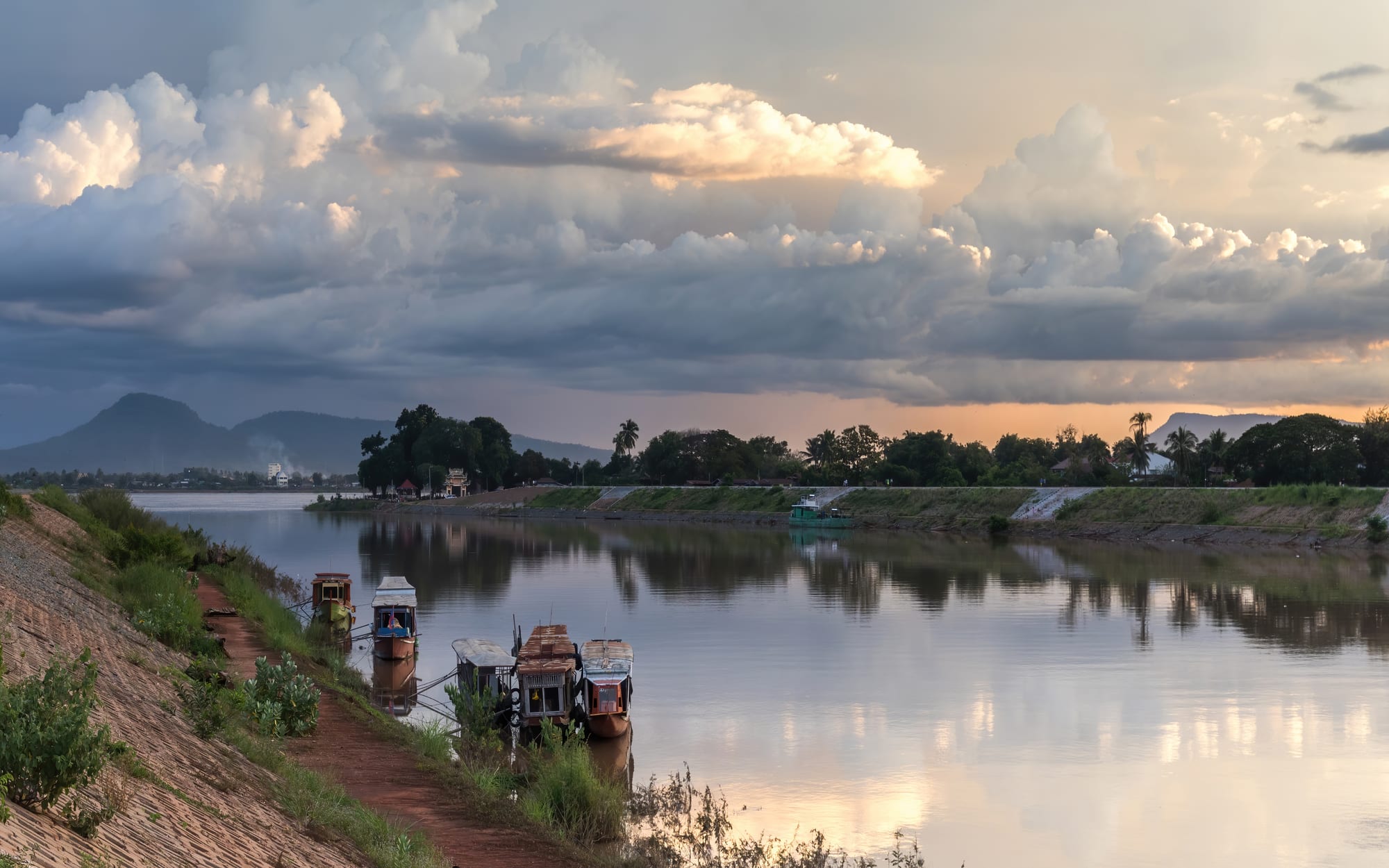
Wooden boats moored along the bank of a wide calm river at sunset, with low hills and palms beyond and tall clouds overhead

Pakse & the South, Laos

Pakse

Boats on the Xe Don river at sunset in Pakse, southern Laos. (Basile Morin / Wikimedia Commons · CC BY-SA 4.0)

The largest town of southern Laos, built by the French in the early 20th century where the Xe Don river joins the Mekong. It is the capital of Champasak province and the market, transport and coffee-trading centre of the south, and the usual base for the Khmer temple of Wat Phou and the waterfalls of the Bolaven plateau.

Neighbourhoods

  • The town centre
    • First-time visitors
    • Best for food
    • Close to transport

    The grid of streets between the Xe Don and the Mekong, where most guesthouses, noodle shops, bakeries and tour offices are. Low shophouses, a few French-era buildings and several temples stand within a few blocks of each other, and everything in the centre is walkable.

    Open in Maps
  • The Mekong riverfront
    • Sunsets
    • Quiet walks
    • Riverside dining

    The embankment along the south-western edge of town, lined with restaurants and bars that open in the late afternoon. Boats tie up below, and the view runs across to the hill of Phou Salao and the bridge downstream.

    Open in Maps
  • Around Dao Heuang market
    • Markets
    • Local life

    The busiest commercial quarter, on the south side of town near the bus stands. The market halls sell coffee, tea, dried fish, fruit and clothing, and the surrounding streets are full of small traders, workshops and food stalls from early morning.

    Open in Maps
  • The Xe Don bank and the north
    • Quiet and residential
    • Temples

    Residential lanes spreading north from the Xe Don towards the airport, mixing wooden houses, concrete villas and temple compounds. It is quieter than the centre, with local markets rather than visitor restaurants.

    Open in Maps
  • The east bank and Phou Salao
    • Viewpoints
    • Half-day trips

    Across the Mekong by the bridge, a low hill crowned by a large seated golden Buddha looks back over the town and the meeting of the two rivers. Below it the east bank is farmland and scattered villages.

    Open in Maps

Things to do

Temples and landmarks

  • Champasak Palacelandmark

    The huge palace built for Chao Boun Oum, the last Prince of Champasak, who abandoned it unfinished in 1974; it was completed after the revolution, used for party congresses and visiting dignitaries, and turned into a hotel in 1995.

    Open in Maps
  • Pakse International Airporttransit hub

    The airport on the north-western edge of town, the main air gateway to southern Laos.

    Open in Maps

Museums and markets

  • Champasak Provincial Museummuseum

    The provincial museum, holding stelae in the Tham script from the 15th to 18th centuries, pottery, musical instruments, a model of Wat Phou and displays of the textiles, clothing and jewellery of the south's ethnic groups.

    Open in Maps
  • Dao Heuang Marketmarket

    The town's main market, a sprawl of halls near the bus stands selling Bolaven coffee and tea, dried fish, fresh produce, cloth and household goods.

    Open in Maps

Trips from the city

  • Wat Phoulandmark

    A ruined Khmer Hindu temple complex climbing a mountainside above the Mekong about 30 km south, built from the 7th century onwards on a far older sanctuary and made a UNESCO World Heritage Site in 2001.

    Open in Maps
  • Champasakneighborhood

    The small riverside town below Wat Phou, once the seat of a Lao kingdom, with a single long street of wooden and colonial-era houses.

    Open in Maps
  • Bolaven Plateauattraction

    The cool uplands east of Pakse, roughly 1,000 to 1,350 metres high, where the French planted coffee in the early 20th century and rivers fall off the rim in waterfalls.

    Open in Maps
  • Tad Faneattraction

    A major waterfall of the Bolaven plateau, on the Pakse side of Paksong, dropping into a forested gorge.

    Open in Maps
  • Paksongneighborhood

    The coffee town at the centre of the plateau, about 50 kilometres east of Pakse, surrounded by farms and waterfalls.

    Open in Maps
  • Tad Loattraction

    A village beside a series of falls in the north-eastern part of the plateau, long used as a base for village walks and guided treks, with Alak, Katu and Suay villages within a few kilometres.

    Open in Maps
  • Khone Phapheng Fallsattraction

    The rapids where the whole Mekong drops through rock channels near the Cambodian border, about 130 km south of Pakse. At nearly 11 km from edge to edge they form the widest waterfall in the world, and the reason the river is not navigable through to China.

    Open in Maps
  • Xe Pian National Parkpark

    A forested, hilly national park with large wetlands south-east of Pakse, running into Attapeu province, with a great diversity of animals, birds and fish and community-run treks and homestays.

    Open in Maps

Seasonal events

  • Boun Wat PhouFebruary

    The great festival of southern Laos, held at the temple each February, when pilgrims climb the terraces of Wat Phou at Champasak for offerings, music, boat racing and markets.

  • Pi Mai Laomid-April

    The Lao New Year, marked with water throwing in the streets, the washing of Buddha images and temple visits in the hottest week of the year.

  • Boun Ork Phansa and the boat racesOctober

    The end of Buddhist Lent, when candle-lit floats are set on the Mekong at night and long rowing boats race in front of the town the next day.

  • Boun Bang FaiMay

    The rocket festival, when home-made bamboo rockets are fired into the sky to call for rain before the planting season.

Eat and drink

Long-standing places and food districts in Pakse. Hours, ratings and directions come from your maps app, always current.

Pakse classics

  • Riverside restaurants on the Mekongneighborhood

    Open-sided places along the embankment serving grilled Mekong fish, laap, tam mak hoong and Beerlao as the sun goes down behind the far bank.

    Open in Maps
  • Vietnamese noodle shops in the centreneighborhood

    The legacy of the town's old Vietnamese community — feu noodle soup with herbs and lime for breakfast, spring rolls, and khao jii baguettes sold from carts.

    Open in Maps

Markets and coffee

  • Dao Heuang Marketmarket

    The main market, where the food halls sell noodle soup, grilled meat, sticky rice and tropical fruit, and whole sections are given over to Bolaven coffee and tea.

    Open in Maps
  • Bolaven coffee caféscafe

    Cafés around the centre roast and serve beans from the plateau, usually as strong drip coffee poured over condensed milk and ice.

    Open in Maps

Experience Pakse

History

Pakse is a young town in an old landscape. Its name means the mouth of the Se, the point where the Xe Don river joins the Mekong, and the Khmer temple of Wat Phou stood up the river valley to the south for centuries before any town existed here. The seat of power in the region was Champasak, capital of a Lao kingdom that broke away from Lan Xang in the early 18th century and later fell under Siamese control.

The French established an administrative outpost here in 1905, after taking the east bank of the Mekong in 1893. They laid out a small grid of streets between the two rivers, built a customs house and offices, and encouraged Vietnamese and Chinese traders to settle, so that for decades much of the commerce was in their hands: in 1943 some 62 per cent of Pakse's people were Vietnamese. Coffee planted on the Bolaven plateau above the town gave it an export crop, and river boats carried goods down to Cambodia.

The royal house of Champasak kept a presence through the colonial period, and Chao Boun Oum, the last Prince of Champasak and a prominent figure in Lao politics after the Second World War, began a vast palace above the Xe Don. He abandoned it, unfinished, in 1974; the Pathet Lao took power the next year and the prince went into exile. The building was completed under the new government, used for party congresses and visiting dignitaries, and converted into a hotel in 1995. Pakse grew steadily after the country reopened to trade and travel: the Lao-Nippon Bridge carried the road over the Mekong, the road west to Thailand was improved, and the town became the base from which most visitors reach the south.

Culture & Customs

Pakse is a Lao Buddhist town with a strong trading streak. Monks collect alms along the streets at dawn, temple fairs fill the compounds several times a year, and the rhythms of the Buddhist calendar shape the year more than any civil one. The southern Lao spoken here is close to the Isan speech of north-east Thailand across the border, and Thai television and music are part of daily life.

The town's population has long included Vietnamese and Chinese families whose ancestors came as traders and craftsmen under the French, and their shops, noodle kitchens and association halls are part of the centre. Upland peoples from the Bolaven plateau and the mountains beyond — Laven, Alak, Katu and others — come down to the markets to sell coffee, vegetables and woven cloth, and their textiles turn up on market stalls beside Lao silk.

The great event of the regional calendar is the festival held at Wat Phou each February, which draws pilgrims from across the south and from Thailand. Locally, the end of Buddhist Lent in October brings candle-lit floats on the Mekong and racing boats crewed by villages and offices, and Lao New Year in April brings several days of water throwing. Manners are quiet: greetings with palms together, shoes left at the door, and a strong dislike of raised voices or public displays of temper.

Daily Life

Pakse district had about 77,900 people at the 2015 census, making the town the most populous in Champasak province and the biggest in the south. The day starts early, with markets busy by six and noodle soup eaten standing up, and slows in the heat of the afternoon before the riverfront fills again at dusk. Motorbikes are the usual transport, and whole families ride them.

The economy runs on trade, transport and farming. Dao Heuang market gathers produce from the plateau and the river plain, wholesalers move Bolaven coffee and tea towards Vientiane, Thailand and Vietnam, and the border crossing to Ubon Ratchathani makes the town a staging point for freight. Provincial government, a hospital, the university and a growing tourism trade employ much of the rest. Many households also have land outside town and return to it at harvest.

Pakse's concerns are those of a small provincial capital: an unreliable power and water supply in places, roads that suffer badly in the wet season, young people leaving for work in Thailand, and a dependence on commodity prices for coffee and rubber. Dams on the Mekong and its tributaries have brought investment, jobs and arguments about fish stocks and resettlement, and building work along the riverfront has changed the look of the town over the past decade.

Food

Pakse eats from the Mekong and the plateau. Grilled fish — ping pa, split, salted and cooked over charcoal — is the classic riverside meal, eaten with sticky rice pulled from a woven basket and dipped in chilli sauce. Laap pa, minced fish with herbs, lime, chilli and toasted rice powder, and mok pa, fish steamed in banana leaf with dill and lemongrass, appear on most local menus, and pa daek, the fermented fish paste of the Lao kitchen, underpins the flavour of many dishes. Tam mak hoong, the fiery green papaya salad, is pounded to order at every market.

Breakfast shows the town's Vietnamese inheritance: feu, a rice noodle soup served with a plate of raw herbs, bean sprouts, lime and chilli, and khao jii, the baguette split and filled with pâté, pork and pickled vegetables. Khao piak sen, a thicker soup of soft rice noodles, is the other morning staple. Spring rolls, sticky rice cakes and grilled skewers are sold from carts around the market.

Coffee is the local signature. The Bolaven plateau above the town has grown Arabica and Robusta since the French period, and Pakse is where it is traded and drunk — usually as a strong drip coffee poured over sweetened condensed milk and served with a glass of weak green tea. Beerlao accompanies dinner, and lao-lao, the village rice spirit, appears at celebrations.

Planning tools

Budget

Pakse is inexpensive even by Lao standards. Guesthouse rooms, market meals and shared songthaews cost very little, and the main expenses are hiring a motorbike or a car and driver for the Bolaven plateau and Wat Phou. Riverside hotels and organised tours are the only things that push a day much higher.

Daily Budget Midrange
USD 40–90 (riverside hotel, restaurant dinners, a private driver for the plateau, coffee farm visits)
Daily Budget Shoestring
USD 15–30 (guesthouse room, market and noodle-shop meals, shared songthaews, a rented motorbike)

Cash machines are easy to find here but scarce further south, so draw kip in Pakse before heading to the islands or the plateau.

Best Time to Visit

November to February is the pleasant season, dry and warm, with the plateau green after the rains and the Wat Phou festival in February. March to May is very hot in the lowlands. The June to October monsoon brings heavy afternoon rain but also the fullest waterfalls and the boat races at the end of Lent.

Suggested Number of Days

The town itself is small and can be seen in a day or two. Most visitors stay longer and use it as a base for the south, and a loop of the uplands by motorbike adds two or three days on its own.

First Visit
1–2 days
With Surroundings
3–5 days

Transportation

The centre is small enough to cover on foot, and jumbos and tuk-tuks handle anything further for a few thousand kip agreed in advance. Songthaews and minibuses leave from bus stations on the edge of town for the plateau, Champasak and the south, and rented motorbikes and bicycles are widely available. Cars with drivers can be arranged through hotels and travel agents.

Agree the fare before getting into a tuk-tuk, and check the brakes and lights on any rented motorbike before riding up to the plateau.

Airport & Station Connections

Pakse International Airport sits a few kilometres north-west of the centre, with flights to Vientiane and some regional services. Buses run along Route 13 from Vientiane and Savannakhet in the north and to the Cambodian border in the south, and international coaches cross to Ubon Ratchathani in Thailand by way of the Vang Tao border west of the town. The Lao-Nippon Bridge carries the road over the Mekong.

Walkability

The grid between the two rivers is flat and compact, and walking between guesthouses, temples, the riverfront and restaurants takes minutes rather than an hour. Pavements are uneven and often used for parking, traffic crosses without much warning, and the heat of the middle of the day discourages long walks. The market and the bus stations are far enough out to want a tuk-tuk.

Safety

Pakse is quiet and crime against visitors is rare, mostly opportunist theft from rooms and bags. The greater risks are road accidents on rented motorbikes, the Mekong's currents, slippery rocks at the plateau waterfalls, and unexploded ordnance, which remains a hazard in parts of southern Laos that were heavily bombed.

Ride carefully on the plateau roads in the rain, swim only where locals do, keep to paths and cleared ground in the countryside, and lock valuables away. Check current official travel advice before travelling.

Climate

A tropical climate with a hot dry season, a long monsoon and a short cooler spell. Rain falls mainly between May and October, often as heavy afternoon storms, and the Mekong rises and browns through those months before dropping again.

Summer
very hot before the rains, with March to May days often 33–38°C, then humid and wet from June to October
Winter
dry and warm, generally 20–32°C from November to February, with mild nights

Local Customs

Laos is Theravada Buddhist and manners are gentle and indirect. Greetings are made with the nop, palms together at the chest, and voices stay low; open anger is embarrassing rather than effective.

Shoulders and knees should be covered in temples and shoes left outside halls and homes; women do not touch monks or hand things to them directly, heads are not touched, and permission is asked before photographing people or ceremonies. Tipping is not expected, though rounding up is welcome.

Common Payment Methods

The currency is the Lao kip. Cash is used for almost everything, Thai baht and US dollars are sometimes accepted for larger sums, and cards work only in hotels and a few travel agencies. Cash machines are easy to find in the centre but dispense limited amounts, so carry enough kip when leaving town.