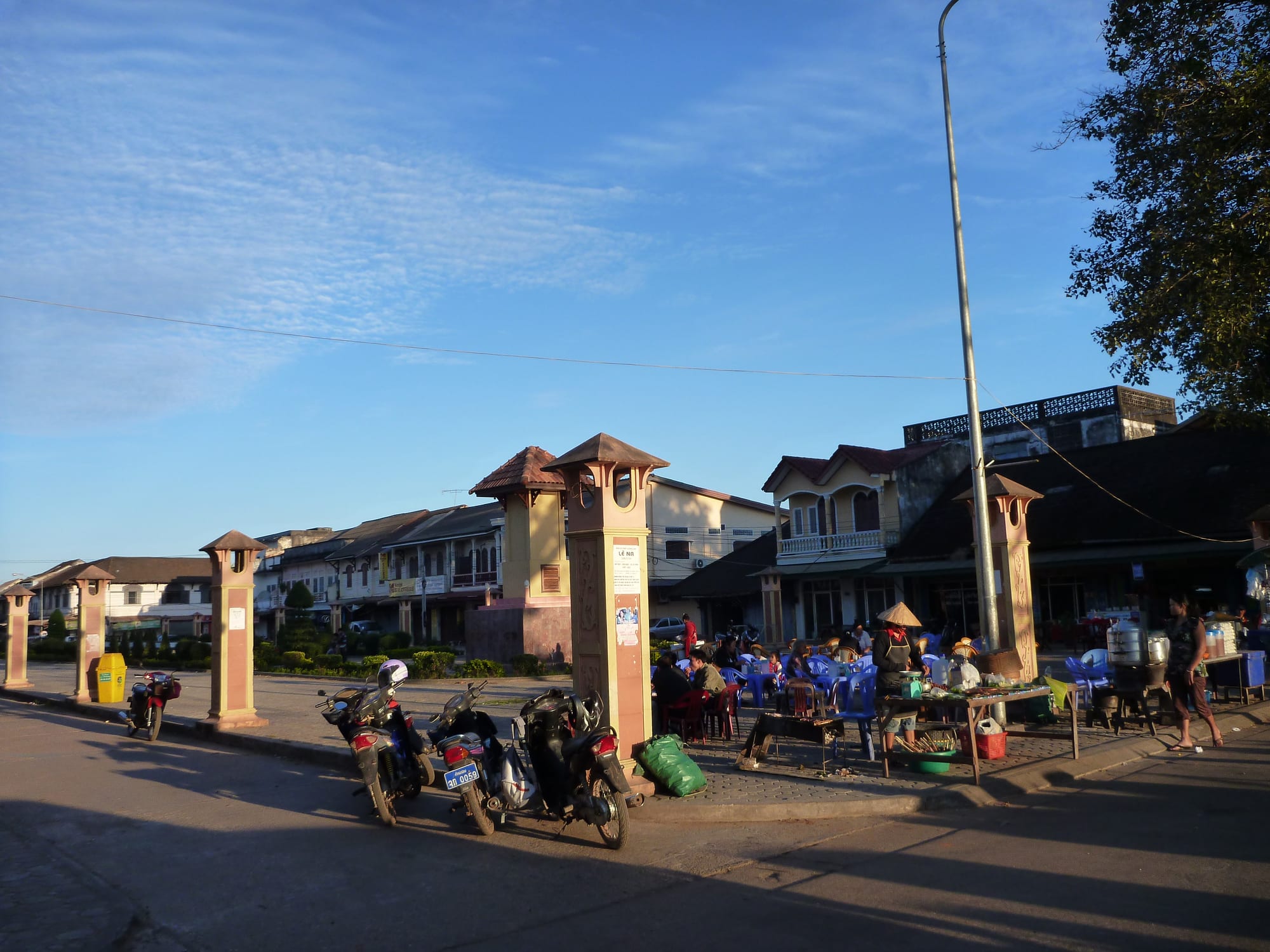
Low colonial shophouses and food stalls around an open square in Thakhek, with parked motorbikes and brick gate pillars in the foreground

Vientiane & Central Laos, Laos

Thakhek

The central square of Thakhek, lined with shophouses and evening food stalls. (Adriaan Castermans / Wikimedia Commons · CC BY-SA 3.0)

The capital of Khammouane province, a quiet Mekong town facing Nakhon Phanom in Thailand, with a small grid of French-era shophouses around a riverside square. It is best known as the starting point of the Thakhek loop, a motorbike circuit through limestone country to the long river cave at Kong Lor.

Neighbourhoods

  • The old town and riverside square
    • First-time visitors
    • Historic district
    • River views

    A handful of blocks of weathered French-era shophouses around an open square set back from the Mekong, with guesthouses, noodle shops and evening food stalls. The promenade along the river looks straight across to Thailand.

    Open in Maps
  • The bus station and bridge road
    • Close to public transport
    • Practical stops

    The newer strip along Route 13 and the road east to the Third Thai–Lao Friendship Bridge, several kilometres from the river, with the bus station, workshops, motorbike hire and cheaper rooms.

    Open in Maps
  • The Sikhottabong road
    • Quiet and residential
    • Landmarks

    The riverside road running south of town past villages, gardens and small temples to the gilded stupa of That Sikhottabong. Traffic is light and the Mekong is in view for much of the way.

    Open in Maps

Things to do

In and around the town

  • That Sikhottabonglandmark

    A tall gilded stupa on the bank of the Mekong some seven kilometres south of the town, associated with the Sikhottabong kingdom of the middle Mekong and contemporary with That Inhang in Savannakhet and That Phanom across the river. Its festival is the province's main religious gathering.

    Open in Maps
  • The Mekong promenadeattraction

    The riverside walk and viewing terrace in the centre of town, busiest at sunset when food stalls and beer tables spread along it.

    Open in Maps
  • Third Thai–Lao Friendship Bridgelandmark

    The 1,423-metre road bridge over the Mekong to Nakhon Phanom in Thailand, opened in November 2011, which carries freight between Thailand and Vietnam through Laos.

    Open in Maps
  • Thakhek morning marketmarket

    The town's produce market, where river fish, sticky rice, chillies, herbs and forest vegetables are sold from early morning.

    Open in Maps

Caves and karst

  • Tham Nang Aenattraction

    A large cave east of the town on the road into the limestone country, with lit chambers and a stream running through it.

    Open in Maps
  • Buddha Caveattraction

    A cliff cave north-east of Thakhek holding old bronze Buddha images, a pilgrimage site reached by a stairway up the rock face.

    Open in Maps
  • Phou Hin Pounpark

    A National Biodiversity Conservation Area in the limestone country behind the town, a landscape of forested karst towers, sinkholes and river caves in the Annamite range, home to rare species including the Laotian rock rat.

    Open in Maps

Further afield

  • Tham Kong Loattraction

    A river cave about 130 km north of Thakhek that carries the Nam Hin Bun for some seven kilometres through a limestone mountain, travelled by longtail boat from the village of Ban Kong Lor.

    Open in Maps
  • Nam Theun 2 Damattraction

    The second largest hydropower scheme in Laos after the Xayaburi dam, on the Nakai plateau some 70 km east of the town, whose reservoir flooded a forested valley and left standing dead trees in the water.

    Open in Maps
  • Nakhon Phanomneighborhood

    The Thai town directly across the Mekong, 736 km north-east of Bangkok, reached by the bridge with the right visa or stamp, with a promenade facing Laos.

    Open in Maps

Seasonal events

  • That Sikhottabong festivalthird lunar month, usually February

    The province's biggest religious gathering, with processions, offerings and a fair on the ground around the stupa.

  • Pi Mai Lao (Lao New Year)mid-April

    Three days of water-throwing, temple visits and sand stupas in the hottest part of the year.

  • Boun Bang Fai (rocket festival)May

    Villages around Khammouane fire home-made bamboo rockets to ask for rain before planting.

  • Boun Ok PhansaOctober

    The end of the Buddhist rains retreat, marked by candle-lit floats on the Mekong and longboat races on the river.

Eat and drink

Long-standing places and food districts in Thakhek. Hours, ratings and directions come from your maps app, always current.

Markets and food streets

  • The riverside square at nightneighborhood

    Stalls and open-air restaurants around the square and along the promenade grill river fish, chicken and sausages and serve them with sticky rice and Beerlao.

    Open in Maps
  • Thakhek morning marketmarket

    Noodle soup, grilled meat, papaya salad and bags of jaew chilli paste sold from dawn, with fish brought up from the Mekong.

    Open in Maps
  • The shophouse cafés of the old townneighborhood

    A few coffee shops and bakeries in the old French-era blocks serving Lao coffee with condensed milk and baguettes filled with pâté and pickles.

    Open in Maps

Experience Thakhek

History

Thakhek's name means guest landing, a reference to the traders who used this stretch of the Mekong long before the town took shape. The area is tied in Lao tradition to Sikhottabong, a legendary kingdom of the middle Mekong, and the stupa of That Sikhottabong south of the town is said to stand on an ancient foundation and has been rebuilt more than once.

The modern town is largely a French creation. From the 1890s the protectorate developed it as a river port and provincial seat, laying out a small grid of shophouses, offices and villas behind a riverside square. Vietnamese merchants and clerks brought in under colonial policy came to dominate it: in 1943 some 85 per cent of the town's people were Vietnamese. Timber, tin from the hills and trade with Nakhon Phanom across the water supported it, and a railway from Thakhek to Tân Ấp in Vietnam was begun and abandoned, leaving traces near the town.

The mid-20th century brought war. The Mekong border was a line of Cold War tension, and eastern Khammouane, crossed by parts of the Ho Chi Minh trail network, was bombed heavily; unexploded ordnance is still cleared from the province. Many residents left for Thailand in the years around 1975.

Since the 1990s the town has grown again on trade and transport. Route 13 runs through it, Route 12 heads east towards Vietnam, and the Third Thai–Lao Friendship Bridge opened in November 2011, making Thakhek a corridor town for freight between Thailand and Vietnam. The Nam Theun 2 dam on the Nakai plateau entered commercial operation in April 2010, and the motorbike loop out to Kong Lor has made the town a fixture on the traveller route.

Culture & Customs

Khammouane is old lowland Lao country, and Thakhek keeps the customs of the Mekong valley rather than the uplands. Buddhism sets the calendar: the alms round at first light, ordinations, the rains retreat and the offerings at That Sikhottabong, whose February festival is the biggest gathering in the province and draws people from both banks of the river. The baci, in which white cotton threads are tied round the wrist to call the spirits back to the body, marks weddings, departures and welcomes.

The town has a mixed inheritance. Vietnamese families settled here under the French and a Vietnamese temple and community remain; Thai influence arrives daily across the bridge in television, music and goods; and Phou Thai and other Tai groups live in the valleys east of the town, with their own dress, weaving and spirit rituals. Khammouane silk and cotton weaving is a recognised craft, and villages in the province keep looms under the houses.

Life is conducted slowly and quietly. The riverside square fills in the cool of the evening, with food stalls, beer and families rather than nightlife, and the town is asleep early. Manners are conservative: modest dress, soft speech, no public displays of temper or affection, and shoes left at the door. Travellers on the loop are a familiar sight, and local guesthouses along the route have built a small industry around them.

Daily Life

Thakhek is a small provincial capital, the administrative centre of a province of some four hundred thousand people, laid out between the Mekong and Route 13 with the countryside beginning almost at once. Government offices, the market, schools, the hospital and trade across the bridge provide most of the work in town, alongside transport and warehousing for the freight that moves between Thailand and Vietnam.

Beyond the built-up area, households live from rice on the plain, maize, cassava, cattle and fishing in the Mekong. The province's other income comes from hydropower on the Nakai plateau, limestone quarrying and cement, mining in the hills, and tourism around the caves and the loop. Nam Theun 2 resettled several thousand villagers from the flooded plateau, and the long-term resettlement is still debated. Many young people from Khammouane work in Thailand and send money home.

The day starts before six at the market and ends early: offices open around eight, break for a long lunch through the worst of the heat, and the riverfront fills at sunset. Power supply and roads have improved steadily, but flooding along the Mekong and its tributaries in the wet season, rising prices as the kip falls, and the slow business of clearing unexploded ordnance from farmland are constants of life in the province.

Food

Thakhek eats the food of the Mekong plain: sticky rice, khao niao, taken by hand from a basket at every meal, with laap, minced meat or fish dressed with lime, fish sauce, herbs and toasted ground rice, and tam mak hoong, green papaya pounded with chilli, lime and fermented fish sauce. Padaek, the thick fermented fish sauce of the Lao kitchen, gives the local cooking its depth, and the town's own fish comes from the river a few streets away.

Mekong fish is the thing to eat here, grilled whole over charcoal, salted and stuffed with lemongrass as ping pa, or steamed in banana leaves with dill and herbs as mok pa. Soups thickened with vegetables and herbs, grilled chicken pressed between bamboo sticks, and pork sausages are stall food; khao piak sen, thick rice noodles in chicken broth, and feu, the Lao pho, are the usual breakfasts. Jaew, a family of pounded chilli dips made with roasted tomato, eggplant or fish, comes with almost everything.

The French left bread behind: khao jii, a baguette split and filled with pâté, pickled carrot and chilli, is sold in the morning, and coffee is drunk strong and sweet over condensed milk. Beerlao is the beer, drunk with ice at the riverside tables, and lao-lao, the clear rice spirit, appears at any village celebration along the loop.

Planning tools

Budget

Thakhek is one of the cheaper provincial towns in Laos. Guesthouse rooms, noodle shops and market food cost little, and the main outlays are motorbike hire and fuel for the loop, guesthouse stays along the way and the boat through Kong Lor cave. A driver or a hired car for the circuit costs considerably more than a motorbike.

Daily Budget Midrange
USD 50–110 (comfortable hotel, restaurant meals, motorbike hire or a driver and the Kong Lor boat)
Daily Budget Shoestring
USD 20–35 (guesthouse room, market and noodle-shop meals, local transport)

Withdraw kip in town before starting the loop: the villages along it have few cash machines and fuel, food and rooms are paid for in cash.

Best Time to Visit

November to February is the best window, dry and warm, with the loop roads in good condition and the Kong Lor river low enough for the boats. March to May is very hot on the Mekong plain. The rains from June to October make the karst green but can flood the cave, wash out tracks and cut sections of the loop.

Suggested Number of Days

The town itself is a half-day or a night's stop. The loop is the reason most people stay, and it takes three or four days at a reasonable pace, more in the rains. Road conditions and the state of the cave are what change the number.

First Visit
1 day
With Surroundings
3–5 days

Transportation

The old town is small and walkable, and tuk-tuks and songthaews cover the few kilometres out to the bus station and the bridge. Beyond that, transport means a hired motorbike, a car with a driver, or buses along Route 13 north to Vientiane and south to Savannakhet; local buses also run east towards Kong Lor and the Vietnamese border.

Check brakes, tyres and lights before renting a motorbike for the loop, allow three or four days rather than rushing it, and carry a spare inner tube and plenty of water.

Airport & Station Connections

Most arrivals are by road. Buses run down Route 13 from Vientiane and up from Savannakhet, stopping at a bus station a few kilometres from the river. From Thailand, the Third Thai–Lao Friendship Bridge links the town with Nakhon Phanom, whose airport lies 13 km west of that town. Thakhek has no passenger rail service and no scheduled flights.

Walkability

The old town and the riverfront are flat and easily covered on foot in half an hour, with little traffic outside the market hours. The bus station, the bridge and That Sikhottabong are all several kilometres out and need a ride, and heat and thin shade make midday walking hard for much of the year.

Safety

Crime is uncommon and the town is quiet. The serious risks are on the road: motorbike accidents on the loop are frequent, with loose gravel, dust, livestock and night driving the usual causes. Caves and rivers flood in the rains, and unexploded ordnance remains in parts of eastern Khammouane, which was heavily bombed near the Ho Chi Minh trail.

Wear a helmet and cover arms and legs on the loop, ride in daylight, keep to marked paths and cleared ground in the countryside, and avoid caves and rivers after heavy rain. Check current official travel advice before travelling.

Climate

A tropical monsoon climate on the Mekong plain, hot for most of the year, with a dry season from November to April and heavy rain from May to October. The Annamite slopes east of the town are among the wettest parts of Laos in the monsoon.

Summer
hot and humid, commonly 32–36°C, with fierce heat in April and heavy rain from May to October
Winter
dry and warm, about 28–31°C by day, with cooler mornings around 16–18°C in December and January

Local Customs

Manners follow the Lao pattern: the nop with palms pressed together instead of a handshake, quiet voices, and patience rather than complaint. Shoulders and knees are covered at That Sikhottabong and other temples, shoes are removed at the door, and women neither touch monks nor hand things to them directly. Tipping is not expected.

Dress modestly in town as well as at temples, ask before photographing people, especially at the market and in villages along the loop, and do not photograph bridges, military posts or border installations.

Common Payment Methods

The currency is the Lao kip, and cash is used for nearly everything. Cards are accepted at a small number of hotels only. Cash machines and money changers are in town near the market and the bridge, but the loop villages have almost none, and Thai baht is sometimes taken near the border at a poor rate.