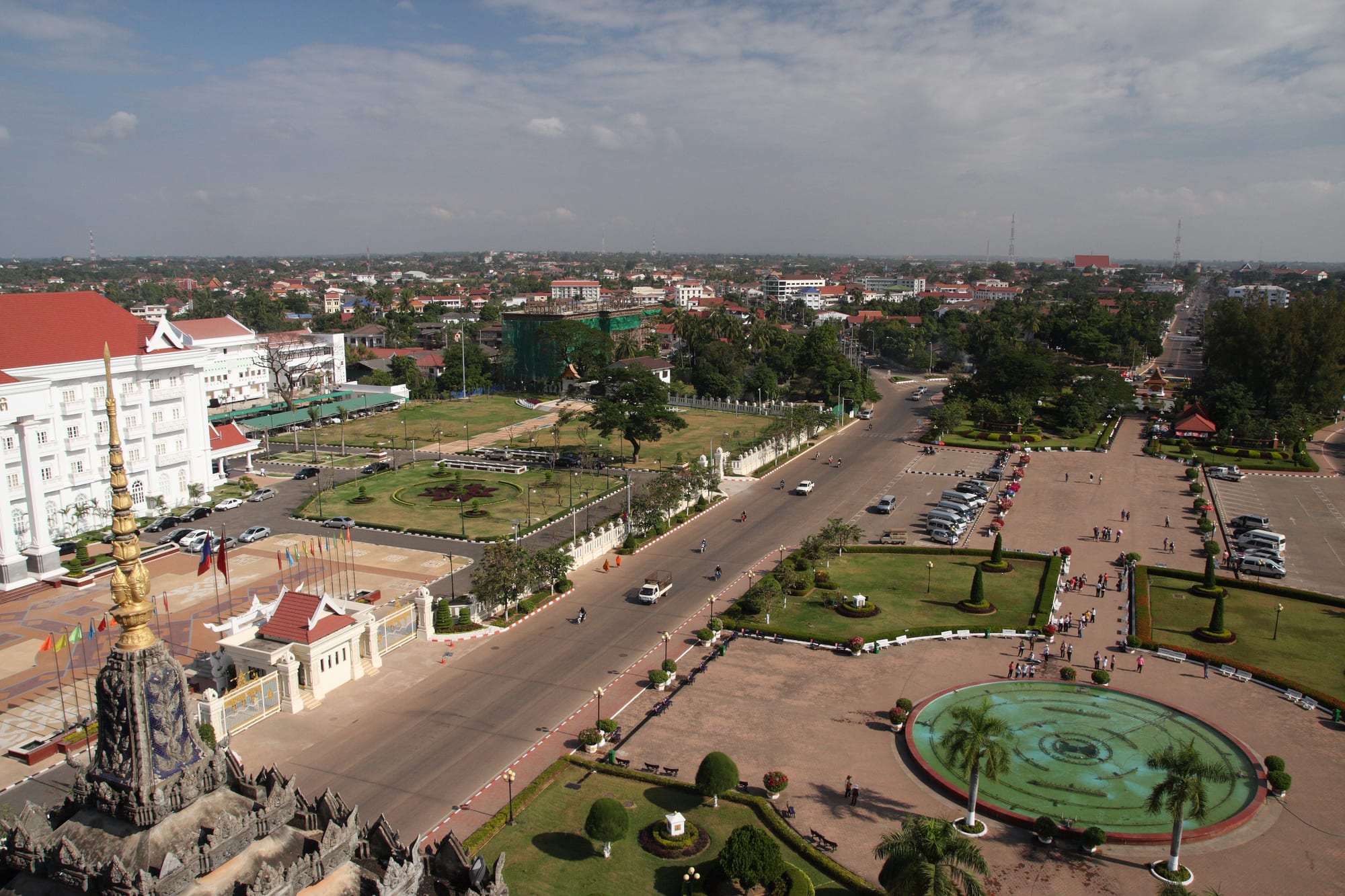
Wide boulevard, gardens and a fountain below the gilded spire of the Patuxai arch, with the low rooftops of Vientiane beyond

Vientiane & Central Laos, Laos

Vientiane

Vientiane seen from the Patuxai arch, looking down Lane Xang Avenue. (yeowatzup / Wikimedia Commons · CC BY 2.0)

The capital of Laos, spread along a bend of the Mekong facing Thailand. Founded as a Lan Xang royal city in the 16th century, sacked by Siam in the 1820s and rebuilt by the French, it is a low-rise capital of gilded stupas, tree-lined avenues and riverside promenades, and one of the quietest capitals in mainland South-East Asia.

Neighbourhoods

  • Chanthabouly and the old centre
    • First-time visitors
    • Historic district
    • Best for food

    The colonial-era heart of the city between the Mekong and Lane Xang Avenue, with Wat Si Saket, Haw Phra Kaew, the Presidential Palace and most of the older hotels. Shophouses hold cafés, bakeries and travel agents, and the streets are short and shaded.

    Open in Maps
  • The Mekong riverfront
    • Evenings out
    • Markets
    • Riverside walks

    A raised embankment and promenade along Quai Fa Ngum, with the statue of King Anouvong looking across to Thailand. At dusk the night market stalls go up, aerobics classes fill the paved terraces and food carts line the road behind.

    Open in Maps
  • Around Pha That Luang
    • Landmarks
    • Festivals

    Open ground a few kilometres north-east of the centre around the national stupa, with ministries, the Lao National Culture Hall nearby and wide approach roads. It is the setting for Vientiane's biggest Buddhist festival each November and is quiet the rest of the year.

    Open in Maps
  • Sisattanak
    • Quiet and residential
    • Best for food

    The southern district downstream of the centre, with embassies, guesthouses and a growing number of restaurants and bars along Dongpalane and the riverside road. Residential lanes, temples and small markets sit behind the main streets.

    Open in Maps
  • Xaysetha
    • Local life
    • Close to public transport

    The eastern district where much of the city's newer housing, offices and shopping sits, running out towards the wetlands east of the city and the ring road. It is where many residents actually live and shop, away from the visitor streets.

    Open in Maps
  • Sikhottabong
    • Close to public transport
    • Practical stops

    The western district containing Wattay International Airport and the roads out towards the Friendship Bridge. Markets, warehouses and workshops line the main roads, with riverside villages behind them.

    Open in Maps

Things to do

Temples and monuments

  • Pha That Luanglandmark

    The gilded stupa ordered by King Setthathirat in 1566, destroyed in the Siamese invasion of 1828 and rebuilt in its present form in the 1930s; it is the national symbol of Laos.

    Open in Maps
  • Patuxailandmark

    The concrete victory arch closing Lane Xang Avenue, built between 1957 and 1968 with cement supplied by the United States for an airbase, which earned it the nickname the vertical runway; stairs climb to a rooftop view.

    Open in Maps
  • Wat Si Saketlandmark

    Built in 1818 on the order of King Anouvong and probably the oldest temple still standing in Vientiane, its cloister wall holding more than 2,000 small Buddha images.

    Open in Maps
  • Haw Phra Kaewmuseum

    The former royal temple built to house the Emerald Buddha, now a museum of Lao religious sculpture opposite Wat Si Saket.

    Open in Maps
  • Wat Si Muanglandmark

    The temple of the city pillar, the busiest place of everyday worship in Vientiane, where residents come to make offerings and have their fortunes told.

    Open in Maps
  • That Damlandmark

    A weathered brick stupa on a roundabout in the old centre, stripped of its gilding and the subject of a legend about a seven-headed naga.

    Open in Maps
  • Wat Ong Teu Mahawihanlandmark

    A working monastery and centre of Buddhist learning in the old centre, named for the large bronze Buddha in its hall.

    Open in Maps
  • Presidential Palacelandmark

    The French-built palace at the head of Lane Xang Avenue, used for state ceremonies and seen from the gates rather than inside.

    Open in Maps

Museums and memory

  • Lao National Museummuseum

    The national collection covering prehistory, the Lan Xang kingdoms, the colonial period and the revolution.

    Open in Maps
  • Lao Textile Museummuseum

    Traditional wooden houses on the edge of the city displaying handwoven Lao silk and cotton, looms and dyeing.

    Open in Maps

Parks and the river

  • Chao Anouvong Parkpark

    The riverside park and promenade created in 2010 for the city's 450th anniversary, with a large bronze statue of the last king of Vientiane facing Thailand across the Mekong; the night market sets up along it.

    Open in Maps

Markets

  • Talat Saomarket

    The morning market at the corner of Lane Xang Avenue, an old covered market of textiles, silver and electronics beside a modern shopping mall.

    Open in Maps
  • Vientiane night marketmarket

    Rows of red-roofed stalls along the Mekong promenade selling clothes, handicrafts and souvenirs from late afternoon.

    Open in Maps
  • Talat Khua Dinmarket

    The fresh produce market behind Talat Sao, where the city buys its herbs, river fish, sticky rice and grilled meat.

    Open in Maps

Short trips from the city

  • Buddha Parkattraction

    A riverside meadow of more than 200 concrete Buddhist and Hindu figures, begun in 1958 by the mystic Bunleua Sulilat, about 25 kilometres south-east of the city.

    Open in Maps
  • First Thai–Lao Friendship Bridgelandmark

    Opened in April 1994 as the first bridge across the lower Mekong, it links the city with Nong Khai in Thailand and carries a metre-gauge railway to the Thai network.

    Open in Maps
  • Phou Khao Khouay National Protected Areapark

    A protected sandstone massif of forest, waterfalls and wild elephant habitat north-east of the capital.

    Open in Maps
  • Nam Ngum Damattraction

    The reservoir north of the city, dotted with wooded islands, whose fisheries supply Vientiane's markets and whose power is sold to Thailand.

    Open in Maps

Seasonal events

  • Boun That LuangNovember

    Vientiane's most important Buddhist festival, held over three days at the full moon of the twelfth lunar month, when monks and pilgrims gather at Pha That Luang for processions, wax-flower offerings and a fair.

  • Boun Ok Phansa and the boat racesOctober

    The end of the Buddhist rains retreat, marked by candle-lit floats on the Mekong and longboat racing along the riverfront.

  • Pi Mai Lao (Lao New Year)mid-April

    Three days of water-throwing, temple visits and sand stupas at the hottest time of the year, when much of the city closes.

  • Boun Bang Fai (rocket festival)May

    Home-made rockets are fired from village grounds around the capital to call the rains.

Eat and drink

Long-standing places and food districts in Vientiane. Hours, ratings and directions come from your maps app, always current.

Markets and food streets

  • Talat Sao and Talat Khua Dinmarket

    The morning market and the fresh market beside it, where stalls sell grilled chicken, papaya salad, sticky rice and noodle soup to eat on the spot.

    Open in Maps
  • The Mekong riverfront stallsneighborhood

    Carts and plastic stools along the embankment at dusk, cooking grilled fish, skewers, sausages and green papaya salad beside the night market.

    Open in Maps
  • The old centre around Nam Phuneighborhood

    The densest concentration of restaurants, cafés and bakeries in Laos, mixing Lao kitchens with French, Italian, Indian, Japanese and Vietnamese places in a few blocks.

    Open in Maps
  • Dongpalane and the Sisattanak restaurantsneighborhood

    Where residents eat: sin dat barbecue halls, noodle shops, beer gardens and Vietnamese grills along a long suburban road south-east of the centre.

    Open in Maps

Experience Vientiane

History

Vientiane, Viang Chan in Lao, grew from a Mekong trading settlement on a fertile bend of the river, and appears in Lao chronicles long before it became a capital. In the 1560s King Setthathirath moved the seat of Lan Xang here from Luang Prabang, partly to put distance between his court and Burmese armies. He raised Pha That Luang over an older shrine and built the Haw Phra Kaew for the Emerald Buddha, and for a century and a half the city was the political centre of a kingdom that stretched across the middle Mekong.

Lan Xang broke apart in the early 18th century and Vientiane became a small kingdom under growing Siamese pressure. In 1779 a Siamese army carried the Emerald Buddha away to Thonburi. King Anouvong's revolt in the 1820s ended in defeat, and the city was sacked and left largely deserted for decades, its temples burnt and its people resettled across the river. Wat Si Saket, finished just before the revolt, was among the few buildings to survive.

The French made Vientiane the administrative capital of their Lao protectorate in the 1890s and rebuilt it with a grid of villas, offices and avenues. After independence it was the stage for Cold War politics, including the 1960 coup led by Captain Kong Le and the street fighting that followed, and the Patuxai arch rose between 1957 and 1968. In 1975 the Pathet Lao took the city and proclaimed the Lao People's Democratic Republic. The Friendship Bridge opened in 1994, and the railway from China reached the capital in 2021.

Culture & Customs

Vientiane is where Lao national culture is presented to itself and to the outside world. The Buddhist hierarchy has its seat here, the country's biggest religious festival fills the ground at Pha That Luang each November, and the state ceremonies, the national museum and the culture hall are all in the capital. Monks in orange collect alms at dawn along the same streets where office workers queue for noodle soup an hour later.

Manners are quiet and indirect. Greetings are made with the nop rather than a handshake, voices stay low, and an argument conducted loudly loses the person making it more than it gains. The baci, in which white cotton threads are tied round the wrist to call the spirits back to the body, marks weddings, departures, recoveries and the arrival of guests, and visitors are often invited to one. Bo pen nyang, roughly never mind, is the phrase heard most often.

The city looks across the river as much as inland. Thai television, music and fashion are part of daily life, and the Lao spoken in Vientiane is close to Isan speech on the Thai bank. At the same time a distinct urban culture has grown: Lao pop and hip hop, a café scene in the old shophouses, contemporary textile design, and a small art and film community. Evenings belong to the Mekong embankment, where aerobics classes, food carts and families fill the promenade into the night.

Daily Life

The city had about 840,000 people at the 2023 census, by far the largest urban area in Laos, though the city still feels low and unhurried: few buildings rise above a handful of storeys and the centre empties early. Residents live mostly in the outer districts of Xaysetha, Sisattanak and Sikhottabong, in single-storey houses behind gates, while the old French quarter has turned over to hotels, offices and restaurants.

The economy runs on government, trade across the Friendship Bridge, services, construction and a growing number of Chinese-funded projects, including the railway and the industrial parks near the border crossing. Special economic zones and new developments on the wetlands east of the centre have pushed the city outward. The Beerlao brewery is on the outskirts, garment factories employ many women, and tourism supports the centre. A steep fall in the value of the kip and high inflation have squeezed salaries since the early 2020s, and many young people work in Thailand.

The day begins before six with noodle soup and the alms round; offices open around eight, close for a long lunch and finish in the late afternoon. The riverfront fills at dusk with joggers, aerobics classes, food carts and the night market, and the city is quiet again well before midnight. Flooding from the Mekong, traffic on roads built for far fewer vehicles, and air thick with smoke in the March burning season are the everyday complaints.

Food

Vientiane eats better than anywhere else in Laos, and its signature dish is nam khao: deep-fried rice balls broken up and tossed with sour fermented pork sausage, peanuts, herbs, lime and chilli, scooped into lettuce leaves. Laap, minced meat or fish dressed with lime, fish sauce, herbs and toasted ground rice, and tam mak hoong, the fiery green papaya salad with fermented fish sauce, appear at almost every meal, always with sticky rice taken by hand.

Breakfast is khao piak sen, thick hand-cut rice noodles in chicken broth, or feu, the Lao version of pho, or khao jii pâté, a baguette filled with pâté, pickled vegetables and chilli — the most useful survival of the French period, along with the city's bakeries and cafés. Mekong and Nam Ngum fish is grilled whole with lemongrass and salt as ping pa, or steamed in banana leaves with dill as mok pa. Sin savanh, sweet dried beef with sesame, is the standard snack.

Evenings belong to sin dat, a domed tabletop grill with broth in the moat around it, where friends cook meat and vegetables over charcoal for hours, and to the riverfront stalls. Beerlao, brewed on the edge of the city, is drunk with ice; Bolaven coffee from the southern plateau is served strong and sweet with condensed milk; and lao-lao rice spirit is poured at every baci.

Planning tools

Budget

Vientiane is the most expensive place in Laos for hotels and eating out, though it is still cheap by regional standards. Street food, markets and local noodle shops cost very little; the international restaurants and cafés of the old centre are priced closer to Bangkok. Transport within the city, mostly tuk-tuks and ride-hailing, is a steady small cost.

Daily Budget Midrange
USD 50–110 (good hotel in the centre, restaurant meals, a driver for Buddha Park and the temples)
Daily Budget Shoestring
USD 20–35 (guesthouse or hostel, market and street food, tuk-tuks and bicycle hire)

The temples, the riverfront promenade and the night market cost little or nothing; the larger costs are hotel rooms and any trip out to the dam or the protected area.

Best Time to Visit

November to February is the pleasant season, dry and warm by day with cool mornings, and it holds the That Luang festival in November. March to May is very hot, with April the fiercest month and Lao New Year in the middle of it. The rains from June to October bring heavy afternoon downpours, a full Mekong and the boat races in October.

Suggested Number of Days

Two days cover the capital's temples, monuments and riverfront at an unhurried pace. Three or four allow trips out of the city and time for markets and cafés. Heat and the afternoon rains slow everything down, so more time helps between March and October.

First Visit
2 days
With Surroundings
3–4 days

Transportation

There is no metro or tram and the city bus network is limited, so most people move by tuk-tuk, ride-hailing app, hired bicycle or motorbike. The centre is small enough to walk. The China–Laos Railway leaves from a station about 15 kilometres north-east of the centre for Vang Vieng, Luang Prabang and the Chinese border, and a separate metre-gauge line runs from Thanaleng, east of the city, over the Friendship Bridge into Thailand.

Agree a tuk-tuk fare before getting in or use a ride-hailing app, and allow time to reach the China–Laos Railway station, which is well outside the centre.

Airport & Station Connections

Wattay International Airport is about three kilometres west of the centre, with flights to Bangkok, Hanoi, Kuala Lumpur, Chinese cities and around Laos. Many travellers instead fly to Udon Thani in Thailand and cross the First Thai–Lao Friendship Bridge, about 20 kilometres from the city. The China–Laos Railway links the capital with Vang Vieng, Luang Prabang and Boten on the Chinese border, and buses run south along Route 13.

Walkability

The old centre between the river and Lane Xang Avenue is flat, compact and easy to walk, and the riverfront promenade is the best stretch in the city. Beyond that, distances open out: Pha That Luang and Patuxai are a long walk from the river in heat, pavements are uneven or parked on, and crossing the main roads takes patience.

Safety

Vientiane is a calm capital with little violent crime. The recurring problems are bag-snatching by thieves on motorbikes, theft from parked motorbikes and occasional scams; traffic is the real danger, with few pedestrian crossings and many motorbikes. Drug offences carry severe penalties, and drink-spiking has been reported in bars.

Carry bags on the side away from the road, wear a helmet on a motorbike, watch for traffic at every crossing, and avoid the river embankment alone late at night. Check current official travel advice before travelling.

Climate

A tropical savanna climate, hot for most of the year, with a dry season from November to April and a monsoon from May to October. The Mekong rises steeply in the rains and falls to sandbanks by March.

Summer
hot and humid, commonly 32–36°C, with fierce heat in April and heavy afternoon rain from May to October
Winter
dry and warm, about 28–30°C by day, with mornings that can fall to 15°C in December and January

Local Customs

Greetings use the nop, palms together with a slight bow, rather than a handshake. Shoulders and knees are covered in temples, shoes are removed before entering a temple hall or a home, and women do not touch monks or hand things to them directly. Voices are kept low and disagreements are handled without anger; losing one's temper in public is badly received. Photographing government and military buildings is not welcome.

Dress modestly at Pha That Luang and Wat Si Muang, do not sit with the soles of the feet pointing at a Buddha image; tipping is not customary but small change is appreciated.

Common Payment Methods

The currency is the Lao kip, which has lost value sharply in recent years, so prices change often. Cash rules: markets, tuk-tuks and small restaurants take nothing else. Cards are accepted at hotels and larger restaurants, cash machines are plentiful in the centre with per-withdrawal limits and fees, and Thai baht and US dollars are sometimes taken at a poor rate.