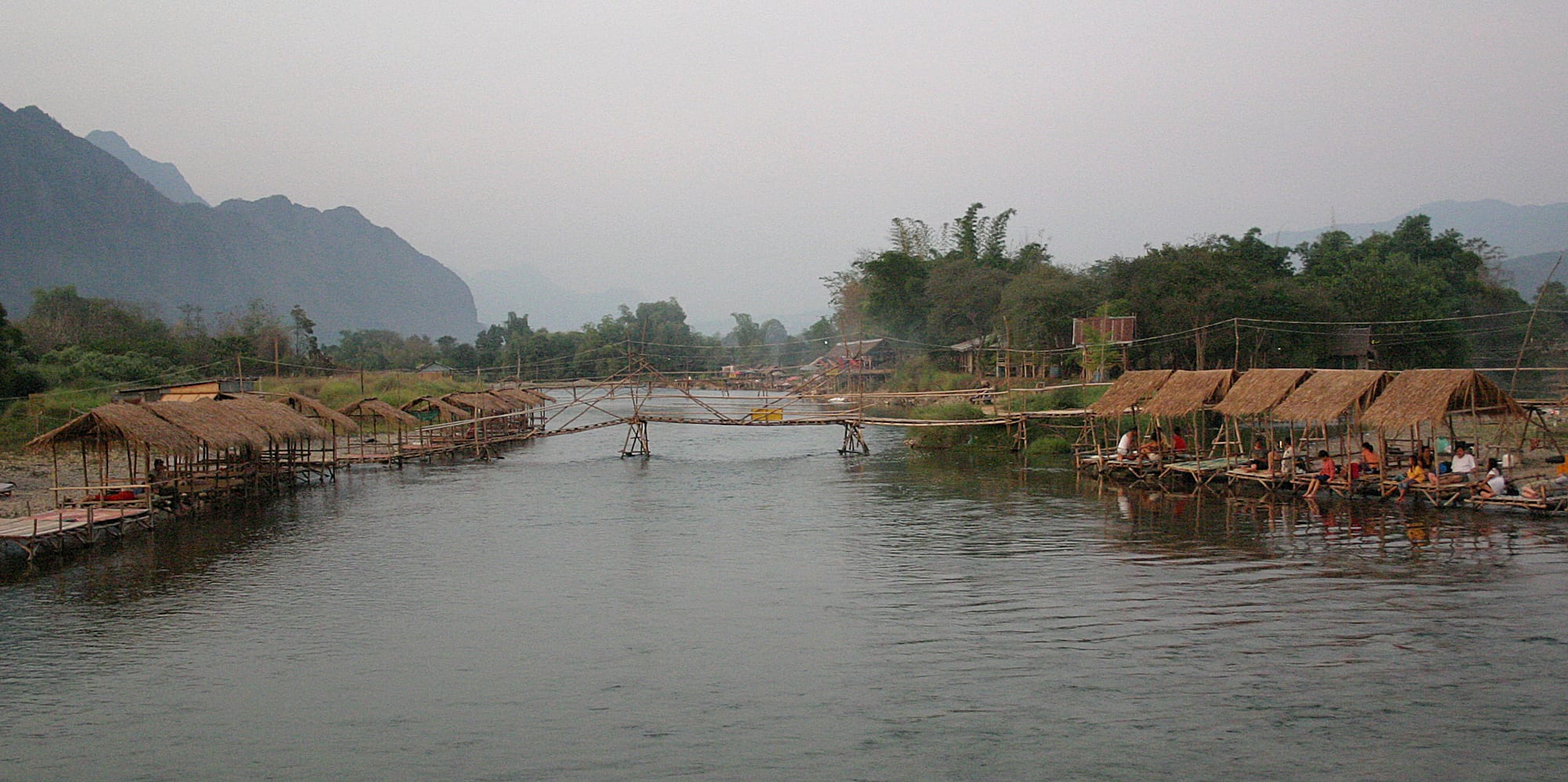
Bamboo huts and a low footbridge on the Nam Song river at Vang Vieng, with hazy limestone mountains behind

Vientiane & Central Laos, Laos

Vang Vieng

The Nam Song river at Vang Vieng, with riverside shelters and karst hills beyond. (Gerd Eichmann / Wikimedia Commons · CC BY-SA 4.0)

A small town on the Nam Song river in Vientiane Province, set among limestone karst towers riddled with caves and spring-fed pools. A wartime airstrip and then a stop on the road north, it became famous in the 2000s for river tubing and riverside bars, and has since turned towards climbing, kayaking, ballooning and viewpoint walks.

Neighbourhoods

  • The town centre and old airstrip
    • First-time visitors
    • Best for food
    • Close to public transport

    A grid of short streets around the flat open ground of a former wartime airstrip, holding most of the guesthouses, restaurants, tour offices and minibus stops. Everything in it is within a ten-minute walk.

    Open in Maps
  • The Nam Song riverbank
    • River views
    • Evenings out
    • Sunsets

    The western edge of town, where bars, bungalows and open-sided restaurants face the water and the karst wall beyond it. Footbridges cross to the far bank, and the tubing and kayaking launches are here.

    Open in Maps
  • The far bank and the rice fields
    • Quiet and residential
    • Countryside
    • Cycling

    Across the river, tracks run between rice fields and villages to the foot of the limestone towers, past homestays, small resorts and the paths to the caves and viewpoints. It is quieter and darker at night than the town.

    Open in Maps

Things to do

Caves and lagoons

  • Tham Changattraction

    A lit cave in the cliff south-west of the town, reached across the Nam Song and up a long flight of steps, with a spring inside it and a view over the valley from the mouth. It served as a refuge during the Chinese-Ho invasions of the early 19th century.

    Open in Maps
  • Tham Phu Kham and the Blue Lagoonattraction

    A hillside cave north-west of the town, above the village of Ban Na Thong, holding several Buddha images including a large reclining bronze one, with a blue spring-fed pool below it.

    Open in Maps
  • Tham Namattraction

    A water cave north of the town, entered by floating in on an inner tube along a rope in the dark.

    Open in Maps

The river, the karst and viewpoints

  • Nam Song Riverattraction

    The river that runs past the town between karst walls, used for tubing, kayaking and paddleboarding and lined with bamboo bridges and riverside bars.

    Open in Maps
  • Mount Nam Xayviewpoint

    A steep, rough climb south-west of the town to a bare summit with a motorbike prop, looking over rice fields and a ring of limestone peaks.

    Open in Maps
  • Pha Ngeunviewpoint

    A shorter and sharper scramble up a karst tower across the river, with platforms looking back over the valley and the town.

    Open in Maps

Around the town

  • Vang Vieng morning marketmarket

    The produce market on the eastern side of town, where villagers bring river fish, herbs, bamboo shoots and sticky rice soon after dawn.

    Open in Maps
  • The old airstriplandmark

    The flat strip of ground through the centre of town, cut as an airfield during the war in Laos, when it was known as Lima Site 6, and now open ground in the middle of the streets.

    Open in Maps
  • Vang Vieng railway stationtransit hub

    The station on the Boten–Vientiane railway, the Lao section of the Laos–China Railway, which put the town on a fast line between Vientiane and Luang Prabang.

    Open in Maps

Seasonal events

  • Pi Mai Lao (Lao New Year)mid-April

    Days of water-throwing, temple visits and music in the streets and along the river at the hottest point of the year.

  • Boun Bang Fai (rocket festival)May

    Bamboo rockets are fired from village grounds around the valley to ask the sky for rain before the planting season.

  • Boun Ok PhansaOctober

    The end of the Buddhist rains retreat, with offerings at the monasteries and candle-lit floats set on the Nam Song.

Eat and drink

Long-standing places and food districts in Vang Vieng. Hours, ratings and directions come from your maps app, always current.

Markets and food streets

  • Vang Vieng morning marketmarket

    Grilled chicken, sticky rice, papaya salad, noodle soup and bags of chilli paste sold from stalls and eaten at plastic tables beside them.

    Open in Maps
  • The town centre streetsneighborhood

    A dense run of Lao kitchens, Korean barbecue, Indian and Western places, sandwich carts and coffee shops in a few short blocks.

    Open in Maps
  • The riverside bars and restaurantsneighborhood

    Open-sided decks and cushioned platforms along the Nam Song serving grilled fish, laap and Beerlao facing the karst at sunset.

    Open in Maps

Experience Vang Vieng

History

Vang Vieng began as a Lao village on the Nam Song, a staging point on the route between Vientiane and the northern mountains where the river cuts through a belt of limestone. The caves in the surrounding karst have been used for shelter and as shrines for centuries, and several still hold Buddha images.

The war in Laos changed it. In the 1960s an airstrip was cut through the middle of the village as part of the network of small airfields used by American aircraft and by the aid and supply flights that supported the Royal Lao side; the flat strip of land through the town centre is the remains of it. Fighting and bombing in the Cold War years drove movement between the valley and the hills, and the town remained small and poor after 1975.

Backpackers arrived in the 1990s after Laos reopened to independent travel, drawn by cheap rooms and the karst scenery. Through the 2000s the town became known across South-East Asia for tubing down the Nam Song between riverside bars selling buckets of spirits, with rope swings and slides into shallow water. The town's hospital recorded 27 tourist deaths in 2011 from drowning and diving injuries, and in the third quarter of 2012 the Lao government pulled down the riverside bars and regulated the river. The town rebuilt itself around outdoor activity and a largely different visitor: climbers, kayakers, cyclists and, since the late 2010s, large numbers of Korean, Chinese and Thai travellers. The Vientiane–Boten Expressway reached the town in 2020 and the Laos–China Railway opened a station here in 2021, bringing weekend crowds from the capital.

Culture & Customs

For all its visitors, Vang Vieng remains a Lao market town with monasteries, an alms round at dawn and a Buddhist calendar that sets the year. The valley and the hills above it are mixed: lowland Lao along the river, with Hmong and Khmu villages on higher ground, some of them resettled from more remote areas, whose dress, language and spirit beliefs differ from those of the town. Village life turns on rice, maize, cattle and, increasingly, work in tourism.

The big festivals are the national ones. Pi Mai in April fills the streets with water, and the end of the rains retreat in October brings offerings at the monasteries and candle-lit floats on the Nam Song. Boun Bang Fai, the rocket festival before the rains, is kept in the villages around the town, with home-made bamboo rockets fired from the fields.

The town's older reputation for drunken tubing is a sensitive subject, and residents point out that the bars were closed and the river regulated more than a decade ago. Local expectations about behaviour are conservative: swimwear belongs at the river rather than in town, modest dress is expected at temples, and the police enforce closing hours. Hot air ballooning, paramotoring, rock climbing on the limestone and kayaking have become the town's public face, and a generation of local guides and climbers has grown up with them.

Daily Life

Vang Vieng is a district capital of modest size: the town itself can be crossed on foot in a quarter of an hour, and most of the district's people live in the farming villages of the valley around it. Tourism is the economy — guesthouses, hostels, resorts, restaurants, tour offices, motorbike and buggy hire, and the guides, drivers and boatmen who work for them — set against rice farming, maize, cattle and market gardening in the valley behind.

Development has come fast. The railway station, the expressway and a run of new hotels have changed the scale of the place in a few years, bringing visitors from Vientiane for the weekend and tour groups from China, Korea and Thailand. Land prices along the river have risen, construction is constant, and rubbish disposal, water quality and pressure on the caves and lagoons are live local concerns. Cement works and quarrying in the limestone also employ people nearby.

The rhythm of the day is early: monks on the alms round and the market at first light, activities through the morning, a hot and largely idle afternoon, then the riverbank at sunset and restaurants until the bars close. Power cuts and dust in the dry season, mud and flooding in the wet, and the seasonal swing between crowded and empty months shape how residents plan the year.

Food

Vang Vieng eats what the Lao countryside eats, with a long menu for visitors laid over the top. Sticky rice, khao niao, comes in a woven basket with every meal and is taken by hand. Laap, minced meat or fish with lime, fish sauce, herbs and toasted ground rice, and tam mak hoong, green papaya pounded with chillies, lime and fermented fish sauce, are the everyday dishes, alongside ping kai, charcoal-grilled chicken flattened between bamboo sticks.

The river supplies fish, grilled whole with lemongrass and salt as ping pa or steamed in banana leaves with dill as mok pa. Breakfast is khao piak sen, thick rice noodles in chicken broth, or feu, the Lao version of pho, or a baguette split and filled with pâté and pickles as khao jii — the bread a survival of the French period. Evenings often mean sin dat, the tabletop charcoal barbecue and hotpot that groups cook over for hours.

The visitor trade has added its own layers: Korean barbecue and Indian curry houses, pancake and sandwich carts on the main streets, smoothie stalls and a run of cafés serving Bolaven coffee from the southern plateau. Beerlao is drunk with ice, and lao-lao, the clear rice spirit, is poured at village celebrations in the valley.

Planning tools

Budget

Vang Vieng has some of the cheapest hostel beds in Laos alongside a growing number of resort hotels with views of the karst, so costs vary widely by choice of room. Food is inexpensive. The real spending is on activities: kayaking, caving, climbing, buggy hire, motorbike rental and a balloon flight, which is the single largest cost in town.

Daily Budget Midrange
USD 50–110 (resort or riverside hotel with a view, restaurant meals, a guided cave or kayak trip and motorbike hire)
Daily Budget Shoestring
USD 20–35 (hostel bed, market and noodle-shop meals, a tube or a bicycle)

Carry cash for activities and village entry fees; cash machines exist in town but can be empty, and small operators rarely take cards.

Best Time to Visit

November to February is the most comfortable season, dry and warm with cool, misty mornings that suit ballooning and climbing. March and April are hot and often hazy with smoke from field burning. The rains from June to October make the karst intensely green but raise the river, flood the caves and can close the water routes.

Suggested Number of Days

Two days are enough for the caves, the river and one climb. Three or four suit anyone who wants to cycle the valley, add climbing or take things slowly in the heat. The wet season closes some caves and river sections, which changes what is possible.

First Visit
2 days
With Surroundings
3–4 days

Transportation

The town is small and walkable, and bicycles, motorbikes and buggies are hired everywhere for the tracks across the river. Tuk-tuks run to the caves, the lagoons and the railway station. The China–Laos Railway and an expressway both link the town with Vientiane and Luang Prabang, and minibuses still use the old winding Route 13.

Tracks beyond the river are rough, dusty in the dry season and deep in mud after rain, and a helmet is needed on any motorbike or buggy.

Airport & Station Connections

The town is about 130 km north of Vientiane. A station on the Boten–Vientiane railway sits outside the town, with trains from Vientiane and Luang Prabang; tuk-tuks meet arrivals. The Vientiane–Boten Expressway has cut the road journey from the capital, and minibuses from Vientiane, Luang Prabang and Phonsavan use the bus stop in the centre. The nearest airport is Wattay in Vientiane.

Walkability

The centre is flat, compact and easily crossed on foot in minutes, and the riverbank is a short walk from any guesthouse. The caves, lagoons and viewpoints are several kilometres out along unpaved tracks, so most people cycle or ride. The viewpoint climbs are steep, loose and need proper shoes.

Safety

The hazards here are the river and the hills rather than crime. Drowning while tubing or kayaking, particularly after drinking, has been the most serious risk; the Nam Song runs fast and high in the rains and caves can flood without warning. Falls on the steep viewpoint climbs and motorbike and buggy accidents on loose tracks are common, and drink and drugs are a recurring problem in the town's bars. In November 2024 six foreign tourists died of suspected methanol poisoning after drinking contaminated spirits at a hostel in the town.

Wear the life jacket offered on the river, avoid the water when it is high or after drinking, wear a helmet, keep to marked trails in the hills, and be cautious about what is served in bars. Check current official travel advice before travelling.

Climate

A tropical monsoon climate, a little cooler than Vientiane because of the hills around the valley. The dry season runs from November to April, with strong heat in March and April, and the rains from May to October bring mist, cloud and swollen rivers.

Summer
hot and humid, generally 30–35°C by day, with heavy afternoon rain from May to October
Winter
dry and warm, about 27–30°C by day, with misty mornings that can drop to around 13°C

Local Customs

Manners are those of rural Laos: a nop rather than a handshake, quiet voices and no public anger. Swimwear belongs at the river and the lagoon, not in the town's streets or at a temple, where shoulders and knees are covered and shoes come off at the door. The town's reputation from the 2000s is a sore point locally, and rules on late-night bars are enforced.

Cover up away from the water, ask before photographing villagers or children, remember that women do not touch monks or hand things to them directly, and treat drug offers as the serious legal risk they are.

Common Payment Methods

The currency is the Lao kip and cash is used for nearly everything, including guides, tube hire and village fees. A few hotels and larger restaurants take cards. Cash machines are in the centre but can run out at weekends, and Thai baht is sometimes accepted at a poor rate.