A steep forested limestone pinnacle rising above rice fields, with misty karst ridges behind under a grey sky

Laos

Vientiane & Central Laos

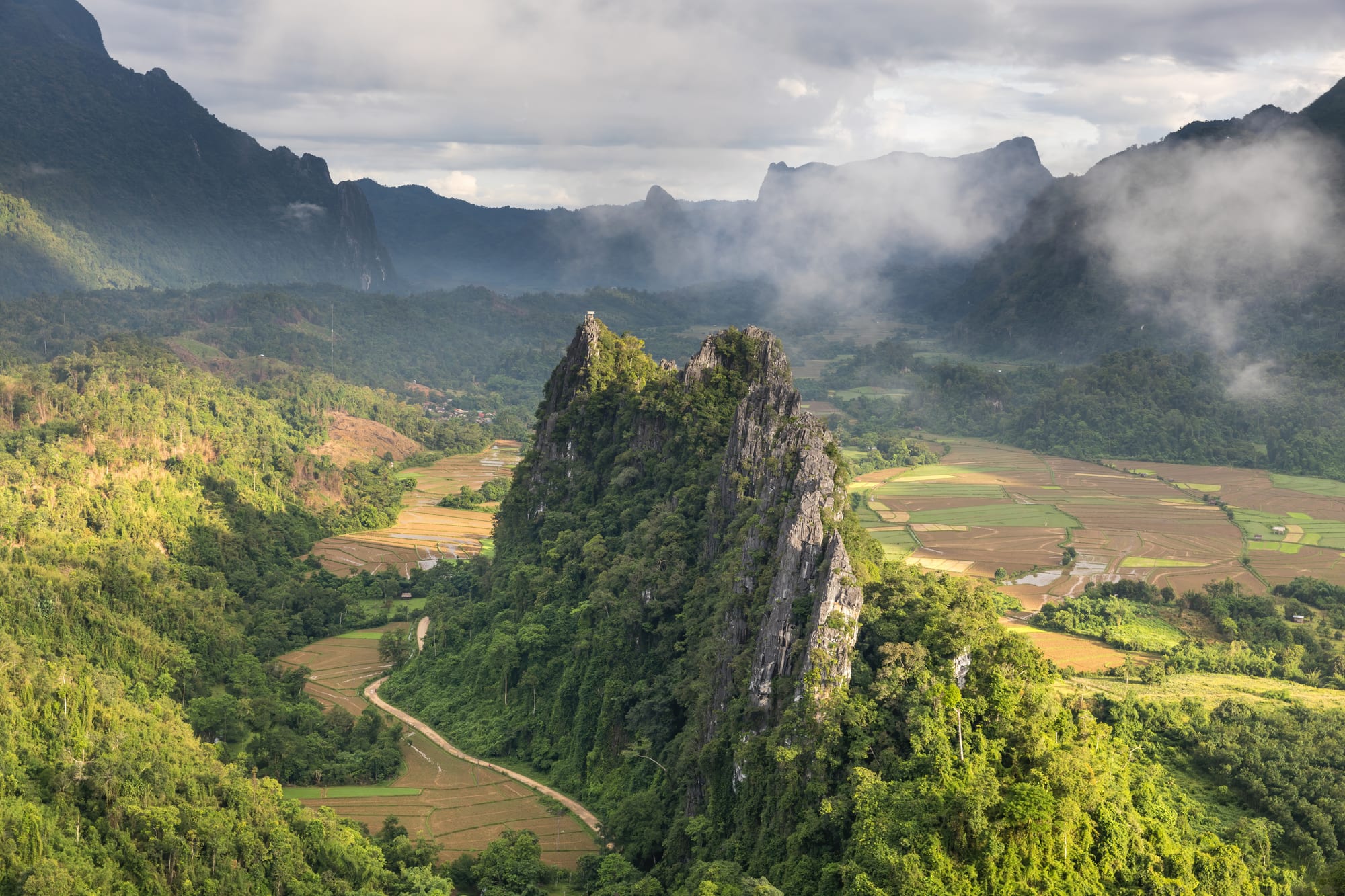
Karst peaks and rice fields around Vang Vieng, seen from the top of Mount Nam Xay. (Basile Morin / Wikimedia Commons · CC BY-SA 4.0)

The central belt of Laos, from the capital Vientiane on the Mekong across the plains facing Thailand and up into the karst country of Vang Vieng, Xaisomboun and Khammouane — the seat of government, the country's most urban corner, and a limestone landscape of caves and river valleys.

Explore Vientiane & Central Laos

History

Vientiane, Viang Chan in Lao, grew as a Mekong trading town long before King Setthathirath made it the capital of Lan Xang in the 1560s. He built Pha That Luang and the Haw Phra Kaew to house the Emerald Buddha, and the city became the kingdom's political centre. When Lan Xang broke apart in the early 18th century, Vientiane became its own kingdom under growing Siamese pressure; Siamese forces took the Emerald Buddha to Thonburi in 1779. King Anouvong's revolt against Siam in the 1820s ended in defeat and the sacking of the city, which lay largely empty for decades. Wat Sisaket, built under Anouvong, is among the few buildings to survive.

The French chose Vientiane as the administrative capital of their Lao protectorate, rebuilding it with a grid of villas and offices, while Thakhek grew as a river town on the Mekong. After independence the city was the stage of the Cold War: the 1960 coup by Captain Kong Le and the fighting that followed, American aid money and, in Xaisomboun, the CIA-supported base at Long Tieng, where General Vang Pao's Hmong forces fought the Pathet Lao. The Patuxai arch was built between 1957 and 1968 with cement reportedly intended for a runway.

After 1975 Vientiane became the capital of the Lao People's Democratic Republic. The first Thai–Lao Friendship Bridge opened in 1994, the railway arrived in 2021, and Xaisomboun, long a closed special zone, became a province in 2013. The Nam Theun 2 dam on the Nakai plateau in Khammouane is one of the country's largest hydropower schemes.

Culture & Customs

Central Laos is where the national culture is most visibly on show. Vientiane hosts the government, the Buddhist hierarchy and the national festivals, above all Boun That Luang in November, when monks and the faithful gather at the stupa, and the Boun Ok Phansa boat races on the Mekong at the end of Buddhist Lent. The capital has also absorbed Thai television, music and fashion from across the river, and Lao spoken in Vientiane is close to the Isan speech of north-east Thailand.

The countryside is more varied. Hmong communities are prominent in Xaisomboun and the hills of Vientiane Province, and Xaisomboun has seen conflict between the government and Hmong groups. Khammouane has old lowland Lao villages and the stupa of That Sikhottabong at Thakhek, with its own annual festival, while Phou Thai and other Tai groups live along the eastern valleys. The Baci ceremony, with its white strings tied round the wrist, marks arrivals and farewells everywhere.

Manners are those of the country but a little more cosmopolitan: short dress is tolerated in the capital's cafés yet frowned on at temples, and Vang Vieng has largely moved on from its reputation for drunken tubing parties in the 2000s.

Daily Life

The Vientiane prefecture has close to a million people, making it by far the largest urban area in Laos, though it still feels like a large town, with a riverside promenade, morning markets and low buildings. Vang Vieng, Paksan and Thakhek are small provincial towns, and Xaisomboun town, the province's economic centre, is smaller still.

The capital's economy runs on government, trade across the Friendship Bridge, construction, services and a growing number of Chinese-funded projects. The Beerlao brewery is on its outskirts. Outside the city, rice farming, the Nam Ngum reservoir's fisheries, hydropower, mining and cement, and tourism in Vang Vieng support most households. Inflation and the falling kip have squeezed salaries, and many young people work across the river in Thailand.

The day starts with noodle soup at dawn, office hours from about eight, a lunch break, and evenings on the Mekong promenade in Vientiane, where aerobics classes and a night market fill the riverbank at sunset.

Food

Vientiane is the best place in Laos to eat, from street stalls to French bistros. Its signature dish is nam khao, a salad of crumbled deep-fried rice balls mixed with fermented pork sausage, herbs, peanuts and lime. Khao piak sen, thick rice noodles in chicken broth, and feu, the Lao version of Vietnamese pho, are the usual breakfasts, and khao jii pâté, a baguette with pâté, pickles and chilli, is sold on every corner. Sin dat, a tabletop barbecue and hotpot of meats and vegetables, is the social meal of the evening.

Freshwater fish from the Mekong and the Nam Ngum reservoir is eaten grilled with salt and lemongrass as ping pa, or steamed in banana leaves as mok pa with dill and herbs. Laap and tam mak hoong accompany almost everything, along with sticky rice. Sin savanh, sweet dried beef with sesame, is a popular snack.

Beerlao is brewed near the capital, and Vientiane's cafés serve Bolaven coffee. In the countryside, lao-lao rice spirit and fermented jar wine appear at celebrations.

Attractions & Natural Wonders

In Vientiane, the gilded Pha That Luang is a national monument, and Wat Sisaket, with thousands of small Buddha images in its cloister walls, and the Haw Phra Kaew museum stand opposite each other on Setthathirath Road. The Patuxai arch closes Lane Xang Avenue, and the Mekong promenade and night market draw crowds at dusk. About 25 kilometres south-east, beside the Mekong, Buddha Park (Xieng Khuan) holds a reclining Buddha and more than 200 concrete figures made by the mystic Bunleua Sulilat from 1958.

North of the capital, Vang Vieng's karst peaks rise straight from the rice fields along the Nam Song. The town's attractions are the Tham Chang and Tham Phu Kham caves, the Blue Lagoon swimming holes, kayaking and tubing on the river and climbs to viewpoints such as Mount Nam Xay. The Nam Ngum reservoir, with its fisheries, lies to the east.

In Khammouane, the Thakhek loop leaves the Mekong town of Thakhek for a circuit of limestone valleys, caves, the Nakai reservoir, and the village of Ban Kong Lor. There, the Kong Lor cave carries the Nam Hinboun river for about seven kilometres through a mountain, and boats carry visitors through it. The stupa of That Sikhottabong stands on the Mekong at Thakhek.

Cities in Vientiane & Central Laos

Planning basics

Budget

Vientiane is the most expensive place in Laos for eating out and mid-range hotels, with international restaurants, cafés and bars priced closer to Bangkok than to rural Laos. Vang Vieng has cheap hostels alongside a growing number of resort hotels, and Thakhek and the villages along the loop are inexpensive. Motorbike hire for the loop and adventure activities in Vang Vieng are the main extra costs.

Daily Budget Midrange
USD 50–110 (good hotel in Vientiane or a resort in Vang Vieng, restaurants, tours and motorbike hire)
Daily Budget Shoestring
USD 20–35 (guesthouse or hostel, street food and noodle shops, buses and trains)

Vientiane has the country's best choice of cash machines and money changers, so change or withdraw enough before heading along the Thakhek loop.

Safety

Vientiane is a safe capital, with bag-snatching from motorbikes the main street crime. Vang Vieng's risks are river accidents while tubing or kayaking, drink and drugs, and falls on the viewpoint climbs. Motorbike accidents are common on the Thakhek loop, and caves and rivers flood in the rains. Unexploded ordnance remains in parts of Xaisomboun and Bolikhamxay.

Wear a helmet, avoid the river when it is high or after drinking, and keep to marked trails in the hills. Check current official travel advice before travelling.

Climate

Hotter than the north and less mountainous. Vientiane and the Mekong plain are hot almost all year, with the most pleasant weather from November to February and fierce heat in April. The karst areas around Vang Vieng and Kong Lor are a little cooler, and the Annamite side of Khammouane and Bolikhamxay is one of the wettest parts of the country in the monsoon.

Summer
hot and humid, 30–36°C, with heavy rain from June to October and some flooding along the rivers
Winter
dry and warm, 17–30°C, with cool mornings in Vang Vieng and the hills

Transportation

Vientiane's Wattay airport has regional flights, and the Thai–Lao Friendship Bridge links the city with Nong Khai, where Thai trains connect. The China–Laos Railway runs north to Vang Vieng, and an expressway also links the two. Route 13 runs south along the Mekong to Thakhek. The Thakhek loop is done by rented motorbike or with a driver.

Rent a well-maintained motorbike with good brakes for the loop, and allow three or four days rather than rushing it.

Best Time to Visit

November to February, when the air is dry, the roads of the Thakhek loop are passable and the Kong Lor river is calm. Vientiane's Boun That Luang festival in November and the boat races on the Mekong at the end of Buddhist Lent are the capital's biggest events. The wet season makes the countryside green but can flood the cave and wash out loop tracks.