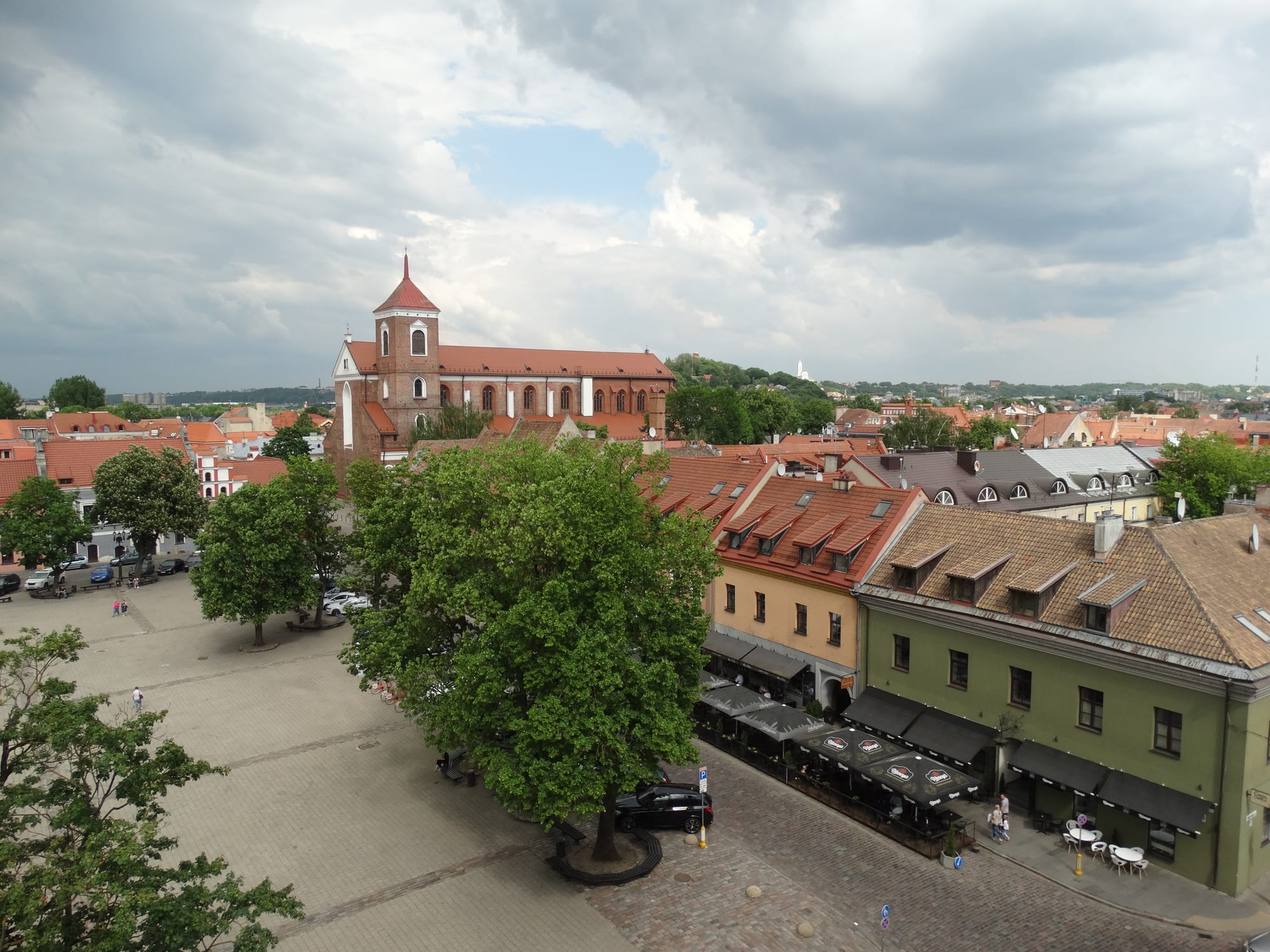
A cobbled old-town square with linden trees and café awnings, red-tiled roofs and a brick cathedral beyond

Vilnius, Kaunas & Eastern Lithuania, Lithuania

Kaunas

Town Hall Square in the Kaunas Old Town, with the cathedral behind. (Vilensija / Wikimedia Commons · CC BY-SA 3.0)

Lithuania's second city, at the confluence of the Nemunas and Neris — a medieval castle town and Hanseatic trading post that became the temporary capital between 1920 and 1939. Its interwar modernist buildings are now a UNESCO World Heritage Site, and it is a student city devoted to the basketball club Žalgiris.

Neighbourhoods

  • Old Town
    • First-time visitors
    • Historic district
    • Best for food

    The oldest part of the city, beside the confluence of the Nemunas and Neris and the park at its tip. Cobbled Vilniaus Street runs from Town Hall Square, past the castle, cathedral and Gothic merchants' houses, to the start of Laisvės alėja.

    Open in Maps
  • New Town
    • Modernist architecture
    • Nightlife
    • Close to public transport

    The 19th-century New Town, built along Laisvės alėja, a pedestrian boulevard lined with linden trees, shops, restaurants, theatres and museums. Many of the interwar modernist buildings are here, and so is the bus station, a short walk from the railway station.

    Open in Maps
  • Žaliakalnis
    • Viewpoints
    • Quiet and residential

    The 'green hill' north of the centre, one of the largest residential areas in the city, reached from the New Town by a wood-panelled funicular of 1931. The huge Resurrection Basilica stands at the top.

    Open in Maps
  • Aleksotas
    • Viewpoints
    • Local life

    The district on the left bank of the Nemunas, across the Vytautas the Great Bridge from the Old Town. A funicular of 1935 climbs its hill to a panorama over the Old Town's roofs and spires.

    Open in Maps
  • Vilijampolė
    • Jewish heritage
    • Local life

    A former separate town on the right bank of the Neris near the confluence, where Jews settled from the 14th century; its old nickname Slabotkė is still used. Two bridges link it with the Old Town and Žaliakalnis.

    Open in Maps
  • Šančiai
    • Local life
    • Quiet and residential

    A district divided into Lower and Upper Šančiai, whose cemetery holds the reburied remains of the transatlantic pilots Darius and Girėnas.

    Open in Maps

Things to do

The Old Town

  • Kaunas Castlelandmark

    A Gothic castle of the mid-14th century on a rise near the confluence, of which about a third survives.

    Open in Maps
  • Town Halllandmark

    The 16th-century former town hall in the middle of Town Hall Square, now a branch of the city museum and a wedding hall.

    Open in Maps
  • House of Perkūnaslandmark

    A Gothic merchants' house that was the office of Hanseatic traders from 1440 to 1532, named after a figure found in its walls that was taken to be the thunder god Perkūnas.

    Open in Maps
  • Kaunas Cathedral Basilicalandmark

    The cathedral of Sts Peter and Paul, seat of the Archbishop of Kaunas, in the Old Town.

    Open in Maps
  • Church of Vytautas the Greatlandmark

    The oldest church in the city, a Gothic building on the bank of the Nemunas with the only Gothic cross-shaped plan in Lithuania.

    Open in Maps

Interwar Kaunas and museums

  • Laisvės alėjaneighborhood

    The linden-lined pedestrian boulevard that forms the spine of the New Town, the longest pedestrian street in Eastern Europe.

    Open in Maps
  • Kaunas Central Post Officelandmark

    A post office of 1932, from the temporary-capital years, in which modernism and a national style intertwine.

    Open in Maps
  • M. K. Čiurlionis National Art Museummuseum

    The museum of the painter and composer Čiurlionis, founded in 1921, in an interwar Art Deco and functionalist building.

    Open in Maps
  • Vytautas the Great War Museummuseum

    A museum opened in 1936 with weapons and history from prehistoric times to today, a 35-bell carillon in its tower and the Tomb of the Unknown Soldier in the square outside.

    Open in Maps
  • Devil Museummuseum

    A collection of devil sculptures, carvings and masks from around the world, begun by the artist Antanas Žmuidzinavičius.

    Open in Maps
  • Resurrection Basilicaviewpoint

    The largest basilica in the Baltic states, a modernist landmark on Žaliakalnis, consecrated in 2004 and completed in 2005.

    Open in Maps
  • Žaliakalnis Funiculartransit hub

    Opened in 1931, the oldest funicular in Lithuania and one of the oldest still working anywhere, with wood-panelled cars.

    Open in Maps
  • Aleksotas Funiculartransit hub

    A funicular opened in 1935 that climbs from the Vytautas the Great Bridge to a viewpoint over the Old Town.

    Open in Maps

War and memory

  • Ninth Fortmuseum

    A fort of the late 19th-century Kaunas Fortress, used by the Soviets as a prison and by the Nazis as a place of mass execution of Jews, now a memorial and museum.

    Open in Maps
  • Kaunas Fortresslandmark

    A 19th- and early 20th-century ring of forts covering about 65 square kilometres, one of the largest defensive works in Europe.

    Open in Maps

Parks, river and sport

  • Pažaislis Monasterylandmark

    The largest monastery complex in Lithuania and its best-known Baroque building, on a peninsula in the Kaunas Reservoir, with a richly marbled church.

    Open in Maps
  • Kaunas Botanical Gardenpark

    A university botanical garden of 62.5 hectares, the second largest in Lithuania.

    Open in Maps
  • Žalgiris Arenaattraction

    The largest indoor arena in the Baltic states, on an island in the Nemunas, home of the EuroLeague basketball club Žalgiris.

    Open in Maps

Short trips from the city

  • Rumšiškėsattraction

    A small town on the Kaunas Reservoir about 20 kilometres east, home of the Lithuanian Open Air Museum of rural buildings.

    Open in Maps
  • Birštonasattraction

    A spa town on the Nemunas about 30 kilometres south, with town rights dating from 1529.

    Open in Maps

Seasonal events

  • Kaunas Jazzlate April, with smaller autumn and pre-Christmas series

    The largest jazz festival in Lithuania, held since 1991, which has brought artists from more than 20 countries.

  • Days of Kaunas Cityend of May

    Three days of folk art fairs and concerts celebrating the privileges granted to the city in 1463.

Eat and drink

Long-standing places and food districts in Kaunas. Hours, ratings and directions come from your maps app, always current.

Food districts

  • Old Town restaurantsneighborhood

    Cobbled Vilniaus Street and Town Hall Square hold cafés, bars and restaurants serving Lithuanian classics in old merchants' houses.

    Open in Maps
  • Laisvės alėjaneighborhood

    The New Town's boulevard is lined with restaurants, cafés and bars, busiest on summer evenings.

    Open in Maps

Experience Kaunas

History

Folk history says the city grew up around a fortress built where the Nemunas and the Neris meet, and took the name of its builder. Kaunas was first mentioned in 1361, and its brick castle defended the confluence against the Teutonic Order. In 1408 Vytautas the Great granted it Magdeburg rights and chose its coat of arms with an aurochs, and in 1441 it joined the Hanseatic League, which opened its only kontor in the Grand Duchy here; the merchants' office survives as the House of Perkūnas.

Napoleon's Grand Army passed through twice in 1812 and devastated the city both times. Under the Russian Empire Kaunas became the capital of a governorate in 1843 and was ringed with the forts of Kovno Fortress. In 1897 more than a third of its people were Jews. When Poland seized Vilnius in 1920, Kaunas became the temporary capital: the Constituent Assembly first met here on 15 May 1920, and under Mayor Jonas Vileišis it grew rapidly and was extensively modernised; its cultural life, fashion and Art Deco architecture earned it the nickname "Little Paris".

In 1940 the Japanese vice-consul Chiune Sugihara issued transit visas here that let thousands of Jewish refugees escape. Under Nazi occupation the Jews of Kaunas, about a quarter of the population, were confined and murdered, many at the Ninth Fort. In Soviet times the city again became a major centre of resistance, and on 14 May 1972 the 19-year-old Romas Kalanta set himself on fire in protest. Since independence Kaunas has been European Capital of Culture, in 2022, and in 2023 its interwar architecture was added to the UNESCO World Heritage List.

Culture & Customs

The temporary-capital years still define how Kaunas sees itself. More than 12,000 building permits were issued between 1918 and 1940, and the modernist post office, museums, villas and churches of that time earned the city the title of UNESCO City of Design, the first in Central and Eastern Europe, as well as its World Heritage listing. The Čiurlionis museum, founded in 1921, keeps the work of the painter and composer M. K. Čiurlionis.

Basketball is close to a civic religion. Žalgiris, founded in 1944, became one of the most popular non-violent outlets for national feeling in its Soviet-era duels with CSKA Moscow, and today its EuroLeague games fill the largest indoor arena in the Baltic states. About 93 per cent of the city's people are Lithuanian, a higher share than in the capital.

Music runs through the calendar. Kaunas Jazz, founded in 1991, is the country's largest jazz festival, and the Days of Kaunas City at the end of May fill the Old Town with folk art fairs and concerts. The carillon in the tower of the War Museum, completed in Belgium in 1935, plays over the square in front of the museum, with its Tomb of the Unknown Soldier.

Daily Life

About 390,000 people lived in the Kaunas functional urban area in 2021, and the city itself holds about a tenth of Lithuania's population. The city has long been called the "student city": about 40,000 students attended its universities and colleges in 2023, including Vytautas Magnus University and Kaunas University of Technology, and in 2024 it entered a world ranking of the best student cities. Most of the city's pupils go on to universities or colleges, in a country where 58 per cent of 25–34-year-olds had tertiary education in 2022.

The economy mixes manufacturing and logistics, as one of the largest logistics centres in Lithuania, with newer information technology and electronics businesses. Many people live in the hill districts such as Žaliakalnis, one of the largest residential areas, while the Old Town has turned from a district with industry into a place of homes, shops and leisure.

Life moves at a gentler pace than in the capital. Laisvės alėja is the place for an evening walk, the riverbanks and the reservoir fill up in summer, and a Žalgiris game is a shared event across the city.

Food

Kaunas eats as the rest of Lithuania does. Cepelinai, large dumplings of grated potato stuffed with ground meat, curd cheese or mushrooms, served with a sour cream sauce and bacon bits, are the national dish. Šaltibarščiai, the bright pink cold soup of beetroot and kefir, is the summer staple. Kugelis, a baked potato pudding, and vėdarai, intestines stuffed with mashed potato, reflect the German influence on Lithuanian cooking.

Kibinai, the mutton-and-onion pastries of the Karaim community, are associated with nearby Trakai but sold widely, and šakotis, the spit-baked "tree cake", appears at celebrations. Soups are served very often and are widely regarded as the key to good health, and barley, rye, beets, mushrooms, berries and dairy products — a speciality — run through the national cuisine, along with many ways of pickling food for winter.

The Old Town's Vilniaus Street and Town Hall Square and the New Town's Laisvės alėja are where most restaurants, cafés and bars cluster, from traditional kitchens to modern ones. Trejos devynerios, steeped with 27 herbs, is one of the best-known Lithuanian herbal spirits.

Planning tools

Budget

Kaunas is generally a little cheaper than Vilnius for rooms and meals, and hourly trains make the capital easy to reach. Prices rise for big basketball games, concerts at the arena and festival weekends.

Daily Budget Midrange
USD 95–180 (mid-range hotel, restaurants, museum tickets, a day trip)
Daily Budget Shoestring
USD 45–75 (hostel or guesthouse, cafés and bakeries, city buses)

The Old Town, Laisvės alėja and the funicular viewpoints cost little or nothing; rooms cost more on big game and festival weekends.

Best Time to Visit

May to September, when café terraces fill Laisvės alėja and the Old Town, and the riverbanks and the reservoir are at their best. The jazz festival comes in late April and the city's own festival at the end of May. Winter is cold but brings Christmas decorations and the basketball season.

Suggested Number of Days

Two days cover the Old Town, the New Town and the main museums. Three or four days allow time for the forts, the reservoir and nearby towns, or for using Kaunas as a cheaper base for Vilnius.

First Visit
2 days
With Surroundings
3–4 days

Transportation

City buses cover Kaunas, paid with a Žiogas card or app, and two historic funiculars climb the hills. Trains run hourly to Vilnius, and buses reach Druskininkai and towns across the country.

Use the funiculars for the two best views of the city.

Airport & Station Connections

Kaunas Airport, where Ryanair is the main carrier, is 14 kilometres north-east of the centre. Vilnius is about 100 kilometres to the east, linked by frequent trains; the bus station is in the New Town, 300 metres north of the railway station.

Walkability

The centre is easy on foot: the Old Town and Laisvės alėja form one long, mostly traffic-free walk from the confluence to the New Town. The hills either side are steep, but the funiculars help. The forts and Pažaislis need a bus or a car.

Safety

Lithuania is a very safe country with low levels of violent crime. Kaunas is calm; petty theft in busy places and slippery streets in winter are the main concerns.

Watch belongings in crowds and at big events, and take care on icy pavements in winter. Check current official travel advice before travelling.

Climate

A humid continental climate, with warm summers, cold and sometimes snowy winters, and an average annual temperature of about 7°C.

Summer
warm and pleasant, with average daytime highs of 21–22°C and lows around 12°C; some days reach 30°C
Winter
relatively cold and sometimes snowy, with averages between -8 and 0°C; it rarely falls below -15°C

Local Customs

Kaunas is one of the most Lithuanian of the country's cities, with about 93 per cent of its people Lithuanian. Basketball matters enormously here, and Žalgiris home games fill the arena. Churches are places of active Catholic worship.

Dress modestly in churches, keep voices down during services, and expect conversation to turn to basketball.

Common Payment Methods

The currency is the euro. Cards and contactless payment work almost everywhere, ATMs are easy to find, and a little cash is useful for small purchases.