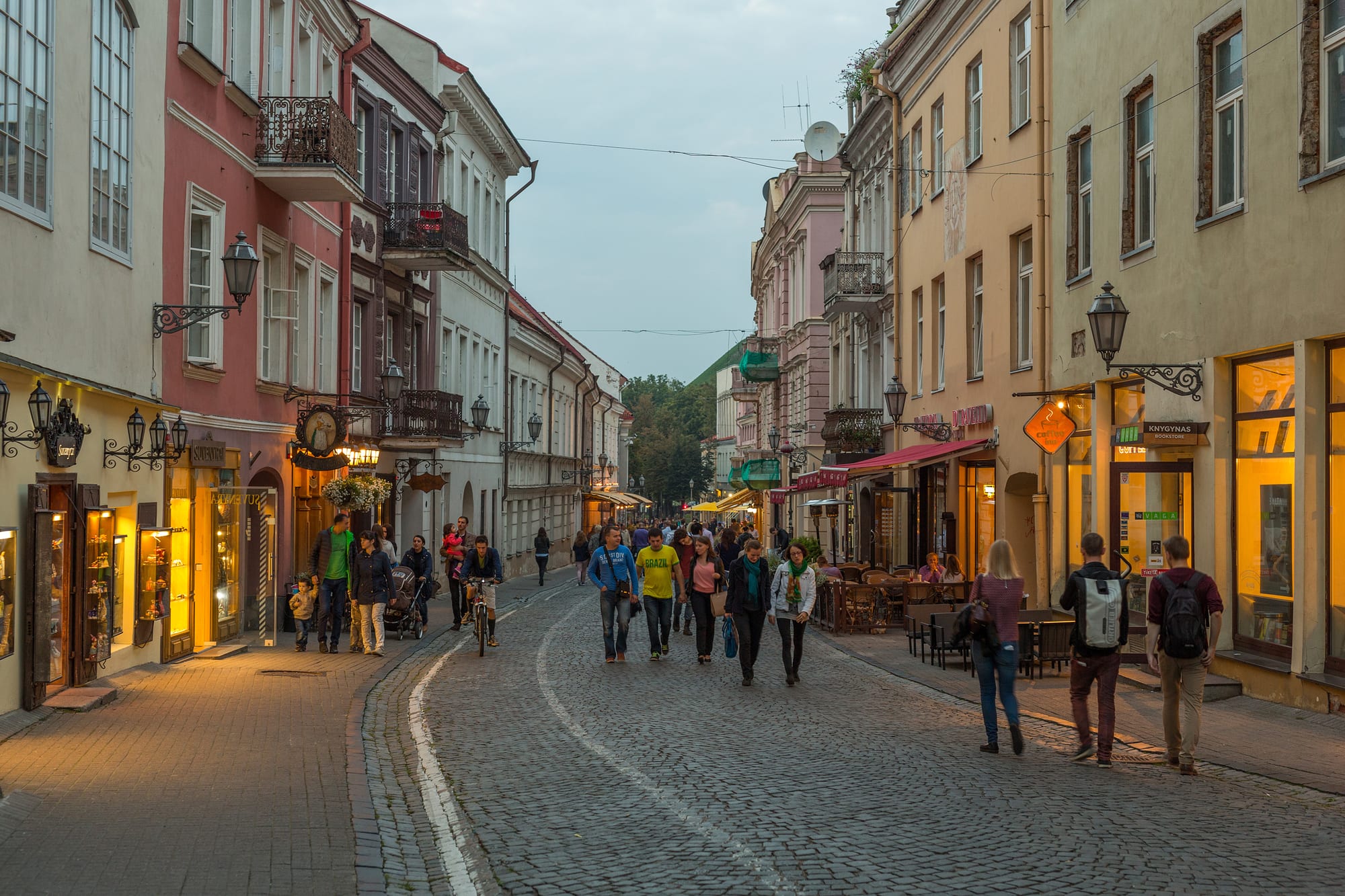
A cobbled street of pastel old-town houses with iron lanterns, shop windows and café terraces lit at dusk

Vilnius, Kaunas & Eastern Lithuania, Lithuania

Vilnius

Pilies Street, the main street of the Vilnius Old Town, at dusk. (Diliff / Wikimedia Commons · CC BY-SA 3.0)

Lithuania's capital, on the Neris where the small Vilnia joins it — seat of the Grand Dukes since at least 1323, a university city since 1579 and, before the Holocaust, the 'Jerusalem of the North'. Its UNESCO-listed Baroque old town of churches and courtyards now sits beside the glass towers of a new business district and a large fintech and science sector.

Neighbourhoods

  • Old Town
    • First-time visitors
    • Historic district
    • Best for food

    One of the largest surviving old towns in Northern Europe, covering about 3.6 square kilometres between the castle hill and the Gate of Dawn. Pilies Street, the main artery, is lined with cafés and stalls, and the university's courtyards, the Cathedral Square and Town Hall Square are all a short walk apart.

    Open in Maps
  • Užupis
    • Arts and culture
    • Cafés
    • Quiet streets

    The district 'beyond the river', across the Vilnia from the Old Town, neglected in Soviet times and long popular with artists. On 1 April 1997 it declared itself an independent republic with its own constitution, and it is often compared with Montmartre and Christiania.

    Open in Maps
  • Naujamiestis
    • Close to public transport
    • Local life

    The 'New Town' beside the Old Town, an eldership of about 28,000 people around the railway station, with the bus station next door. It is a practical base for arrivals and departures, a short walk from the Old Town.

    Open in Maps
  • Šnipiškės
    • Modern city
    • Markets

    On the north bank of the Neris, the business district of skyscrapers such as the Europa Tower, still mixed with the protected late 19th- and early 20th-century wooden houses known as the Shanghai district. The Kalvarijos Market is here.

    Open in Maps
  • Žvėrynas
    • Quiet and residential
    • Historic homes

    A small, older neighbourhood almost surrounded by a bend of the Neris, once a private hunting ground and later a resort, so many decorated wooden houses survive. A footbridge leads across the river to Vingis Park.

    Open in Maps
  • Antakalnis
    • Baroque architecture
    • Green spaces

    One of the oldest and largest historic suburbs, running east along the Neris. It holds the Church of St Peter and St Paul, the Sapieha Palace and its Baroque park, and the Antakalnis Cemetery, where the victims of January 1991 are buried.

    Open in Maps

Things to do

Famous landmarks

  • Vilnius Cathedrallandmark

    The main Catholic cathedral of Lithuania, on Cathedral Square, once the place where the Grand Dukes were inaugurated and today the setting for masses for newly elected presidents.

    Open in Maps
  • Gediminas's Towerviewpoint

    The surviving part of the Upper Castle on Gediminas Hill, a symbol of the city and the country, with a viewing platform over the Old Town and the business district.

    Open in Maps
  • Palace of the Grand Dukes of Lithuaniamuseum

    The rulers' palace in the Lower Castle, first built in the 15th century and rebuilt in Renaissance style on its original site between 2002 and 2018.

    Open in Maps
  • St Anne's Churchlandmark

    A Flamboyant and Brick Gothic church from around 1500 on the bank of the Vilnia, one of the buildings that won the Old Town its UNESCO listing.

    Open in Maps
  • Gate of Dawnlandmark

    A surviving city gate whose chapel holds a revered painting of the Virgin Mary, one of the main Catholic pilgrimage sites in Lithuania.

    Open in Maps
  • Vilnius Universitylandmark

    Founded in 1579 as a Jesuit academy by Stephen Báthory, the first and largest university in Lithuania, whose historic ensemble in the Old Town has around thirteen courtyards.

    Open in Maps
  • Church of St Peter and St Paullandmark

    A Baroque church in Antakalnis whose white interior holds some 2,000 stucco figures by Giovanni Pietro Perti, considered a masterpiece of the Commonwealth era.

    Open in Maps

Museums and memorials

  • Museum of Occupations and Freedom Fightsmuseum

    Artefacts and records of the 50-year Soviet occupation, in the building that housed the KGB.

    Open in Maps
  • Vilna Gaon Museum of Jewish Historymuseum

    The museum of the heritage of Lithuanian Jewry, in a city that was one of the great centres of Jewish learning before the Holocaust.

    Open in Maps
  • MO Museummuseum

    A modern art museum opened in 2018 in a building by Studio Libeskind, with a collection of about 6,000 Lithuanian works from the 1950s to today.

    Open in Maps
  • Vilnius TV Towerviewpoint

    At 326.5 metres the tallest structure in Lithuania, in the Karoliniškės district, where civilians were killed defending it in January 1991; it holds a museum of the freedom fight.

    Open in Maps
  • Paneriailandmark

    A forested neighbourhood about 10 kilometres from the centre, the site of the Ponary massacre, in which as many as 100,000 people were killed during the Second World War.

    Open in Maps

Parks and viewpoints

  • Hill of Three Crossesviewpoint

    A monument of three white crosses in Kalnai Park, rebuilt in 1989 after the Soviet authorities tore down its predecessor, with a small observation deck over the Old Town.

    Open in Maps
  • Bernardine Gardenpark

    A park of more than 9 hectares on the bank of the Vilnia between Gediminas's Tower and the Bernardine Monastery, with botanical sections and room for festivals.

    Open in Maps
  • Vingis Parkpark

    The largest park in the city, 162 hectares in a bend of the Neris, with an amphitheatre where the national Song Festival has its main concerts.

    Open in Maps

Markets

  • Halės turgusmarket

    The main market hall of Vilnius, built in 1906 and looking like a railway terminus, and a place to see everyday Vilnius shopping for food.

    Open in Maps

Short trips from the city

  • Trakai Island Castlelandmark

    The red-brick island castle of the Grand Dukes on Lake Galvė, in the lakeside town of Trakai, an easy trip by train or bus.

    Open in Maps
  • Kernavė Archaeological Sitelandmark

    A medieval capital of the Grand Duchy on the Neris, with hillforts and a UNESCO World Heritage archaeological site.

    Open in Maps

Seasonal events

  • Kaziuko mugėearly March

    St Casimir's Fair, a folk arts and crafts fair dating to the early 17th century, filling the streets and markets on the Sunday nearest to 4 March and drawing tens of thousands of visitors.

  • Kino pavasarisMarch

    The Vilnius International Film Festival, held every March since 1995 and the largest film festival in the country.

  • Užupis Independence Day1 April

    The anniversary of the day in 1997 when the artists' district declared itself a republic.

  • Christmas tree on Cathedral SquareDecember

    The city's Christmas tree goes up on the main square of the Old Town.

Eat and drink

Long-standing places and food districts in Vilnius. Hours, ratings and directions come from your maps app, always current.

Vilnius classics

  • Etno Dvarasrestaurant

    A chain serving traditional Lithuanian food such as cepelinai and potato pancakes, with branches by the university and at the Gate of Dawn.

    Open in Maps
  • Old Town restaurantsneighborhood

    The Old Town streets hold a wide choice of restaurants and terraces, from traditional Lithuanian cooking to modern kitchens.

    Open in Maps

Markets

  • Halės turgusmarket

    The 1906 market hall, the city's main covered market for food shopping.

    Open in Maps
  • Kalvarijos Marketmarket

    The Kalvarijos Market in Šnipiškės, on the north bank of the Neris.

    Open in Maps

Experience Vilnius

History

A legend recorded around the 1530s says Grand Duke Gediminas dreamed of an Iron Wolf howling on a hilltop, a sign that a castle and city would be built there. The city was certainly the capital by 1323, when Gediminas named it in a letter, and from the 13th century to the mid-17th century the castle complex was the rulers' residence. Under the Polish–Lithuanian Commonwealth Vilnius flourished, especially after Stephen Báthory founded the university in 1579, and the style known as Vilnian Baroque is named after the city. It was a city of many faiths and a world centre of Torah study, which Napoleon called the "Jerusalem of the North" in 1812.

Then came the Russian Empire, which closed the university in 1832, and, after a conflict between Poland and Lithuania, Polish rule from October 1920. Lithuania regained the city in September 1939, but the Soviet Union annexed the country in June 1940. Under Nazi occupation the Jewish community was confined to a ghetto and murdered, many of them at Paneriai on the edge of the city. After the war a population exchange with Poland transformed a city where Poles had been the majority, and Vilnius grew as the capital of Soviet Lithuania.

On 11 March 1990 the Supreme Council declared independence restored there. On 13 January 1991 Soviet troops attacked the radio and television building and the TV Tower, killing 14 civilians; Moscow recognised independence that September. The Old Town became a UNESCO World Heritage Site in 1994, the city hosted the NATO summit in 2023, and in 2025 it was European Green Capital.

Culture & Customs

Vilnius has long been Lithuania's most diverse city. Lithuanians became a clear majority only after 1990 — about two-thirds of residents in 2021 — after a post-war period when the population became a mix of Lithuanians, Russians and Poles. Catholic devotion is visible everywhere, centred on the Gate of Dawn chapel, while the memory of Jewish Vilna is kept by the Vilna Gaon museum, a memorial stone in the former ghetto and the memorial at Paneriai.

Literature runs deep: Adam Mickiewicz studied at the university, and more than 200 tiles and plaques on Literatų Street honour writers linked to the city. Užupis, a run-down district in Soviet times, became the artists' quarter, and its tongue-in-cheek republic, with a constitution posted on a street wall, sums up the capital's playful side. The national Song and Dance Festival, held about every four years since 1990, brings some 30,000 singers and dancers to Vingis Park, part of a Baltic tradition recognised by UNESCO.

The calendar has its fixed points. Kaziuko mugė fills the streets with crafts, gingerbread and verbos, the palm-like bundles of dried flowers, around 4 March; Kino pavasaris, the film festival, follows in spring; and since 2023 a festival has celebrated šaltibarščiai, the pink cold beetroot soup. Basketball is followed closely, with BC Rytas the city's best-known club.

Daily Life

About 620,000 people lived in the city according to a July 2026 estimate, and around 770,000 in the wider urban area. Vilnius is the engine of the national economy: government, banking and a large fintech sector drawn by flexible e-money licensing, alongside laser research and life sciences. More than 20,000 students study at the university campuses of Sunrise Valley alone.

Wealthier residents live in new buildings or renovated Soviet-era flats, and part of Žvėrynas has luxurious private houses near Vingis Park, while neighbourhoods around the Old Town such as Antakalnis, Žirmūnai and Naujamiestis are popular with middle-class residents. More distant districts such as Lazdynai, Karoliniškės, Šeškinė, Justiniškės, Pašilaičiai and Fabijoniškės have more affordable housing, but longer commutes, traffic congestion and a shortage of parking.

The capital sets the pace for the country, as the seat of government, of the stock exchange and of the most-watched television networks. The Belarusian border, closed off by a barrier completed in 2022, lies not far from the city.

Food

The capital's restaurants serve the national classics. Cepelinai, "zeppelins", are large dumplings of grated potato stuffed with ground meat, curd cheese or mushrooms and served with a sour cream sauce and bacon bits. In summer šaltibarščiai, a bright pink cold soup of beetroot and kefir, is everywhere, and the city now holds a festival in its honour. Kugelis, a baked potato pudding, and vėdarai, intestines stuffed with mashed potato, show the German influence on the national cooking.

Kibinai, the mutton-and-onion pastries of the Karaim community, came to the region from the Crimea and are best known in Trakai, but they are sold in Vilnius bakeries too. Šakotis, the spit-baked "tree cake", is the centrepiece of celebrations. The Old Town streets hold a wide mix of restaurants, from traditional chains serving cepelinai and potato pancakes to modern kitchens.

For produce, locals use Halės turgus, the market hall of 1906, and the Kalvarijos Market across the Neris in Šnipiškės. Trejos devynerios, steeped with 27 herbs, is one of the best-known Lithuanian herbal spirits.

Planning tools

Budget

Vilnius is the most expensive place in Lithuania, above all for hotels in the Old Town, but it remains cheaper than the Nordic capitals across the sea. Food, public transport and museums are good value, and much of the Old Town, the parks and the riverside can be enjoyed for nothing.

Daily Budget Midrange
USD 110–210 (mid-range hotel, restaurants, museum tickets, a day trip)
Daily Budget Shoestring
USD 50–85 (hostel bed or guesthouse, market and café food, buses and trolleybuses)

City bus and trolleybus tickets are bought by contactless card; Old Town rooms cost more at weekends and during big festivals.

Best Time to Visit

May to September brings café terraces, long evenings and the most festivals, with June having the longest days. Early March has the Kaziuko fair and the film festival, and December brings the Christmas tree and a snowy Old Town, though days are short and cold.

Suggested Number of Days

Two or three days suit a first visit, as the Old Town is compact. Four or five days allow for trips to the lakes and the medieval sites outside the city as well, or for a slower look at the museums and the outer districts.

First Visit
2–3 days
With Surroundings
4–5 days

Transportation

City buses and trolleybuses cover the whole city, with tickets bought by contactless payment, and express buses cross it faster. Ride-hailing apps such as Bolt and Uber are widely used. Trains run from the central station to Kaunas and to Trakai, and buses link Vilnius with the rest of the country.

Buy tickets by contactless card on board; trains run to both Kaunas and Trakai.

Airport & Station Connections

Vilnius Čiurlionis International Airport, the country's busiest, is about 6 kilometres south of the centre and has a direct rail link to the main railway station, beside the bus station on the edge of the Old Town. Trains and buses arrive from Kaunas, about 100 kilometres to the west, and from the rest of Lithuania.

Walkability

The Old Town is best seen on foot, with most sights within a twenty-minute walk of each other along cobbled streets, and Užupis is just across the Vilnia. The outer districts and the TV Tower need a bus or trolleybus. Cobbles can be slippery and icy in winter.

Safety

Lithuania is a very safe country with low levels of violent crime. Vilnius is relatively safe, though valuables are best kept out of sight in busy streets. The Belarusian border runs close to the city and is fenced and guarded.

Watch belongings in crowds and keep away from the Belarusian border strip. Check current official travel advice before travelling.

Climate

A cool, fairly continental climate with warm summers and cold, often snowy winters.

Summer
warm, with a July average of about 19°C and periodic heat waves above 30°C
Winter
cold, with a January average of about -4°C; temperatures below -25°C are recorded every other year

Local Customs

Christmas and Easter are widely kept, and churches such as the Gate of Dawn chapel are places of active worship, so modest dress and quiet are expected. Lithuanian is the main language, and some churches hold services in Polish or Russian.

A small tip of up to a euro is customary for taxi drivers; dress modestly and keep voices down in churches during services.

Common Payment Methods

The currency is the euro. Cards and contactless payment are accepted almost everywhere, and city transport tickets are bought by contactless card. ATMs are easy to find; a little cash helps at markets.