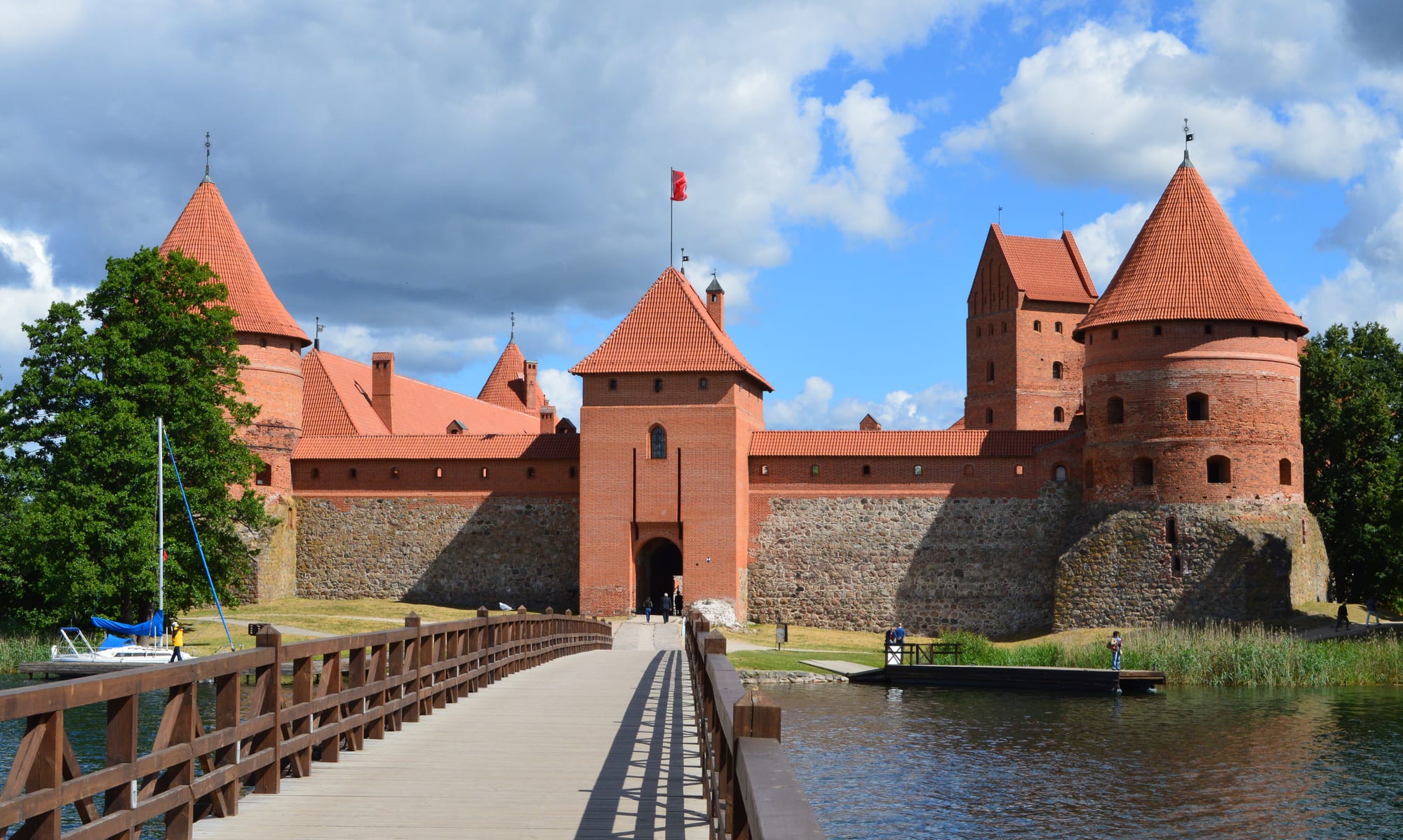
A wooden footbridge over a lake leading to a red-brick castle gate between round towers with conical tiled roofs

Vilnius, Kaunas & Eastern Lithuania, Lithuania

Trakai

The footbridge to Trakai Island Castle on Lake Galvė. (Scotch Mist / Wikimedia Commons · CC BY-SA 4.0)

A small lake town 28 kilometres west of Vilnius, built by the Grand Dukes as a seat of power — its red-brick castle stands on an island in Lake Galvė. Karaim settlers brought from the Crimea around 1400 still give the town its own identity and its kibinai pastries, and the lakes and castles now draw visitors from the capital.

Neighbourhoods

  • Karaimų Street and the old town
    • Historic district
    • Best for food
    • First-time visitors

    The long main street running through the town between the lakes, with the kenesa, the Karaim prayer house, at No. 30. The walk to the castle footbridge starts here.

    Open in Maps
  • The castle shore
    • Lake views
    • Boat trips

    The lakeshore of the town facing Lake Galvė and its 21 islands, where footbridges lead out to the Island Castle and boat-hire operators line the shore.

    Open in Maps
  • Užutrakis
    • Quiet and green
    • Parkland

    The peninsula across Lake Galvė from the castle, between Galvė and Lake Skaistis, where the Tyszkiewicz family built their manor and park around 1900.

    Open in Maps

Things to do

Castles and history

  • Trakai Island Castlelandmark

    The red-brick castle on an island in Lake Galvė, begun by Kęstutis in the 14th century and completed around 1409 by Vytautas the Great, who died there in 1430; rebuilt in the 1950s–60s, it holds the town's history museum.

    Open in Maps
  • Trakai Peninsula Castlelandmark

    The ruined walls and towers of Kęstutis's earlier castle of about 1350–1377, between Lake Galvė and Lake Luka, destroyed in the 17th century; its grounds were granted to a Dominican cloister in 1678.

    Open in Maps
  • Trakai Kenesalandmark

    The wooden Karaim prayer house on Karaimų Street, completed around 1800, a rare surviving kenesa of the old Commonwealth.

    Open in Maps
  • Senieji Trakai Castlelandmark

    In Old Trakai, about 4.5 kilometres away, the site of Gediminas's first brick castle and birthplace of Vytautas in 1350, destroyed by the Teutonic Order in 1391.

    Open in Maps

Lakes and parkland

  • Lake Galvėpark

    A lake of about 361 hectares with 21 islands, many tied to legends of tragic love; boats can be hired along the shore facing the castle.

    Open in Maps
  • Užutrakis Manorlandmark

    The late 19th-century manor and park of the Tyszkiewicz family on the far shore of Lake Galvė, one of the most valued manor houses in Lithuania.

    Open in Maps
  • Trakai Historical National Parkpark

    Founded in 1991 to protect the town and the forests, lakes and villages around it, described as the only historical national park in Europe.

    Open in Maps

Short trips from the town

  • Vilnius Old Townneighborhood

    The capital's UNESCO-listed Baroque old town, about 28 kilometres east by train or bus.

    Open in Maps

Seasonal events

  • Summer concerts at the Island Castlesummer

    Festivals and concerts are held in the island castle in the summer months.

Eat and drink

Long-standing places and food districts in Trakai. Hours, ratings and directions come from your maps app, always current.

Trakai classics

  • Kibinai cafés on Karaimų Streetneighborhood

    Cafés along Karaimų Street sell kibinai, the Karaim mutton-and-onion pastries that became the town's speciality.

    Open in Maps
  • Kibinenecafe

    A café for Karaim food on Vytauto Street, known for its kibinai.

    Open in Maps

Experience Trakai

History

The name Trakai, from the Lithuanian word for a glade, was first recorded by the Teutonic Knights in 1337. The town began at Senieji Trakai, Old Trakai, where Grand Duke Gediminas built a brick castle before moving his capital to Vilnius. His son Kęstutis inherited it and moved the town to its present site between the lakes, building the peninsula castle and beginning the island castle. Kęstutis's son Vytautas the Great, born at Old Trakai in 1350, finished the island castle around 1409, granted the town Magdeburg rights that year — among the first in Lithuania — and spent more time here than in Vilnius. He died in the island castle in 1430.

Vytautas resettled Karaim from the Crimea in 1397 and 1398 after a campaign against the Golden Horde, and Tatars came too. Christian and Karaim communities each had their own self-government. After the Union of Lublin in 1569 the town slowly declined as political life moved elsewhere. The Karaim suffered heavily in 1648, were reduced to three families by war, famine and plague early in the 18th century, and then recovered to about 300 by 1765. The peninsula castle was destroyed in the Russo-Polish War of 1654–1667 and never rebuilt.

In the 20th century Trakai passed between Polish, Soviet and German rule; in 1944 the Polish Home Army and Soviet partisans drove the Germans out, and after the war many Poles left. The island castle was rebuilt in the 1950s and 1960s on Lithuanian initiative, despite resistance from the Soviet authorities, and its history museum was established in 1962.

Culture & Customs

Trakai's identity is bound up with the Karaim, a small Turkic-speaking people of Judaic faith whose kenesa, completed around 1800, stands on Karaimų Street. Their language, Karaim, is now spoken by only a few dozen people, and the Trakai dialect is critically endangered, though official support and the interest of visitors give it a chance of survival. Many Karaim do not regard themselves as Jews, and their story — from the Crimea to the island castle, where they are presented as its ancient defenders — is a large part of the town's appeal.

The town has always been mixed. Lithuanians, Poles and Russians live alongside the Karaim, Lipka Tatars, Litvak Jews and Russian Old Believers. In the 2021 census about two-thirds of residents were Lithuanian and nearly a fifth Polish.

The castle stands for the golden age of Vytautas, who made the town the capital in 1409, and in summer it becomes a stage for festivals and concerts. Lake Galvė and the other lakes around the town carry their own legends, most of them tragic love stories.

Daily Life

About 5,400 people lived in Trakai at the 2021 census: roughly 68 per cent Lithuanians, 19 per cent Poles and 7 per cent Russians, with small Belarusian, Karaim and Tatar communities. It is the administrative centre of Trakai District Municipality, and its closeness to Vilnius — only 7 kilometres from the capital's city limits — makes it a popular tourist destination and shapes its economy.

On summer weekends the town fills with day visitors walking from the bus station to the castle, hiring boats on Lake Galvė and stopping at the kibinai cafés. On weekdays and in winter it returns to the pace of a small lake town. A new bus station opened in 2022, with a supermarket in its complex, and trains from Vilnius terminate at a simple platform on the south edge of town.

The town lies within Trakai Historical National Park, founded in 1991 to protect it together with the surrounding forests, lakes and villages, and the lakes around it — Galvė, Luka, Totoriškės, Akmena and Gilušis — set the shape of its streets.

Food

Kibinai are the town's signature: pastries filled with mutton and onion, brought by the Karaim from the Crimea and now so tied to Trakai that tourist guides mention them as the local speciality. English-language travel guides compare them to Cornish pasties. They are sold in cafés along Karaimų Street and elsewhere in the town, and the tradition is one of the clearest ways the Karaim heritage reaches visitors.

The rest of the menu is Lithuanian. Cepelinai, large dumplings of grated potato stuffed with meat, curd cheese or mushrooms and served with a sour cream sauce and bacon bits, are the national dish, and in summer šaltibarščiai, the pink cold soup of beetroot and kefir, is everywhere. Kugelis, a baked potato pudding, and šakotis, the spit-baked "tree cake", appear too.

Lithuanian cooking draws on what the land provides — barley, potatoes, rye, beets, mushrooms and berries, with dairy products as a speciality — and the forests and lakes around Trakai are part of that larder.

Planning tools

Budget

Trakai is cheap to reach from Vilnius and most visitors come for the day. The castle charges for entry, while the town, the lakeshore and the peninsula castle grounds cost little. Lakeside rooms and cafés fill up and cost more on summer weekends.

Daily Budget Midrange
USD 100–190 (lakeside guesthouse, restaurant meals, castle tickets, boat hire)
Daily Budget Shoestring
USD 45–80 (guesthouse, kibinai and café meals, the train or bus from Vilnius)

Visit on a weekday or early in the day in summer to avoid the biggest crowds at the castle.

Best Time to Visit

May to September, when the lakes are open for boating, concerts are held at the castle and the town's cafés spill outside. Winter brings frozen lakes and a quiet, snowy town, with short days.

Suggested Number of Days

Most visitors come for a day from Vilnius. Staying overnight allows time on the lakes, the manor across the water and Old Trakai, and an evening when the day crowds have gone.

First Visit
1 day
With Surroundings
2 days

Transportation

The town is small enough to cross on foot. Buses from Vilnius arrive at a bus station opened in 2022, and trains run from Vilnius in about 35 minutes to a simple station on the south edge of town. Boats can be hired on Lake Galvė.

Check the last train back to Vilnius, which leaves in the evening; buses run more often through the day.

Airport & Station Connections

Trakai is 28 kilometres west of Vilnius. Trains take about 35 minutes and stop in Old Trakai on the way, and buses run at least hourly. Vilnius Čiurlionis International Airport is the nearest airport.

Walkability

The whole town lies along one long street between the lakes, so everything can be reached on foot; the railway station is on the south edge of town, a little farther from the castle than the bus station.

Safety

Lithuania is a very safe country with low levels of violent crime. In Trakai the main risks are on the water: lake swimming, and thin ice in winter.

Swim only at recognised places and never walk on lake ice unless it is known to be safe. Check current official travel advice before travelling.

Climate

A cool, fairly continental climate with warm summers and cold, often snowy winters, when the lakes freeze.

Summer
in nearby Vilnius, July averages about 19°C, with periodic heat waves above 30°C
Winter
in nearby Vilnius, January averages about -4°C, and snow is common

Local Customs

Trakai has long been home to several communities — Lithuanians, Poles, Russians, Karaim, Tatars and Old Believers. The kenesa is a place of worship for the small Karaim community, and churches are places of active Catholic worship.

Dress modestly and keep voices down in churches and the kenesa, and ask before photographing people outside their homes.

Common Payment Methods

The currency is the euro. Cards and contactless payment are widely accepted, and a little cash is useful for boat hire and small cafés.