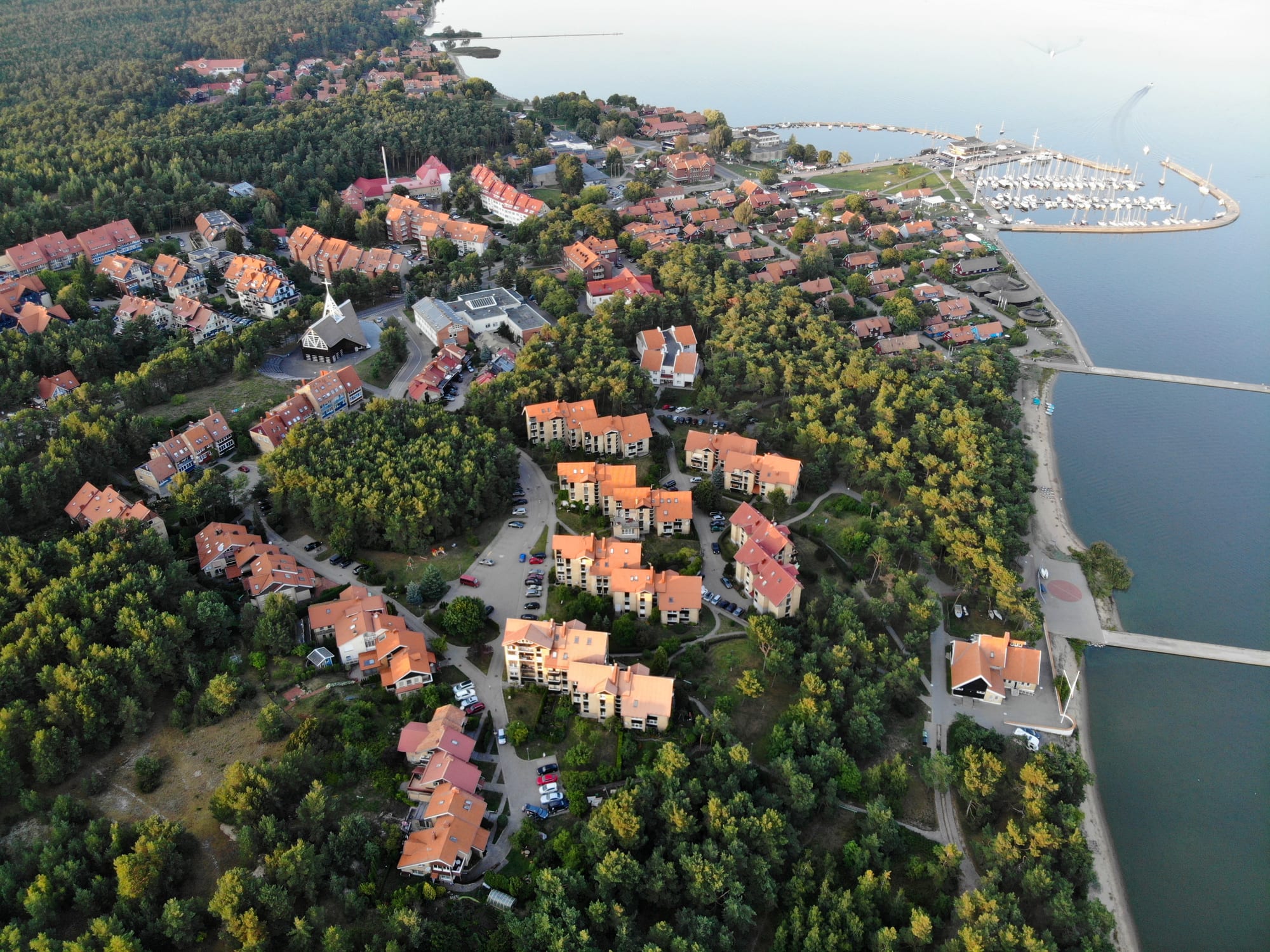
Aerial view of Nida's red-roofed houses among pine forest beside the calm Curonian Lagoon, with a marina and piers

Klaipėda & Western Lithuania, Lithuania

Nida

Nida and its marina on the Curonian Lagoon, seen from above. (LinasD / Wikimedia Commons · CC BY-SA 4.0)

A resort village of about 1,500 people near the southern end of the Lithuanian Curonian Spit, between the lagoon and the Baltic and close to the Russian border. Moved in the 1730s to escape drifting sand, it became an artists' colony and Thomas Mann's summer home, then a closed Soviet resort, and now fills each summer below the bare Parnidis dune.

Neighbourhoods

  • The harbour and village centre
    • First-time visitors
    • Best for food
    • Close to public transport

    The lagoon side of Nida around the old ferry pier and the port, where the bus from Smiltynė ends. Most of the restaurants and smoked-fish places, the amber gallery, the fisherman's homestead and the bicycle hire kiosks are within a few minutes' walk, with the Mann house on a hill above the lagoon.

    Open in Maps
  • The Baltic beach
    • Beaches
    • Families

    On the far side of the forested dune ridge, a long sandy Blue Flag beach on the open sea, with a few beach bars. Parts of the shore near Nida are used for nude bathing.

    Open in Maps
  • Preila and Pervalka
    • Quiet and residential
    • Nature

    Two small settlements on lagoon bays to the north. Preila sits about 6 km north of Nida among dunes that include Vecekrugas, the spit's highest, and Pervalka, about 5 km beyond it, has 19th- and 20th-century cottages, a marina and a cycle path to Nida.

    Open in Maps

Things to do

Dunes and nature

  • Parnidis Duneviewpoint

    A drifting, almost bare dune south-east of the village, 52 metres high, with an observation deck and a large sundial restored after a Baltic gale damaged it.

    Open in Maps
  • Grobštas Nature Reservepark

    An expanse of open dunes reaching towards the Russian border, including the Sklandytojų and Parnidis dunes and the hollow called Death Valley between them.

    Open in Maps
  • Nida beachbeach

    The village's Baltic beach, a Blue Flag beach backed by dunes and pine forest.

    Open in Maps
  • Curonian Spit National Parkpark

    The national park, set up in 1991, that protects the dunes, forests and lagoon shore of the Lithuanian side of the spit, which is also a UNESCO World Heritage Site.

    Open in Maps

Village sights and museums

  • Nida Lighthouselandmark

    The lighthouse on Urbas hill, first built in 1874, destroyed in the war and rebuilt in 1945 and 1953, now run by the local history museum.

    Open in Maps
  • Thomas Mann Culture Centremuseum

    The summer house that Thomas Mann built above the lagoon and used in 1930–32, restored in 1995–96 as a memorial museum and cultural centre.

    Open in Maps
  • Fisherman's Ethnographic Homesteadmuseum

    A fisherman's house of 1927 by the pier, restored in 1973 to show how spit families lived.

    Open in Maps
  • Evangelical Lutheran churchlandmark

    A red-brick Brick Gothic church of 1888 from the German period, with a wooden interior and an old graveyard.

    Open in Maps
  • Curonian Spit History Museummuseum

    A museum in the village on the local history of the people of the spit.

    Open in Maps
  • Amber gallery-museummuseum

    An exhibition in the village on Baltic amber, with some pieces for sale.

    Open in Maps

Short trips along the spit

  • Vecekrugas Duneviewpoint

    The highest dune on the spit at about 67 metres, forested with mountain pines and topped by an observation deck, south of Preila.

    Open in Maps
  • Grey Dunestrail

    Dunes near Pervalka almost 60 metres high, held in place by lichen and a thin layer of soil, crossed by a boardwalk.

    Open in Maps
  • Juodkrantėattraction

    The second-largest settlement on the Lithuanian spit, a former fishing village that became a resort in the late 19th century.

    Open in Maps
  • Hill of Witchestrail

    An outdoor gallery near Juodkrantė of about 80 wooden sculptures of characters from Lithuanian folklore, along a series of trails.

    Open in Maps

Seasonal events

  • Thomas Mann FestivalJuly

    A literary festival lasting about a week, organised each summer by the Thomas Mann Culture Centre.

  • Nida Jazz Festivallate July

    A jazz festival held every year since 2001.

Eat and drink

Long-standing places and food districts in Nida. Hours, ratings and directions come from your maps app, always current.

Nida classics

  • Smoked fish by the harbourneighborhood

    Fish is what Nida serves: smoke-dried eel and bream, sold at the places clustered around the ferry pier.

    Open in Maps
  • Restaurants around the ferry pierneighborhood

    About a dozen restaurants, cafés and bars stand close together by the old pier, the centre of the village's summer evenings.

    Open in Maps

Experience Nida

History

The Curonians, a Baltic people, had a settlement called nida here when the Teutonic Knights first recorded it in 1385. The original village stood on the road along the spit from Königsberg to Memel, about 5 km south of today's site near the High Dune at Cape Grobštas. It passed with the region to Ducal Prussia, lost nearly all its people to plague in 1709, and in the 1730s, threatened by drifting sand, moved north to its present position. In the 19th century the dunes that had buried villages were fixed by planting forest, and a lighthouse was built on Urbas hill in 1874. By 1878 Nida had 655 people, the largest village on the spit, living mostly from fish sold in Klaipėda and other coastal towns.

From the late 19th century the dunes drew painters from the Königsberg art academy. Herman Blode's inn became the centre of an expressionist artists' colony visited by Lovis Corinth, Max Pechstein, Karl Schmidt-Rottluff and others. Nida passed to Lithuania with the Klaipėda Region in 1923 but stayed mostly German, and in 1929 Thomas Mann built a summer house above the lagoon, where he spent the summers of 1930–32 and wrote part of Joseph and His Brothers. After Germany retook the region in 1939 the house was seized at Hermann Göring's order for Luftwaffe officers.

The war and the flight and expulsion of the German population left the spit almost empty. Under Soviet rule Nida became a little-visited fishing village and later a controlled-entry resort reserved for party officials, which kept its old buildings largely intact. Since 1990 it has been open to all, tourism has flourished, and Mann's cottage was restored in 1995–96 as a cultural centre.

Culture & Customs

The artists' colony set the tone for what Nida became: a place people come to for the light, the sand and the quiet. The Thomas Mann Culture Centre keeps the writer's house as a memorial and holds an annual festival, and the Nida Jazz Festival has run every year since 2001. Holidays here are low-key and family-centred, though in recent years the village has also become known for electronic music and modern art events at a forest retreat.

Local heritage is Curonian and Prussian. The Nidden Kurenwimpel, or Curonian pennants, are ornate carved flags once particular to local families, with animal and human figures that recall a pagan pictographic tradition; replicas stand around the village. In the cemetery, krikštai, pagan-style wooden burial markers, still stand in place of tombstones, and the red-brick Lutheran church of 1888 recalls the time when services were held in both Lithuanian and German.

Visitors are mostly Lithuanians, Germans, Latvians and Russians — between 200,000 and 300,000 each summer, many times the population. Because the spit is a national park and a UNESCO World Heritage Site, building and behaviour are closely regulated to protect the dunes and the look of the village, and residents are protective of both.

Daily Life

About 1,500 people live in Nida all year. It is the administrative centre of Neringa, the municipality that covers most of the Lithuanian part of the spit. Life revolves around the lagoon side, where the houses, the port, the shops and the pier are sheltered from the sea winds by the forested dune ridge.

Tourism is the economy. In summer the village fills with holidaymakers, the restaurants and bicycle hire kiosks around the pier stay busy into the evening, and boats leave the marina for the lagoon; the port also serves fishing boats. Out of season the population shrinks back to the permanent residents, buses are fewer, and many places close. A local radio station, Neringa FM, broadcasts on air and online.

The single road along the spit, linking Smiltynė with Zelenogradsk in Russia, passes the edge of the village, and an hourly bus connects Nida with the ferry at Smiltynė. Nida's small airfield takes only light aircraft. The closeness of the border, and the protection rules of the park, shape what can be built and where people may go.

Food

In Nida, the food is fish. Smoked eel and bream are the classic starters across the Baltic coast and especially on the Curonian Spit, and the places around the ferry pier serve them smoke-dried, alongside other fish from the lagoon and the sea. The cooking of Lithuania Minor, the old Prussian borderland the village belonged to, was known for freshwater fish that was smoked, salted, roasted and dried, and for the country's best-known fish soup.

Herring is eaten marinated, baked, fried or in aspic, and crayfish are a summer delicacy served with beer. Bars offer kepta duona — black bread fried in oil and rubbed with garlic — and piršteliai prie alaus, thin rolled puff pastries, as beer snacks. Lithuanian beer, alus, is the everyday drink.

Restaurants also serve the national dishes found across Lithuania, such as cepelinai, potato dumplings stuffed with meat, mushrooms or cheese and often served with sour cream, and the pink cold beetroot soup šaltibarščiai in summer. About a dozen places to eat are clustered around the pier, with pizza and beach bars on the sea side of the spit.

Planning tools

Budget

Nida is one of the more expensive places on the Lithuanian coast in July and August, when rooms are scarce and fill months ahead. June and September cost less. Food is moderate, and a bicycle is the cheapest way to get around. Cars and motorbikes entering Neringa pay an environmental fee, and the car ferry from Klaipėda adds to the cost of driving.

Daily Budget Midrange
USD 110–210 (guesthouse or apartment, restaurant dinners, museum tickets, bicycle hire)
Daily Budget Shoestring
USD 50–85 (campsite or simple guesthouse room, smoked fish and cafés, bus and bicycle)

Book July and August stays well ahead, or visit in June or September.

Best Time to Visit

June to early September for the beach, the lagoon and cycling along the spit; July and August are the busiest weeks, with the Mann and jazz festivals. Late spring and September are quieter. Out of season Nida is very quiet, with fewer buses and many places closed, but the dunes can be walked all year.

Suggested Number of Days

Two or three days suit a first stay in the village. Allow four or five to cycle or ride the bus along the rest of the spit as well. Summer beach holidays often run to a week, and visits from Klaipėda as a long day out are common.

First Visit
2–3 days
With Surroundings
4–5 days

Transportation

Most of Nida is within walking distance, and bicycles can be hired from kiosks by the pier and in the village. A cycle track runs about 30 km north to Juodkrantė past the high dunes, and the bus from Smiltynė stops at Juodkrantė and, on request, at the smaller villages. Sailing, kayaking and paddle-boarding happen on the sheltered lagoon.

Carry water and wind protection on the dune walks and stay on the boardwalks and marked paths.

Airport & Station Connections

Nida is reached through Klaipėda: a short ferry crosses to Smiltynė, and a bus that carries bicycles runs down the spit to Nida in about an hour; drivers take the car ferry and follow the only road along the spit. In summer direct buses also run from Vilnius and Kaunas. The nearest airport with scheduled flights is Palanga, north of Klaipėda; Nida's own airfield has no scheduled routes.

Walkability

The village is small, and the harbour, museums, lighthouse and Mann house are a short walk apart, though some sit on wooded hills. The Baltic beach lies across the forested ridge, and the Parnidis dune is a longer walk south; sandy paths and steps make some routes harder going.

Safety

Lithuania is a very safe country with low levels of violent crime. Nida lies a few kilometres from the border with Russia's Kaliningrad region, which runs across the spit to the south. The other risks are natural: cold water and currents on the Baltic, wind on the dunes and fire in the dry pine forests.

Keep well away from the Kaliningrad border on land and in the water, swim at supervised beaches and stay on marked paths on the protected dunes. Check current official travel advice before travelling.

Climate

A cool coastal climate, close to oceanic, with south-westerly and north-westerly winds; the villages sit on the lagoon side, sheltered from the sea winds by the forested dunes. Summers are mild and winters cold but softer than inland Lithuania.

Summer
mild — across Neringa, August is the warmest month, averaging about 17°C
Winter
cold — in nearby Klaipėda, January and February highs average about 1°C and lows about -5°C

Local Customs

Tipping is not deeply ingrained in Lithuania but is appreciated. Nida's heritage is Curonian and Prussian: the carved Curonian pennants, replicas of which stand around the village, were once particular to local families, and the old graveyard keeps its wooden krikštai. The spit is protected, with rules to preserve the dunes and the village architecture.

Shops cannot sell alcohol between 20:00 (15:00 on Sundays) and 10:00, and drinking in public places is illegal.

Common Payment Methods

The currency is the euro. Cards and contactless payment are widely accepted in the village, and there is a supermarket near the pier. Some smoked-fish stalls and small seasonal places may prefer cash, so a little is useful.