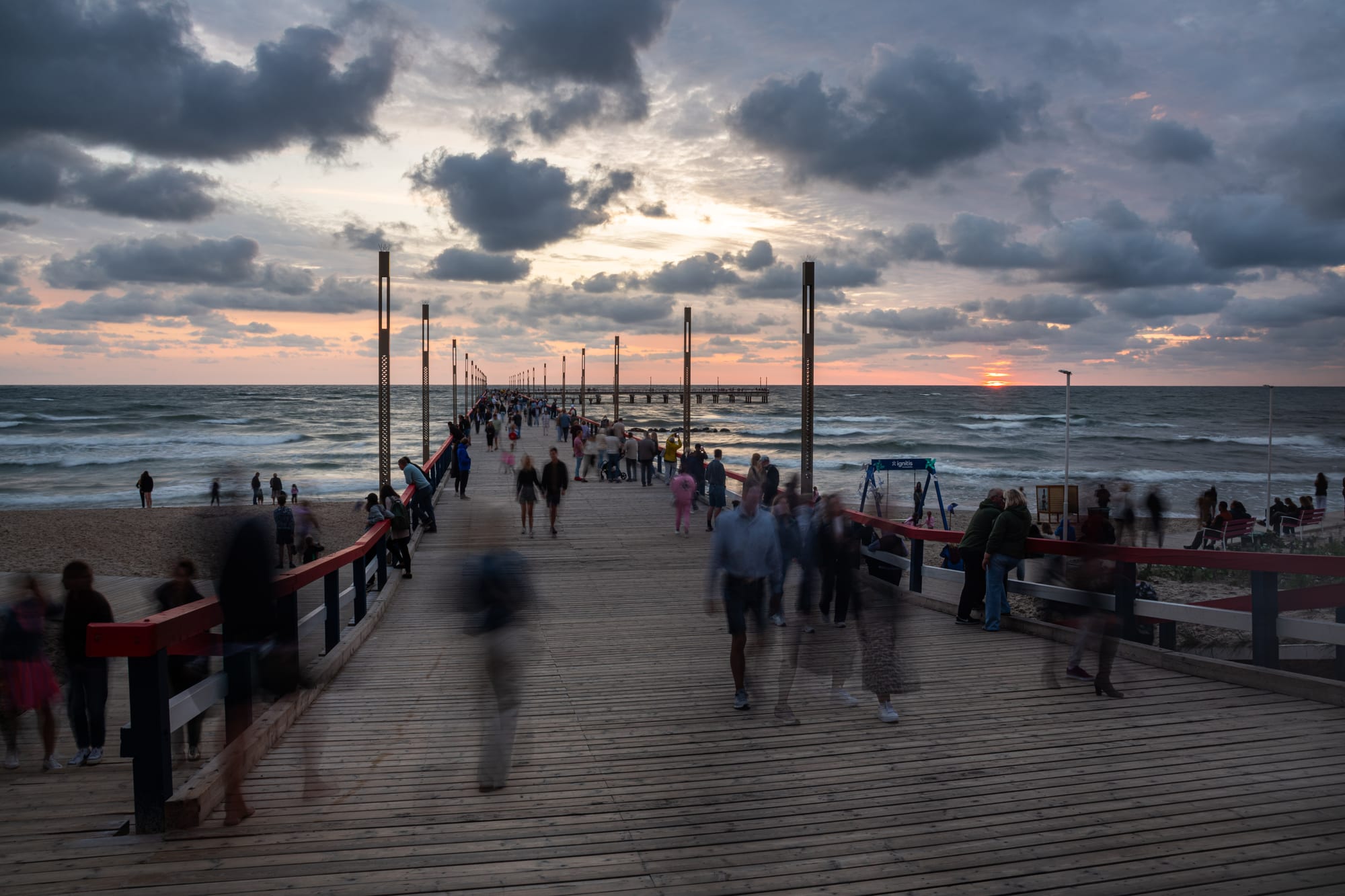
The long wooden Palanga Pier stretching into a choppy Baltic Sea at sunset, with walkers on the boards under heavy clouds

Klaipėda & Western Lithuania, Lithuania

Palanga

Palanga Pier on the Baltic at sunset. (Michael Kuhn / Wikimedia Commons · CC BY 4.0)

Lithuania's largest and busiest summer resort, on the Baltic about 25 km north of Klaipėda, with 18 km of sandy beach backed by dunes and pine woods. A Curonian settlement on the old Amber Road, it grew into a resort under the Tyszkiewicz counts, whose pier, palace and park — now the Amber Museum and botanical garden — still define the town.

Neighbourhoods

  • Central Palanga and Basanavičiaus street
    • First-time visitors
    • Nightlife
    • Beaches

    The heart of the resort, along the pedestrian street named after Jonas Basanavičius that runs almost a kilometre from Vytauto street to the pier. In summer it is lined with restaurants, bars, rides and souvenir stalls and gets very crowded in the evening; the beach and the pier lie at its end.

    Open in Maps
  • The botanical park and the south
    • Museums
    • Parks
    • Quiet and residential

    The southern part of town around the Tiškevičiai Palace, its large landscaped park and Birutė Hill, with older villas and quieter beaches further south towards Nemirseta.

    Open in Maps
  • Šventoji
    • Beaches
    • Families
    • Quiet and residential

    A separate small resort about 12 km north of the centre, near the Latvian border, administratively part of Palanga. Once a trading harbour, it is a smaller, quieter alternative for a beach stay.

    Open in Maps

Things to do

Landmarks and the seafront

  • Palanga Pierlandmark

    A wooden pier about 470 metres long, built in 1882 for shipping bricks and used only by walkers since 1892; it is the town's favourite place to watch the sunset.

    Open in Maps
  • Basanavičiaus streetneighborhood

    The pedestrian spine of the resort, with restaurants, bars, funfairs and a 40-metre observation wheel, busy late into summer nights.

    Open in Maps
  • Palanga beachbeach

    Sand stretching for many kilometres either side of the pier, up to 300 metres wide and backed by dunes; the central strip is crowded in high summer and quieter further away.

    Open in Maps
  • Church of the Assumption of the Blessed Virgin Marylandmark

    The town's sturdy red-brick Roman Catholic church on Vytauto street.

    Open in Maps
  • Villa Anapilislandmark

    A villa built in 1898 and restored to its interwar appearance, named after the mountain of the afterlife in Lithuanian pagan mythology.

    Open in Maps

Museums and parks

  • Palanga Amber Museummuseum

    A branch of the Lithuanian National Museum of Art in the Tiškevičiai Palace, with about 28,000 pieces of amber, some 15,000 of them holding inclusions such as insects.

    Open in Maps
  • Palanga Botanical Parkpark

    The large park around the palace, designed by Édouard André and a botanical garden since 1960, with ponds, fountains and about two hundred kinds of trees and shrubs.

    Open in Maps
  • Birutė Hillviewpoint

    A forested dune in the park with a 19th-century chapel, where legend places the shrine of the priestess Birutė and excavations found prehistoric settlement.

    Open in Maps
  • Palanga Resort Museummuseum

    The history of the town, shown in an old villa.

    Open in Maps
  • Antanas Mončys House-Museummuseum

    Sculpture by the sculptor and painter Antanas Mončys, opened in 1999, with changing exhibitions of other artists' work.

    Open in Maps
  • Sculpture Gardenpark

    Twenty-eight contemporary statues by artists from Armenia, Estonia, Latvia, Lithuania and Ukraine.

    Open in Maps
  • Anaičiai Ethnographic Cemeteryattraction

    A collection of 19th- and early 20th-century graves preserved as part of local heritage.

    Open in Maps

Short trips from the town

  • Nemirsetaattraction

    The southern district of Palanga, whose old inn and customs house marked for about five centuries the northernmost point of Prussia.

    Open in Maps
  • Kretingaattraction

    The district town 12 km east, the nearest railway station to Palanga.

    Open in Maps
  • Klaipėdaattraction

    Lithuania's port city to the south, with a timber-framed old town and the ferry to the Curonian Spit.

    Open in Maps
  • Seaside Regional Parkpark

    A protected stretch of coast between Palanga and Klaipėda, with forest, dunes and the Dutchman's Cap bluff above the sea.

    Open in Maps

Seasonal events

  • Palanga SealsFebruary

    A mass winter swim in the icy Baltic, while those on shore eat fish.

  • Jurginės folklore festivalspring

    A folklore festival held each spring since 1990 to mark the awakening of nature.

  • Opening of the summer seasonstart of summer

    The town's biggest celebration, marking the start of the resort season.

  • Aurum 1006 kmJuly

    A motor race in several categories held over three days.

Eat and drink

Long-standing places and food districts in Palanga. Hours, ratings and directions come from your maps app, always current.

Food streets

  • Basanavičiaus streetneighborhood

    The main pedestrian street is lined with cheap and cheerful places to eat and drink all the way to the pier.

    Open in Maps
  • Lithuanian and Samogitian dishesrestaurant

    Restaurants across the resort serve cepelinai, cold beetroot soup in summer, smoked fish and herring, with fried garlic bread as a beer snack.

    Open in Maps

Experience Palanga

History

People lived near Šventoji some 5,000 years ago, and between the 10th and 13th centuries Palanga was a main settlement of the Curonians' Mēguva Land, a centre of trade and crafts on the old Amber Road. It first appears in writing in 1161, when King Valdemar I of Denmark landed and took the Curonian castle. The Treaty of Melno gave it to the Grand Duchy of Lithuania in 1422. Legend says the priestess Birutė tended a sacred fire on the hill that bears her name before Grand Duke Kęstutis carried her off as his wife.

Palanga passed to the Russian Empire in 1795, and in 1824 Count Michał Tyszkiewicz bought the manor. His grandson built a pier in 1882 to ship bricks and passengers, and his great-grandson Feliks commissioned the neo-Renaissance palace, completed in 1897 to designs by Franz Schwechten, in a park laid out by Édouard André. The town became a resort, and after the 1864 ban on Lithuanian printing it was an important route for smuggled books.

Palanga belonged briefly to Latvia after the First World War and passed to Lithuania in 1921 in an exchange of territory that gave the country a coastline. Before the Second World War nearly half its people were Jewish, and the amber craft for which the town is known was largely a Jewish trade. After German forces arrived in June 1941, the Jewish men were shot outside the town and the women and children murdered a month later. In the Soviet period the park became a botanical garden in 1960 and the palace the Amber Museum.

Culture & Customs

Palanga is where Lithuanians go to the seaside, and its culture is that of a summer resort. Basanavičiaus street becomes a pedestrian carnival of restaurants, bars and rides in high season; evening walks end on the pier for the sunset; and concerts are held on summer evenings, including at the palace, which has been a gathering place for music since the Tyszkiewicz era. The town marks the opening of the season as its biggest celebration, and festivals of folklore, children's song, classical music and dance run through the year.

The Tyszkiewicz legacy is everywhere — the pier, the palace, the park and its old oak planted by President Antanas Smetona. So is amber: the museum holds about 28,000 pieces, and amber jewellery is sold all along the main street. The town takes pride in its place in Lithuanian history, from Birutė's legend and the chapel on her hill to the smuggling of banned books and the first public performance of a play in Lithuanian, the comedy America in the Bathhouse.

Palanga lies in Samogitia, and its name is probably Curonian, linked to marshy lowlands. The Jewish community that once made up half the town is remembered by a memorial stone in the botanical park.

Daily Life

About 18,500 people lived in Palanga at the start of 2025. The city municipality takes in Šventoji, Nemirseta, Būtingė, the airport and other former fishing villages, stretching 24 km along the coast from Nemirseta to the Latvian border. In summer the population is many times that.

Tourism is the economy. Palanga is officially a climatic, balneological and mud therapy resort, valued for its sea air, its sunny summers and its mineral waters. Restaurants, bars, rides and shops depend on a short, intense season, and almost all the visitors are Lithuanian. One of the oldest working pharmacies in the country, founded in the mid-19th century, still serves the town.

The year has two speeds. From June to August the streets are full late into the night and the beaches are crowded; in winter Palanga is quiet and windy. The town has gymnasium and art schools, and Kretinga, 12 km inland, has the nearest railway station.

Food

Palanga's food is the food of a Samogitian seaside town. Samogitia is known for its many porridges, crayfish, kastinys — a sour cream spread registered as a traditional speciality — and cibulinė, a herring and onion soup. Along the Baltic, smoked eel and bream are common starters, and herring is eaten marinated, baked, fried or in aspic. Crayfish are a summer delicacy served with beer.

The resort's restaurants also serve the national dishes found across Lithuania: cepelinai, potato dumplings stuffed with meat, mushrooms or cheese and often served with sour cream, and šaltibarščiai, the pink cold soup of beetroot and kefir eaten in summer with hot boiled potatoes. Sour cream comes with almost everything, from soups to pancakes.

Basanavičiaus street is lined with cheap and cheerful places to eat, and beer is the main drink. Bar snacks include kepta duona, black bread fried in oil and rubbed with garlic, and piršteliai prie alaus, thin rolled puff pastries served with beer. Amber shops and food stalls share the street, which stays busy until late in summer.

Planning tools

Budget

Prices peak in July and August, when Palanga is full of holidaymakers and rooms must be booked well ahead. June and September are cheaper and calmer. Food on Basanavičiaus street is mostly inexpensive, and the beach, the pier and the botanical park cost nothing.

Daily Budget Midrange
USD 100–210 (resort hotel, restaurant dinners, the Amber Museum, bicycle hire)
Daily Budget Shoestring
USD 45–80 (simple guesthouse, cafés and street food, buses and a bicycle)

Book months ahead for July and August, or come in June or September.

Best Time to Visit

June to August for the beach and the full resort season, with July and August the busiest; the warm months bring more sunny days than elsewhere in Lithuania. September is quieter. Out of season Palanga is calm, windy and much emptier, apart from the February sea swim.

Suggested Number of Days

A day or two covers the town itself. Allow three to five days to add the rest of the coast to the north and south. Summer beach holidays here often last a week or more.

First Visit
1–2 days
With Surroundings
3–5 days

Transportation

The centre is easy on foot, with many pedestrian streets and paths, and a bicycle is more useful than a car; bikes of many kinds can be hired. Buses link the town with the airport, Šventoji and Klaipėda, taxis can be ordered by phone, and ride-hailing apps operate. There is no railway in the municipality.

Use a bicycle for the quieter beaches away from the centre, and order taxis by phone or app.

Airport & Station Connections

Palanga International Airport, between Palanga and Šventoji, is about 7 km from southern Palanga along the A13 and has seasonal flights to Scandinavia, Britain, Ireland and other European cities. Buses run to Klaipėda, about 25 km south, and some long-distance buses from Vilnius and Kaunas continue there. The nearest railway station is in Kretinga.

Walkability

Central Palanga is flat and very walkable: Basanavičiaus street, the pier, the church and the botanical park are all a short walk apart. The beach runs the whole length of the town, so long seaside walks are easy; Šventoji and the airport are a bus or bicycle ride away.

Safety

Lithuania is a very safe country with low levels of violent crime. Palanga is calm, and ordinary care with belongings in the summer crowds is enough. The main natural risks are currents and cold water on the Baltic beaches.

Swim at supervised beaches, keep valuables close in the evening crowds and buy amber from established shops, as fakes are sold at small stalls. Check current official travel advice before travelling.

Climate

A maritime climate, windy and fairly wet, with mild summers and cold winters that are softer than inland. The warm months are sunnier here than in most of Lithuania.

Summer
mild — in nearby Klaipėda, July and August highs average about 22°C and lows about 13°C
Winter
cold — in nearby Klaipėda, January and February highs average about 1°C and lows about -5°C

Local Customs

Tipping is not deeply ingrained in Lithuania but is appreciated. Palanga is a domestic resort, where almost all visitors are Lithuanian, and summer here is a national tradition. The town is in Samogitia and proud of the legend of Birutė, the priestess who became a grand duchess.

Shops cannot sell alcohol between 20:00 (15:00 on Sundays) and 10:00, and drinking in public places is illegal.

Common Payment Methods

The currency is the euro. Cards and contactless payment work almost everywhere, and ATMs are easy to find in the centre. Some small stalls on Basanavičiaus street prefer cash, so a little is useful.