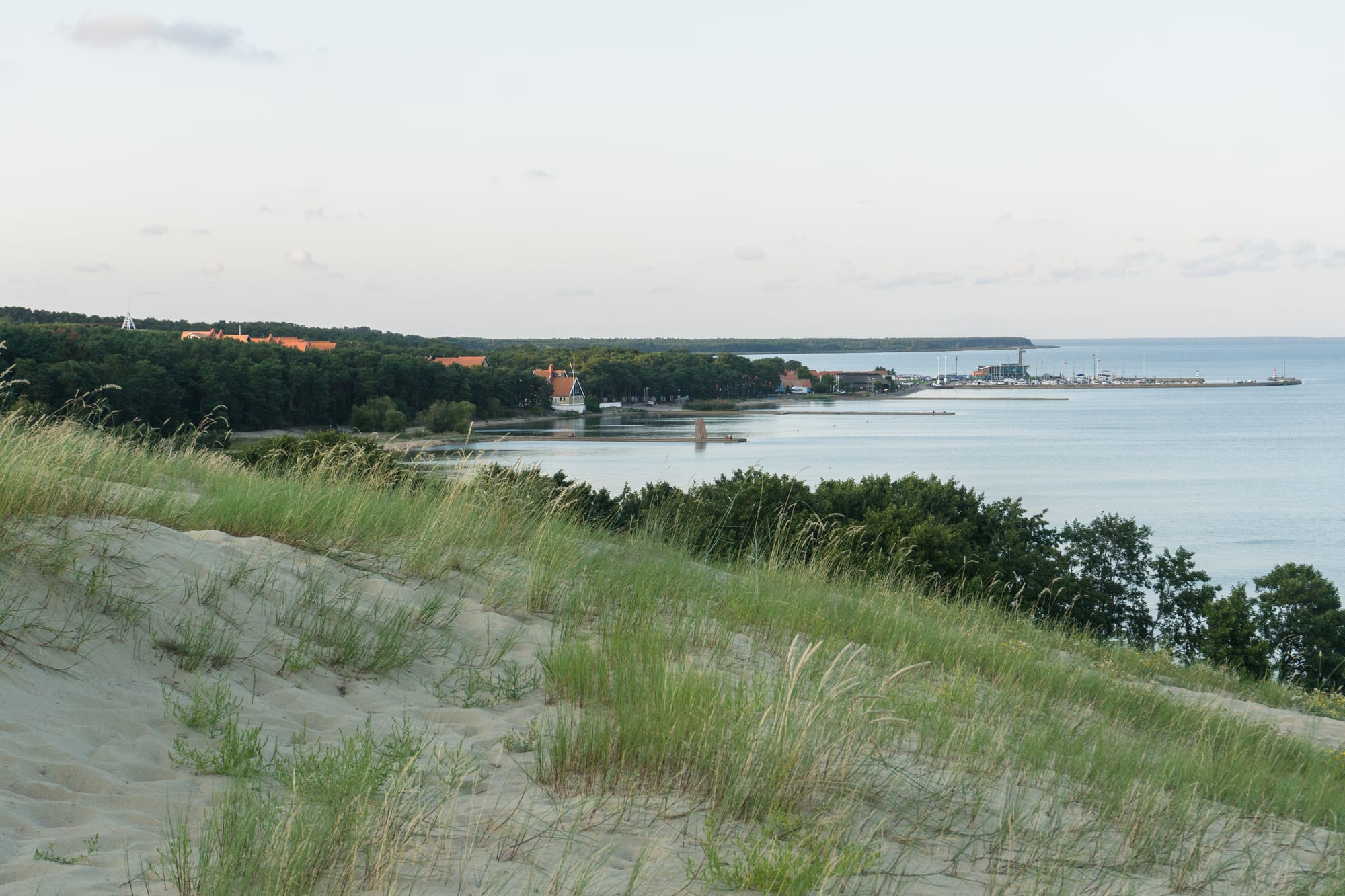
A grassy sand dune above pine woods, red roofs and a small harbour on the calm waters of a wide lagoon

Lithuania

Klaipėda & Western Lithuania

Nida and its harbour on the Curonian Lagoon, seen from the dunes of the Curonian Spit. (Alexey Komarov / Wikimedia Commons · CC BY-SA 4.0)

Lithuania's western half — the port of Klaipėda, the Curonian Spit and the resort of Palanga on the Baltic, the upland lakes of Samogitia, Šiauliai and the Hill of Crosses in the north, and the farm country of Suvalkija in the south-west — a region shaped by Prussia, the sea and a fiercely independent Samogitian identity.

Explore Klaipėda & Western Lithuania

History

The west was the land of the Curonians on the coast, the Samogitians in the uplands and the Skalvians and Sudovians further south. In 1236 the Samogitians crushed the Livonian Brothers of the Sword at the Battle of Saule, traditionally placed near Šiauliai, and they resisted the Teutonic Order for almost two centuries, becoming the last people in Europe to accept Christianity, in the early 15th century. The Order built Memelburg castle in 1252 at the mouth of the Danė, and the town of Memel, today's Klaipėda, stayed under German rule for nearly seven centuries.

Memel and the lowlands along the Nemunas formed part of Prussia, where Lithuanian-speaking Lutherans lived in what Lithuanians call Lithuania Minor. In 1923 Lithuania took the Memel Territory in a staged revolt; Nazi Germany forced its return in March 1939, and after 1945 its German population fled or was expelled and the city was resettled from across the Soviet Union. Samogitia, meanwhile, was a Catholic stronghold under the Commonwealth and the Russian Empire, and in the 19th century its bishop Motiejus Valančius led a temperance movement and a network of book smugglers who defied the tsarist ban on Lithuanian printing in the Latin alphabet.

Suvalkija, in the south-west, was a prosperous farming region that produced Vincas Kudirka, author of the national anthem. The Soviet period brought shipyards and a fishing fleet to Klaipėda, a nuclear missile base in the Samogitian forest and repeated attempts to bulldoze the Hill of Crosses.

Culture & Customs

Samogitians (Žemaičiai) have the strongest regional identity in Lithuania. Their speech, Samogitian, is so different from standard Lithuanian that it is often called a separate language, and it lives on in local songs; the region's coat of arms is a black bear. The region is devout: roadside crosses and chapels, carved saints called dievukai, and the great summer church festival at Žemaičių Kalvarija.

The coast has a different character. Klaipėda's old town, lighthouses and Protestant heritage recall Prussian Memel, and the Curonian Spit keeps fishermen's houses painted in dark reds and blues, with carved weathervanes called kurėnų vėtrungės that once identified fishing boats by village. Palanga is the traditional summer playground of Lithuanians, and Klaipėda's Sea Festival is the biggest event on the coast.

Užgavėnės, the Shrovetide carnival, is celebrated with masks, pancakes and the burning of a straw effigy. Šiauliai, a working city, dates its founding to the 1236 battle, and Suvalkiečiai, the people of Suvalkija, are the butt of Lithuanian jokes about thrift.

Daily Life

Klaipėda, with about 160,000 people, is Lithuania's third city and Šiauliai (about 110,000) its fourth. Palanga has fewer than 20,000 permanent residents but many times that in summer. Telšiai, Plungė, Mažeikiai, Tauragė, Marijampolė and Šilutė are the main regional towns, and Neringa, the municipality of the Curonian Spit, has only a few thousand people.

Klaipėda's ice-free port handles containers, oil products, grain and fertiliser and has a liquefied natural gas terminal, alongside shipbuilding, furniture and plastics. Mažeikiai has the country's only oil refinery, Šiauliai hosts the NATO air-policing base as well as food and electronics factories, and Marijampolė is known for its large used-car trade. Samogitia and Suvalkija remain farming regions, with young people leaving for the cities.

The rhythm is seasonal: quiet winters, then a summer migration to the coast when Palanga's Basanavičiaus street and the spit's cycle paths fill up. Current issues include the port's future as Belarusian transit has ended and the protection of the fragile dunes.

Food

The coast lives on fish. Smokehouses in Nida and Juodkrantė sell hot-smoked bream, vimba, eel and flounder from the lagoon and the sea, eaten on the spot with bread and beer, and Klaipėda's markets have smoked sprats and herring. Klaipėda is also the home of the Švyturys brewery, founded in the 18th century.

Samogitia has the most distinctive regional cooking. Kastinys is sour cream kneaded and washed into a soft spread, eaten with boiled potatoes; šiupinys is a hearty stew of groats, peas or beans, potatoes and meat; and žemaičių blynai are Samogitian pancakes of boiled mashed potato stuffed with minced meat and fried. Buckwheat porridge and dark rye bread complete the table.

Suvalkija's farms are known for smoked meats and fertile farmland, and the whole region eats cepelinai and kugelis as elsewhere in Lithuania. Honey, herbal teas and home-baked šakotis appear at family celebrations, and Palanga's summer promenade is lined with ice-cream and waffle stalls.

Attractions & Natural Wonders

The Curonian Spit, a UNESCO World Heritage Site shared with Russia, is the region's great natural sight: nearly 100 kilometres of sand between the Baltic and the Curonian Lagoon, of which about half is Lithuanian. Nida, near the southern end, has the Parnidis dune with its sundial, the Thomas Mann summer house and wooden fishermen's cottages; Juodkrantė has the Hill of Witches, a forest trail of carved wooden figures, and a grey heron and cormorant colony. At Smiltynė, opposite Klaipėda, are the Lithuanian Sea Museum and dolphinarium.

Klaipėda's old town has timber-framed warehouses, Theatre Square with the Ännchen von Tharau statue and the castle museum, and the sailing ship Meridianas on the Danė. Palanga, to the north, offers its long beach and pier, Birutė Park and the Amber Museum in the Tyszkiewicz palace. To the south, the Nemunas Delta Regional Park around Rusnė and the ornithological station at Ventė Cape draw birdwatchers.

Inland, Žemaitija National Park surrounds Lake Plateliai, with the Cold War Museum in the former Plokštinė missile base, and Žemaičių Kalvarija lies close by. The Hill of Crosses stands about 12 kilometres north of Šiauliai. In the south, the castles of Raudonė and Panemunė overlook the Nemunas.

Cities in Klaipėda & Western Lithuania

Planning basics

Budget

Prices are highest on the coast in July and August, when Palanga and the Curonian Spit fill with holidaymakers and accommodation in Nida is scarce and expensive. Klaipėda is moderately priced, and inland Samogitia, Šiauliai and Suvalkija are among the cheapest parts of Lithuania. Visitors driving onto the Curonian Spit pay an environmental entry fee.

Daily Budget Midrange
USD 100–210 (seaside hotel or guesthouse, restaurants, a hire car or bicycle hire)
Daily Budget Shoestring
USD 45–80 (hostel or guesthouse, cafés and smoked-fish stalls, buses and bicycles)

Book Nida and Palanga months ahead for July and August, or visit in June or September for lower prices.

Safety

The region is safe, with low crime. The Curonian Spit borders Russia's Kaliningrad region south of Nida, and the border area must not be approached. Other risks are natural: rip currents and cold water on the Baltic beaches, fire in the dry pine forests of the spit, ticks, and strong winds on the dunes.

Swim at supervised beaches, stay on marked paths on the protected dunes and keep away from the Kaliningrad border. Check current official travel advice before travelling.

Climate

The coast has the mildest winters and coolest summers in Lithuania, with strong winds and frequent rain, especially in autumn; Klaipėda is one of the wetter places in the country. Inland, the Samogitian Upland gets more rain and snow than the plains, while Šiauliai and Suvalkija have a more continental climate with colder winters.

Summer
mild, around 17–22°C on the coast, warmer inland; sea water rarely above 20°C
Winter
cool and windy on the coast, around 0 to -3°C; colder and snowier inland

Transportation

Klaipėda has ferries to Germany and Sweden and a short ferry crossing to Smiltynė on the Curonian Spit, where buses run to Juodkrantė and Nida in about an hour; a cycle path follows the spit. Palanga Airport serves the coast. Trains link Klaipėda with Šiauliai and Vilnius, and buses cover Palanga, Telšiai, Plungė, Tauragė and Marijampolė. A car suits Žemaitija National Park and the Hill of Crosses.

Cross to the Curonian Spit by the Smiltynė ferry and use a bicycle or bus; reach the Hill of Crosses by car or taxi from Šiauliai.

Best Time to Visit

June to early September for the beaches, cycling on the Curonian Spit and Palanga's summer season; July and August are the busiest. Late May, June and September are quieter and good for birdwatching at Ventė Cape during the migration. The Hill of Crosses can be visited all year, and Klaipėda holds its Sea Festival at the end of July.