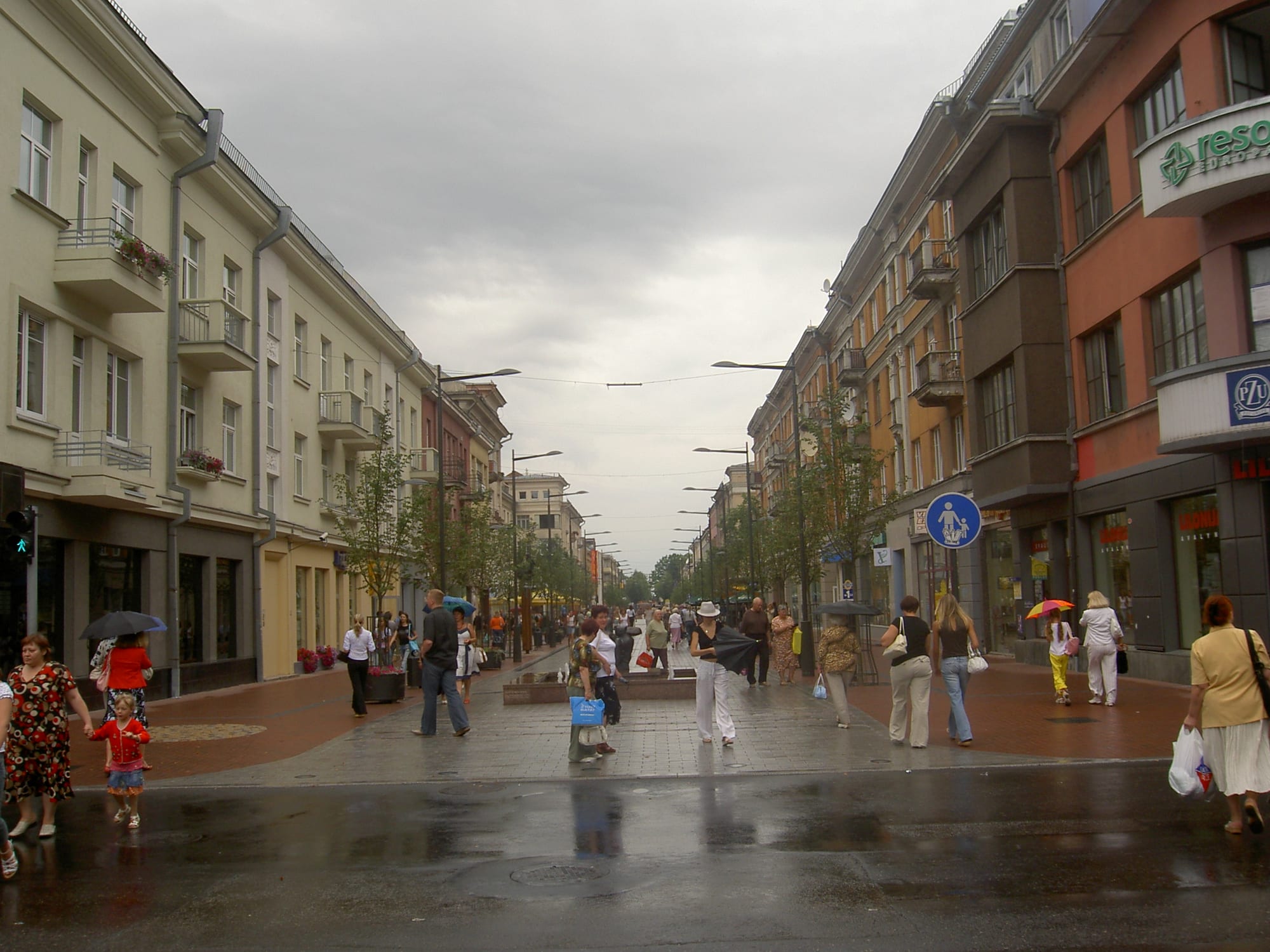
The pedestrian Vilniaus street in Šiauliai after rain, lined with pastel apartment blocks, shops and young trees

Klaipėda & Western Lithuania, Lithuania

Šiauliai

Vilniaus street, the pedestrian boulevard through the centre of Šiauliai. (Dezidor / Wikimedia Commons · CC BY 2.5)

Lithuania's fourth city, on the northern plain about 128 km from Riga, which dates itself to the Battle of Saule in 1236. Rebuilt after a peasant revolt and two world wars, and scarred by the Holocaust, it is a working industrial city of boulevards, lakes and quirky museums, a NATO air base, and the starting point for the Hill of Crosses 12 km to the north.

Neighbourhoods

  • City centre and Vilniaus boulevard
    • First-time visitors
    • Museums
    • Nightlife

    The grid of streets around the pedestrian stretch of Vilniaus street, dotted with sculptures and murals, and its crossing with Tilžės street at Rooster Clock Square. Most of the museums, the drama theatre, the pubs and the railway station are within walking distance.

    Open in Maps
  • The cathedral and Talša lakeside
    • Historic district
    • Parks
    • Quiet and residential

    The area around the Renaissance cathedral and, by the shore of Lake Talša, Sundial Square, the wooded old city cemetery next to it and the iron fox sculpture.

    Open in Maps
  • Rėkyva and the south
    • Beaches
    • Outdoor activities

    The southern part of the city around Lake Rėkyva, one of the largest lakes in Lithuania, with sandy beaches, a pier, yacht clubs and a nature reserve on its western shores. It is where the city celebrates midsummer.

    Open in Maps

Things to do

Famous landmarks

  • Šiauliai Cathedrallandmark

    The Church of Saints Peter and Paul, built between 1617 and 1626 and a significant example of Renaissance and Mannerist building, with a tall spire and loopholes from its defensive past; a cathedral since 1997.

    Open in Maps
  • Rooster Clock Squarelandmark

    The downtown crossroads of Vilniaus and Tilžės streets, where the rooster on the clock tower, repaired in 2003, crows at noon and six in the evening.

    Open in Maps
  • Vilniaus street boulevardneighborhood

    The 1.28-kilometre pedestrian section of Vilniaus street, lined with shops, cafés, street sculptures and murals.

    Open in Maps
  • Sundial Squarelandmark

    A lakeside square where a golden archer on a column casts its shadow on a great sundial, commemorating the Battle of Saule — 'sun' — of 1236.

    Open in Maps
  • Old city cemeterypark

    A wooded cemetery next to Sundial Square, opened during a cholera outbreak in 1831 and used until 1959, with Catholic, Orthodox and freethinkers' sections.

    Open in Maps

Museums

  • Chaim Frenkel Villamuseum

    The Art Nouveau mansion of 1908 built by the leather magnate Chaim Frenkel, now a museum of his era and of the city's Jewish community.

    Open in Maps
  • Bicycle Museummuseum

    The history of the bicycle, in a city long home to a bicycle factory.

    Open in Maps
  • Photography Museummuseum

    A small museum of the history of photography on Vilniaus street, beside Rooster Clock Square.

    Open in Maps
  • Šiauliai History Museummuseum

    The city's history, presented in a building rebuilt in 2022.

    Open in Maps
  • Cat Museummuseum

    A collection of feline memorabilia, with live cats in residence.

    Open in Maps

Lakes, parks and sport

  • Lake Rėkyvabeach

    A large lake on the city's southern edge, popular for fishing, kiteboarding and windsurfing, with sandy beaches and a pier.

    Open in Maps
  • Botanical Gardenpark

    A small, well-kept garden run by the university.

    Open in Maps
  • Žaliūkiai Miller's Farmsteadattraction

    A 19th-century windmill restored to working order.

    Open in Maps
  • Šiauliai Arenaattraction

    The city's largest arena, opened in 2007, home of BC Šiauliai basketball and a venue for concerts.

    Open in Maps

Short trips from the city

  • Hill of Crosseslandmark

    About 12 km north, a former hill fort covered with crosses since the 1831 uprising — an estimated 100,000 by 2006 — bulldozed three times by the Soviets and rebuilt each time; Pope John Paul II came here in 1993.

    Open in Maps
  • Franciscan Hermitage at the Hill of Crosseslandmark

    A small friary consecrated in 2000 beside the hill, whose church has a large window behind the altar looking out on the crosses.

    Open in Maps
  • Pakruojis Manorattraction

    A 19th-century manor on the Kruoja river, restored and now a tourist attraction.

    Open in Maps

Seasonal events

  • Flower of the Sunearly July

    An international folk music and dance festival held over a week.

  • Joninės at Lake Rėkyvamidsummer, June

    The Lithuanian midsummer holiday, celebrated every year by the lake.

Eat and drink

Long-standing places and food districts in Šiauliai. Hours, ratings and directions come from your maps app, always current.

Šiauliai classics

  • Gubernija breweryrestaurant

    Lithuania's oldest business, a brewery founded in 1665 to serve a noble estate, with tastings and a shop at its premises north of the centre.

    Open in Maps
  • Juonė pastuogėrestaurant

    A tavern serving traditional Lithuanian food, with live music.

    Open in Maps

Pubs and cafés

  • Vilniaus streetneighborhood

    The city's pubs and many of its cafés and restaurants cluster on and around the pedestrian boulevard.

    Open in Maps

Experience Šiauliai

History

Šiauliai takes its founding date from 22 September 1236, when the Livonian Order's chronicles recorded the Battle of Saule, in which Samogitian and Semigallian forces destroyed the Livonian Brothers of the Sword. It grew as a defence post against the crusading orders, then, after their defeat at Grunwald in 1410, as a farming town; a wooden church was built in 1445 and the brick church that is now the cathedral in 1617–26. Magdeburg rights followed in the 16th century, but war and plague devastated the town again and again.

Its rebirth came after a peasant revolt in 1769, when Antoni Tyzenhaus rebuilt it on a rectangular Classicist grid with brick public buildings. King Stanisław August Poniatowski confirmed its rights in 1791 and gave it a coat of arms with the bear of Samogitia. Under the Russian Empire, the Riga–Tilsit road and the railway of 1871 made it an industrial city. Chaim Frenkel's leather works became the largest in the empire, and by 1897 Šiauliai was the third city of Lithuania; by 1909 more than half its people were Jewish.

About 85 per cent of the buildings burned in the First World War. Rebuilt by 1929, the city made most of Lithuania's leather and much of its footwear, flax fibre and sweets. German troops arrived in June 1941; that summer about 8,000 Jews from the city and region were murdered in the Kužiai forest, and the rest were confined to two ghettos. About 80 per cent of the city was destroyed in the war and rebuilt in Soviet style, with electronics and engineering plants. Since independence the airfield has become a NATO air base, and in 2020 work began on a large aircraft maintenance centre there.

Culture & Customs

The Hill of Crosses is the cultural landmark most associated with the city. Crosses are thought to have first been placed on the former hill fort after the uprising of 1831 for rebels whose bodies were never found; under Soviet rule the hill became a symbol of quiet resistance, and the authorities bulldozed it three times. Lithuanian cross-crafting is recognised by UNESCO as intangible cultural heritage, and since 1990 the number of crosses has grown enormously.

In the city itself, the Battle of Saule — the name means "sun" — is a point of pride, commemorated by the golden archer on Sundial Square. Šiauliai has a taste for small, quirky museums — of bicycles, photography, cats, angels, radio and television — and its main boulevard is dotted with sculptures and murals. The State Drama Theatre and the Saulė concert hall stand on Tilžės street, and the Flower of the Sun folk festival brings international music and dance in July.

Sport matters here. Rugby, basketball, football, athletics and cycling are the most popular, and the local rugby clubs Vairas and Baltrex are multiple national champions and the main academies of Lithuanian rugby. BC Šiauliai plays at the arena built for the 2011 European basketball championship. The 2024 film The Southern Chronicles, set in the city's Pietinis housing district, became one of the highest-grossing Lithuanian productions.

Daily Life

About 113,000 people lived in Šiauliai in 2024. At the 2021 census about 94 per cent were Lithuanian and 3 per cent Russian. The city spreads over about 81 square km, much of it green space and water, and much of it was rebuilt in Soviet style after the war, including large housing districts such as Pietinis.

The economy grew from leather and later electronics, metalworking and wood processing; since independence the service sector has grown, and shops are strung along Tilžės street, the city's longest at almost 10 km. The NATO air-policing base and the aircraft maintenance centre at the airport add jobs, and Vilnius University's Šiauliai Academy, as the former Šiauliai University has been called since 2021, brings students. In 2025 the city joined UNESCO's Global Network of Learning Cities.

Daily routines centre on the pedestrian stretch of Vilniaus street and the malls, with 37 urban bus routes linking the districts. In summer residents head for the beaches of Lake Rėkyva and celebrate midsummer there. Artūras Visockas has been mayor since 2015.

Food

Šiauliai sits where Samogitia meets Aukštaitija, and its table draws on both. Aukštaitija is known for potato dishes and vėdarai, potato sausages, and northern Aukštaitija is the country's beer region; Samogitia is known for its many porridges, kastinys — a sour cream spread registered as a traditional speciality — and cibulinė, a herring and onion soup. Restaurants also serve the national dishes found everywhere in Lithuania: cepelinai, potato dumplings stuffed with meat, mushrooms or cheese and often served with sour cream, and in summer šaltibarščiai, the pink cold soup of beetroot and kefir.

Beer is the city's pride. Gubernija, founded in 1665 to serve a noble estate and counted as Lithuania's oldest business, still brews on the northern side of the city and sells its beer for tasting. With beer, bars serve kepta duona, black bread fried in oil and rubbed with garlic, and piršteliai prie alaus, thin rolled puff pastries.

Šiauliai once made about a third of Lithuania's sweets, and a chocolate museum in the centre recalls the trade. A budget canteen near the centre serves traditional Lithuanian lunches, a tavern on Aušros avenue adds live music to the same cooking, and the pubs and cafés of Vilniaus street fill in the evenings.

Planning tools

Budget

Šiauliai is one of the cheaper cities in Lithuania, well below Vilnius and the coastal resorts in summer. Budget canteens serving traditional food keep lunches cheap, many museums charge small fees, city buses are inexpensive, and the Hill of Crosses is free to visit.

Daily Budget Midrange
USD 90–170 (central hotel, restaurant dinners, museum tickets, a taxi to the Hill of Crosses)
Daily Budget Shoestring
USD 40–70 (hostel or budget hotel, canteen lunches, city buses)

A taxi to the Hill of Crosses can wait while visitors walk round, which suits a short visit.

Best Time to Visit

May to September, for the boulevard terraces, the lakes and the Flower of the Sun festival in early July; midsummer is celebrated at Lake Rėkyva. The Hill of Crosses is open all year; winters are cold, with short days.

Suggested Number of Days

One or two days are enough for the city and its nearest surroundings, and two or three for the wider countryside and manors. Without a car the bus and the walk out to the hill take a little more time.

First Visit
1–2 days
With Surroundings
2–3 days

Transportation

The centre is compact enough to walk, and city buses cover the rest; single tickets are sold on board and e-cards at the bus station. Taxis can be booked through accommodation or by app. For the Hill of Crosses, buses towards Joniškis stop at Domantai, about 2 km from the hill by a signed lane, or a taxi can wait while visitors walk round.

Take the Joniškis bus to the Domantai stop for the Hill of Crosses, then follow the signed lane on foot.

Airport & Station Connections

Trains from Vilnius take about two and a quarter hours, and from Šiauliai the line continues via Telšiai to Klaipėda in just under two hours; a daily train also runs north to Riga and Tallinn. Buses arrive from Vilnius, Kaunas, Klaipėda and Riga at the bus station in the Saulės miestas shopping centre. Šiauliai's airport, 7 km south-east, is mainly a military base with no commercial flights; Vilnius and Kaunas have the nearest scheduled services.

Walkability

The city sprawls, but most of the sights sit in a compact central area: the railway station, Vilniaus boulevard, Rooster Clock Square, the cathedral and Sundial Square are all within walking distance. Lake Rėkyva and the Hill of Crosses need a bus or a car.

Safety

Lithuania is a very safe country with low levels of violent crime. Šiauliai is a calm working city where ordinary precautions are enough, and winter brings icy pavements and roads.

Use licensed taxis booked by phone or app, and take care on icy streets in winter. Check current official travel advice before travelling.

Climate

A warm-summer humid continental climate, colder in winter than the coast. Summers are mild and winters cold, with about 620 mm of rain and snow a year.

Summer
mild — July averages about 18°C
Winter
cold — January averages about -3°C

Local Customs

Tipping is not deeply ingrained in Lithuania but is appreciated. The Hill of Crosses is a place of pilgrimage: visitors may leave a cross smaller than 3 metres, and quiet, respectful behaviour is expected. Many residents have a command of Russian, while far fewer speak English.

Shops cannot sell alcohol between 20:00 (15:00 on Sundays) and 10:00, and drinking in public places is illegal.

Common Payment Methods

The currency is the euro. Cards and contactless payment are widely accepted, and ATMs are easy to find in the centre. Some budget canteens take cash only, so a little is useful.