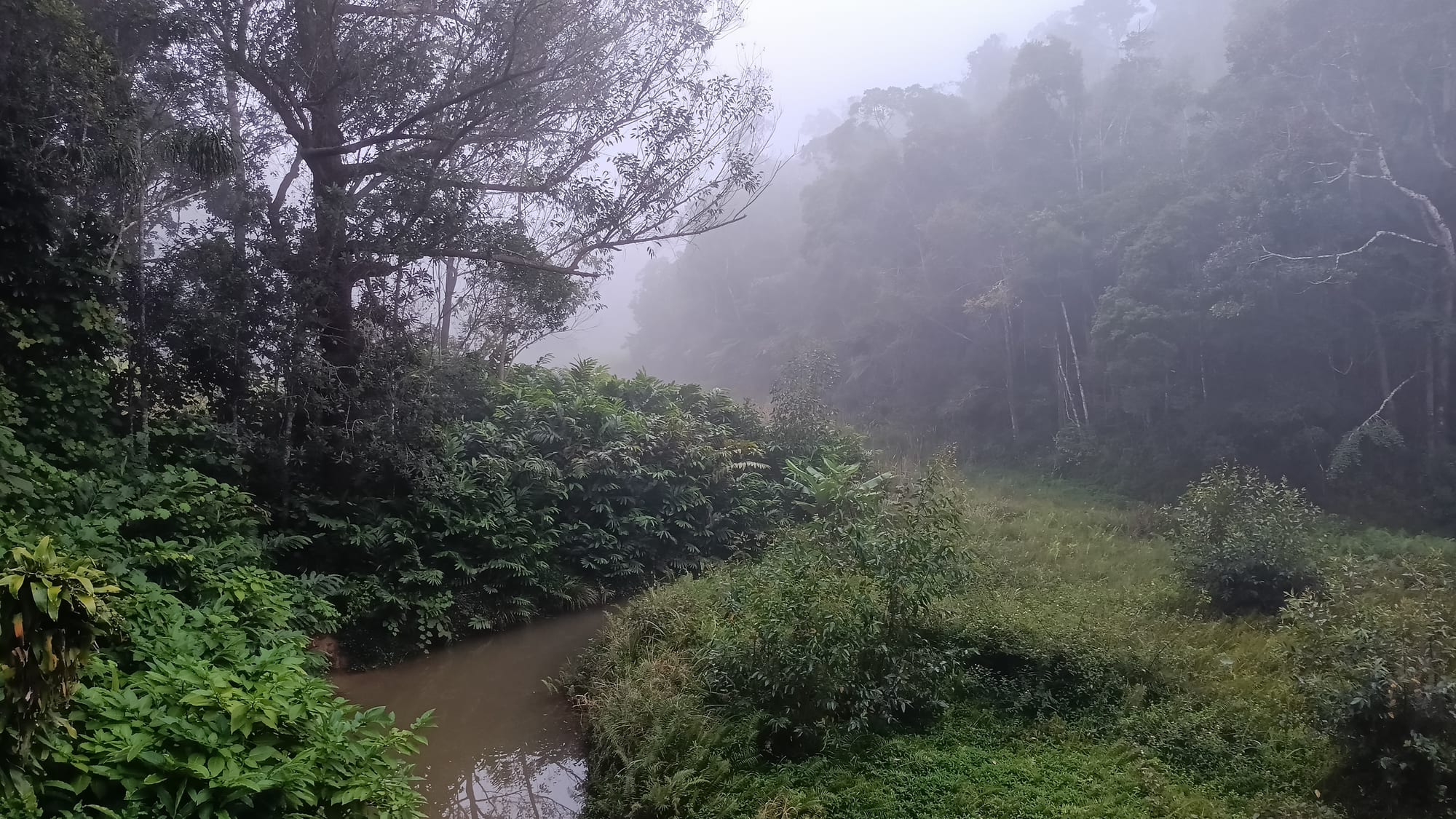
Mist drifting over dense green rainforest above a narrow brown stream and a grassy clearing

Andasibe, Sainte-Marie & the East, Madagascar

Andasibe

Mist over the Analamazaotra forest and a stream near Andasibe, on Madagascar's eastern escarpment. (Zoubl / Wikimedia Commons · CC BY-SA 4.0)

A small village on the forested eastern escarpment of Madagascar, about 1,000 metres up and a few hours east of Antananarivo. Known in the colonial period as Périnet, it grew around the railway to the coast and now lives from the rainforest beside it, where the indri, one of the largest living lemurs, calls across the valleys at dawn.

Neighbourhoods

  • Andasibe village
    • Local life
    • Budget stays
    • Close to the station

    A single main street of timber and brick houses, small shops and eating places around the railway station and the market, a couple of kilometres off the main road. Simple guesthouses here are the cheapest base, and the village is where guides, porters and most park staff live.

    Open in Maps
  • The park entrance and the main road
    • First-time visitors
    • Early starts
    • Lodges

    Most lodges stand along the road between the highway junction and the forest gate, set among trees and gardens with the escarpment behind them. Staying here puts the reserve entrance within a short walk or drive, which matters for dawn visits when the indri are calling.

    Open in Maps
  • The forest edge and the community reserves
    • Wildlife
    • Quiet stays
    • Walks

    Beyond the village, hamlets and small reserves managed by local associations sit against the forest, with rice fields and eucalyptus plantations between them. It is quiet, damp and dark at night, and the starting point for guided night walks along the roadside forest.

    Open in Maps

Things to do

The rainforest

  • Andasibe-Mantadia National Parkpark

    The protected montane rainforest beside the village, best known for the indri, one of the two largest living lemurs, whose wailing song carries for kilometres in the early morning.

    Open in Maps
  • The Analamazaotra foresttrail

    The nearer, gentler protected forest beside the village, laid out with walking circuits where indri, diademed sifakas, chameleons and orchids are found.

    Open in Maps
  • Mantadiapark

    The wilder, higher section of the park north of the village on a rough track, with taller forest, waterfalls and pools, and a longer, harder walk for fewer visitors.

    Open in Maps
  • Community forest reservesattraction

    Associations from the village manage forest next to the park, running guided day and night walks on their own trails and reforesting cleared land with native trees.

    Open in Maps
  • Night walks along the forest roadtrail

    After dark, torchlight walks on the roadside and reserve trails pick out mouse lemurs, woolly lemurs, chameleons, tree frogs and leaf-tailed geckos.

    Open in Maps
  • Torotorofotsy marshpark

    A large wetland of reeds and open water north-west of the village, best known for its frogs, among them the golden mantella, which is found in only a few places around Moramanga and Andasibe.

    Open in Maps
  • The Maromizaha forestpark

    A forested ridge on the escarpment south-east of the village, managed for conservation and research and walked with local guides.

    Open in Maps

The village

  • Andasibe railway stationtransit hub

    The station on the colonial-era line between Antananarivo and the east coast, around which the village grew when it was known as Périnet.

    Open in Maps

Short trips from the village

  • Moramangaattraction

    A market and railway town where the 1947 uprising against French rule began, with a memorial to its victims, a gendarmerie museum in the centre, and the road junction for the Ambatovy nickel and cobalt mine.

    Open in Maps

Seasonal events

  • Indri breeding and calling seasonDecember to March

    Indri groups call in the early morning through the year, but song is most frequent in the breeding season from December to March, which is also the wettest part of the year on the escarpment.

  • Fête de l'Indépendance26 June

    Madagascar's national day, marked in the village with parades, lantern processions the evening before, music and dancing.

Eat and drink

Long-standing places and food districts in Andasibe. Hours, ratings and directions come from your maps app, always current.

Eating in the village

  • Village hotelyneighborhood

    Small eating houses in the village serve rice with zebu, chicken or beans, soup and noodles, cooked simply and cheaply for guides, drivers and railway workers.

    Open in Maps
  • Lodge dining rooms on the park roadneighborhood

    The lodges along the road to the forest cook set meals of soup, freshwater fish or zebu with rice and vegetables, and are where most visitors eat.

    Open in Maps
  • Andasibe marketmarket

    The village market sells rice, cassava, greens, bananas and honey from the forest edge, along with fried cakes and coffee in the morning.

    Open in Maps

Experience Andasibe

History

Andasibe is a young settlement in an old forest. The escarpment here was Bezanozano country, worked by shifting cultivation and crossed by the trade route between the highlands and the eastern ports, and the forest itself was valued for timber, honey and medicinal plants long before it was mapped. The name of the neighbouring forest, Analamazaotra, belongs to that older landscape.

The village as it stands grew with the railway. The colonial line from Antananarivo to Toamasina was pushed through these hills in the early twentieth century, and a station, workshops and a settlement appeared where the track crossed the valley; under French rule the place was known as Périnet, a name still used by older guidebooks and by some residents. Goods from the escarpment moved down the line to the coast, and railway families made up much of the population.

Protection of the surrounding forest began with a special reserve at Analamazaotra, set up largely for the indri, and the wider Andasibe-Mantadia National Park followed, adding the higher forest to the north. From the 1990s the village turned increasingly to visitors: guiding, portering, lodges and the associations that now manage community forest beside the park. Logging, charcoal burning, shifting cultivation and the nickel mine and pipeline near Moramanga have all shaped the land around it, and the forest that remains is the village's main asset.

Culture & Customs

Andasibe's identity is bound to the indri. Called babakoto locally, the animal is protected by fady in this region — taboo to hunt or eat — and the legends explain it as kin to people and treat it as sacred, not to be hunted or harmed, though hunting continues in parts of the country. Visitors are asked to keep quiet and at a distance, and guides set the pace of a walk by the animals rather than by the group.

The population is mainly Bezanozano and Betsimisaraka, with families drawn in from the highlands by the railway and, more recently, by conservation and mining work. Ancestral practice is strong: ceremonies for the razana with zebu sacrifice and rum, respect for tombs, and fady that differ from hamlet to hamlet and can govern which days people work the fields. Catholic and Protestant churches stand in the village, and Sunday singing carries down the street.

Guiding has become a local profession, passed on within families and through the village associations, and many guides are expert naturalists with a detailed knowledge of frogs, orchids and birds. The day is shaped by the forest: very early starts while the indri call, quiet afternoons of mist and rain, and night walks with torches along the roadside. Evenings in the village are brief and early — there is little street lighting and the nights are cold and damp.

Daily Life

Andasibe is small, a village in a rural commune of some 13,000 people, of farms and hamlets, and it feels smaller still because it lies off the main road. Houses of timber, brick and corrugated iron line one street around the station and the market, the lodges are scattered along the park road, and rice paddies and eucalyptus plantations fill the valley floors between them.

The economy divides between farming and the forest. Families grow rice, cassava and bananas, keep zebu and poultry, cut eucalyptus for building and charcoal, and collect honey; others work as guides, porters, cooks and cleaners for the park and the lodges, or commute to jobs around Moramanga and the nickel operation. Tourism money is seasonal and thinly spread, and the village felt its absence sharply when travel stopped in the early 2020s.

Days start before first light and end early. Water comes from streams and standpipes, electricity is limited and intermittent, and the road turns to mud in the rains. Pressure on the forest — clearing for fields, firewood and charcoal — remains the central local issue, set against the fact that the forest is what brings visitors and wages.

Food

Eating at Andasibe is highland-and-forest cooking: rice at every meal, with a laoka of zebu, chicken, beans, greens or freshwater fish in a light broth. Ravitoto, pounded cassava leaves stewed with pork, is a favourite here, and romazava, the beef and leafy-green stew flavoured with the tingling anamalao herb, appears on lodge menus as the national dish.

Village food is simple and cheap: soup with noodles in the cold mornings, mofo gasy rice cakes and fried doughnuts from a roadside stall, grilled zebu brochettes, boiled cassava and maize. Bananas, avocados and citrus grow locally, forest honey is sold in reused bottles, and the small freshwater fish and eels of the streams are a local speciality when they can be had.

Lodges cook set menus that lean French — soup, fish or zebu with rice and vegetables, a fruit dessert — and serve Three Horses Beer and rhum arrangé, rum steeped with vanilla, lychee or ginger. Coffee grown on the escarpment is drunk strong and sweet, and ranon'ampango, the smoky water boiled in the empty rice pot, remains the everyday drink in the village.

Planning tools

Budget

Andasibe is a moderately priced stop. Accommodation runs from simple village guesthouses to comfortable forest lodges, and the fixed extras are the park entry fee and the guide, who is obligatory and paid per walk. There is no bank machine in the village, so cash is brought in.

Daily Budget Midrange
USD 80–180 (forest lodge with meals, park fees and guides for day and night walks, transport)
Daily Budget Shoestring
USD 25–40 (village guesthouse, hotely meals, park fee and a shared guide)

Join other visitors to share a guide and a vehicle for the rough track to the northern section of the park, and bring enough cash for the whole stay.

Best Time to Visit

September to December is the driest and most reliable period, and the forest is busiest with wildlife at the start of the rains. January to March brings heavy rain and the cyclone season; the southern winter months are cool, damp and quiet, and leeches are fewer in the dry months.

Suggested Number of Days

Two days allow morning and night walks without rushing, since the forest is at its best at dawn. Three or four suit anyone who wants the wilder northern forest, the wetland and the community reserves as well. Rain and track conditions change the number more than anything else.

First Visit
2 days
With Surroundings
3–4 days

Transportation

There is no public transport within Andasibe: the village, the lodges and the park gate are linked by one road, walked or covered by lodge vehicles and the occasional taxi. Most visitors arrive with a hired car and driver and keep it for the stay. Taxi-brousse minibuses on the main road stop at the junction, a couple of kilometres from the village.

The track to the northern part of the park needs a 4x4 and is often impassable after heavy rain; do not plan on road travel after dark.

Airport & Station Connections

Andasibe lies off the main road from Antananarivo to the east coast, about 140 kilometres from the capital and usually three to four hours by car through the hills. Moramanga, the nearest town, is around 25 kilometres west. Taxi-brousse minibuses running between the capital and Toamasina will set passengers down at the junction.

Walkability

Everything here is walked. The village, the market and the station form a compact cluster, and the park entrance is a walk of a few kilometres from most lodges along a quiet road. Forest trails are steep, muddy and slippery, and paths are unlit at night, so a torch and boots matter more than distance.

Safety

Andasibe is a calm village and crime is rare, with opportunistic theft the main risk. The real hazards are practical: steep, slippery trails and leeches in the forest, malaria on this side of the country, and cyclones between January and March, which can cut the road and bring down trees. Guides are obligatory in the park and know the paths.

Madagascar has a long history of political unrest — mass protests in September 2025 were followed by a military takeover and a change of government, so demonstrations can disrupt movement in the capital. Walk with a guide, keep to the marked trails, take malaria precautions, carry a torch and waterproofs, and avoid travelling the main road at night. Check current official travel advice before travelling.

Climate

Cool, wet and often misty. At around 1,000 metres Andasibe is noticeably colder than the coast below, rain falls in every month, and cloud sits in the valleys at dawn. The heaviest rain and the cyclone risk come between January and March.

Summer
December to February is the southern summer: warm and very wet, generally around 17–27°C, with downpours and cyclone risk
Winter
June to August is the southern winter: cool and damp, with showers and nights that can fall to about 10°C

Local Customs

The village is Bezanozano and Betsimisaraka country, rural and attached to ancestral custom, with fady — local taboos — that can cover particular days, foods or places in the forest. Guides explain what applies on their trails. Greetings are unhurried and modest dress is normal in the village. Lemurs in the park are wild, and feeding or touching them is not done.

Ask before photographing people or houses, keep a distance from the lemurs and stay quiet near them, and do not buy wildlife, wood carvings of protected species or forest products of unclear origin.

Common Payment Methods

The currency is the Malagasy ariary, and the village works in cash: park fees, guides, porters, meals and small guesthouses are all paid that way. There is no cash machine, and only the larger lodges may take a card, so money is drawn in Antananarivo or Moramanga beforehand.