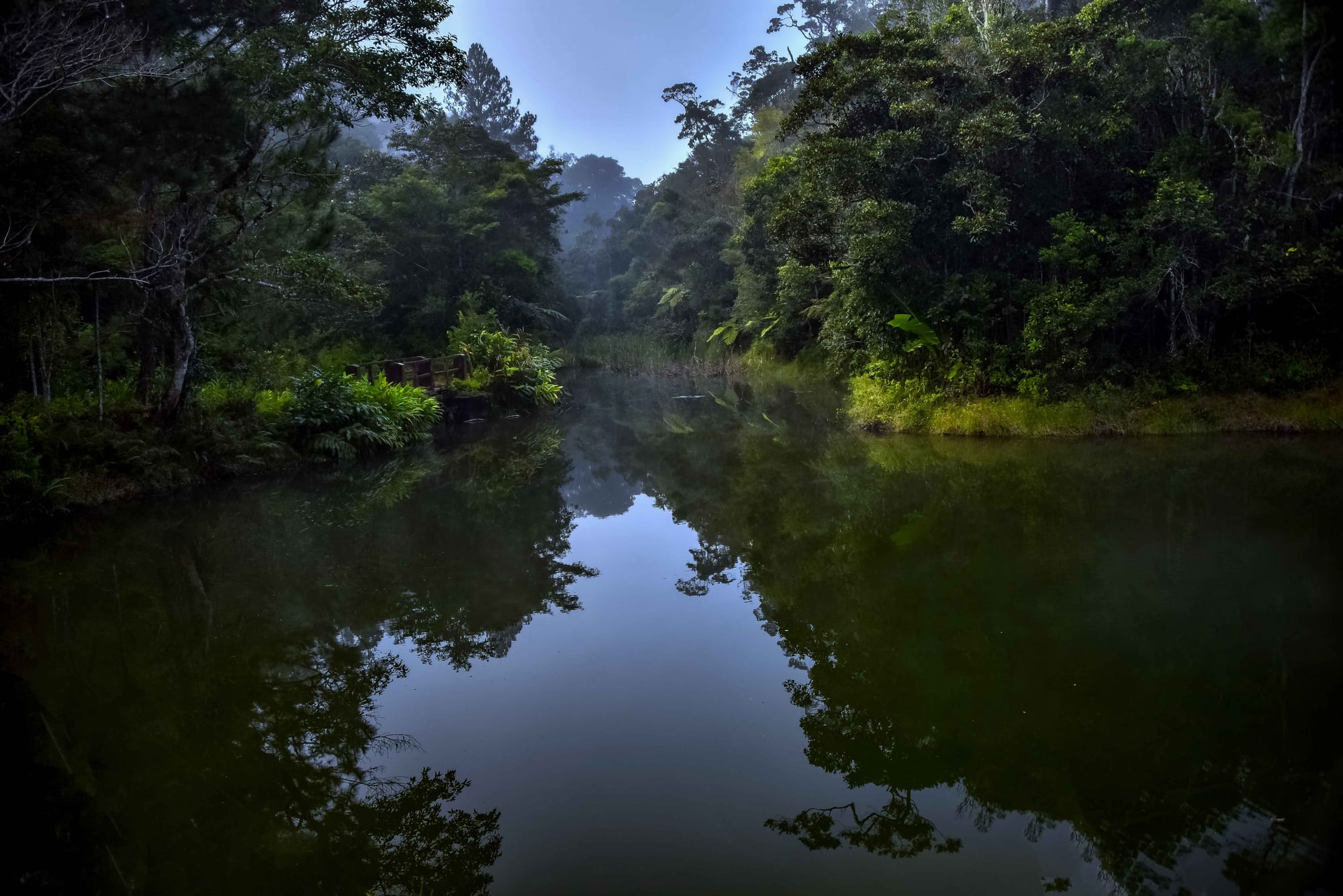
A still forest pool reflecting dense green rainforest and ferns, with mist among the trees at dawn

Madagascar

Andasibe, Sainte-Marie & the East

Rainforest and a forest pool in Andasibe-Mantadia National Park, on the eastern escarpment. (Rod Waddington / Wikimedia Commons · CC BY-SA 2.0)

The rain-soaked east of Madagascar, from the forested escarpment of Andasibe down to the port of Toamasina and north along a coast of lagoons, clove groves and islands to the Masoala peninsula — Betsimisaraka country, with the rice bowl of Lake Alaotra inland and whales off Île Sainte-Marie each winter.

Explore Andasibe, Sainte-Marie & the East

History

The east coast was settled by peoples who became the Betsimisaraka, while the forested escarpment inland was home to the Bezanozano and the plain around Lake Alaotra to the Sihanaka. From the late 17th century European pirates used Île Sainte-Marie and the sheltered bays of this coast as a base for raiding Indian Ocean shipping. In the early 18th century Ratsimilaho, said to be the son of an English pirate and a Malagasy queen, united the coastal clans into the Betsimisaraka confederation, and in 1750 his daughter Bety handed Sainte-Marie to France.

Radama I brought the coast under Merina rule in the 1810s and 1820s, and Toamasina became the kingdom's main port and the point of contact with Europe. French marines seized it in December 1894 at the start of the second Franco-Merina war, and under colonial rule the railway from Antananarivo to Toamasina was completed and the Pangalanes lagoons were linked by canals.

The 1947 uprising against French rule began here, with attacks around Moramanga and on the east coast at the end of March; it spread through the forests of the east and was suppressed over the following two years with tens of thousands of deaths. The anniversary, 29 March, is a national day of remembrance. Since independence the region has been shaped by the port of Toamasina, the export of cloves, coffee and lychees, and the Ambatovy nickel and cobalt mine near Moramanga, whose ore is piped to a processing plant on the coast.

Culture & Customs

The Betsimisaraka are the island's second-largest group and dominate the coast, with the Sihanaka around Lake Alaotra and the Bezanozano inland. Much of the east remains rural and deeply attached to ancestral custom: in the north coffins are placed under outdoor shelters rather than in tombs, and fady vary from village to village, governing anything from which foods may be eaten to which days work in the fields is allowed. Christian churches, Catholic and Protestant, stand in every town.

Ceremonies to honour ancestors involve the sacrifice of zebu, the sharing of rum and palm or cane wine, and long nights of music. The coast has its own dances and songs, and in Toamasina and other towns a Chinese-Malagasy community, descended from migrants who came in the colonial era, adds its own shops, festivals and cooking.

Crafts draw on the forest and the sea: mats and baskets woven from raffia and pandanus, dugout pirogues hollowed from single trees, and on Sainte-Marie pirate lore is part of local identity. Toamasina, known as Tamatave in French, has a relaxed port-city culture of music bars and seafront promenades, and Lake Alaotra's fishermen and rice farmers keep a distinct lakeside way of life.

Daily Life

Toamasina, with over 300,000 people, is the region's city and the country's main port, handling most of Madagascar's foreign trade. Moramanga, Ambatondrazaka, Fenoarivo Atsinanana, Maroantsetra and Ambodifotatra on Sainte-Marie are smaller towns, and most of the population lives in coastal and riverside villages.

Work is export farming — cloves, coffee, lychees, vanilla, bananas and cinnamon — along with rice around Lake Alaotra, fishing, the port and its trades, and mining at Ambatovy. Slash-and-burn farming, called tavy, remains common on the forest edge and is the main pressure on the remaining rainforest; illegal logging of rosewood and ebony has degraded the forests of the Masoala peninsula.

Much of the coast lives by the rains. Villages depend on pirogues and paths, and cyclones regularly flatten houses, clove trees and crops, leaving families to rebuild each season.

Food

The east eats rice with fish and seafood, often cooked with coconut, ginger or tomato, and small freshwater fish from the Pangalanes and Lake Alaotra, whose paddies supply much of the island's rice. Breadfruit, cassava, taro and bananas fill out meals, and greens such as cassava leaves go into pork stews. Toamasina's Chinese-Malagasy community has made dishes such as misao, fried noodles, and soupe chinoise, a noodle soup, everyday food across the region.

Fruit is the east's pride. Lychees from the Toamasina coast are a leading export, and bananas, pineapples, mangoes, jackfruit and rambutans are sold by the roadside. Analanjirofo, the region north of Toamasina, is clove country, and cinnamon, pepper, coffee and vanilla are also grown.

Drinks include betsabetsa, a fermented sugar-cane drink, palm wine, and rhum arrangé flavoured with vanilla, lychee or ginger. Coconut water is sold fresh on the beaches, and roasted coffee from local farms is drunk strong and sweet.

Attractions & Natural Wonders

Andasibe-Mantadia National Park, on the escarpment east of Moramanga, is the easiest place to hear and see the indri, one of the two largest living lemurs, whose wailing song carries through the Analamazaotra forest at dawn. Mantadia, to the north, has wilder forest, and community reserves nearby run night walks for mouse lemurs, chameleons and frogs.

On the coast, Toamasina has a seafront boulevard, a large market and, just north, the Ivoloina park with rescued lemurs. South of the city, the Pangalanes canal links lagoons and lakes behind the dunes; lakes such as Ampitabe lie along its route. To the north, Foulpointe and Mahambo have reef-sheltered beaches.

Île Sainte-Marie, off the coast north of Toamasina, is a long, narrow island of palm-lined beaches, with a pirate cemetery near Ambodifotatra and the small Île aux Nattes at its southern tip; humpback whales come to its waters to breed and calve each southern winter.

In the far north-east, Masoala National Park protects rainforest that runs down to coral reefs and marine parks, with red ruffed lemurs, aye-ayes and leaf-tailed geckos; the island of Nosy Mangabe, in the bay off Maroantsetra, is part of the same park. Inland, Lake Alaotra, the largest lake in Madagascar, has reedbeds with the Alaotra gentle lemur and many waterbirds.

Cities in Andasibe, Sainte-Marie & the East

Planning basics

Budget

The east is moderately priced. Andasibe's lodges range from simple bungalows to comfortable forest hotels, and park fees and the obligatory guides are the main extra. Sainte-Marie has beach hotels at many price levels, and Masoala is expensive because it requires flights, boats and organised camps or lodges. Toamasina has cash machines; the rest of the coast relies on cash.

Daily Budget Midrange
USD 80–180 (lodge or beach hotel, park fees and guides, boat transfers)
Daily Budget Shoestring
USD 25–40 (bungalow or guesthouse, hotely meals, taxi-brousse)

Book night walks and the Mantadia excursion through the guide association at Andasibe, and budget separately for the boat to Masoala.

Safety

The east is generally calm. Theft and night-time robbery occur in Toamasina, and boat safety is the main concern on crossings to Sainte-Marie and along the coast, where sea conditions change quickly. Malaria is intense on the coast, cyclones can cut roads for days, and swimming is unsafe away from reef-sheltered beaches because of currents and sharks.

Use boats with life jackets, swim only where locals advise, take malaria precautions and follow cyclone warnings. Check current official travel advice before travelling.

Climate

The wettest part of Madagascar: trade winds bring rain in every month. The coast is hot and humid, while Andasibe, at around 1,000 metres, is cooler and often misty. Cyclones strike this coast often, mostly between January and March.

Summer
hot and humid on the coast, 24–31°C, with heavy rain and cyclone risk
Winter
warm on the coast, 18–27°C, with showers; cool and damp at Andasibe, down to about 10°C at night

Transportation

The RN2 runs from Antananarivo through Moramanga to Andasibe in about three to four hours and on to Toamasina in roughly a day's drive. Sainte-Marie has flights from the capital and boat crossings from Soanierana-Ivongo, north of Toamasina. The Pangalanes are travelled by boat from points near Ambila and Toamasina, and Masoala is reached by flying to Maroantsetra and continuing by boat.

Cross to Sainte-Marie with an established operator in the morning, when the sea is usually calmer, and avoid overloaded boats.

Best Time to Visit

September to December is the driest and most reliable period for the forests and the coast. Humpback whales gather off Île Sainte-Marie in the southern winter, though showers are frequent then. January to March brings the cyclone season, when roads, boats and flights can be disrupted.