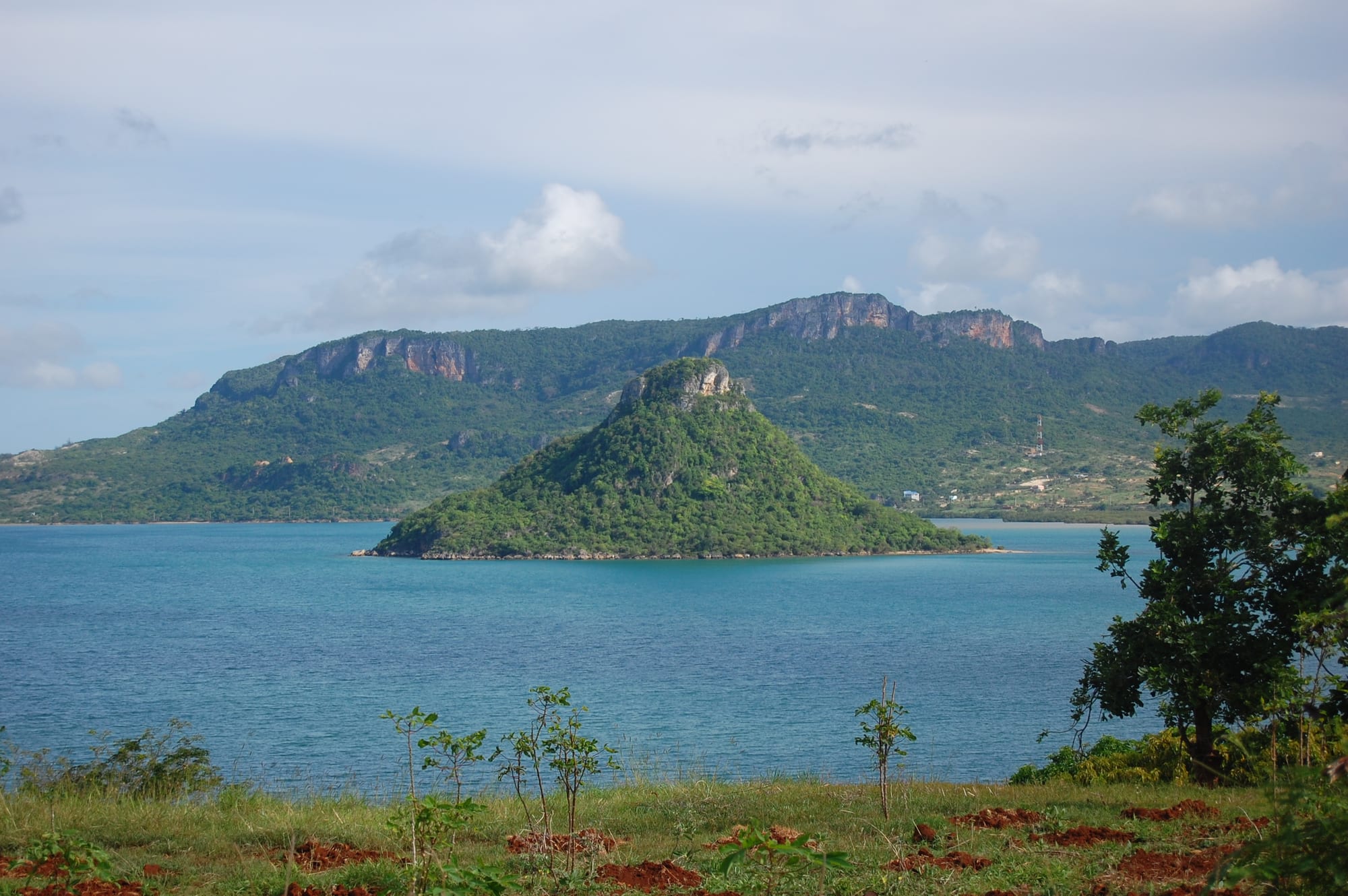
A cone-shaped forested islet in a turquoise bay, with a long cliff-topped green ridge behind it

Madagascar

Nosy Be, Diego Suarez & the Northwest

The Sugarloaf, a forested islet in the bay of Diego Suarez at Madagascar's northern tip. (AngeN / Wikimedia Commons · CC BY-SA 4.0)

Madagascar's northern tip and north-west coast, from the harbour city of Diego Suarez and the vanilla country of Sava down to Mahajanga on the Mozambique Channel — Sakalava and Antankarana land, with the island resort of Nosy Be, the limestone tsingy of Ankarana and the dry forests of Ankarafantsika.

Explore Nosy Be, Diego Suarez & the Northwest

History

The north-west faced Africa and Arabia long before it faced Europe. From about the 11th century Swahili and Arab traders ran ports on its bays, among them Mahilaka on the Ampasindava bay, and Islamised settlers, the Rasikajy, later made Vohémar on the north-east coast a trading port. Around 1700 the Sakalava kingdom of Boina rose in the north-west, with Mahajanga as its trading port, while the Antankarana ruled the far north.

In the 19th century Merina armies pushed into both. Sakalava and Antankarana leaders looked to France for help, and in 1840–41 Nosy Be passed to French protection; its main town, Hell-Ville, is named after the admiral de Hell. After the first Franco-Merina war, Madagascar ceded the bay of Diego Suarez to France in 1885, and it became a French naval base. In 1895 the French expedition that ended the Merina kingdom landed at Mahajanga and marched inland.

In the Second World War, British forces landed near Diego Suarez in May 1942 to seize the harbour from Vichy France. After independence, Mahajanga saw deadly riots against its large Comorian community in 1976, after which many Comorians left. Today the region's weight lies in tourism on Nosy Be, the port of Mahajanga, and the vanilla of Sava, whose price swings bring sudden wealth and sudden hardship.

Culture & Customs

This is Sakalava and Antankarana country, with the Tsimihety inland and the Betsimisaraka on the Sava coast, and it looks outward: Comorians, Indian and Pakistani traders known as Karana, Arab-descended families and French residents have all settled in its ports. Islam is more visible here than on the plateau, with many mosques in Mahajanga and a strong Muslim presence on Nosy Be, alongside Christianity and ancestral religion.

Sakalava royalty still carries weight. Royal relics are kept in shrines called doany and honoured in ceremonies, and tromba, possession by the spirits of dead kings, is central to religious life: mediums speak in the voices of royal ancestors at gatherings accompanied by music. Many fady here relate to royal spirits and sacred sites.

The north is the home of salegy, the fast, danceable music of accordion, electric guitar and drums that fills bars from Diego to Mahajanga. Women often paint their faces with masonjoany, a paste of ground wood used as sun protection and cosmetic, and wear the brightly printed lamba wrap. The pace is slower than in the capital, and the local Malagasy dialects differ noticeably from the Merina standard.

Daily Life

Mahajanga, with about 250,000 people, is the region's biggest city and a port for the west coast, with a seafront promenade that fills at sunset. Diego Suarez, officially Antsiranana, has about 115,000 people and a grid of fading colonial buildings around its naval harbour; Hell-Ville on Nosy Be, Ambanja, Ambilobe, Sambava, Antalaha and Antsohihy are the other main towns.

The economy mixes tourism on Nosy Be and around Diego, fishing, and export crops: vanilla in Sava, cocoa and coffee in the Sambirano valley around Ambanja, ylang-ylang and pepper on Nosy Be, and sugar cane. Mahajanga ships goods and has sea links to the Comoros, while cattle herding dominates the dry interior.

Life follows the heat, with work early, a long midday rest and busy evenings on the seafronts. In Sava the vanilla calendar rules: money floods and ebbs with the harvest price, while roads to much of the north become difficult during the rains.

Food

The north-west cooks with the sea and the coconut. Fish, prawns, crab, octopus and lobster are grilled or simmered in coconut milk, and chicken in coconut sauce is a coastal classic served with rice. The Indian and Comorian communities have added samosas, known as sambos, curries, biryani and khimo, a minced-meat dish that is a speciality of Mahajanga.

Grilled zebu brochettes are sold from street stalls at dusk on the Mahajanga seafront, along with grilled corn and cassava. The Sambirano valley's fine cocoa is made into chocolate, and Nosy Be grows pepper and distils ylang-ylang for the perfume industry. Sava's vanilla goes into sauces for fish and chicken as well as into rum.

Fruit is abundant: mangoes, cashews, lychees and coconuts depending on the season. The rum distillery of Dzama began on Nosy Be, and rhum arrangé — rum steeped with fruit, spices or vanilla — is poured in every beach bar. Fresh coconut water and tamarind or baobab-fruit juices are the soft alternatives.

Attractions & Natural Wonders

Nosy Be and its islands are the region's best-known draw: the volcanic crater lakes and view from Mont Passot, the Lokobe forest with its black lemurs and chameleons, the beaches of Andilana and Ambatoloaka, and boat trips to Nosy Komba's lemurs, the marine reserve of Nosy Tanikely for snorkelling, and the islets of Nosy Iranja, whose name means turtle island.

Diego Suarez sits on a vast bay guarded by the Sugarloaf islet. Boats from Ramena cross to the Emerald Sea, a shallow lagoon behind a reef at the bay's mouth, and the coast of the Three Bays lies nearby. Inland, the Red Tsingy are eroded spires of red earth, and Montagne d'Ambre National Park, above Joffreville, protects cool rainforest with crater lakes, waterfalls and tiny leaf chameleons.

Further south, Ankarana National Park is a limestone massif of grey tsingy pinnacles, caves with bats and underground rivers, and canyons of forest with crowned lemurs. On the east coast, the vanilla coast of Sava around Sambava, Antalaha and Andapa has curing sheds open to visitors and, inland, the rainforest mountains of Marojejy National Park.

In the south-west, Mahajanga has its seafront baobab, among the island's largest, and the eroded red and white cliffs of the Cirque Rouge. Ankarafantsika National Park protects dry deciduous forest with Coquerel's sifakas, and Lake Ravelobe, home to crocodiles and waterbirds.

Cities in Nosy Be, Diego Suarez & the Northwest

Planning basics

Budget

Nosy Be is the most expensive part of Madagascar, with resort hotels, boat excursions and many prices quoted in euros; Diego Suarez and Mahajanga are moderate, and the Sava towns and the countryside are cheap. Boat trips, park fees and the domestic flights needed to reach Sava add up. Diego, Mahajanga, Nosy Be and Sambava have cash machines; smaller places do not.

Daily Budget Midrange
USD 80–210 (beach hotel, boat excursions, park fees and guides, a car with driver)
Daily Budget Shoestring
USD 25–45 (guesthouse, hotely meals, taxi-brousse and shared boats)

Share boat and 4x4 excursions on Nosy Be and around Diego with other travellers to cut costs.

Safety

The north is among the calmer parts of Madagascar for visitors. Theft on beaches and in Diego and Mahajanga at night is the main risk. Nosy Be has a chronic problem with sex tourism that the authorities have struggled to resolve. Add malaria, crocodiles in rivers and the Ankarafantsika lake, and cyclones on the east coast.

Leave valuables in the hotel on the beach, use licensed boat operators with life jackets, and take malaria precautions. Check current official travel advice before travelling.

Climate

Hot all year. The west coast and Nosy Be have a dry season from about May to October and heavy rain from December to March, while Diego Suarez is drier and famously windy for much of the dry season. The Sava coast, facing the trade winds, is wet for much of the year and more exposed to cyclones. Montagne d'Ambre is noticeably cooler and often misty.

Summer
hot and humid, 25–33°C, with heavy rain and a cyclone risk from December to March
Winter
warm and dry on the west coast and Nosy Be, 20–30°C; strong winds around Diego Suarez

Transportation

Nosy Be, Diego Suarez, Mahajanga and Sambava have airports with flights to Antananarivo. Nosy Be is also reached by speedboat or ferry from Ankify, near Ambanja, on the mainland. The RN6 links Diego Suarez with Ankarana and Ambanja and continues south towards Mahajanga, which has its own paved road from the capital, a long day's drive. Sava is reached mainly by air.

Fly between Nosy Be or Diego Suarez and Mahajanga or Sava where possible — road journeys take a day or more.

Best Time to Visit

May to November is the main season: dry, with calm seas around Nosy Be and open tracks to Ankarana, whose caves and canyons can be flooded in the rains. September to November is warm and good for diving. The Sava coast is best in the drier spells of September to December.