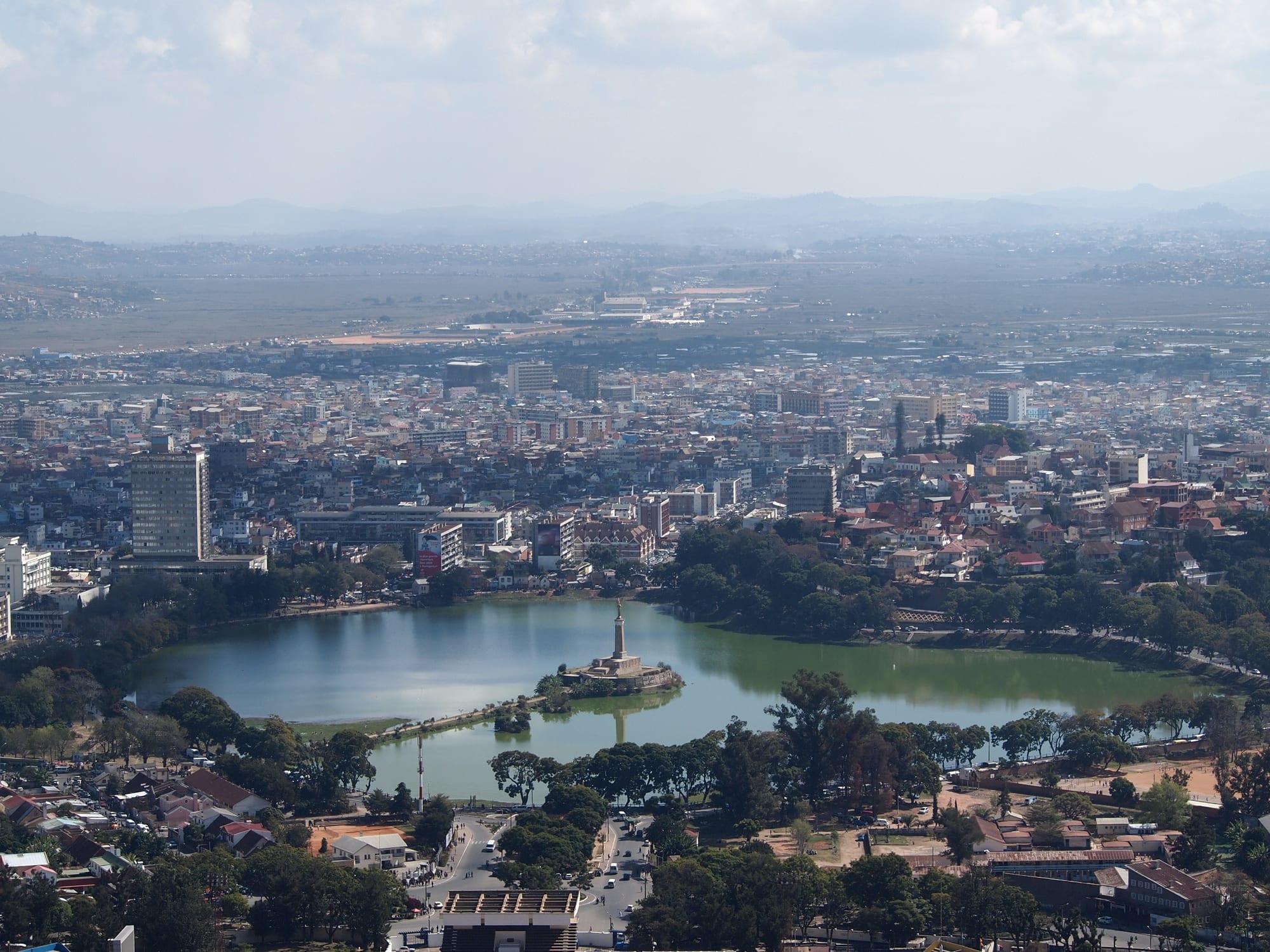
A city of low pale buildings spread over a plain around an oval lake with a monument on a small island

Antananarivo & the Central Highlands, Madagascar

Antananarivo

Lake Anosy and the lower town of Antananarivo, seen from the hills above. (Lemurbaby / Wikimedia Commons · CC BY-SA 3.0)

Madagascar's capital, built across a ridge and the hills around it at about 1,280 metres, with rice paddies still flooding at its edge. Founded by the Merina in the early seventeenth century and reshaped under French rule, it holds the royal Rova, brick houses with wooden balconies, long stairways between quarters, and the country's government, main university and main airport.

Neighbourhoods

  • Haute-Ville and Andohalo
    • Historic district
    • Views
    • First-time visitors

    The old upper town along the highest ridge, below the Rova. Brick houses with wooden verandas, the Andohalo cathedral and small squares stand along narrow lanes, and long flights of stone steps drop towards the lower town. The quietest and most historic part of the city, with the widest views.

    Open in Maps
  • Analakely
    • Markets
    • Local life
    • Street food

    The commercial heart of the lower town, built in the valley between the ridges. Market stalls fill the streets and the covered halls, minibuses and pedestrians crowd the Avenue de l'Indépendance, and the Soarano railway station closes the view at its northern end.

    Open in Maps
  • Antaninarenina
    • Central
    • Close to public transport

    The terrace above Analakely, linked to Analakely by one of the city's two largest staircases, built under Ranavalona I, and holding the historic Hôtel Colbert, jewellers' shops, luxury stores and administrative offices. It is the usual link between the upper and lower towns.

    Open in Maps
  • Isoraka
    • Best for food
    • Nightlife

    A small quarter of villas on a slope west of the centre, where houses have been converted into upscale restaurants and inns and the nightlife is lively. Walkable in the evening, though taxis are the usual way home.

    Open in Maps
  • Ivandry and Ambatobe
    • Quiet and residential

    Greener, more spread-out residential districts in the north of the city, with little to see and roads less crammed than in the centre.

    Open in Maps
  • Tsimbazaza and Ampefiloha
    • Parks
    • Museums

    South and west of Lake Anosy, a flatter area of ministries, offices and apartment blocks built on reclaimed marsh, with the zoological and botanical park of Tsimbazaza.

    Open in Maps

Things to do

Famous landmarks

  • Rova of Antananarivolandmark

    The royal compound of the Merina sovereigns on the city's highest hill, whose stone Manjakamiadana palace was destroyed by fire in 1995 and has since been restored.

    Open in Maps
  • Andafiavaratra Palacemuseum

    The former residence of Rainilaiarivony, prime minister for 31 years in the nineteenth century, near the Rova on the city's highest hill and now a museum holding some 1,466 objects saved from the 1995 fire.

    Open in Maps
  • Lake Anosylandmark

    An artificial lake below the upper town, ringed by jacaranda trees, with a war memorial on an island at its centre reached by a causeway.

    Open in Maps
  • Andohalo Cathedrallandmark

    The Catholic cathedral of the Immaculate Conception in the Andohalo quarter of the upper town, built in Gothic Revival style between 1873 and 1890, its façade facing west over the city centre.

    Open in Maps
  • Andohalo and the upper town stairwaysviewpoint

    Stone staircases and terraces linking the ridge to the valley, with views across the tiled roofs and, on clear days, to the paddies beyond the city.

    Open in Maps

Parks and museums

  • Tsimbazaza Zoopark

    A combined zoo and botanical garden displaying Malagasy wildlife and holding the country's largest herbarium, with a museum of tribal carvings and skeletons of extinct animals such as the elephant bird.

    Open in Maps
  • Analakely Marketmarket

    The city's central market district, spread through covered halls and the surrounding streets, selling vegetables, fabric, hardware and cooked food.

    Open in Maps

Short trips from the city

  • Royal Hill of Ambohimangalandmark

    A fortified royal hill about 24 kilometres north-east, inscribed as a UNESCO World Heritage Site in 2001, with the wooden house of Andrianampoinimerina, royal tombs and gateways closed by great stone discs.

    Open in Maps
  • Lemurs' Parkpark

    A private reserve about 22 kilometres south-west of the city, where nine lemur species, many of them confiscated pets, range freely among planted trees beside the Katsaoka River.

    Open in Maps
  • Ivato International Airporttransit hub

    The country's main airport, about 15 kilometres north-west of the centre, the country's main international gateway and the hub of Madagascar Airlines.

    Open in Maps

Seasonal events

  • Independence DayJune

    The national holiday on 26 June, marking the independence proclaimed at the capital's Mahamasina stadium in 1960, with public celebrations and concerts.

  • Alahamady BeMarch

    The Malagasy New Year, which opens Alahamady, the first month of the traditional calendar, and falls in March.

  • Famadihana seasonVaries

    Highland families hold the turning of the bones, usually once every five to seven years, rewrapping ancestors in fresh silk shrouds and dancing with them before reburial; it is a family celebration of kinship rather than a public event.

Eat and drink

Long-standing places and food districts in Antananarivo. Hours, ratings and directions come from your maps app, always current.

Antananarivo classics

  • Highland hotely canteensrestaurant

    Small one-room eating houses all over the city serving rice with a laoka — romazava beef and greens broth, ravitoto with pork, or beans — at a fixed cheap price.

    Open in Maps
  • Mofo gasy and street frittersmarket

    Sweetened rice-flour cakes cooked in charcoal moulds at dawn beside every busy junction, a popular breakfast often eaten with coffee from the kiosks.

    Open in Maps

Food districts and markets

  • Analakely Marketmarket

    The central market for produce, spices and cooked food, where highland vegetables, zebu meat and heaps of chillies for sakay are sold through the day.

    Open in Maps
  • Isoraka restaurantsneighborhood

    The city's densest run of restaurants, in converted villas on a hillside west of the centre, mixing Malagasy cooking with French and Italian menus.

    Open in Maps
  • Antaninarenina cafésneighborhood

    Pâtisseries and coffee houses along the upper terrace, an inheritance of French rule, serving Malagasy-grown coffee and pastries.

    Open in Maps

Experience Antananarivo

History

Tradition places the city's founding in the early seventeenth century, when the Merina king Andrianjaka took the hill of Analamanga and is said to have garrisoned it with a thousand soldiers — the name Antananarivo, the city of the thousand, recalls them. Successive sovereigns built their compounds on the ridge, and the marshes below were drained into the rice fields that still surround the city.

Antananarivo became the capital of a state that dominated the island after Andrianampoinimerina, ruling from nearby Ambohimanga, reunited Imerina at the end of the eighteenth century and moved his seat here. His son Radama I allied with Britain and welcomed London Missionary Society teachers, who wrote Malagasy in the Latin alphabet; Ranavalona I later restricted the missionaries and persecuted Malagasy Christians, whose deaths are commemorated by the memorial churches on the ridge. Under Rainilaiarivony, prime minister from 1864 to 1895, stone and brick began to replace timber across the city and the court became Protestant.

French troops took the city in 1895, the monarchy was abolished two years later, and the colonial administration cut avenues through the lower town, drained more marsh and built the railway station at Soarano. Since independence in 1960 the capital has been where Madagascar's power changes hands: the protests of 1972, the crisis of 2009 that removed the president and raised the city's mayor in his place, and the youth-led protests of 2025 over water and power cuts, which ended in the army's CAPSAT unit turning against the president.

Culture & Customs

Antananarivo is the centre of Merina culture and of Malagasy public life. Kabary, the formal oratory of proverbs and allusion, is still expected at weddings and funerals, and a good speaker is admired in the way a musician is. Hira gasy troupes in red jackets and straw hats perform day-long programmes of song, dance and moral argument in the city and the villages around it, and the valiha, a tube zither of bamboo, remains the emblem of highland music. Churches are full on Sundays — the capital is strongly Protestant and Catholic — and their choirs supply much of the city's musical training.

The ancestors underpin everything. Family tombs stand on the hillsides and among the paddies, and every five to seven years families hold famadihana, the turning of the bones, when ancestors are rewrapped in new silk lamba and danced with before reburial. These are private family occasions rather than spectacles. The lamba itself, the traditional wrap, is still worn by elders and at ceremonies.

Manners are indirect and unhurried, and open disagreement in public is avoided. The city is also Madagascar's centre of publishing, film and popular music, from salegy brought up from the coast to Malagasy hip hop, and its art schools and small galleries sit alongside the university at Ankatso.

Daily Life

About 1.3 million people were counted in the city at the 2018 census, with roughly three million in the wider urban area — close to a tenth of the country's population, in a metropolis that has grown far faster than its roads, water mains and power supply. The city climbs its ridges in tiers: brick houses with balconies on the heights, dense low-rise quarters in the valleys, and newer districts and factory zones spreading north towards the airport.

Antananarivo concentrates government, banking, the universities and hospitals, along with light industry — textiles, brewing, soap, and food and tobacco processing. Much of the population works informally — market trading, portering, tailoring, repairing — and poverty is severe in the lower quarters, where the flood-prone districts by the paddies are exposed to floods and landslides in the rainy season.

The day starts before six in cool air, with fritters and rice porridge sold at the roadside, and the minibuses are jammed by seven. Midday is hot and bright; markets wind down in the late afternoon, and the streets empty early. Power cuts and water shortages are the constant grievance, along with the price of rice, and were the grievance behind the protests of 2025. Traffic congestion, wood-smoke haze in the dry season and flooding in the wet are the city's other daily facts.

Food

The capital eats the highland Malagasy way: rice at every meal, in quantity, with a laoka on the side. Romazava — beef simmered with leafy greens and the mouth-numbing herb anamalao — and ravitoto sy henakisoa, pounded cassava leaves cooked with pork, are the dishes most often served to visitors, alongside voanjobory, Bambara groundnuts stewed with meat, and varanga, shredded roast beef. Sakay, a fierce chilli paste, is on every table, and the meal is washed down with ranovola, the smoky water boiled in the pan of scorched rice.

Breakfast is street food. Mofo gasy, small sweetened rice-flour cakes, are cooked in charcoal moulds at dawn; vary sosoa, a soupy rice porridge, is eaten with kitoza, strips of zebu meat smoked over a fire. Through the day, stalls sell masikita, skewers of grilled zebu, and sambos, the fried pastries of Indian origin that the rest of the world calls samosas. Koba, a log of ground peanuts, sugar and rice flour steamed in banana leaf, is sold in slices.

French influence is strong in the bakeries and pâtisseries of the upper terraces, where baguettes, croissants and Malagasy-grown coffee are staples of the middle class. Three Horses Beer, brewed at Antsirabe, is the standard beer; the country's own vanilla turns up in sauces and restaurant cooking, and the rum toaka gasy is widely produced, drunk neat or as rhum arrangé.

Planning tools

Budget

The capital has the widest spread of prices in Madagascar. Guesthouses, hotely meals and shared taxi-be minibuses cost very little, while the business hotels, imported wine and restaurant dinners of Isoraka and Antaninarenina cost many times more. A car with driver for trips out to Ambohimanga or the Lemurs' Park is usually the largest single item.

Daily Budget Midrange
USD 70–160 (comfortable hotel, restaurant dinners, a car with driver for day trips)
Daily Budget Shoestring
USD 25–45 (guesthouse room, hotely meals, taxi-be and shared taxis)

Cash machines are easy to find here and scarce in smaller towns, so draw money before leaving the city.

Best Time to Visit

April to November is dry and clear, the easiest time for walking the stairways and for road trips out of the city, though nights from June to August are genuinely cold. October and November are warm, with the paddies turning green after the first rains. December to March brings heavy afternoon storms and flooding in the low quarters.

Suggested Number of Days

Two days cover the upper town, the royal sites and the markets at an unhurried pace. Three or four allow the royal hills and reserves outside the city as well. Traffic is the main constraint: crossing the city can take an hour, so fewer things fit into a day than the map suggests.

First Visit
2 days
With Surroundings
3–4 days

Transportation

Taxi-be minibuses run fixed routes across the city for a few hundred ariary and are crowded and slow. Cream-coloured shared taxis and app-based cars are the usual choice for visitors, with fares agreed before setting off in the older taxis. Traffic jams are severe from mid-morning to evening, and many upper-town lanes are stairways or too narrow for cars.

Allow far more time than the distance suggests, and leave early for the airport.

Airport & Station Connections

Ivato International Airport lies about 15 kilometres north-west of the centre, roughly 45 minutes to an hour and a half by road depending on traffic, and handles the flights from Europe, Africa and the Indian Ocean islands as well as the domestic network. Overland, the RN7 and RN2 arrive from the south and east, and taxi-brousse bush taxis use separate stations on the edge of the city according to the direction they serve.

Walkability

The historic upper town is best seen on foot, and its stairways make short work of slopes that cars must circle around — though the climbs are steep and the altitude is felt. The lower town around Analakely is walkable but congested, with broken pavements and heavy traffic. Between districts, distances are longer than they look and most people take a taxi. Walking after dark is not advised anywhere in the city.

Safety

Madagascar has a long history of political unrest — mass protests in September 2025 were followed by a military takeover and a change of government, so demonstrations can disrupt movement in the capital. Antananarivo also has a high rate of petty theft, with pickpockets and bag-snatchers around Analakely market, the stairways of the old town and the bus stations, and robberies after dark.

Take taxis after dark, carry little in Analakely, avoid demonstrations, and do not travel by road at night. Check current official travel advice before travelling.

Climate

A highland climate, much cooler than the coasts. The southern-hemisphere summer, December to February, is the wet season, with warm days and heavy afternoon storms; the winter months of June to August are dry and sunny by day and cold at night. Cyclones usually lose most of their force before reaching the plateau but can bring days of rain.

Summer
warm and wet, about 17–27°C, with afternoon thunderstorms from November to March
Winter
dry and sunny by day, about 18–22°C, with nights of 5–10°C

Local Customs

Greetings are unhurried, with a handshake and enquiries after family; French is widely understood in the city and a few words of Malagasy are appreciated. Dress is modest and neat. Ancestral custom matters: tombs are treated with respect, local fady taboos vary from place to place, and photographing tombs, ceremonies or individual people calls for permission first.

Tipping is not obligatory but small amounts are welcomed for guides and drivers; ask before taking photographs of people, tombs or ceremonies.

Common Payment Methods

The currency is the Malagasy ariary. Cash machines are plentiful in the centre and dispense ariary, and banks and hotels change euros and US dollars. Cards are accepted in the larger hotels, supermarkets and some restaurants, but markets, taxis, small eating houses and street stalls are cash only, so small notes are useful.