💰 Budget
Antsirabe is cheaper than the capital in almost everything. Guesthouses and hotely meals cost little, a rickshaw across town is a small sum, and the main expenses are a hired car with driver for the lakes and Betafo, and whatever is spent in the gem and craft workshops. Cash machines exist in the town centre but not in the villages beyond it.
- Daily Budget Midrange
- USD 70–160 (comfortable hotel, restaurant dinners, a car with driver for day trips)
- Daily Budget Shoestring
- USD 20–35 (guesthouse room, hotely meals, taxi-brousse and pousse-pousse)
Agree the fare with a rickshaw driver before setting off, and change or withdraw money here rather than in the smaller towns further south.
📅 Best Time to Visit
May to September is the driest time, with April and October close behind, best for the lakes, the terraces and walking. The town sits higher than Antananarivo and its winter nights, from June to August, are cold, so warm clothes are needed. November to March is warmer and wetter, with muddy tracks and the greenest paddies.
⏳ Suggested Number of Days
A day or two is enough for the town itself, which is small and easily covered on foot or by rickshaw. Two or three allow the surrounding countryside as well. Many travellers stop here for a night on the way south along the RN7.
- First Visit
- 1–2 days
- With Surroundings
- 2–3 days
🚆 Transportation
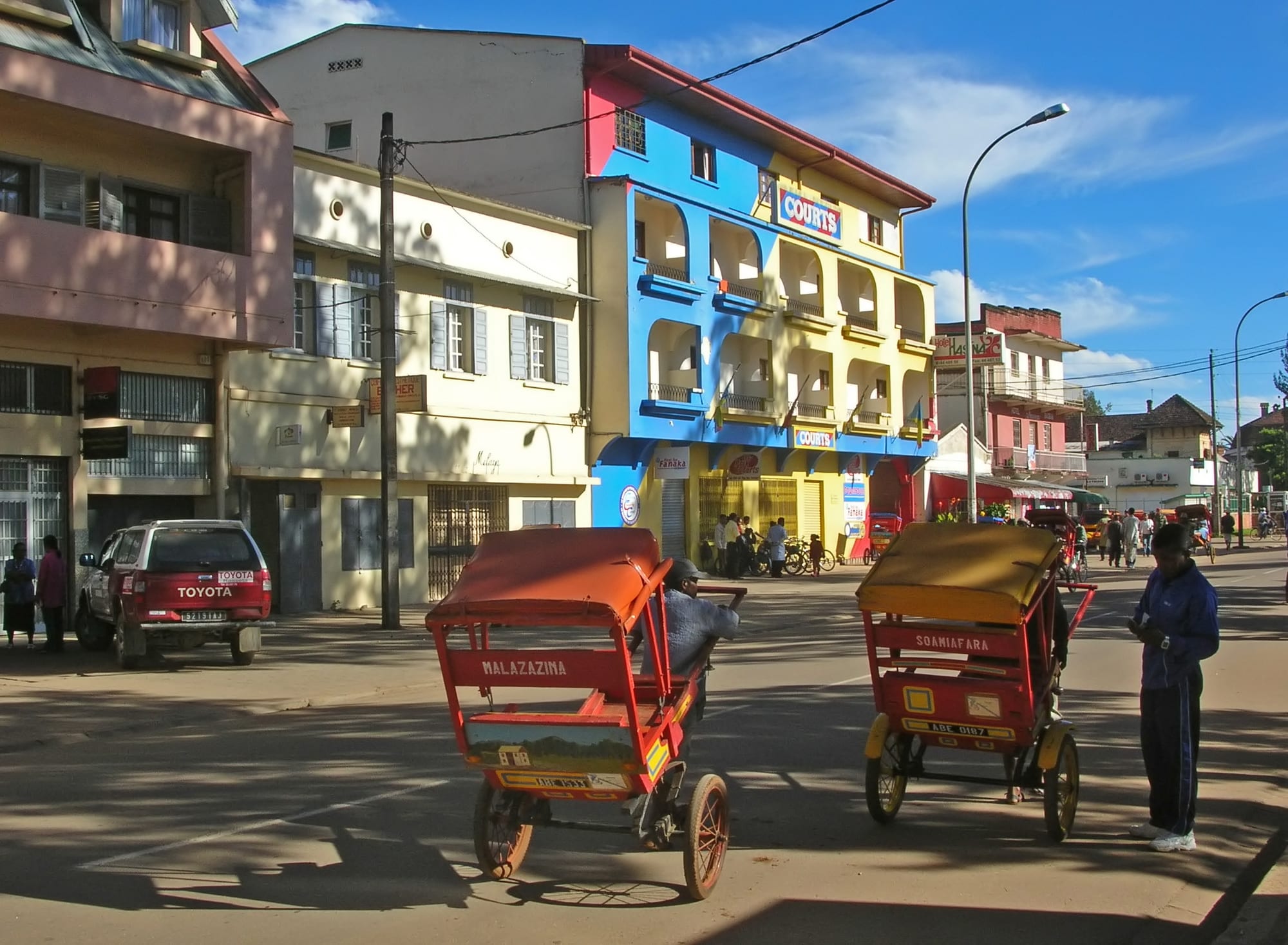
Pousse-pousse and cyclo-pousse rickshaws are the standard way to move around town, alongside small buses, tuk-tuks and private taxis. Taxi-brousse minibuses leave mostly from the main bus station in the north of the city for Antananarivo, for the south along the RN7 and for Betafo and Morondava to the west. Cars with drivers can be hired for the lakes and the surrounding countryside.
Roads to the crater lakes and Betafo are rough in places, so allow more time than the distances suggest.
🛬 Airport & Station Connections
Antsirabe is reached by road. The RN7 from Antananarivo, about 170 kilometres north, takes roughly four to five hours by taxi-brousse or car depending on traffic leaving the capital, and the same road continues south towards Ambositra and Fianarantsoa. Most visitors fly into Ivato at Antananarivo. The railway from the capital now carries only freight.
🚶 Walkability
The centre is flat, laid out on wide straight avenues, and easy to walk end to end in half an hour. Pavements are uneven and the traffic mixes cars, rickshaws and carts, but distances are short and the altitude keeps the air cool. The lakes and the terraces are too far to walk and need a vehicle or a bicycle.
🛡️ Safety
Outside Antananarivo the highlands are generally calm, though petty theft happens in the market and around the bus stations, and the RN7 has a poor accident record. Political demonstrations concentrate in the capital rather than here, but national unrest can affect fuel supplies and road travel. Roads out of town are unlit and used by pedestrians and carts after dark.
Carry little in the market, use a taxi or rickshaw after dark, and do not travel by road at night. Check current official travel advice before travelling.
🌦️ Climate
Cool for the tropics, and colder than the capital because of the altitude. The southern-hemisphere summer, December to February, is the rainy season, with warm days and heavy afternoon storms; the winter months of June to August are dry and sunny by day with sharply cold nights, and frost is possible on the higher ground nearby.
- Summer
- warm and wet, about 15–26°C, with afternoon thunderstorms from November to March
- Winter
- dry and sunny by day, about 17–21°C, with nights near or below 5°C
🤝 Local Customs
Greetings are unhurried and a handshake is usual. Malagasy is spoken everywhere and French is widely understood. The pousse-pousse pullers, craft sellers and guides who approach visitors in the street are working hard for small sums; a polite refusal is understood. Ancestral custom is strong on the plateau, and tombs stand in the fields around the town.
Ask before photographing people, tombs or ceremonies, dress modestly, and treat family tombs as private property.
💳 Common Payment Methods
The currency is the Malagasy ariary. Cash machines and banks are in the town centre and change euros and US dollars; cards are taken by the larger hotels and a few restaurants and gem dealers, but everything else — markets, rickshaws, hotely meals, workshops — is cash, in small notes.