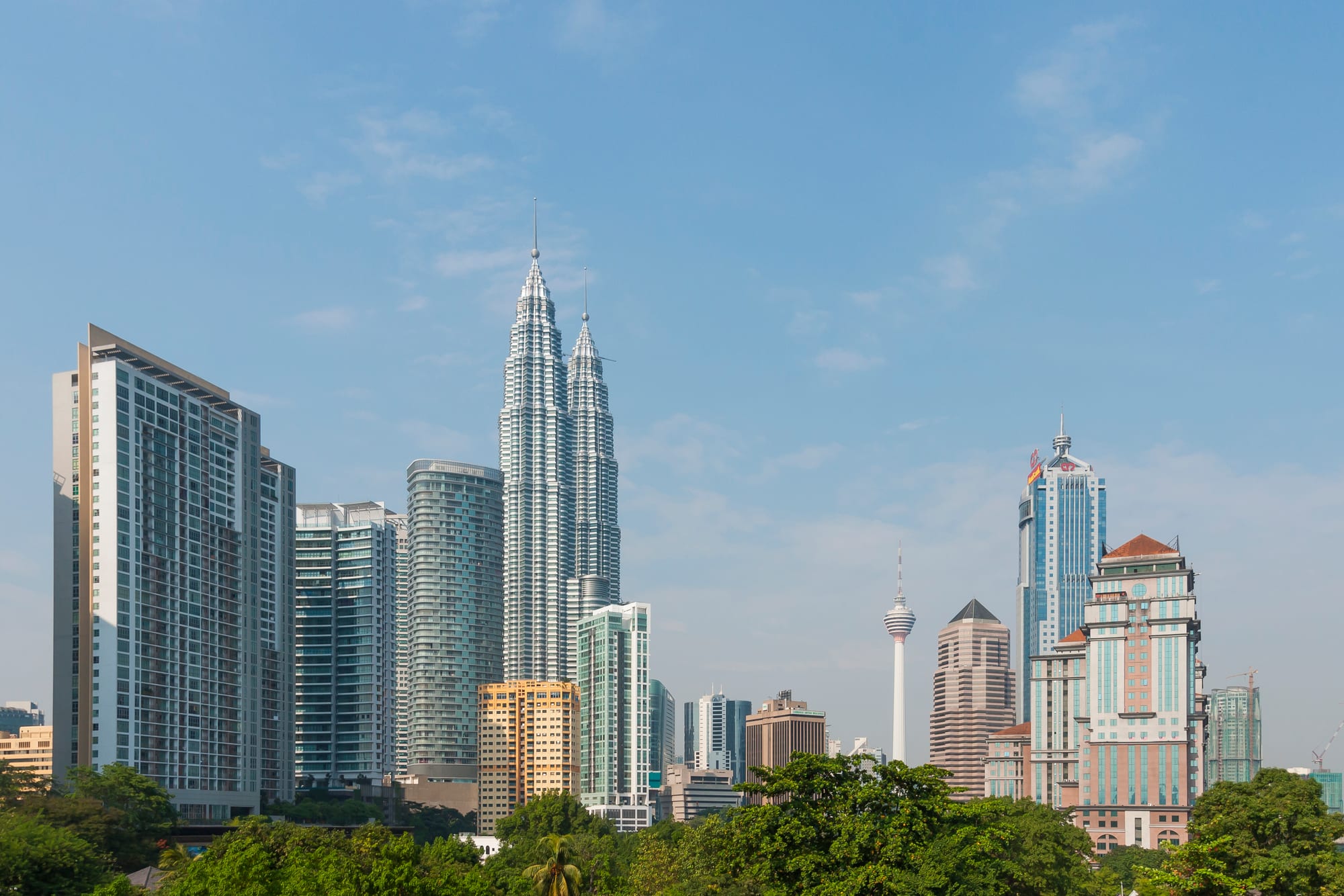
The twin spires of the Petronas Towers rising above glass apartment blocks and green trees, with a slender communications tower to the right

Kuala Lumpur & the Central Peninsula, Malaysia

Kuala Lumpur

The Kuala Lumpur skyline with the Petronas Twin Towers and, at right, the KL Tower. (CEphoto, Uwe Aranas / Wikimedia Commons · CC BY-SA 3.0)

Malaysia's capital, built where the Gombak and Klang rivers meet, began as a tin-mining camp in the 1850s and grew into the country's financial and political centre. Steel-clad towers stand over Moorish colonial offices, Chinese shophouses and a surviving Malay village, and its street-food districts and rail network are the everyday face of a mixed, fast-moving city.

Neighbourhoods

  • KLCC and the Golden Triangle
    • First-time visitors
    • Shopping
    • Close to public transport

    The district built around the Petronas Twin Towers, with a large park, a shopping centre at the foot of the towers and most of the city's business hotels. It runs into the Golden Triangle of offices and malls, and an elevated walkway links it to Bukit Bintang.

    Open in Maps
  • Bukit Bintang
    • Best for food
    • Nightlife
    • Shopping

    The main shopping and entertainment quarter, a dense grid of malls, hotels, massage shops and bars. Jalan Alor's food stalls fill one street behind the malls and Changkat Bukit Bintang is the bar strip; the monorail and MRT both stop here.

    Open in Maps
  • Chinatown and Petaling Street
    • Historic district
    • Best for food
    • Budget stays

    The oldest commercial quarter, laid out along Petaling Street and the surrounding shophouse blocks. Market stalls sell clothes and souvenirs under a covered arcade, Chinese, Hindu and Muslim places of worship stand within a few streets, and old coffee shops and hostels fill the side lanes.

    Open in Maps
  • Merdeka Square and the old centre
    • History
    • Architecture
    • Walking

    The colonial core beside the river confluence that gave the city its name. The Moorish-style Sultan Abdul Samad Building faces the old cricket padang, with the Jamek Mosque, the Textile Museum and the riverside walkways a few minutes away.

    Open in Maps
  • Kampung Baru
    • Local life
    • Best for food
    • Malay heritage

    A Malay settlement founded in colonial times and still made up of wooden stilt houses and small lanes, directly across the river from the Petronas Towers. Its food stalls and restaurants are among the best known in the city, and the contrast of village roofs against the towers is its defining view.

    Open in Maps
  • Brickfields
    • Best for food
    • Close to public transport
    • Temples

    The city's Little India, south-west of the centre, with sari shops, garland sellers, banana-leaf restaurants and Hindu and Buddhist temples. KL Sentral, the main rail interchange and the airport train terminus, stands at its edge.

    Open in Maps
  • Bangsar
    • Quiet and residential
    • Cafés
    • Nightlife

    A residential suburb a few kilometres south-west of the centre, popular with professionals and expatriates. Bangsar Baru's streets hold cafés, restaurants and bars, and there is a night market once a week.

    Open in Maps

Things to do

Famous landmarks

  • Petronas Twin Towerslandmark

    The 452-metre twin skyscrapers completed in 1998, linked by a double-decker skybridge on the 41st and 42nd floors and still the tallest twin towers in the world.

    Open in Maps
  • KL Towerviewpoint

    A concrete communications tower on Bukit Nanas with an observation deck that gives the wider view of the city, including the Petronas Towers themselves.

    Open in Maps
  • Sultan Abdul Samad Buildinglandmark

    The Moorish-style former colonial secretariat of 1897, with a copper-domed clock tower, facing Merdeka Square across the road.

    Open in Maps
  • Merdeka Squarelandmark

    The old cricket padang where the Union Flag came down and the Malayan flag was raised at midnight on 31 August 1957, hours before independence was declared at Merdeka Stadium.

    Open in Maps
  • Masjid Jameklandmark

    A 1909 mosque of pink brick and white domes standing at the meeting of the Gombak and Klang rivers, the point where the city began.

    Open in Maps
  • National Mosque of Malaysialandmark

    The country's national mosque, opened in 1965, with a folded concrete roof shaped like an open umbrella and a slender minaret.

    Open in Maps
  • Kuala Lumpur railway stationlandmark

    A white 1910 station building of arches, domes and minarets by the colonial architect A. B. Hubback, still served by local trains.

    Open in Maps
  • Thean Hou Templelandmark

    A large six-tiered Chinese temple on a hill in Seputeh, dedicated to the sea goddess Mazu and known for its lanterns and city views.

    Open in Maps

Museums and galleries

  • Islamic Arts Museum Malaysiamuseum

    The largest museum of Islamic art in Southeast Asia, near the Lake Gardens, with manuscripts, textiles, ceramics and architectural models under decorated domes.

    Open in Maps
  • National Museummuseum

    The country's main historical museum, in a Malay-style building with gabled roofs, covering prehistory, the sultanates, colonial rule and independence.

    Open in Maps

Parks and viewpoints

  • Perdana Botanical Gardenpark

    The Lake Gardens, laid out in the 1880s west of the centre, with lakes, an orchid garden and a large walk-in bird park nearby.

    Open in Maps
  • KLCC Parkpark

    A landscaped park at the foot of the Petronas Towers, designed by Roberto Burle Marx, with a jogging path, a lake and a fountain show after dark.

    Open in Maps
  • KL Forest Eco Parkpark

    A remnant of lowland rainforest on Bukit Nanas in the middle of the city, crossed by a canopy walkway and trails to the foot of the KL Tower.

    Open in Maps
  • Titiwangsa Lake Gardenspark

    A park around a lake north-east of the centre, with the standard postcard view of the skyline across the water.

    Open in Maps

Temples, markets and street life

  • Sri Mahamariamman Templelandmark

    The oldest Hindu temple in the city, founded in 1873, with a tall gopuram tower of carved figures at the edge of Chinatown.

    Open in Maps
  • Central Marketmarket

    An Art Deco market hall completed in 1937 on the site of a wet market of 1888, now full of craft, batik and souvenir stalls.

    Open in Maps
  • Petaling Streetmarket

    The covered market street at the heart of Chinatown, busiest in the evening, with stalls, fruit sellers and old kopitiam coffee shops around it.

    Open in Maps

Short trips from the city

  • Batu Caveslandmark

    A limestone hill on the northern edge of the city whose main cavern holds a Hindu temple to Murugan, reached by 272 painted steps beside a tall golden statue.

    Open in Maps
  • Sultan Salahuddin Abdul Aziz Mosquelandmark

    The blue-domed state mosque at Shah Alam, west of the capital, the largest mosque in Malaysia and the second largest in Southeast Asia by capacity.

    Open in Maps
  • Genting Highlandsattraction

    A cool hill resort about an hour north-east, reached by road and cable car, with a casino, theme park and hotels on a ridge above the forest.

    Open in Maps

Seasonal events

  • ThaipusamJanuary or February, on the full moon of the Tamil month of Thai

    The Hindu festival of Murugan, when a procession leaves the Sri Mahamariamman Temple for the Batu Caves and devotees carry milk pots and kavadi up the steps.

  • Chinese New YearJanuary or February

    Lanterns, lion dances and temple crowds in Chinatown and at Thean Hou Temple, with many shops closed for several days.

  • Hari Raya Aidilfitrivaries with the Islamic calendar

    The end of Ramadan, preceded by large night bazaars selling festive food and followed by open houses; much of the city empties as people return to their home towns.

  • DeepavaliOctober or November

    The Hindu festival of lights, marked with decorations and markets in Brickfields and open houses across the city.

  • National Day31 August

    Malaysia's independence day, marked with a parade and rehearsals that close roads around Merdeka Square.

Eat and drink

Long-standing places and food districts in Kuala Lumpur. Hours, ratings and directions come from your maps app, always current.

Food streets and markets

  • Jalan Alorneighborhood

    A street behind Bukit Bintang lined with open-air Chinese seafood and barbecue restaurants and stalls, busiest from early evening until late.

    Open in Maps
  • Petaling Street and Madras Laneneighborhood

    Chinatown's market street and the hawker stalls in the lanes off it, known for noodle soups, curry laksa and old coffee shops.

    Open in Maps
  • Kampung Baruneighborhood

    Malay food at its most traditional — nasi lemak, grilled fish and coconut-based curries — served at stalls and open-fronted restaurants among the wooden houses.

    Open in Maps
  • Brickfieldsneighborhood

    Little India's banana-leaf rice houses, thosai stalls and sweet shops, with Tamil, Keralan and north Indian cooking on the same streets.

    Open in Maps
  • Chow Kit marketmarket

    A long-established market north of the centre, selling produce, meat and fish in the morning, with Malay and Indonesian food stalls around it in a district known for its Indonesian community.

    Open in Maps

Coffee shops and bars

  • Mamak stallsrestaurant

    Indian-Muslim coffee shops found on almost every street, open around the clock for roti canai, teh tarik, nasi kandar and mee goreng.

    Open in Maps
  • Changkat Bukit Bintangneighborhood

    The main bar and restaurant strip, a steep street of converted shophouses above Jalan Alor with everything from craft beer to cocktail rooms.

    Open in Maps

Experience Kuala Lumpur

History

The city began around 1857, when Chinese tin miners working for a Selangor chief pushed up the Klang river and landed at the muddy confluence with the Gombak that gave Kuala Lumpur its name. The first camps were wooden, malarial and violent, and the settlement was fought over in the Selangor Civil War of the 1860s and 1870s. Under the Hakka leader Yap Ah Loy, appointed Kapitan Cina in 1868, it was rebuilt after fire and flood and grew into the trading centre of the tin fields.

After Britain installed a Resident in Selangor, the state capital was moved here in 1880, and the British Resident Frank Swettenham ordered the town rebuilt in brick. The railway arrived, and a run of public buildings in a Moorish style went up facing the padang: the Sultan Abdul Samad Building in 1897, the railway station in 1910, the Jamek Mosque in 1909. In 1896 Kuala Lumpur became the capital of the Federated Malay States, and rubber estates around it brought Tamil labourers to add to the Malay and Chinese population.

Japanese forces occupied the city from 1942 to 1945. On 31 August 1957 independence was proclaimed at Merdeka Stadium and the flag raised on the padang now called Merdeka Square. Communal riots broke out in the city on 13 May 1969 and reshaped national politics. In 1974 Kuala Lumpur was separated from Selangor as a federal territory; the Petronas Twin Towers were completed in 1998, and from the end of that decade the federal government moved its ministries out to the new city of Putrajaya, leaving the capital as the commercial and royal centre.

Culture & Customs

Kuala Lumpur is the most mixed place in Malaysia: Malay, Chinese and Indian Malaysians, Indigenous families from Sabah and Sarawak, migrant workers from Indonesia, Bangladesh and Nepal, and professionals from every state. Malay, English, Cantonese, Mandarin and Tamil are heard within a block of each other, and Malaysian English — Manglish, with its borrowed words and its sentence-ending "lah" — is the shared city idiom.

The festival calendar belongs to everyone at once. Thaipusam takes a procession from the Sri Mahamariamman Temple to the Batu Caves; Chinese New Year lights the Chinatown streets and the temples; Ramadan brings bazaars of festive food to every neighbourhood and Hari Raya the open house, where friends of any faith are fed; Deepavali does the same in Brickfields. Islam is the religion of the Malay majority and shapes public life, from the call to prayer to Friday afternoons, when offices empty for a time.

Away from the festivals, the city's culture runs on food, shopping and football. The mall is a social space as much as a shop, late-night mamak stalls show European league matches to full tables, and badminton is followed closely. Manners are gentle and indirect: greetings are soft, the right hand is used for giving and receiving, and open confrontation is avoided. Race and religion are handled carefully in public conversation, and modest dress is expected at mosques and temples.

Daily Life

About 2.1 million people live within the federal territory and about 8.8 million in Greater Kuala Lumpur, the conurbation that takes in the Klang Valley and spreads into Selangor through Petaling Jaya, Shah Alam, Subang Jaya, Klang and Kajang. Most live in condominium towers or suburban terraced houses well outside the centre, and commutes are long: the rail network keeps expanding, but the roads still fill twice a day.

The economy is built on finance and banking, oil and gas administration, professional services, retail, media and a growing technology and data-centre sector, with the federal civil service now largely at Putrajaya. The city draws workers from across the country and the region, and housing costs are a constant complaint, as are floods after the heaviest storms.

The day starts early, often with nasi lemak or roti canai at a stall on the way to work, and pauses in the heat of the afternoon. Lunch is a quick food-court meal; the evening belongs to the mall, the night market and the mamak table, where groups sit over teh tarik long after midnight. Weekends mean family meals, markets and, for many, the drive back to a home town elsewhere in the country.

Food

Kuala Lumpur eats from every Malaysian kitchen at once, and mostly outside the home. The city's own dish is Hokkien mee, thick yellow noodles braised dark in soy sauce with pork, squid and crisp pork fat — different from the Penang version of the same name. Alongside it come wantan mee, curry laksa in a coconut gravy, claypot chicken rice cooked over charcoal and the chilli-and-anchovy plate of nasi lemak, the national breakfast.

The Indian-Muslim mamak shop is the city's great leveller, open at any hour for roti canai with dhal, mee goreng mamak, nasi kandar piled with curries and teh tarik, tea poured between two pots until it froths. Brickfields serves banana-leaf rice, thosai and sweets; Kampung Baru serves Malay cooking at its most traditional, from grilled fish to coconut curries; Chinatown's lanes keep the old noodle and porridge stalls; and Jalan Alor fills each evening with open-air seafood and barbecue tables.

Markets shape the routine. The pasar malam, a night market that moves from neighbourhood to neighbourhood on a fixed day of the week, sells cooked food and produce from the pavement; Chow Kit is the big wet market; and Ramadan bazaars appear for a month each year. Durian, sold from kerbside stalls in season, divides visitors sharply. Drinks are kopi from a kopitiam, fresh lime and sugarcane juice and the pink rose-milk air bandung, with beer and cocktails in the bar districts.

Planning tools

Budget

Kuala Lumpur is the most expensive city in Malaysia but cheap by the standards of other Asian capitals. Hawker and mamak meals cost very little, the rail network is inexpensive, and hotel rooms are good value outside major holidays. Alcohol is heavily taxed and is often the single biggest item on an evening bill.

Daily Budget Midrange
USD 75–160 (city hotel, restaurant dinners, Grab rides, museum entries)
Daily Budget Shoestring
USD 25–45 (hostel bed or budget room, hawker and mamak meals, MRT, LRT and monorail)

Stay near an MRT, LRT or monorail station and use the trains rather than taxis; many of the best things — Merdeka Square, the temples, KLCC Park, the markets — cost nothing.

Best Time to Visit

Any month works in an equatorial city with little seasonal change. June to August and December to February are slightly drier. Thaipusam, usually in late January or early February, fills the Batu Caves and the roads to them; Chinese New Year and Hari Raya close many businesses but empty the traffic. Regional haze can affect air quality in some years, mainly between August and October.

Suggested Number of Days

Two to three days cover the central districts, the main museums and the food streets. Four or five allow for the Selangor towns, the hill resorts and the caves north of the city. Heat, rain and traffic slow everything down, so fewer sights fit into a day than the distances suggest.

First Visit
2–3 days
With Surroundings
4–5 days

Transportation

The Klang Valley has an extensive network of MRT, LRT, monorail and Komuter lines, with interchanges at KL Sentral and in the centre and a stored-value card accepted across them. A Komuter line serves the Batu Caves. Grab, the region's ride-hailing app, is cheap and the usual way to reach places off the rail lines, and buses fill the gaps slowly. Traffic in the city centre is heavy at peak hours.

Buy a stored-value card for the rail lines, allow extra time in the afternoon rush and during storms, and use Grab rather than flagging taxis on the street.

Airport & Station Connections

Kuala Lumpur International Airport at Sepang, about 45 kilometres south of the centre, is the country's main gateway and the base of several low-cost carriers; the KLIA Ekspres train reaches KL Sentral in around half an hour, and taxis and buses take longer. Subang airport, much closer, handles turboprop and regional flights. Long-distance buses use the Bandar Tasik Selatan terminal in the south, and ETS trains run north to Ipoh, Penang and the Thai border.

Walkability

The centre is walkable in parts — Merdeka Square, Chinatown and the river quarter form one compact area, and a covered walkway links Bukit Bintang with KLCC — but heat, humidity, sudden downpours, broken or missing pavements and wide roads with few crossings make longer walks hard work. Most people combine short walks with trains or Grab rides, and indoor walkways and malls are used as shortcuts in the middle of the day.

Safety

Kuala Lumpur is generally safe and violent crime against visitors is rare. The common problems are bag-snatching by motorcyclists, pickpockets in crowded markets and on packed trains, taxi touts at transport hubs and card skimming. Traffic is the bigger everyday hazard: motorcycles use pavements and crossings are scarce. Heavy storms can cause flash floods in low-lying parts of the city.

Carry bags on the side away from the traffic, use Grab at night and keep clear of drains and underpasses in heavy rain. Check the latest advice before booking any island or dive trip off eastern Sabah, wear bags on the traffic-free side, dress modestly around mosques and in the religious east-coast states, and note that drug trafficking carries a mandatory death penalty. Check current official travel advice before travelling.

Climate

Equatorial and humid, warm and much the same all year, with sunny mornings and frequent heavy thunderstorms in the late afternoon. The wettest months are around April and from October to November. Sheltered by the Titiwangsa range, the city avoids the worst of both monsoons.

Summer
hot and humid, about 24–34°C, with late-afternoon storms
Winter
much the same, about 23–33°C, with heavier rain in November and December

Local Customs

Tipping is not expected; mid-range and upmarket restaurants add a service charge instead. Dress is relaxed in the malls and bars but modest clothing is expected at mosques and temples, where shoes are removed and robes are lent to visitors at the main mosques. The right hand is used for eating and for passing things, and shoes come off at the door of a home.

Ask before photographing worshippers, avoid eating and drinking in public in daylight in front of others during Ramadan, and note that alcohol is sold openly but is taxed heavily and is not served everywhere.

Common Payment Methods

The currency is the Malaysian ringgit (MYR), written RM. Cards and QR payment apps are accepted in malls, hotels and chain restaurants, but hawker stalls, markets and small coffee shops often want cash. ATMs are easy to find, and money changers in the malls give better rates than airport counters.