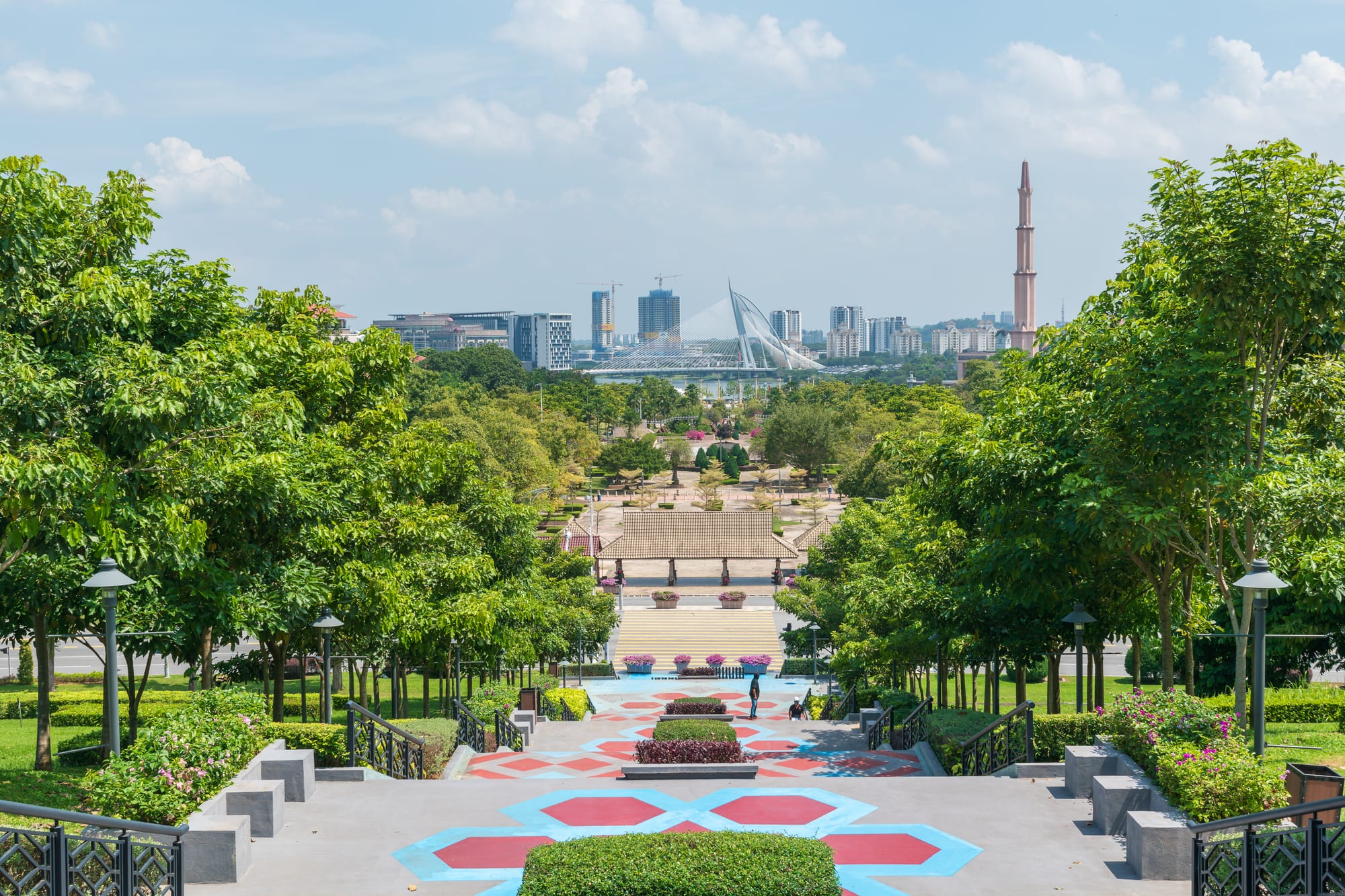
A formal tiled stairway and garden framed by trees, looking across parkland to a white cable-stayed bridge and office towers

Kuala Lumpur & the Central Peninsula, Malaysia

Putrajaya

The view from the Putrajaya Steps across the gardens towards the city centre. (Dominic Nelson / Wikimedia Commons · CC BY-SA 4.0)

A planned city built in the 1990s on former plantation land south of Kuala Lumpur to hold Malaysia's federal ministries, and a federal territory in its own right since 2001. Its ministries, mosques and bridges are arranged around an artificial lake and wide boulevards, and many of its residents are civil servants and their families.

Neighbourhoods

  • Precinct 1 and the Core Island
    • First-time visitors
    • Architecture
    • Government buildings

    The ceremonial centre on an island in the lake, holding the Putra Mosque, the prime minister's Perdana Putra complex, Putra Square and the main ministries. Almost everything a visitor comes to see is within a walk of this precinct, though the distances along its boulevards are long.

    Open in Maps
  • Precinct 2 and the waterfront
    • Best for food
    • Boat trips
    • Evenings

    The lakeside strip below the Core Island, with the jetty for lake cruises, restaurants and cafés along a promenade and the convention centre on the hill above. It is where the city feels busiest after dark.

    Open in Maps
  • Alamanda and the commercial precinct
    • Shopping
    • Close to public transport
    • Hotels

    The commercial quarter around the Alamanda shopping centre, the only mall in the city, with the main cluster of hotels, chain restaurants and a cinema. Putrajaya Sentral, the city's rail gateway, stands a few kilometres away in Precinct 7.

    Open in Maps
  • The residential precincts
    • Quiet and residential
    • Local life

    Numbered precincts of terraced houses, government quarters and apartment blocks spread around the lake, each with its own mosque, school, shops and food court. They are quiet, green and planned to a pattern, and they empty at weekends.

    Open in Maps
  • Precinct 3 and the Palace of Justice
    • Architecture
    • Walking

    The judicial quarter south of the Core Island, where the domed Palace of Justice faces the steel-walled Iron Mosque and ministry buildings in Islamic and Moorish styles line the roads. It is an area of formal set-piece architecture rather than street life.

    Open in Maps

Things to do

Landmarks and government architecture

  • Putra Mosquelandmark

    The rose-tinted granite mosque on Putra Square beside the lake, built between 1997 and 1999, with a prayer hall under a pink dome that holds up to 15,000 worshippers.

    Open in Maps
  • Perdana Putralandmark

    The green-domed complex on the hill above Putra Square that houses the prime minister's office, the city's most photographed building.

    Open in Maps
  • Tuanku Mizan Zainal Abidin Mosquelandmark

    The Iron Mosque, built largely of architectural steel with mesh walls that filter the light, in Precinct 3.

    Open in Maps
  • Palace of Justicelandmark

    The domed and arcaded courts building in a Mughal and Moorish style, completed in 2003, when the Federal Court and the Court of Appeal moved here from Kuala Lumpur.

    Open in Maps
  • Istana Melawatilandmark

    The second of the national palaces, on a hill in Precinct 1, used as a royal retreat by the King; it is seen from outside only.

    Open in Maps
  • Putrajaya International Convention Centrelandmark

    A silver, eye-shaped hall on a ridge south of the lake, with wide views over the city from its terraces.

    Open in Maps

The lake and its bridges

  • Putrajaya Lakeattraction

    The 650-hectare artificial lake at the centre of the plan, used for cruise boats, water sports and fishing, and designed to cool the city.

    Open in Maps
  • Seri Wawasan Bridgelandmark

    A cable-stayed bridge with a forward-leaning sail-shaped pylon, lit in colour at night.

    Open in Maps
  • Putra Bridgelandmark

    The main bridge to the Core Island, its piers and pavilions modelled on Persian bridge architecture, carrying a road and a pedestrian level.

    Open in Maps
  • Seri Gemilang Bridgelandmark

    The ceremonial approach to the convention centre, with arches, obelisks and viewing balconies over the water.

    Open in Maps

Parks and wetlands

  • Putrajaya Botanical Gardenpark

    The largest botanical garden in the country, on the northern shore, with themed plant collections, a canopy bridge and a palm collection.

    Open in Maps
  • Putrajaya Wetlands Parkpark

    The largest constructed freshwater wetlands in the tropics, built to filter water entering the lake and now a park of channels and reed beds with walking and cycling paths and a great deal of birdlife.

    Open in Maps

Short trips from the city

  • Cyberjayaneighborhood

    The technology township planned alongside Putrajaya, built around data centres, offices and a university campus.

    Open in Maps
  • Sepang International Circuitattraction

    The motor-racing circuit south of the city, host of motorcycle grand prix racing and endurance events.

    Open in Maps
  • Batu Caveslandmark

    The limestone hill north of Kuala Lumpur whose cavern holds a Hindu temple to Murugan, reached by 272 painted steps.

    Open in Maps

Seasonal events

  • Hari Raya Aidilfitrivaries with the Islamic calendar

    The end of Ramadan, preceded by a large Ramadan bazaar and marked by open houses, including official ones held in the administrative capital.

  • National Day31 August

    Malaysia's independence day; the national parade has been held at Putra Square in some years, and government buildings are decorated through the month.

Eat and drink

Long-standing places and food districts in Putrajaya. Hours, ratings and directions come from your maps app, always current.

Where people eat

  • Precinct 2 waterfront restaurantsneighborhood

    Cafés and restaurants along the promenade below the Core Island, the closest thing the city has to an evening dining strip, with tables looking over the lake.

    Open in Maps
  • Alamanda food court and restaurantsneighborhood

    The mall in Precinct 1 where much of the city eats at lunchtime, with a food court of Malay, Chinese and Indian stalls alongside chain restaurants.

    Open in Maps
  • Precinct food courts and medan seleraneighborhood

    Each residential precinct has a hawker centre serving nasi campur, grilled fish and noodles to civil servants at lunch, quiet in the evening.

    Open in Maps
  • Putrajaya Ramadan bazaarmarket

    A large seasonal market of Malay festive food set up during the fasting month, one of the biggest in the Klang Valley.

    Open in Maps

Experience Putrajaya

History

Putrajaya is a deliberate creation, not a town that grew. By the early 1990s Kuala Lumpur's centre was congested and the federal government was scattered across dozens of rented buildings, so the administration decided to build a new seat on about 4,600 hectares of oil-palm and rubber plantation bought from Selangor. The site had been the Prang Besar estate, opened as a rubber plantation in 1921; the new city took its name from Tunku Abdul Rahman Putra, Malaysia's first prime minister, with jaya meaning success.

Work began in the mid-1990s under Prime Minister Mahathir Mohamad, whose government also laid out the neighbouring technology township of Cyberjaya as part of the same Multimedia Super Corridor scheme. Two rivers were dammed to form a lake at the heart of the plan, the ground was raised into a series of numbered precincts, and a ceremonial boulevard was drawn from the convention centre to the prime minister's office. The first civil servants moved in during 1999, the year the Putra Mosque was completed, and the prime minister's department followed.

Most federal ministries had relocated by the early 2000s and the Federal Court and Court of Appeal followed in 2003, though parliament, the palace and the central bank stayed in Kuala Lumpur, which remains the national capital. In February 2001 Putrajaya was ceded by Selangor to become Malaysia's third federal territory, after Kuala Lumpur and Labuan. Building continued through the following two decades, adding courts, a second landmark mosque, further bridges and residential precincts, and the city has since been connected to the capital and the airport by rail.

Culture & Customs

The city's character comes from its purpose. Most working residents are public servants, and the rhythm of the place follows the government's: crowded car parks and full food courts on weekday mornings, a long midday break on Fridays for prayers, and near-silence at weekends and during festival holidays, when many residents return to home towns elsewhere.

Its population is overwhelmingly Malay and Muslim, a far higher share than in the Klang Valley around it, and public life reflects that. The two great mosques are civic landmarks as much as religious ones, Ramadan brings one of the region's largest bazaars, and official open houses at Hari Raya are held in the ceremonial squares. Dress is more formal and more covered than in the capital, and alcohol is much less visible.

Architecturally the city was planned as a statement: Islamic and Mughal motifs, domes, arches and monumental axes, arranged along a ceremonial boulevard in a manner drawn from planned capitals elsewhere. Opinions divide sharply, in Malaysia as much as among visitors, between admiration for its ambition and scepticism about a city built for cars and ceremonies. Its parks, lake sports and cycling routes have given it a second identity as a place for weekend recreation, and it hosts national events — parades, balloon flights, flower shows — that need space the capital does not have.

Daily Life

Something over 100,000 people live in Putrajaya, spread through numbered precincts of terraced houses, government quarters and apartment blocks, while many more commute in each day from Kuala Lumpur, Cyberjaya, Bangi and Kajang. It is among the youngest and most planned populations in the country, with schools, clinics, mosques and a local shopping row built into each precinct.

The economy is the federal government, plus the services that support it: contractors, security, cleaning, catering, the courts, and the hotels and convention business. Cyberjaya's offices and data centres next door provide private-sector work, and the airport corridor is close. Household incomes are comparatively high, and most families own at least one car.

The day begins early, with prayers and a school run before the heat, and the offices empty by late afternoon. Evenings are for the food courts, the malls, the lakeside promenade and the parks, where the cooler hours bring out joggers, cyclists and families. Common complaints are the distances, the dependence on cars, the sleepiness of weekends, and rents that rise as more people move out from the capital.

Food

Putrajaya's food is Malay first. The staple of the working day is nasi campur — rice with a choice of curries, fried fish, vegetables and sambal, priced by what is taken — eaten at precinct food courts known as medan selera. Breakfast is nasi lemak wrapped in banana leaf, roti canai with dhal, or a bowl of laksa, usually with kopi or teh tarik pulled between two pots.

Ikan bakar, fish or squid split, coated in spice paste and grilled over charcoal, is a local standby, served with rice, ulam — raw herbs and leaves — and sambal belacan. Ayam percik, chicken grilled with a coconut and chilli glaze, and satay from stalls that set up in the evening are similarly common, and the city's Indian-Muslim mamak shops supply nasi kandar, mee goreng and late-night tea in the precincts where they exist.

Because the city is new, it has no dish of its own and few long-established institutions; food is found in malls, hotel restaurants, precinct hawker centres and the lakeside cafés rather than in old shophouses. The exception is the fasting month, when the Ramadan bazaar sets out rows of stalls selling murtabak, grilled meats, kuih in bright colours and sweet drinks such as air bandung and sugarcane juice, and draws crowds from well beyond the city.

Planning tools

Budget

Putrajaya costs less than Kuala Lumpur for food, since most eating is done at food courts and mall restaurants aimed at civil servants, but it has fewer budget beds; hotels are mid-range business places and fill during conferences. Getting between precincts adds ride-hailing fares for anyone without a car.

Daily Budget Midrange
USD 70–150 (business hotel, restaurant meals, Grab rides between precincts, a lake cruise)
Daily Budget Shoestring
USD 25–45 (budget room or a stay in Kuala Lumpur, food-court meals, bus and train)

Many visitors come out from Kuala Lumpur for the day by train rather than staying; the mosques, bridges, parks and lakeside walks cost nothing.

Best Time to Visit

The weather varies little, so timing depends on events and crowds. Mornings and late afternoons are the only comfortable times to walk the boulevards. Weekdays show the city working; at weekends the ministries close and the parks and lake fill with families. The balloon fiesta and the flower festival draw heavy traffic on their weekends.

Suggested Number of Days

One day covers the mosques, the lake and the main buildings. Two suit anyone who also wants the parks, a boat trip and the neighbouring townships. Heat and long distances between precincts slow a visit more than the map suggests.

First Visit
1 day
With Surroundings
2 days

Transportation

The city was designed around the car, and its precincts are linked by wide boulevards and roundabouts rather than streets. Putrajaya Sentral, in Precinct 7, is the rail hub, served by the KLIA Transit line and by the MRT Putrajaya Line from the capital; from there local buses run to the precincts, and Grab is the simplest way to move between sights. Cycle paths and lake cruises cover some of the distances pleasantly.

Plan on a ride-hailing app or a hire car between precincts; walking from one landmark to the next in the middle of the day is hot and exposed.

Airport & Station Connections

Putrajaya lies roughly 30 kilometres south of central Kuala Lumpur, on the way to Kuala Lumpur International Airport, which makes it a common stop between the two. The KLIA Transit train links Putrajaya Sentral with KL Sentral and the airport, the MRT Putrajaya Line runs out from the capital, and buses and taxis use the expressways.

Walkability

Walkability is the city's weak point. Within the Core Island the mosque, Putra Square and the prime minister's complex are close together and pleasant to walk between, and the lakeside promenades and park paths are good for a stroll early or late. Everywhere else the scale is designed for cars, with long blocks, few crossings and little shade, so most people drive or ride between precincts.

Safety

Putrajaya is one of the safest places in Malaysia, with a heavy official presence, low crime and quiet streets. The practical risks are heat exhaustion and sunburn on long walks, sudden thunderstorms, and traffic on wide roads where drivers move quickly and pedestrian crossings are far apart.

Carry water, keep out of the midday sun and take care crossing the boulevards. Check the latest advice before booking any island or dive trip off eastern Sabah, wear bags on the traffic-free side, dress modestly around mosques and in the religious east-coast states, and note that drug trafficking carries a mandatory death penalty. Check current official travel advice before travelling.

Climate

Equatorial and humid, with high temperatures and heavy humidity all year and frequent thunderstorms in the late afternoon. The open boulevards and the lake make the heat feel stronger than in the shaded streets of the capital. Rain is heaviest around April and from October to November.

Summer
hot and humid, about 24–34°C, with late-afternoon storms
Winter
much the same, about 23–33°C, with heavier rain in November and December

Local Customs

This is a government city and dress is noticeably more conservative than in Kuala Lumpur. Visitors to the Putra Mosque and the Iron Mosque must cover arms and legs; robes are lent at the entrance, shoes are removed, and the prayer halls close to visitors at prayer times, particularly on Friday afternoons. Photography of ministry buildings from the street is normal, but guards may stop people entering compounds.

Dress modestly, time a visit around Friday prayers, and do not photograph security posts or the palace grounds.

Common Payment Methods

The currency is the Malaysian ringgit (MYR), written RM. Cards and QR payment work in the malls, hotels and restaurants; food-court stalls and the Ramadan bazaar are cash businesses. ATMs are in the shopping centres and precinct shop rows rather than spread along the boulevards.