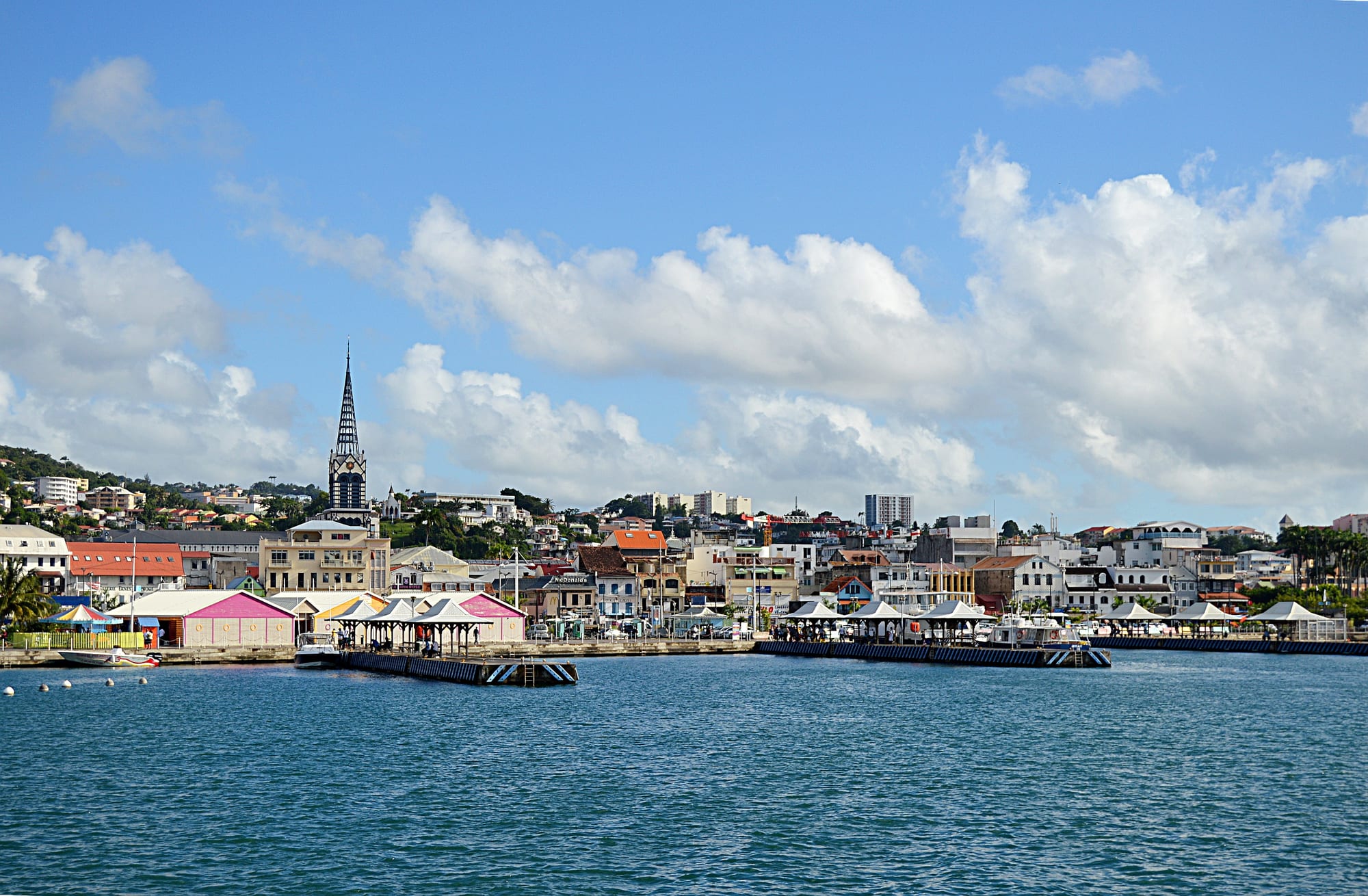
Fort-de-France's waterfront across blue water, with a dark spire, piers and hillside houses under white clouds

Martinique

Fort-de-France

The harbour and waterfront of Fort-de-France seen from the bay. (Scott S Bateman / Wikimedia Commons · CC BY-SA 4.0)

The capital of Martinique, spread around a deep bay on the island's Caribbean coast below green hills. Founded beside a French fort in the 17th century, it became the island's main city after Mont Pelée destroyed Saint-Pierre in 1902. Today it is the administrative and commercial centre, with an iron-framed cathedral, a library shipped from Paris, a busy market and a seafront promenade.

Neighbourhoods

  • Centre-ville
    • First-time visitors
    • Historic district
    • Shopping

    The old colonial grid between La Savane, Fort Saint-Louis and the river, always somewhat crowded by day. Rue Victor Hugo is the main shopping street, the cathedral and the Grand Marché are a few blocks apart, and the streets end at the seafront promenade with its bars and restaurants.

    Open in Maps
  • Pointe Simon and the seafront
    • Waterfront
    • Close to public transport

    The western edge of the centre, where the cruise terminal sits and the dedicated bus line to Le Lamentin and the airport begins. The Malecon promenade and the small Plage de la Française beach are popular places to walk and meet.

    Open in Maps
  • Terres-Sainville
    • Local life
    • Quiet and residential

    A former marsh north-west of the old town, drained and built over in the early 20th century. It is lived-in rather than visited, with its own church and sports ground.

    Open in Maps
  • Didier and Balata
    • Cooler hills
    • Quiet and residential
    • Nature

    The cooler heights north of the centre, where better-off families built villas away from the heat of the lower town. The road climbs through Didier towards the rainforest, and Balata, further up in the hills, has a domed church and a botanical garden.

    Open in Maps

Things to do

Famous landmarks

  • Fort Saint-Louislandmark

    A seaside fortress on a rocky point in the bay, built up from strongholds begun in 1638, now both an active naval base and a listed historic site; there are daily tours, though the naval part is off-limits.

    Open in Maps
  • Saint-Louis Cathedrallandmark

    A Romanesque Revival cathedral of 1895 with an iron frame meant to withstand the fires, earthquakes and hurricanes that destroyed the six churches before it on the same site.

    Open in Maps
  • Schœlcher Librarylandmark

    The public library facing La Savane, a building mixing Byzantine, Art Nouveau and Egyptian influences, first put up for the Paris Exposition of 1889, then taken apart, shipped to Martinique and rebuilt; it is named after the abolitionist Victor Schœlcher.

    Open in Maps
  • Sacré-Cœur de Balatalandmark

    A church in the hills above the city, known as the 'Montmartre of Martinique', modelled freely on the Sacré-Cœur basilica in Paris.

    Open in Maps

Parks and the waterfront

  • La Savanepark

    An unfenced park on the bay, once a royal garden for testing new plants, now the city's main green space and venue for events; the statue of the Empress Joséphine that stood here was torn down in 2020.

    Open in Maps
  • The Malecon and Plage de la Françaisepark

    The seafront promenade and small town beach, a favourite place for residents to walk, meet and let children play.

    Open in Maps
  • Ferry across the baytransit hub

    Regular boats cross the bay from the centre to several landings around Les Trois-Îlets, avoiding the traffic and giving a view of the city from the water.

    Open in Maps

Museums and markets

  • Regional Museum of History and Ethnographymuseum

    A museum that documents Martinique's history and cultural heritage.

    Open in Maps
  • Dillon Distillerymuseum

    A former plantation turned rum distillery, worked by enslaved labour for a century and a half; it now ages and bottles its rum here and has a small museum about rum-making.

    Open in Maps
  • Grand Marchémarket

    The covered market on rue Blénac and rue Isambert, with stalls of flowers, fresh fruit and vegetables, herbs and spices.

    Open in Maps
  • Rue Victor Hugoneighborhood

    The main shopping street of the old centre, a strip of boutiques and island shops, with vendors of fresh fruit and flowers.

    Open in Maps

Walks and nature

  • Cascade Didiertrail

    A waterfall reached by the Route de Didier, through a tunnel into tropical forest only a short drive from downtown.

    Open in Maps
  • Cascade Absalontrail

    A waterfall in the forest up the Route de Balata, reached by a turning just after the Balata Garden.

    Open in Maps
  • Balata Gardenpark

    A private botanical garden of three hectares on the Route de Balata, about 10 km from the city.

    Open in Maps

Short trips from the city

  • Les Trois-Îletsattraction

    The resort commune across the bay, reached by ferry, with beaches, a marina and the Pagerie museum on the estate of the Empress Joséphine's family.

    Open in Maps
  • Saint-Pierreattraction

    The former capital on the north-west coast, destroyed by the 1902 eruption of Mont Pelée, with ruins left standing among the rebuilt town.

    Open in Maps
  • Mont Peléetrail

    The active volcano of northern Martinique, whose volcanoes and forests, with the peaks of the north, were listed as a UNESCO World Heritage Site in 2023.

    Open in Maps

Seasonal events

  • Carnivalthe days before Lent, ending on Ash Wednesday

    Martinique's four-day Carnival, held in towns across the island, with parades, drums and costumes, ending with the burning of Vaval, a papier-mâché figure; many businesses close.

  • Festival culturel de Fort-de-FranceJune and July

    The city's yearly cultural festival of music, theatre and dance.

Eat and drink

Long-standing places and food districts in Fort-de-France. Hours, ratings and directions come from your maps app, always current.

Fort-de-France classics

  • Grand Marchémarket

    The covered market for spice mixes, flowers, tropical fruit and vegetables, and the easiest place to see what Martinican kitchens use.

    Open in Maps
  • Seafront bars and restaurantsneighborhood

    The promenade at the edge of the centre has a string of bars and restaurants serving Creole dishes and French cooking.

    Open in Maps

Food districts

  • Rue Victor Hugo and the old centreneighborhood

    Snack bars, bakeries and lunchtime Creole restaurants serving office workers and shoppers in the colonial grid.

    Open in Maps

Experience Fort-de-France

History

The site on the great bay was first called Cul-de-Sac Royal. A fort went up on the rocky point from 1638, and the town that grew beside it became Fort-Royal; in 1692 the colonial capital was moved here from Saint-Pierre, which remained the island's commercial centre. Renamed Fort-de-la-République during the Revolution, the town reverted to Fort-Royal and took the name Fort-de-France in 1807. Fire and earthquakes repeatedly damaged it, which is why the cathedral standing today, completed in 1895, is the seventh church on its site and has an iron frame.

The eruption of Mont Pelée in 1902 destroyed Saint-Pierre and killed most of its population, leaving Fort-de-France as Martinique's main city. In the early 20th century the marshes north-west of the centre were drained and the new district of Terres-Sainville was built over them, but rural migration after the mid-1950s outpaced building, and informal settlements such as Texaco — the setting of Patrick Chamoiseau's Goncourt-winning novel — spread over the hills around the centre. Aimé Césaire, the poet of Négritude, was mayor for 56 consecutive years, from 1945 to 2001.

Since the 1990s the commune's population has fallen as families moved to Le Lamentin, Schœlcher and other neighbouring communes. Colonial memory has been the subject of protests: statues of Victor Schœlcher in the city and in neighbouring Schœlcher were destroyed on 22 May 2020, and the statue of the Empress Joséphine on La Savane, beheaded in 1991, was torn down the same year. In March 2026 Didier Laguerre was re-elected mayor.

Culture & Customs

Fort-de-France is the island's cultural centre as well as its capital. The Schœlcher Library and the regional museum of history and ethnography keep Martinique's written and material heritage, La Savane hosts open-air events, and the city runs a cultural festival every June and July. Césaire's long tenure gave the city a strong identity as a place of writers and ideas, and Chamoiseau's novel made one of its hillside districts known far beyond the Caribbean.

Music runs through daily life. Zouk, which grew out of Martinique and Guadeloupe, is the most popular style, and bèlè, an older form with group dancing, song and drums in call-and-response, is kept alive alongside biguine and jazz; the pianist Michel Sardaby was born here. At Carnival, which takes over the island's towns for four days before Lent, calypso and soca are heard too, many men parade in elaborate women's costume, and the papier-mâché figure of Vaval is burned on Ash Wednesday.

The city is French in its institutions and Creole in its speech and manners. Greetings matter, and family, the Sunday meal and the market anchor social life. Public statues in the capital have been at the centre of protests over colonial memory.

Daily Life

About 75,500 people lived in the commune at the 2023 census, and about 115,500 in its urban unit in 2022; it is still the most populous commune on the island. The commune is large, stretching some 12 km from north to south, and is divided into more than a hundred quartiers, from the dense centre and Terres-Sainville to housing estates such as Dillon and Bon Air and the cooler, wealthier heights of Didier, Tivoli and Balata.

The economy rests on government offices, commerce and the port, which handles cargo from Europe, cruise ships and ferries to neighbouring islands. Much activity has moved to Le Lamentin, home to the airport and the main commercial zones, and commuting between the two produces heavy traffic every working day. Several older districts are being renovated under a programme to revive the city centre, and a dedicated bus line now links Pointe Simon with Le Lamentin.

The rhythm of the day is set by the heat: shops open early, many close at midday and reopen in the afternoon, and the centre empties in the evening as people head home to the suburbs. The 2024 cost-of-living protests brought roadblocks and disruption to the city and the airport.

Food

Fort-de-France eats Creole food. Accras de morue, small salt-cod fritters, are the standard snack and starter; colombo, a curry of chicken, pork or goat seasoned with a spice blend brought by Indian indentured labourers, is a staple; and fish is served as court-bouillon, in a spiced tomato and lime sauce, or as blaff, poached in a broth flavoured with lime and herbs. Boudin créole, a Creole blood sausage, is sold at snack stands and in restaurants.

The Grand Marché is the place to see the raw materials: piles of tropical fruit and vegetables, flowers, and bags of colombo powder and other spice mixes. The city's snack bars serve sandwiches, accras and plate lunches to office workers, and the seafront restaurants mix Creole dishes with French cooking.

The drink is rum. Martinique's rhum agricole is distilled from fresh sugar-cane juice rather than molasses, and the ti-punch — white rum, cane syrup and a piece of lime — is the usual aperitif. The old Dillon distillery, inside the city, still ages and bottles its rum.

Planning tools

Budget

Fort-de-France has French prices, though the market, snack bars and the bus keep a day in the city cheaper than one at the beach resorts. Most visitors stay across the bay or in the south and come in for the day, so the city has a limited choice of places to stay. A hire car is the main extra cost for exploring beyond it.

Daily Budget Midrange
USD 150–300 (hotel, restaurant meals, museum entry, car hire or taxis)
Daily Budget Shoestring
USD 65–105 (guesthouse room, market and snack-bar food, buses and the bay ferry)

La Savane, the seafront, the cathedral, the market and the walks to the waterfalls cost nothing; check the Fort Saint-Louis tour arrangements locally.

Best Time to Visit

December to April, the drier season known as the Carême, has clearer skies and is the busiest time of year, peaking at Christmas, Carnival and Easter. From June to November rain is heavier and hurricanes are possible, and flooding can follow intense downpours; the city's cultural festival fills June and July.

Suggested Number of Days

The centre can be seen in a day or two. Many visitors use the city as a base for the rest of the island, which adds several days; a car and the season's rain both change how far a day can reach.

First Visit
1–2 days
With Surroundings
4–6 days

Transportation

Traffic between Fort-de-France and the neighbouring communes is heavy at commuting times. City buses run from early morning until the evening every day, including Sundays and holidays, and do not take cash. A dedicated bus line runs from Pointe Simon to Le Lamentin and the airport. Taxis are plentiful, and ferries cross the bay to Les Trois-Îlets.

City buses do not take cash; use the ferry rather than the road to reach the beaches of Les Trois-Îlets.

Airport & Station Connections

Martinique Aimé Césaire International Airport is in Le Lamentin, the neighbouring commune, with flights from Paris, the Caribbean and North America; taxis, hire cars and the dedicated bus line link it to the city. The port has cruise ships and ferry links to Guadeloupe, Dominica and Saint Lucia.

Walkability

The colonial centre is compact, flat and easy on foot, with La Savane, the fort, the cathedral, the library, the market and the seafront all close together. Pavements are narrow and the midday heat is strong. The hill districts and Balata need a car or a bus.

Safety

Martinique is broadly safe for visitors, with break-ins to cars and holiday rentals and some violent crime in parts of Fort-de-France the main concerns. The centre is busy by day but empties quickly after shops close, and the cost-of-living protests of 2024 brought roadblocks and, in October, an occupation of the airport tarmac.

Leave nothing visible in a parked car, use taxis after dark rather than walking through empty streets, and follow local news for protests or roadblocks. Check current official travel advice before travelling.

Climate

Tropical and humid, with an average temperature of about 26.5°C and heavy rainfall over the year. The trade winds shape the seasons, and the hill districts are noticeably cooler than the lower town.

Summer
the wetter season, June–November — the warmest months are August to October, with days around 31°C and nights of 24–25°C, heavy showers and a risk of hurricanes
Winter
the drier Carême, around February–April — January and February have days around 29°C and nights near 22°C, with clearer skies

Local Customs

French is the official language and Martinican Creole the everyday one; a 'bonjour' on entering a shop is expected. Following French custom, many businesses close at midday and reopen later in the afternoon.

Dress modestly in the cathedral and away from the beach, and ask before photographing market vendors.

Common Payment Methods

The currency is the euro. Cards are widely accepted in shops and restaurants, and there are cash machines in the centre; carry cash for the market, snack bars and small shops.