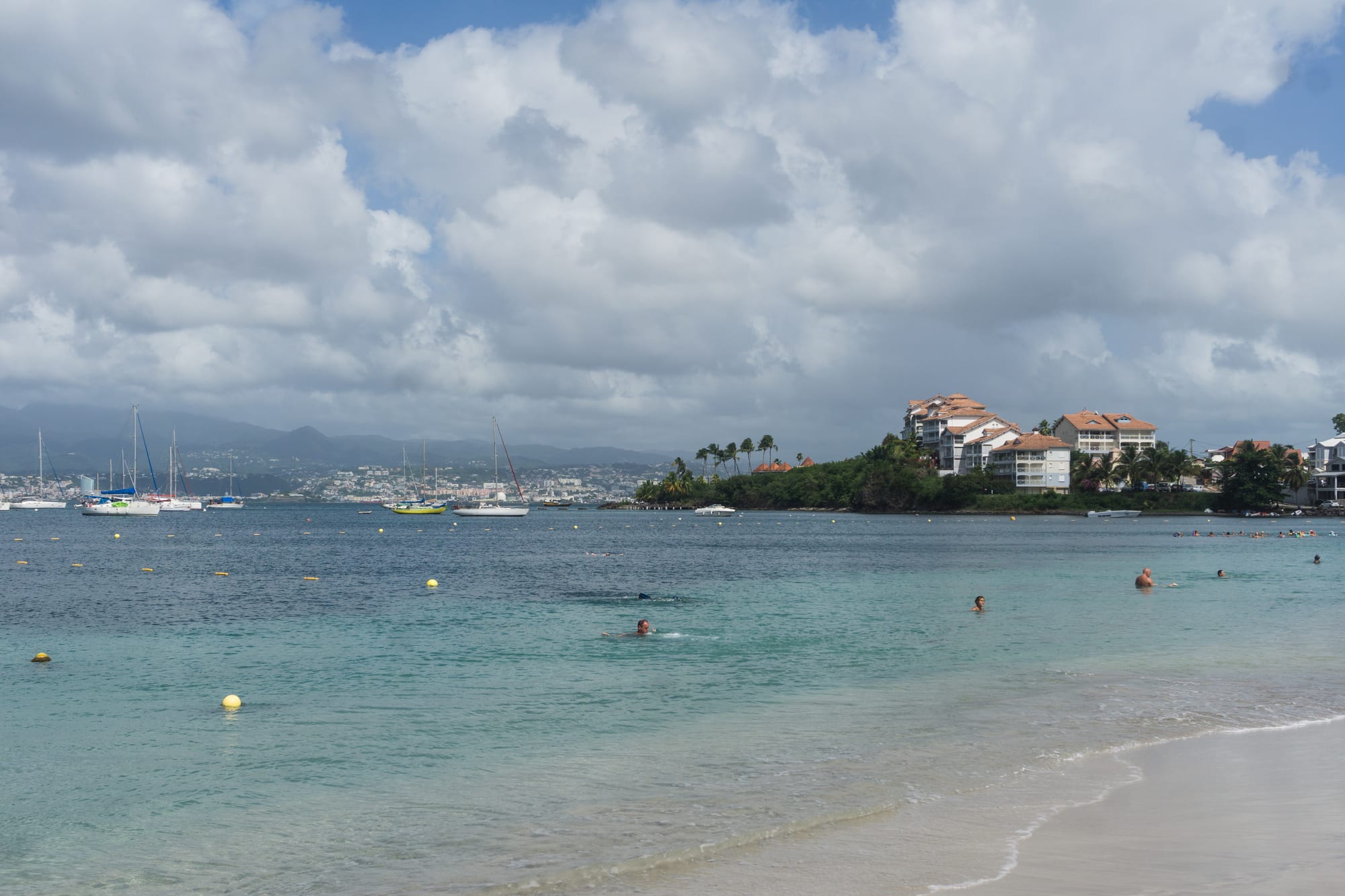
Turquoise water off a beach at Les Trois-Îlets, with swimmers, moored yachts and white buildings on a green headland

Martinique

Les Trois-Îlets

A beach at Les Trois-Îlets, with yachts at anchor in the bay and the far shore beyond. (Alexey Komarov / Wikimedia Commons · CC BY-SA 4.0)

A commune on the southern shore of the Bay of Fort-de-France, facing the capital across the water. Sugar estates made it, among them La Pagerie, where the future Empress Joséphine grew up; since the 1960s tourism has taken over, with hotels and a marina at Pointe du Bout and beaches at Anse Mitan and Anse à l'Âne, linked to the capital by boat.

Neighbourhoods

  • Pointe du Bout
    • First-time visitors
    • Marina
    • Nightlife

    The peninsula where most of the commune's hotels are concentrated, around a marina run by Martinique's chamber of commerce, with a casino, restaurants and shops. Ferries from Fort-de-France land here, and Anse Mitan's beach runs on from it.

    Open in Maps
  • Anse Mitan
    • Beaches
    • Close to the ferry

    A hamlet about 4 km from the village centre, with a white-sand beach lined with a few coconut palms that opens onto the Bay of Fort-de-France. Boats to and from the capital run many times a day.

    Open in Maps
  • Le Bourg
    • Local life
    • Historic village

    The village centre, where the town hall and the main church stand, laid out in the 18th century facing the three small islets that gave the commune its name. Quieter than the resort areas, with a seafront looking across the bay.

    Open in Maps
  • Anse à l'Âne
    • Beaches
    • Quieter stays

    A beach further west along the coast with its own cluster of hotels and its own ferry landing, a slower alternative to Pointe du Bout.

    Open in Maps

Things to do

Museums and history

  • La Pageriemuseum

    The former sugar estate, once called Petite Guinée, that was the home of Joséphine, later Empress of the French; the estate is now a museum.

    Open in Maps
  • La Savane des Esclavesmuseum

    A privately created open-air site, open to the public since 2004, with a partly recreated traditional village and vegetable plots that show island life in colonial times.

    Open in Maps
  • Maison de la Cannemuseum

    A regional museum beside the road towards Rivière-Salée that tells the history of sugar cane in Martinique since its introduction in the mid-17th century, including its use of enslaved labour.

    Open in Maps
  • Coffee and cocoa museum, Château Gaillardmuseum

    A museum of coffee and cocoa on the Château Gaillard estate, one of the commune's old plantations.

    Open in Maps
  • Village de la Poterieattraction

    The Poterie quarter, where the commune's first village grew up in the 17th century around one of its old estates; the pottery village is now one of the commune's sights.

    Open in Maps
  • Notre-Dame-de-la-Bonne-Délivrancelandmark

    The village's main church, in the centre of Le Bourg; the parish was long known as the Trois-Îlets Bénits.

    Open in Maps

Beaches and the bay

  • Anse Mitan beachbeach

    A white-sand beach with a few coconut palms facing the Bay of Fort-de-France, next to Pointe du Bout.

    Open in Maps
  • Anse à l'Ânebeach

    A beach on the south-west side of the commune with its own ferry landing and a few hotels.

    Open in Maps
  • Pointe du Bout marinaattraction

    The marina at the tip of the peninsula, run by Martinique's chamber of commerce, near the site of an 18th-century battery that guarded the bay.

    Open in Maps

Nature

  • Vatable forest and the mangrovepark

    The forest on the old Vatable estate and the mangrove along the shore, both listed among the commune's sights.

    Open in Maps

Short trips from the town

  • Fort-de-Franceattraction

    Martinique's capital, across the bay by ferry, with Fort Saint-Louis, the Saint-Louis Cathedral, the Schœlcher Library and the Grand Marché.

    Open in Maps

Eat and drink

Long-standing places and food districts in Les Trois-Îlets. Hours, ratings and directions come from your maps app, always current.

Les Trois-Îlets classics

  • Pointe du Bout restaurantsneighborhood

    The marina and its lanes have the commune's densest choice of restaurants, from Creole cooking to French menus, several of them aimed at a gastronomic crowd.

    Open in Maps
  • Anse Mitan beach restaurantsneighborhood

    Beach bars and restaurants along the sand at Anse Mitan, serving Creole plates and drinks within sight of the bay.

    Open in Maps
  • Le Bourgneighborhood

    Small places to eat in the village centre, used more by residents than by hotel guests.

    Open in Maps

Experience Les Trois-Îlets

History

The commune takes its name from the three small islets off the village — Thébloux, Charles and Sixtain — named after their last owners, who burned lime in kilns on them. The first village grew up in the 17th century under the impulse of missionaries, around the cove at La Poterie; the settlement moved to the present Bourg in the 18th century, and the parish was long known as the Trois-Îlets Bénits. Sugar estates covered the land: Petite Guinée, later called La Pagerie, and the Vatable, Château Gaillard and Poterie estates produced sugar for France, worked by enslaved Africans.

La Pagerie was the estate of the Tascher de La Pagerie family, and Joséphine, who married Napoleon Bonaparte and became Empress of the French, was baptised in the parish and possibly born here in 1763. The bay's defences left their mark: the Fort d'Alet still stands on a hill south of Anse Mitan, and a battery at Pointe du Bout was recorded in the 1740s. During the Second World War bunkers were built at Pointe du Bout to protect the bay and the Bank of France gold reserves stored in the hills above Fort-de-France.

From the 1960s tourism became the main activity, with hotels built around Pointe du Bout, Anse Mitan and Anse à l'Âne. A boat service across the bay also let many people live in the commune and work in Fort-de-France.

Culture & Customs

Les Trois-Îlets lives with two histories side by side. One is Joséphine's: the Pagerie estate museum and the commune's place in the story of Napoleon's France draw visitors, though the empress born into a planter family is viewed with ambivalence in Martinique. The other is that of the enslaved people who worked the estates. La Savane des Esclaves, created by Gilbert Larose from 2000 and open since 2004 with the declared aim of preserving and sharing the island's heritage, recreates traditional cabins and a village of former times, and the Maison de la Canne traces the history of sugar cane on the island.

The village keeps its Catholic parish church at its centre, and its residents, known as Iléens and Iléennes, mix a resort economy with a strong local life. The artist Khokho René-Corail was born in the countryside of the commune in 1932. Sport is part of everyday life, with the local club, Éveil des Trois-Ilets, offering football, volleyball, judo and karate, and the commune also has a golf course.

Manners follow island custom: a greeting on entering a shop, modest dress away from the beach, and Creole spoken among neighbours while French serves for business and hotel life.

Daily Life

About 6,500 people lived in the commune at the 2023 census, fewer than in 2017, as in much of Martinique. Tourism has been the main activity since the 1960s: hotels, rentals, restaurants, the marina and the casino employ many residents, and the golf course and boat trips add to the trade.

The commune divides into four main areas. Le Bourg has the town hall, the main church and the everyday shops; Pointe du Bout and Anse Mitan hold the hotels and beaches; and Anse à l'Âne has its own beach and hotels further west. Inland, the old estates and the Vatable forest give way to hills and mangrove along the shore.

The ferry shapes the rhythm of the day. Many residents commute to Fort-de-France by boat across the bay rather than by road. In the peak season, from December to April, the resort areas are busy with visitors, while the village keeps a slower pace.

Food

Food in Les Trois-Îlets follows the island's Creole kitchen. Accras de morue, salt-cod fritters, are the usual starter; colombo, a curry of chicken, pork or goat made with a spice blend brought by Indian labourers, is a staple; and fish is served as court-bouillon in a spiced tomato and lime sauce, or as blaff, poached in a broth with lime and herbs. Accras and boudin are also sold at snack stands near the beaches.

The restaurants at Pointe du Bout and along Anse Mitan serve both Creole dishes and French cooking, and several aim at fine dining. The village has simpler places used by residents.

The commune's estates once grew sugar cane, coffee and cocoa, and two museums tell those stories: the Maison de la Canne for sugar, and the coffee and cocoa museum at Château Gaillard. The aperitif is the ti-punch — white rhum agricole, distilled from fresh cane juice, with cane syrup and a slice of lime.

Planning tools

Budget

Les Trois-Îlets is one of Martinique's main resort areas, and prices at Pointe du Bout follow French resort levels. Holiday rentals and smaller guesthouses away from the marina cost less, and the ferry makes a car unnecessary for trips to the capital, though one is needed for the rest of the island.

Daily Budget Midrange
USD 150–300 (hotel near the beach, restaurant meals, museum entry, boat trips, car hire)
Daily Budget Shoestring
USD 65–105 (guesthouse or rental room, snack-bar meals, ferry and buses)

Use the ferry rather than the road to reach Fort-de-France, and hire a car only for the days spent touring the island.

Best Time to Visit

December to April, the drier season known as the Carême, has the best beach weather and is the peak season, busiest at Christmas, Carnival and Easter. May and November are quieter; from June to November rain is heavier, and hurricane risk peaks from August to October.

Suggested Number of Days

Two or three days cover the beaches and the museums. Many visitors stay longer and use the commune as a base for the south of the island and the capital, which turns a short stay into a week; the weather and a hire car both affect how much fits in.

First Visit
2–3 days
With Surroundings
5–7 days

Transportation

Boats cross the bay between Fort-de-France and several landings in the commune, including Pointe du Bout, Anse Mitan and Anse à l'Âne, and many residents commute to the capital this way. Taxis are readily available for journeys further than a walk, and a hire car is the practical way to reach the rest of the island.

Check the boat times at the landing before relying on a crossing, especially in the evening.

Airport & Station Connections

Martinique Aimé Césaire International Airport is in Le Lamentin, on the far side of the bay, and visitors arrive by taxi or hire car. Many come over from Fort-de-France on the bay ferry instead.

Walkability

Pointe du Bout and Anse Mitan are compact and close together, so the marina, beaches and restaurants are easy on foot. Le Bourg, the museums and Anse à l'Âne are spread out along the coast and inland, and need a car, a taxi or a boat.

Safety

Martinique is broadly safe for visitors, with break-ins to cars and holiday rentals and some violent crime in parts of Fort-de-France the main concerns. In the resort areas the practical risks are thefts from cars, rentals and unattended bags on the beach.

Do not leave valuables in a car or on the sand, lock rental doors and windows at night, and use insect repellent. Check current official travel advice before travelling.

Climate

Across the island the climate is tropical, hot and humid, with temperatures around 28–31°C. The drier Carême runs from December to April, and the south-west coast is drier than the rainforested north.

Summer
the wetter hivernage, June–November — hot and humid, around 28–31°C across the island, with heavy showers, and the hurricane season
Winter
the drier Carême, December–April — still around 28–31°C across the island, with less rain and the best beach weather

Local Customs

French is the official language and Martinican Creole the everyday one; English is understood in the hotels and around the marina but not widely elsewhere. A 'bonjour' on entering a shop is expected. The memory of Joséphine, born into a planter family here, is regarded locally with ambivalence.

Cover up away from the beach, especially in church and in the village, and ask before photographing people.

Common Payment Methods

The currency is the euro. Cards are widely accepted at the marina, hotels and restaurants; carry some cash for small shops, snack bars and the ferry.