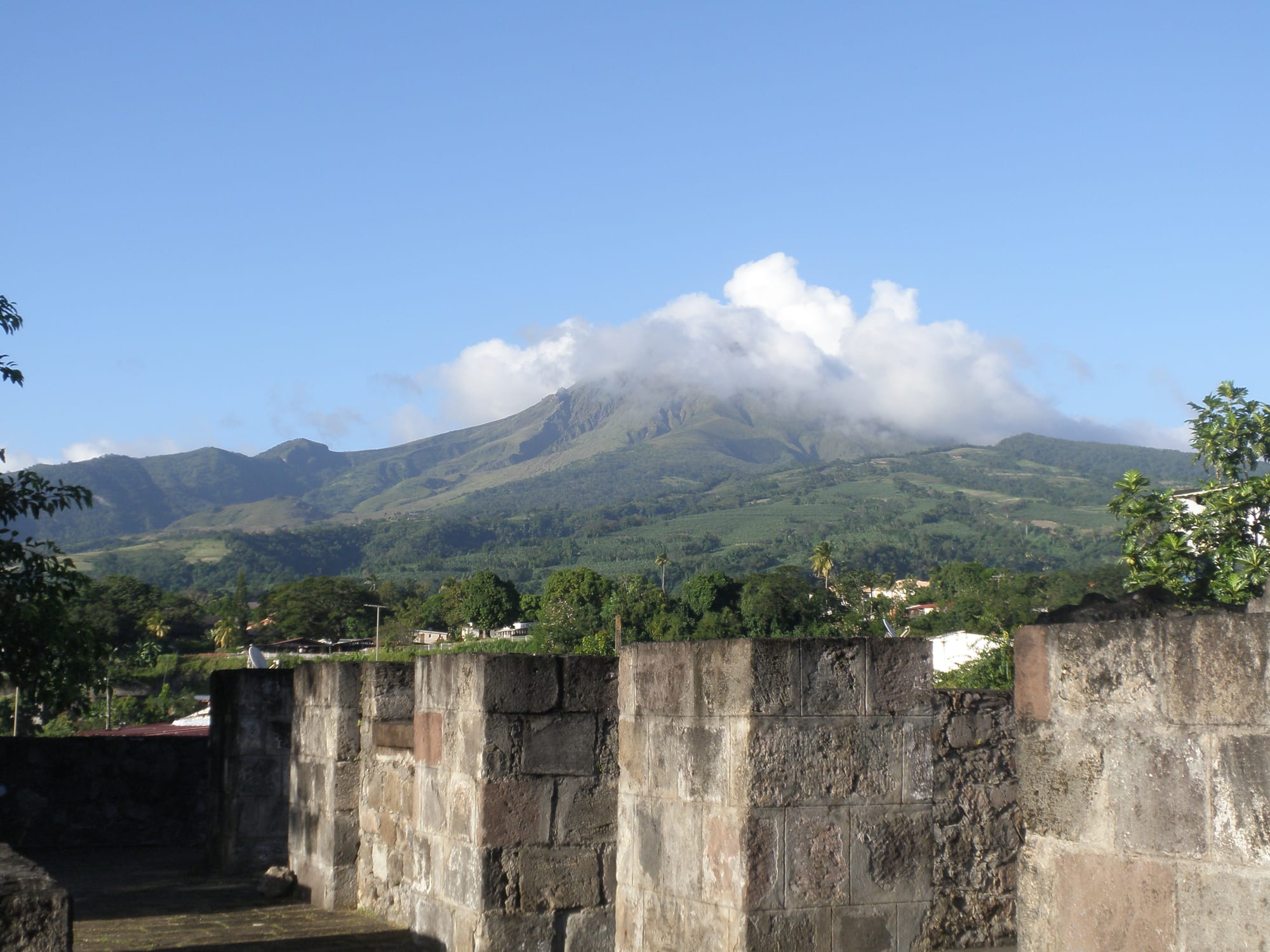
Stone pillars of a ruined theatre in the foreground, with green slopes and a cloud-capped volcano rising behind

Martinique

Saint-Pierre

Mont Pelée seen from the ruined pillars of the theatre's portico in Saint-Pierre. (Thérèse Gaigé / Wikimedia Commons · CC0)

A small town on Martinique's north-west Caribbean coast, below Mont Pelée. The first permanent French settlement on the island, it was the commercial and cultural capital known as the 'Paris of the Caribbean' until the eruption of 8 May 1902 destroyed it in minutes. Partly rebuilt among its ruins, it is now a town of art and history known for its museums and wreck diving.

Neighbourhoods

  • Le Mouillage
    • First-time visitors
    • Waterfront
    • Historic district

    The southern part of town, south of the Roxelane river, below the hills that shelter it from the east wind. The co-cathedral stands in this quarter.

    Open in Maps
  • Le Fort
    • Ruins
    • Museums

    The northern part of town across the Roxelane, named after the small fort d'Esnambuc built when he arrived, and cooled by the east wind. The ruins of the first church, the theatre, the prison and the volcano museum lie in and around it.

    Open in Maps

Things to do

Ruins of the old city

  • Theatre ruinslandmark

    The remains of an 800-seat theatre built in 1786 on the model of the Grand Théâtre of Bordeaux, which had closed in 1901, the year before the eruption; the pillars of its portico still stand.

    Open in Maps
  • Prison ruins and Cyparis's celllandmark

    The ruined prison and the cell whose thick walls shielded the prisoner Louis-Auguste Cyparis, one of the few survivors of the eruption; a listed historic monument.

    Open in Maps
  • Ruins of the Église du Fortlandmark

    The columns and wall remains of the church of the Fort quarter, on the site of the first church built on the island, in 1640; a listed historic monument.

    Open in Maps
  • Roxelane bridgeslandmark

    The river that divides the town, crossed by an old stone bridge of 1766, with a monument to Pierre Belain d'Esnambuc nearby.

    Open in Maps
  • Co-Cathedral of Our Lady of the Assumptionlandmark

    The church of the Mouillage quarter, damaged in 1902 and rebuilt with old stones, volcanic rock and brick; it is the co-cathedral of the Archdiocese of Fort-de-France.

    Open in Maps

Museums

  • Musée Frank-A.-Perretmuseum

    The volcano museum founded in 1932 by the American volcanologist Frank Perret, with photographs of the town before and after the disaster, clocks stopped at the moment of the eruption and objects deformed by the heat.

    Open in Maps
  • Centre de découverte des sciences de la Terremuseum

    A modern earth-science centre just north of town, by the ruins of the Périnelle estate, with a permanent exhibition on Mont Pelée's eruption and a garden with a view of the volcano.

    Open in Maps
  • Habitation Depazattraction

    The rum distillery on the slopes of Mont Pelée where Depaz rum is made, which since 2006 has also distilled the Dillon brand's rum.

    Open in Maps

The sea

  • Wrecks of Saint-Pierre harbourattraction

    The ships sunk by the eruption, now coral-covered dive sites; 13 of them lie in shallow enough water for divers to explore.

    Open in Maps
  • Harbourfront and marketmarket

    The restored waterfront, where the vegetable market stands right by the sea on the spot where enslaved people were once traded.

    Open in Maps

Short trips from the town

  • Mont Peléetrail

    The 1,397-metre active volcano above the town, whose volcanoes and forests, with the peaks of northern Martinique, were listed as a UNESCO World Heritage Site in 2023.

    Open in Maps
  • Fort-de-Franceattraction

    Martinique's capital, about 20 km to the south in a straight line, which took over Saint-Pierre's role after 1902.

    Open in Maps

Seasonal events

  • Carnivalthe days before Lent, ending on Ash Wednesday

    Martinique's four-day Carnival, celebrated in towns across the island, ending with the burning of the papier-mâché figure Vaval.

Eat and drink

Long-standing places and food districts in Saint-Pierre. Hours, ratings and directions come from your maps app, always current.

Saint-Pierre classics

  • Market by the seamarket

    The town's produce market on the harbourfront, for fruit, vegetables and spices.

    Open in Maps
  • Depaz distillerymarket

    The estate distillery on the volcano's slopes, maker of Depaz rhum agricole, which also distils for the old Dillon brand.

    Open in Maps
  • Waterfront restaurantsneighborhood

    Places to eat along the two main streets and the restored harbourfront, serving Creole dishes and fish.

    Open in Maps

Experience Saint-Pierre

History

Saint-Pierre was the first permanent French settlement on Martinique, founded by Pierre Belain d'Esnambuc around a small fort beside the Roxelane river for the French crown and the Compagnie des Îles de l'Amérique. Its sheltered anchorage made it the colony's port, exporting sugar and coffee from the surrounding plantations. In 1692 the governor's seat moved to Fort-Royal, the future Fort-de-France, but Saint-Pierre remained the island's economic and cultural capital. The Great Hurricane of 1780 drove a storm surge of about 8 metres into the town, and it was rebuilt.

In the 19th century it reached its peak and was called the "Paris of the Caribbean", with theatres, cafés, newspapers, a botanical garden and a busy port. From April 1902 Mont Pelée gave warnings — a smell of sulphur, explosions, ashfall — but no evacuation was ordered, partly because of a second round of elections due on 11 May. On 8 May, Ascension Day, at 7.52 in the morning, a burning cloud swept down the volcano and destroyed the town in minutes, killing about 28,000 people, and the ships in the harbour sank. The prisoner Louis-Auguste Cyparis, shielded by the thick walls of his cell, and the shoemaker Léon Compère-Léandre are among the few known survivors.

Fort-de-France took over the role of main city, and Saint-Pierre was only partly reoccupied, never regaining its population or importance. In 1990 the whole town was labelled a Ville d'Art et d'Histoire, and in 2023 the volcanoes and forests of Mont Pelée became a UNESCO World Heritage Site.

Culture & Customs

Saint-Pierre's identity is bound up with memory. The ruins of the theatre, the prison, the Fort church and the old warehouses stand among the rebuilt houses, and the town as a whole carries the national Ville d'Art et d'Histoire label. Its museums tell the story: the Frank-A.-Perret volcano museum, founded in 1932 and holding the Musée de France label, the town's history museum, and the earth-science centre at Périnelle.

Before 1902 it was the island's cultural capital, with a theatre seating 800 that staged plays for visitors as distinguished as Rochambeau and Ferdinand de Lesseps, newspapers and one of the first asylums for the mentally ill. Some of the story has travelled far: the survivor Cyparis later toured with the Barnum & Bailey circus, and the naval officer Georges Hébert, who witnessed the disaster, went on to develop a method of physical training from the experience.

Residents are called Pierrotains and Pierrotines. Daily culture is Creole and Catholic, and the co-cathedral, rebuilt after 1902 through the efforts of the industrialist Victor Depaz, remains the town's main church. Carnival is celebrated here as in towns across the island.

Daily Life

About 4,000 people lived in the commune at the 2023 census, a slight fall since 2017 — a fraction of the tens of thousands who lived here before 1902. The town is still a sub-prefecture and keeps services for the north-west coast: a hospital, the Victor Anicet secondary school, tax and social security offices and an employment agency.

The economy rests mainly on tourism, above all diving on the wrecks in the harbour, which were rediscovered by divers from 1974 and have become popular dive sites. The Depaz distillery makes rum on the volcano's slopes, and quarrying provides some fifty direct jobs.

The town is small — practically two one-way streets parallel to the shore — divided by the Roxelane into the Fort quarter to the north and the Mouillage to the south. Life centres on the restored harbourfront, the market and the church, with Mont Pelée, still active and closely monitored, always in view.

Food

Saint-Pierre eats the island's Creole food. Accras de morue, salt-cod fritters, are the standard snack; colombo, a curry of chicken, pork or goat made with a spice blend brought by Indian labourers, is a staple; and fish is served as court-bouillon, in a spiced tomato and lime sauce, or as blaff, poached in a broth flavoured with lime and herbs. The waterfront market sells the fruit, vegetables and spices that go into them.

Rum is the town's other product. The Depaz distillery on the slopes of Mont Pelée produces rhum agricole — distilled from fresh sugar-cane juice rather than molasses — and since 2006 it has also distilled for the Dillon brand, whose cellars are in Fort-de-France. The ti-punch, white rum with cane syrup and a piece of lime, is the usual aperitif.

The restaurants along the main streets and the harbourfront serve Creole dishes and fish, and snack stands sell accras and boudin.

Planning tools

Budget

Saint-Pierre is visited mostly as a day trip, so costs are museum entries, a meal and, for many, a dive. Divers pay for boat dives on the wrecks; everything else is modest by Martinique's standards. A hire car is the practical way to get here and around the north.

Daily Budget Midrange
USD 150–300 (guesthouse or hotel, restaurant meals, museum entries, a wreck dive, car hire)
Daily Budget Shoestring
USD 65–105 (guesthouse room, market and snack-bar food, shared hire car)

Walking among the ruins and along the harbourfront costs nothing; budget for the museums and, for divers, the boat dives.

Best Time to Visit

December to April, the drier Carême, is the most comfortable time and the best for clear views of Mont Pelée, though the summit is often in cloud. The north of the island is much wetter than the south, and from June to November rain is heavy and hurricanes are possible.

Suggested Number of Days

Most visitors spend a day here. Two or three days allow for diving and a climb of the volcano, which depend on the sea and on the weather on the summit.

First Visit
1 day
With Surroundings
2–3 days

Transportation

The town is small and walkable, practically two one-way streets running parallel to the shore. A hire car is the practical way to reach it and the north of the island; buses and shared taxis exist but are limited for visitors.

Park once and walk; the streets are narrow and one-way.

Airport & Station Connections

Saint-Pierre lies about 20 km north of Fort-de-France in a straight line, on the Caribbean coast, and is reached by road. Martinique Aimé Césaire International Airport is in Le Lamentin, near the capital, and most visitors drive up from there or from the southern resorts in a hire car.

Walkability

The centre is compact and easy on foot: the ruins, the museums, the cathedral and the waterfront are all within a short walk of each other along two parallel streets. The earth-science centre and the Depaz distillery are outside the town and need a car.

Safety

Martinique is broadly safe for visitors, with break-ins to cars and holiday rentals and some violent crime in parts of Fort-de-France the main concerns. Mont Pelée is active and closely monitored, and the town lies at its foot.

Leave nothing in a parked car, follow any instructions from the authorities about the volcano, dive only with a recognised dive centre, and check the weather before climbing Mont Pelée. Check current official travel advice before travelling.

Climate

Across the island the climate is tropical, hot and humid, with temperatures around 28–31°C. The north, with the heights of Mont Pelée, is much wetter than the south, and the volcano's summit is often hidden in cloud.

Summer
the wetter hivernage, June–November — around 28–31°C across the island, with heavy showers and the hurricane season
Winter
the drier Carême, December–April — around 28–31°C across the island, with less rain

Local Customs

French is the official language and Martinican Creole the everyday one. A 'bonjour' on entering a shop is expected. The ruins mark the place where about 28,000 people died in 1902.

Treat the ruins with respect, dress modestly in the cathedral, and ask before photographing people.

Common Payment Methods

The currency is the euro. Cards are accepted at the museums, the dive centres and most restaurants; carry cash for the market and small shops.