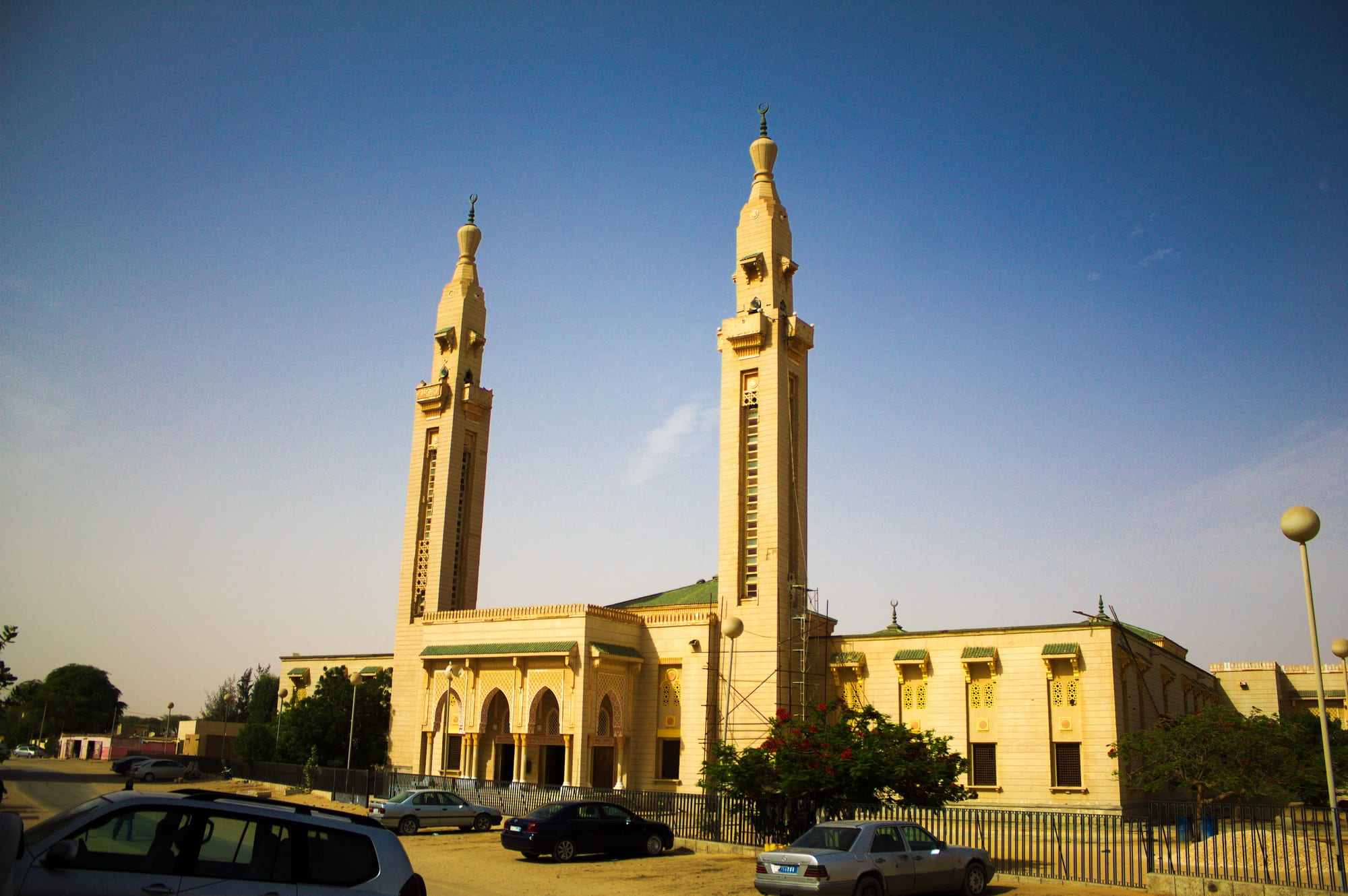
A pale sandstone mosque with two tall minarets and arched doorways under a deep blue sky, with cars parked outside

Nouakchott & the Coast, Mauritania

Nouakchott

The Saudi Mosque, one of the best-known buildings in Nouakchott. (Ammar Hassan / Wikimedia Commons · CC BY 2.0)

Mauritania's capital and by far its largest city, laid out on flat sand between the Atlantic and the dunes of Trarza. Begun in 1958 around a small settlement as independence approached, it grew into a low, wide city of close to 1.5 million after the droughts of the 1970s and 1980s emptied the desert. Its landmarks are a fishing beach, sprawling markets and a small national museum.

Neighbourhoods

  • Tevragh Zeina
    • First-time visitors
    • Restaurants
    • Embassies

    The wealthiest district, in the north-west towards the sea, with the embassies, the main hotels, banks, supermarkets and most of the restaurants that visitors use. Streets are wider and greener than elsewhere, and walled villas stand behind bougainvillea.

    Open in Maps
  • Ksar
    • Historic district
    • Markets
    • Local life

    The oldest part of the city, the village that stood here before the capital was planned, now a dense quarter of shops, workshops and small hotels. Much of the everyday trade of Nouakchott is here or nearby.

    Open in Maps
  • Sebkha
    • Markets
    • Local life

    A crowded low-lying district built on old salt flats and prone to flooding after heavy rain. Known also as the Cinquième, it is a working, residential quarter with a large open-air shopping area, small shops, garages and street kitchens rather than a place of sights.

    Open in Maps
  • El Mina
    • Local life
    • Close to the sea

    A large southern district reaching towards the fishing beach and the port, settled heavily by families who arrived from the countryside during the droughts. Sandy streets, markets and fish trading give it a busy, informal character.

    Open in Maps
  • Arafat
    • Quiet and residential
    • Local life

    One of the outer municipalities on the southern edge of the city, where Nouakchott meets the dunes. It is residential and unplanned in parts, with the markets, mosques and workshops that serve its own population.

    Open in Maps

Things to do

The seafront

  • Port de Pêcheattraction

    The capital's fishing beach, where wooden pirogues are hauled through the surf and the catch is sorted, gutted and sold on the sand.

    Open in Maps
  • Nouakchott's Atlantic beachbeach

    A long open sand beach west of the city, used for evening walks and football rather than swimming, as the Atlantic surf and currents here are strong.

    Open in Maps
  • Friendship Port of Nouakchotttransit hub

    The artificial deepwater harbour known as the Port de l'Amitié, built in the 1980s by a Chinese company on a coast with no natural shelter, and the country's main commercial port.

    Open in Maps

Mosques and civic buildings

  • Saudi Mosquelandmark

    Also called the Nouakchott Grand Mosque, this twin-minaret mosque near the Presidential Palace was built with the assistance of the Saudi government and is the city's best-known place of worship.

    Open in Maps
  • Marocaine Mosquelandmark

    Also known as the Grande Mosquée de La Capitale, a second landmark mosque in the southern part of the centre, next to the Marocaine market and the Moroccan Cultural Centre.

    Open in Maps
  • Nouakchott Olympic Stadiumattraction

    A multi-purpose stadium holding about 10,000 people, with an athletics track, used above all by the Mauritania national football team.

    Open in Maps

Museums

  • National Museum of Mauritaniamuseum

    A small state museum whose two galleries hold archaeological collections of pottery sherds and arrowheads alongside displays of local costume and everyday objects.

    Open in Maps

Markets

  • Marché Capitalemarket

    The central market of Nouakchott, a dense and crowded block of cloth, clothing, household goods and spices in the downtown quarter.

    Open in Maps
  • Marché Marocainmarket

    A large general market in the southern part of the centre, known for everyday goods, food stalls and cheap clothing.

    Open in Maps

Walks and city views

  • Avenue Gamal Abdel Nasserlandmark

    The long main avenue that runs through the centre past ministries, banks and shops, and the closest thing the city has to a high street.

    Open in Maps
  • The dune edgeviewpoint

    On the eastern and southern fringes the streets simply end in sand, where planted belts of trees are used to hold back the dunes.

    Open in Maps

Eat and drink

Long-standing places and food districts in Nouakchott. Hours, ratings and directions come from your maps app, always current.

Food districts and markets

  • Port de Pêche fish stallsmarket

    Fish straight off the boats — sole, grouper, mullet, sardines and octopus — sold on the sand and grilled at simple stands beside the beach.

    Open in Maps
  • Marché Capitalemarket

    Dates, spices, dried fish, bread and fruit sold in the central market, with tea stalls and cheap kitchens around its edges.

    Open in Maps
  • Marché Marocainmarket

    A big everyday market where vegetables, meat, milk and grain are bought, surrounded by street food and juice sellers.

    Open in Maps

Where people eat

  • Tevragh Zeina restaurantsneighborhood

    The district where most sit-down restaurants are found — Lebanese grills and mezze, Moroccan tagines, Senegalese rice dishes, pizza and French-style bakeries.

    Open in Maps
  • Ksar street kitchensneighborhood

    Small unmarked kitchens and stalls around the old quarter serving rice with fish, grilled mutton, bean sandwiches and glasses of tea.

    Open in Maps

Experience Nouakchott

History

Nouakchott barely existed before independence. A small settlement with a fort stood by the ksar, a caravan stop on the track between the Senegal river and the north, while the colony of Mauritania was administered from Saint-Louis in Senegal, outside its own borders. When independence approached, the territory needed a capital inside it, and in 1958 work began on a planned city on the sandy plain a few kilometres from the sea. The plan was for a modest administrative town of about 15,000 people.

Almost everything that followed overturned that plan. The droughts of the 1970s and 1980s destroyed the herds that supported nomadic life across the Sahara and the Sahel, and families who had lost their animals came to the capital in enormous numbers, first into tents on the outskirts and then into the sandy quarters that now spread for kilometres in every direction. Within a generation a country of herders became a country of city dwellers, and Nouakchott absorbed most of the change.

The city has grown outwards rather than upwards, still low-built and laid out on a grid of wide avenues that dissolve into sand at the edges. Its port, opened in the 1980s by a Chinese company and known as the Friendship Port, gave Mauritania a deep-water harbour on a coast with almost no natural shelter, and the fishing beach nearby became the city's main landing place for fish. A new international airport north of the city replaced the old one in June 2016. Dune encroachment, seasonal flooding in the low districts and the pressure of continuing migration from the countryside remain the capital's defining problems.

Culture & Customs

Nouakchott is where Mauritania's communities live side by side: Bidhan and Haratin families from every part of the desert, Halpulaar, Soninke and Wolof from the river valley in the south, and large numbers of Senegalese, Malians and other West Africans working in fishing, building and trade. Hassaniya Arabic is the language of the street, with Pulaar, Soninke and Wolof widely heard and French used in business and administration.

Social life runs on hospitality and on tea. Three rounds of strong, sweet green tea are brewed slowly over coals and poured from a height to raise a foam, each round meant to taste different from the last, and the ceremony is never hurried; it happens in offices, in shops, on mats spread on the sand outside houses. Poetry recited and sung in Hassaniya is highly valued, and the iggawin griot families who keep it are also the country's best-known musicians, playing the tidinit lute and the ardin harp at weddings and gatherings.

Dress marks the city out: men in the pale blue or white daraa, women in the brightly coloured malahfa wrapped over the head and body. Islam is conservative and Sufi-influenced, and the rhythm of the week turns on the Friday midday prayer. The legacy of hereditary slavery, abolished in stages and made a crime in 2007, runs through social relations and politics, and campaigning against its remnants is a visible part of public life in the capital.

Daily Life

Nouakchott's population was counted at 958,399 in the 2013 census and was put at close to 1.5 million by 2023, in a country of about 5.4 million — roughly a third of all Mauritanians live here. Since 2014 the city has been divided into three administrative regions covering nine departments, from wealthy Tevragh Zeina in the north-west to the sprawling outer districts of Arafat, Dar Naim, Toujounine and El Mina.

Government is the city's anchor: the ministries, the central bank, the university and the headquarters of the mining and fishing companies are all here, and so is almost all private business of any size. The port and the fishing beach employ thousands directly and many more in ice, transport, processing and trade. Beyond that the economy is largely informal — market stalls, workshops, taxis, small building sites — and unemployment among young people is high.

The day is shaped by the heat. Shops and offices open early, the middle of the day is quiet, and the streets fill again in the late afternoon and evening, when families walk by the sea and tea is brewed outside. Water supply, drifting sand, rubbish collection and flooding in the low-lying quarters after the August rains are the constant complaints, and a green belt of planted trees is maintained on the city's edge to slow the dunes.

Food

The capital eats fish. Thieboudienne, rice cooked in a tomato sauce with a whole fish and vegetables, carried over from Senegal, is the standard midday meal, and grilled sole, grouper, mullet or sardines are cheap near the beach. Octopus, much of it exported, also appears in local kitchens. Sauces lean on onion, tomato, chilli and dried fish for depth.

Moorish food is meat and milk. Méchoui, a whole lamb or kid roasted for a feast, marks weddings and Eid al-Adha; camel and goat are stewed with rice or with millet couscous; and zrig, soured milk thinned with water and sweetened, is the everyday cooler. Dates from the Adrar and Tagant oases are sold fresh in midsummer and dried the rest of the year, and thin unleavened breads are baked in the sand or on hot plates.

Because Nouakchott gathers people from everywhere, it eats more widely than the rest of the country: Senegalese rice and mafé, a groundnut stew; Lebanese shawarma, hummus and grills; Moroccan tagines; and French bread and pastries sold in every quarter, a colonial inheritance. Alcohol is illegal, so evenings turn on juice, soft drinks and tea, and every meal ends with the three glasses.

Planning tools

Budget

Nouakchott is inexpensive for food and local transport and has the widest choice of hotels in the country, from plain auberges to a few international-standard places whose rates are far above the local average. The costs that mount are a hired car with a driver and any trip north along the coast, which needs a 4x4.

Daily Budget Midrange
USD 90–200 (city hotel, restaurant meals, a hired car with driver)
Daily Budget Shoestring
USD 25–45 (auberge, market and street food, shared taxis)

Carry cash in ouguiya or euros; Nouakchott has the most dependable cash machines in Mauritania, and many of them are in Tevragh Zeina.

Best Time to Visit

November to March is the comfortable season, with warm days, cool nights and clear light, though harmattan dust can turn the sky white for days. Summer is hot and humid by the coast, with a short wet spell in August and September when low-lying districts flood.

Suggested Number of Days

The city itself is usually seen in a day or two, since its interest lies in markets, the fishing beach and daily life rather than monuments. Longer stays are normally built around trips out along the coast or into the dunes, which depend on hiring a vehicle and a driver.

First Visit
1–2 days
With Surroundings
3–5 days

Transportation

Nouakchott is wide and flat, and most journeys are made by shared taxi or by minibus along the main avenues, with fares paid in cash. Taxis are hailed in the street and often shared with other passengers; hotels and agencies arrange cars with drivers by the day. Paved roads lead north to Nouadhibou, south to Rosso and east to Boutilimit and the interior.

Agree the fare before getting into a taxi, and expect frequent police checkpoints on the roads out of the city.

Airport & Station Connections

Nouakchott–Oumtounsy International Airport, which opened in June 2016 about 25 kilometres north of the centre, is the country's main gateway, with international flights to Europe, North Africa and other West African capitals. Overland, buses and bush taxis run up the paved coastal highway from Nouadhibou, about 470 kilometres, and south to Rosso on the Senegal border, about 200 kilometres.

Walkability

The centre can be walked, but distances are long, the sand blows, there is little shade and pavements are broken or absent, so short taxi hops are the usual way to cross the city. The seafront and the market streets are the parts most rewarding on foot, best in the early morning or late afternoon.

Safety

Nouakchott is one of the calmer capitals in the region and violent crime against visitors is uncommon, but petty theft, bag snatching and phone grabs happen, especially after dark, in crowded markets and on the beaches. Traffic is the greater everyday danger, and unlit roads on the edge of the city are hazardous at night.

Keep to the paved road near the northern border, avoid lonely beaches at night, and travel off-road only with a local driver. Check current official travel advice before travelling.

Climate

Hot and dry, softened by the Atlantic and the cold Canary Current, which keep the capital cooler than the interior. Rain is scarce and falls mainly in August and September; dust-laden winds blow in spring.

Summer
hot and humid, generally 30–35°C by day, with occasional heavy downpours in August and September
Winter
warm and dry, about 20–28°C by day, with cool nights and hazy harmattan dust

Local Customs

Mauritania is a conservative Muslim society and dress is modest for everyone: shoulders and knees covered, with most local men in the long daraa robe and women in the wrapped malahfa. Greetings are long and unhurried, the right hand is used for eating and handing things over, and three rounds of mint tea follow almost any visit. Alcohol is illegal, and the legacy of slavery, formally criminalised in 2007, remains a sensitive subject.

Ask before photographing people, markets, or anything official — government buildings, the port, checkpoints and the airport should not be photographed at all.

Common Payment Methods

The currency is the Mauritanian ouguiya (MRU), and this is a cash economy. Cards are accepted only at a few hotels and airline offices, and cash machines, while more reliable here than anywhere else in the country, can be out of service or out of notes. Euros are the easiest currency to change.