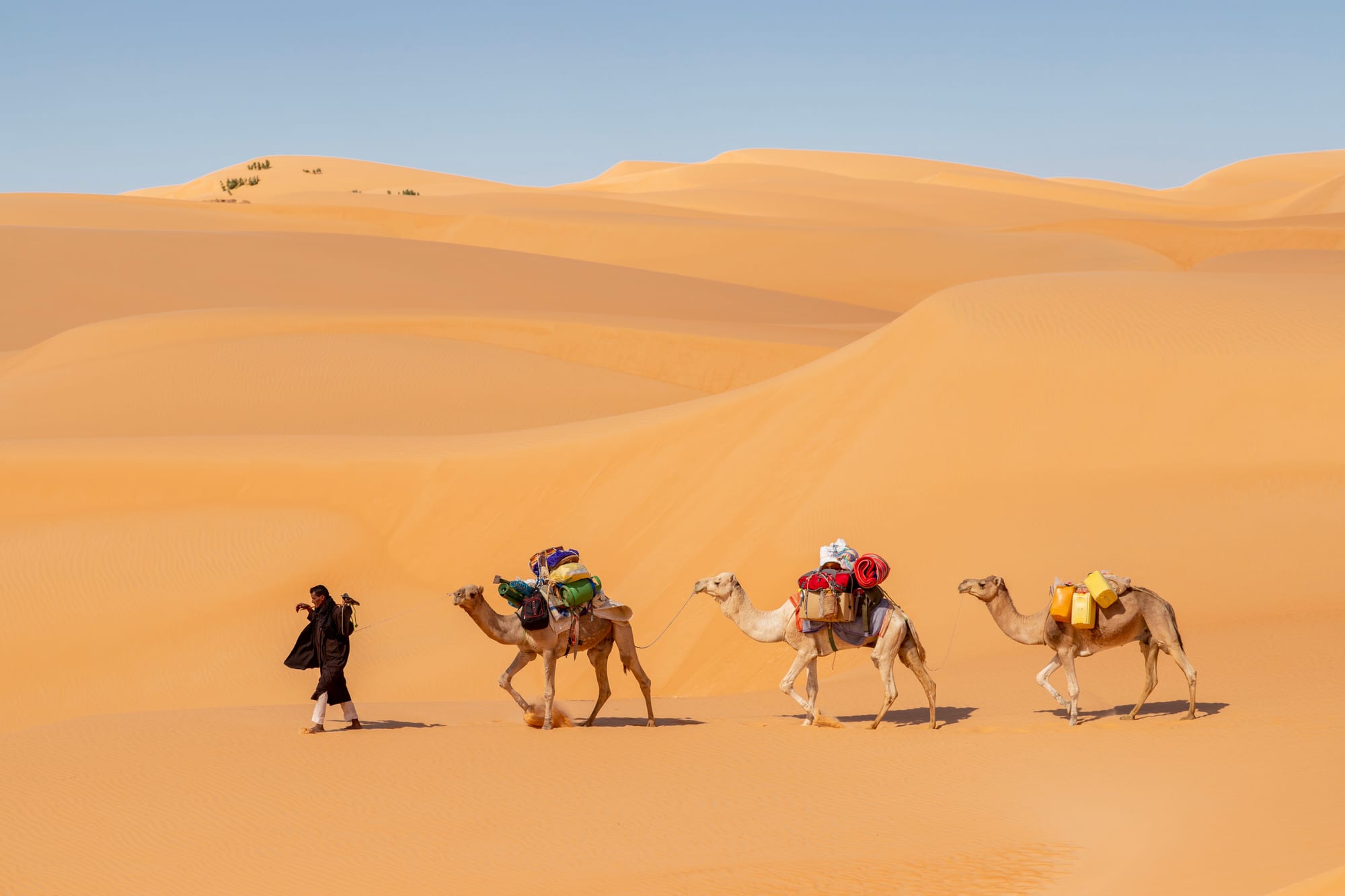
A line of camels and robed herders crossing rippled pale-orange Sahara dunes under a clear sky

Mauritania

A camel caravan in the Amatlich sand sea, in the Adrar region north of Atar. (Valerian Guillot / Wikimedia Commons · Public domain)

A vast, mostly Saharan country on the Atlantic that bridges the Arab Maghreb and Black West Africa — a land of caravan towns, iron ore, and one of the last places on Earth where hereditary slavery persists.

Explore Mauritania

History

The Sanhaja Berbers of this desert launched the Almoravid movement in the eleventh century, a religious and military drive that went on to rule Morocco and Muslim Spain. For centuries the region's wealth lay in the trans-Saharan trade in salt, gold, dates, and enslaved people, and its caravan towns — Chinguetti, Ouadane, Tichitt, and Oualata — became centres of Islamic learning, with libraries of manuscripts that partly survive.

From the thirteenth to the seventeenth centuries, migrations of Arab Bani Hassan tribes gradually dominated the Berbers and spread Hassaniya Arabic. A layered society formed, with warrior and religious lineages, tributary and artisan groups, and a large enslaved population — a hierarchy whose effects have never fully dissolved. France pushed in from Senegal from the late nineteenth century and made Mauritania a colony within French West Africa; independence came in 1960 under Moktar Ould Daddah.

Mauritania's claim to the southern third of Western Sahara dragged it into a losing war in the 1970s, triggering the first of many coups in 1978. The decades since have seen repeated military takeovers, the violent expulsion and killing of thousands of black Mauritanians in 1989–91 — a wrong still officially unaddressed — and long strongman rule. A first peaceful handover of the presidency took place in 2019. Slavery was made a crime only in 2007, and descent-based servitude persists in remote areas despite the law and the campaigners, some jailed, who fight it.

  • Mauritania: The Desert Bridge — A vast Saharan country on the seam between Arab and Black Africa — home of the Almoravids and of caravan cities of scholars, a lightly held French colony, and the last country on Earth to abolish slavery

Culture & Customs

Mauritania sits on a cultural fault line. The Bidhan or "White Moors" are Arab-Berber, Hassaniya-speaking, and historically dominant; the Haratin or "Black Moors", descendants of enslaved people, share that language and are the largest single group; and Afro-Mauritanian peoples — Halpulaar, Soninke, Wolof — live mainly along the Senegal River and keep their own languages and traditions.

Moorish life turns on hospitality and the tea ritual: three rounds of strong, sweet, foamy green tea, poured from a height, each round meant to taste different, and never hurried. Poetry, sung and recited in Hassaniya, is highly prized, and the iggawin griot families are its keepers and the country's best-known musicians. Islam is conservative and Sufi-influenced, and Qur'anic boarding schools have a long scholarly reputation.

Dress is distinctive: the flowing pale-blue or white daraa robe for men, the bright wrapped malahfa for women. In some Moorish communities the old practice of leblouh, force-feeding girls to fatten them for marriage, still lingers, though younger Mauritanians view it negatively.

  • Mauritania: The Land of a Million Poets — A devout, Sufi-shaped Islam, long greetings that are never rushed, a welcome measured by how much a guest eats, and a culture that still prizes the spoken and sung word above almost everything else

Daily Life

The great droughts of the 1970s and 80s destroyed the nomadic economy, and Mauritania went from mostly herders to mostly city-dwellers in a generation. Nouakchott, a small settlement at independence, is now a sprawling capital of well over a million, sandy and low-built, fighting encroaching dunes and seasonal floods. Nouadhibou, in the north, lives off fishing and the iron-ore terminal.

The cash economy rests on iron ore mined at Zouérat and railed to the coast, on gold and copper, on the rich Atlantic fishing grounds, and on the Grand Tortue Ahmeyim offshore gas field, shared with Senegal under a 2018 intergovernmental agreement. Development indicators are low, and the legacy of slavery still shapes who does the hardest and least-paid work.

Away from the cities, herders move camels, goats, and sheep between wells and seasonal pasture; the Senegal River valley grows rice, sorghum, and vegetables and supports river fishing; and the Adrar and Tagant oases tend date palms and small irrigated gardens. Life is organised around prayer times, the heat of the day, and the extended family.

  • Mauritania: Tea Poured Three Times — A nomadic people drawn into the towns within a generation, a household hierarchy that often still runs through the eldest man, and an afternoon ritual of tea, poured three times, that structures the day more reliably than any clock

Food

Mauritanian cooking blends Berber, Arab, French, and West African elements. Thieboudienne — fish, rice, and vegetables in tomato, a dish shared with Senegal — is considered the national dish. Across the country there is méchoui, whole roast lamb or kid; couscous with meat and vegetables; and, among herders, plenty of camel meat and camel milk.

Dates are central, fresh at the summer harvest and dried for the rest of the year. Milk drinks are everyday fare: zrig, soured milk thinned with water and sweetened, and curdled-milk dishes eaten with millet. On the coast, grilled and fried Atlantic fish is abundant and cheap. French bread and pastries are a colonial hangover found in every town.

Every social occasion ends with the long tea ceremony, and a guest is rarely let go without being fed. Meals are typically eaten from a shared dish, with the right hand, seated on mats or carpets.

Attractions & Natural Wonders

The Adrar plateau, reached from Atar, holds Mauritania's headline sights: Chinguetti, a half-buried medieval town with a stark stone mosque and family-kept libraries of centuries-old manuscripts; Ouadane, a UNESCO-listed ruin of dry-stone houses on a ridge; the palm-shaded gorge and pools of Terjit; and the huge monolith of Ben Amera, Africa's largest, with its smaller neighbour Aïsha.

Nearby, close to Ouadane, is the Guelb er Richat — the "Eye of the Sahara" — a 40-kilometre bullseye of concentric rock ridges so large it is a landmark for astronauts. The Amatlich and other sand seas around the Adrar are the classic dune country for camel treks and desert bivouacs.

On the coast, Banc d'Arguin National Park, a World Heritage Site, is one of the world's great sites for migratory shorebirds, its shallows still fished by the Imraguen people using traditional methods. The iron-ore train itself is an attraction — a train up to three kilometres long that travellers ride across the desert on top of the ore — and Nouadhibou's bay holds a graveyard of rusting abandoned ships.

  • Mauritania: Seven Attractions and Natural Wonders — Medieval caravan towns buried in sand, a geological bullseye visible from space, one of the longest trains on earth hauling iron ore through the Sahara, and a coastal park where fishermen have long worked alongside wild dolphins

Planning basics

Budget

Mauritania is inexpensive for food and local transport but costs add up fast once a 4x4, driver, and guide are involved, which is how most desert travel is done. Nouakchott and Atar have simple hotels and auberges; elsewhere accommodation is basic. It is largely a cash economy.

Daily Budget Midrange
USD 80–200 (hotel, a hired 4x4 with driver for the Adrar, guided desert nights)
Daily Budget Shoestring
USD 25–45 (auberge, local food, bush taxis)

Carry euros in cash to change; ATMs are unreliable outside Nouakchott and cards are rarely accepted.

Visa Requirements

Most nationalities need a visa. Mauritania launched an e-visa system in January 2025, and since then visa-required nationals have had to apply for it online before travelling; the old visa on arrival at the airport and at land borders no longer applies, and since June 2025 Mauritanian embassies direct applicants to the e-visa instead of issuing visas themselves. Rules change, so confirm shortly before travel.

Typical Validity
Set by the e-visa; check the length of stay it grants before you travel

Apply for the e-visa online before you fly, and carry a printed copy; the fee is paid on arrival in exact cash, euros or US dollars.

Safety

Nouakchott, Nouadhibou, and the Adrar tourist circuit around Atar, Chinguetti, and Ouadane are generally calm, and Mauritania has not seen a jihadist attack on its soil for many years. However, most governments advise against travel to the border regions with Mali and Algeria and much of the east and south-east, citing terrorism and kidnapping, and against unescorted desert travel. Protests linked to events in the Middle East occur from time to time, sometimes with little warning.

Landmines
Uncleared mines remain near the Western Sahara border in the north

Travel the Adrar with a registered local operator, keep to established routes, and read your government's advisory in full before going.

Climate

Saharan across most of the country — very hot by day, cold at night in winter, and extremely dry, with sandstorms in spring. The Atlantic coast is cooler and often foggy, cooled by the Canary Current. The far south, along the Senegal River, gets a short rainy season from July to September.

Coast
Milder, 20–30°C, humid and hazy
Interior
40–45°C common April–September; cool winter nights

Transportation

Nouakchott has the main international airport, with seasonal charters to Atar. Paved highways link Nouakchott with Nouadhibou, Rosso on the Senegal border, Atar, and Néma in the east. Beyond them, travel is by bush taxi, Mercedes truck, or hired 4x4. A passenger car runs on the iron-ore railway between Nouadhibou and Zouérat.

Iron Ore Train
Travellers can ride free on top of the ore wagons Zouérat–Nouadhibou, a rough trip of many hours, or in the passenger carriages attached for the purpose

Desert routes need a 4x4, a local driver, and a satellite phone; sand can close tracks after wind.

Best Time to Visit

November to February is the season for the Adrar and the desert — warm days, cold nights, and the winter charter flights to Atar. The date harvest fills the Adrar and Tagant oases in July and August despite the heat. Deep summer inland is punishing.

Events
Date harvest (July–August) in the Adrar and Tagant oases

Currency

The currency is the Mauritanian ouguiya (MRU), one of the world's few non-decimal currencies, notionally divided into five khoums. It was redenominated in 2018 (old notes were exchanged at ten to one). This is a cash economy; cards work only in a few Nouakchott hotels.

Cards
Very limited; carry cash
Symbol
UM
Currency Code
MRU — ouguiya

Language

Arabic is the official language; the everyday Arabic of the Moors is Hassaniya. Pulaar, Soninke, and Wolof are recognised national languages, spoken by Afro-Mauritanian communities in the south. French remains widely used in business, administration, and education.

French
Common in cities and among educated Mauritanians
Official Language
Arabic (Hassaniya in daily speech)
National Languages
Pulaar, Soninke, Wolof