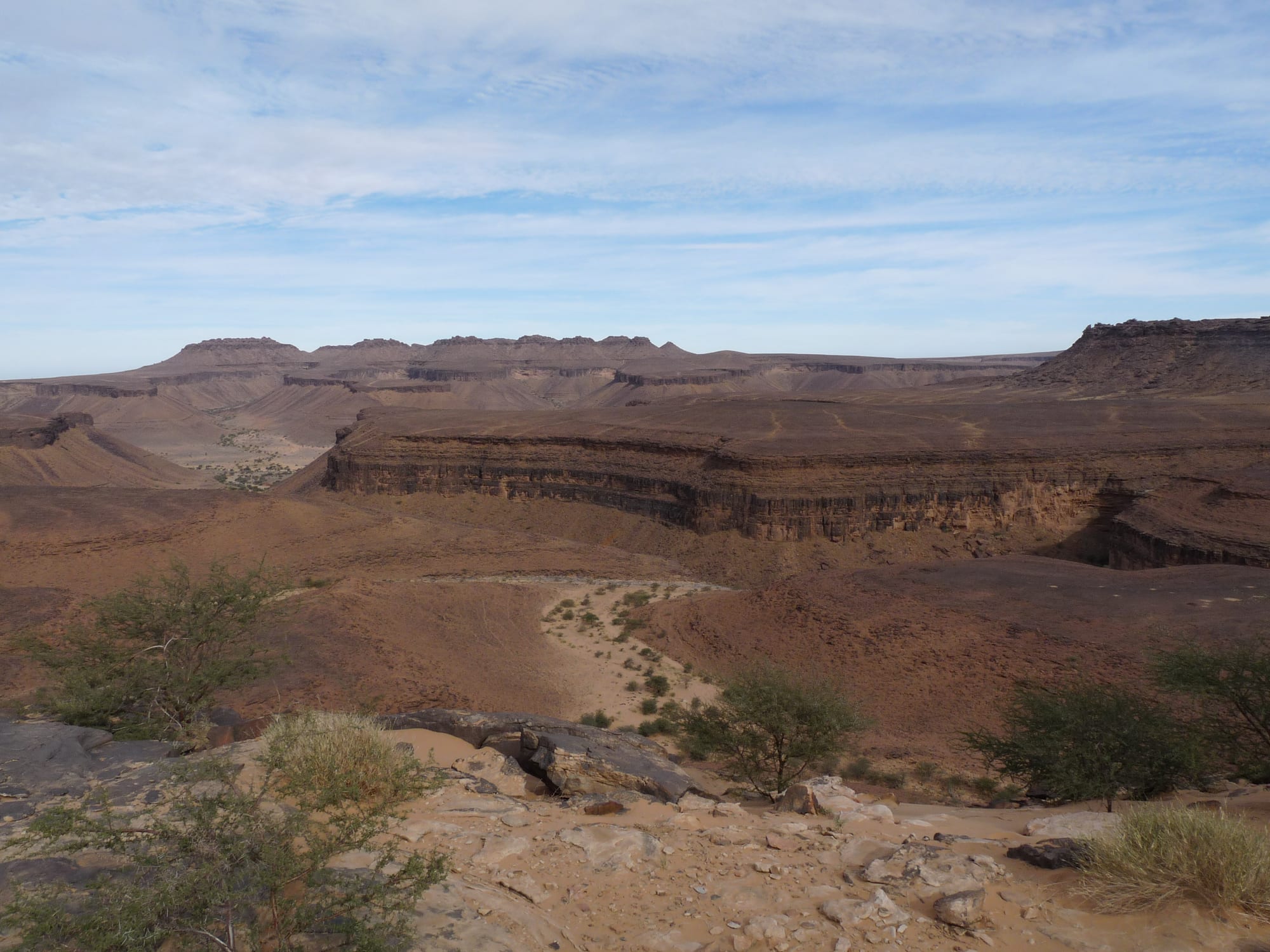
Layered brown sandstone plateaus and cliffs stretching into the distance above a dry valley with scattered acacias

Mauritania

The Adrar & the Desert North

The Adrar plateau seen from the Amogjar pass, between Atar and Chinguetti. (Ji-Elle / Wikimedia Commons · CC BY-SA 3.0)

Mauritania's Saharan heart and far north, from the sandstone plateaus of the Adrar and Tagant, with the caravan towns of Chinguetti, Ouadane and Tichitt, to the iron-ore mountains of Zouérat — a land of palm-grove oases, dune seas, manuscript libraries and the Richat 'Eye of the Sahara', and the core of the country's desert travel.

Explore The Adrar & the Desert North

History

Rock paintings and engravings across the Adrar and Tagant show cattle and wild animals from a wetter Sahara, and along the Dhar Tichitt cliffs farming and herding peoples built stone-walled villages from around 2000 BC. In the 11th century the Almoravid movement drew support from the Sanhaja Berbers of this desert, and Azougui, near Atar, is remembered as one of its bases.

The caravan trade made the region's towns. Ouadane and Chinguetti, which grew from the 13th, sat on routes that carried salt south and gold, slaves and grain north, and Tichitt served the same trade in the Tagant. Chinguetti became so associated with learning and the pilgrimage to Mecca that the whole country was once known in the Arab world as the land of Chinguetti. Portuguese traders built a trading post at Ouadane in 1487. Moorish emirates, of the Adrar and of the Tagant, later divided the region.

The French met fierce resistance. Xavier Coppolani, who led the conquest, was killed in 1905, and the Adrar emirate was subdued only in 1912. Iron ore at Kédia d'Idjil, above Zouérat, transformed the north after the 1950s, when a mining company and a railway to the coast were built; the mines were nationalised in 1974. During the Western Sahara war of the 1970s Polisario fighters raided Zouérat and the railway, and in 2005 an attack on the army post at Lemgheity in the far north killed soldiers.

Culture & Customs

The north is Moorish country, Hassaniya-speaking and organised by old tribal and religious lineages, and it keeps the nomadic traditions more strongly than anywhere else in Mauritania. Guests are received in the tent or the sitting room with the three rounds of green tea, and a visit is not rushed.

Scholarship defines Chinguetti and Ouadane. Families in these towns still guard private libraries of manuscripts, some many centuries old, on law, theology, astronomy and poetry, and keep them in wooden chests against sand and damp. The mahadra, the traditional school where students memorised the Quran and classical texts, gave the region its reputation for learning, and Chinguetti's mosque, with its square stone minaret topped by ostrich eggs, is a national symbol.

The Guétna, the date harvest of early summer, is the great season of the oases, when families gather in the palm groves of the Adrar and Tagant to eat fresh dates and visit relatives. Camel herding remains a source of pride and wealth. Zouérat, by contrast, is a mining town of workers from all over the country.

Daily Life

The region is vast and very thinly peopled. Zouérat, with some tens of thousands of people, is the largest town, and Atar, the capital of the Adrar and a trading town of palm groves, markets and garages, is the other; Tidjikja, Fdérik, Chinguetti and Ouadane are small.

Iron ore is the economy's backbone. The state mining company, SNIM, digs ore in the mountains around Zouérat and Fdérik and sends it to Nouadhibou on trains that can stretch over two kilometres. The oases live from dates, small gardens and herding, and the Adrar from tourism in the winter season, which collapsed after the security scares of the late 2000s and has only partly recovered.

The old towns are losing people to Nouakchott and to the sand, which presses into Chinguetti's lanes and palm groves. Water is precious, drawn from wells and pumped to gardens. In summer, when the heat stops most work, many families escape to the palm groves for the Guétna.

Food

The desert diet rests on dates, milk and meat. Dates are eaten fresh at the Guétna and dried or pressed into paste through the year, and they are the first thing offered to a guest along with tea. Camel's milk, fresh or soured, and zrig, water or milk mixed with fermented milk, are the everyday drinks of herding families.

Camel and goat meat is stewed with vegetables or served over couscous, and strips of dried meat keep through long journeys and is cooked into sauces. For feasts, a whole lamb or kid is roasted as méchoui. In the oases, gardens under the palms grow vegetables and a little grain.

Every meal and every visit ends with green tea with mint, brewed strong and sweet and poured from a height to raise a foam, three glasses in turn.

Attractions & Natural Wonders

The Adrar plateau is the region's centre. From Atar, the road climbs the Amogjar pass, where layered sandstone cliffs overlook valleys of acacia, towards Chinguetti, whose old stone quarter, Friday mosque and manuscript libraries face a sea of dunes. Ouadane's ruined stone town spills down a ridge above its palm grove, and near it lies the Richat structure, the 'Eye of the Sahara', a ring of concentric ridges some 40 kilometres across, now understood as an eroded geological dome rather than a meteor crater. South of Atar, Terjit's springs feed pools in a shaded gorge, and Azougui keeps traces of the Almoravid period. The Amatlich dunes offer camel treks and desert camps.

In the Tagant, Tidjikja is the regional capital, Tichitt a remote ksar at the foot of its cliffs with Neolithic ruins nearby, and in its gueltas, rock pools, small numbers of desert crocodiles survive. Together with Oualata, Chinguetti, Ouadane and Tichitt make up the UNESCO World Heritage Site of the Ancient Ksour.

In the far north, the iron-ore railway to Zouérat crosses the desert past the huge granite monolith of Ben Amera, west of Choum, and travellers ride the train, in the passenger car or on the ore.

Cities in The Adrar & the Desert North

Planning basics

Budget

The Adrar has Mauritania's only real tourist circuit, with auberges and guesthouses in Atar, Chinguetti, Ouadane and Terjit, often including dinner. Food and lodging are inexpensive, but most itineraries need a 4x4 with a driver and guide, which is the main cost; camel treks and desert bivouacs are priced by the day. Tagant and Tiris Zemmour have very few places to stay.

Daily Budget Midrange
USD 100–200 (better auberges, a hired 4x4 with driver and guide, a camel trek)
Daily Budget Shoestring
USD 25–45 (auberge with half-board, bush taxis, the ore train)

Bring cash from Nouakchott; Atar is the only town in the Adrar with banks, and even there cash machines can fail.

Safety

The Adrar circuit of Atar, Chinguetti, Ouadane and Terjit is generally calm and visited with local operators. Most governments advise against travel to the far north and north-east, including much of Tiris Zemmour and the areas near the Algerian and Malian borders, which are military zones where jihadist groups have attacked in the past, as at Lemgheity in 2005. Uncleared landmines lie near the Western Sahara border, and the desert itself kills the unprepared.

Travel with a registered operator, keep to established routes, register at checkpoints and never cross into the northern border zones. Check current official travel advice before travelling.

Climate

Fully Saharan. From April to September the heat is extreme, often above 45°C in Atar and the valleys, with sandstorms in spring, and rain is rare and brief in late summer, slightly more reliable in the Tagant. Winter days are warm and clear, and nights on the plateau and around Zouérat can fall close to freezing.

Summer
extremely hot, 40–47°C by day, with sand-laden winds
Winter
warm and clear, 25–30°C by day, cold nights sometimes near 0–5°C

Transportation

A paved road runs from Nouakchott through Akjoujt to Atar, and Atar has an airport. From Atar, roads and tracks climb the escarpment to Chinguetti, and Ouadane and the Richat are reached by 4x4. Tidjikja in the Tagant, and above all Tichitt, lie at the end of long desert roads and tracks. The ore railway links Zouérat and Choum with Nouadhibou.

Hire a registered local driver and guide for any desert route, carry extra water, and do not drive off-piste alone.

Best Time to Visit

November to February is the season for the Adrar, the dunes and the Richat, with warm days and cold nights. The Guétna date harvest in early summer fills the oases with families despite the heat. Late spring and summer are punishing for travel away from the oases.