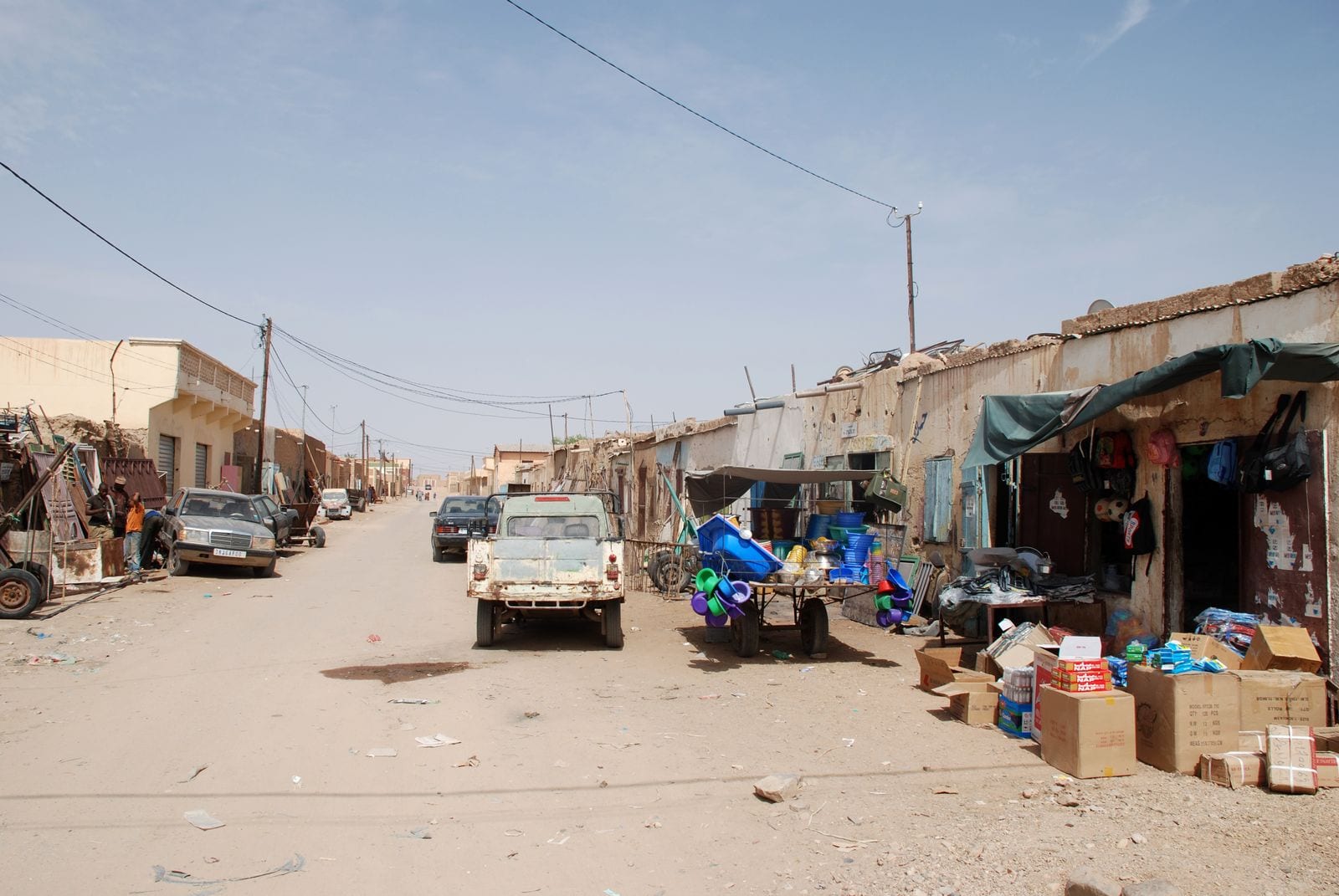
A sandy street of low shops with awnings, parked cars and a pickup truck in Atar

The Adrar & the Desert North, Mauritania

Atar

A street of shops and stalls in Atar. (Bertramz / Wikimedia Commons · CC BY-SA 3.0)

The main town of the Adrar region in northern Mauritania, set where the road from Nouakchott meets the sandstone escarpment. A garrison and trading centre under French rule, it is now the Adrar's administrative seat, market and transport hub, with the region's airport, its banks and garages, and the roads and tracks that lead up to Chinguetti, Ouadane and the oases.

Neighbourhoods

  • The market quarter
    • First-time visitors
    • Shopping
    • Local life

    The commercial heart of the town, a grid of sandy streets around the covered market where dates, vegetables, cloth, tea, hardware and spare parts are sold. Money changers, phone shops, garages and the offices of drivers and desert operators are all in these few blocks, and it is busiest early in the morning and after the afternoon heat.

    Open in Maps
  • The old quarter
    • Historic district
    • Quiet walks

    The older residential streets of low mud-brick and concrete houses behind the market, where the town's mosques stand and life is domestic rather than commercial. Walls are plain and courtyards face inward, and the streets run out into open ground and palms at the edges.

    Open in Maps
  • The palm groves and the wadi
    • Quiet and residential
    • Gardens

    Walled date gardens along the watercourse on the edge of town, watered from wells and worked by families who live in the town itself. They are green, shaded and cool compared with the streets, and busiest at the summer date harvest.

    Open in Maps
  • The airport road
    • Close to transport
    • Where visitors stay

    The spread of newer building along the road out towards the airstrip and the Nouakchott highway, with fuel stations, compounds, several auberges and the yards where 4x4s are loaded for desert trips.

    Open in Maps

Things to do

In the town

  • Atar marketmarket

    The town's covered market and the streets around it, where the Adrar's dates, vegetables trucked from the south, cloth, tea and hardware are traded.

    Open in Maps
  • Atar International Airporttransit hub

    The Adrar's airport on the edge of town, the region's air link, used during the Second World War as a stop on the Cairo-Dakar route and in recent winters by charter flights from France.

    Open in Maps

Short trips from the town

  • Terjitattraction

    An oasis in a narrow gorge about 45 kilometres south by road, where springs feed pools under a dense roof of palms.

    Open in Maps
  • Azouguilandmark

    A palm oasis about 15 kilometres north-west with the remains of a walled settlement remembered as an early Almoravid base.

    Open in Maps
  • Chinguettilandmark

    The old caravan and scholarly town about 75 kilometres east across the plateau, with a dry-stone quarter, a square-towered Friday mosque and family manuscript libraries.

    Open in Maps
  • Aoujeftattraction

    A small oasis town about 60 kilometres south-east, on the southern side of the Adrar plateau among palm groves and old settlements.

    Open in Maps

Eat and drink

Long-standing places and food districts in Atar. Hours, ratings and directions come from your maps app, always current.

Atar staples

  • The covered market and its stallsmarket

    Adrar dates, onions, tomatoes and potatoes brought up from the south, dried meat, tea, sugar and mint — the town's main food supply and the cheapest place to eat from.

    Open in Maps
  • Grill and rice places around the marketrestaurant

    Simple eating houses serving grilled goat or camel, rice or couscous with sauce, and sometimes fish trucked from the coast, seated at plastic tables or on mats.

    Open in Maps
  • Bakeries and tea stallscafe

    French-style baguettes from small bakeries, and stalls where green tea is brewed on a charcoal stove and poured in three rounds.

    Open in Maps

Where visitors eat

  • Auberge kitchensrestaurant

    Most guesthouses cook for their guests, usually a shared dish of rice or couscous with meat and vegetables, with dates and tea afterwards.

    Open in Maps

Experience Atar

History

Atar grew where the plain meets the southern wall of the Adrar plateau, at a break in the escarpment with wells and date palms — a natural halt on the routes between the caravan towns above and the pastures and markets to the south. Long before it became a town of any size, the oasis and its groves supported herding families and a trade in dates, and the Almoravid-era site at Azougui, a short way to the north-west, shows how old settlement in this corner of the Adrar is. A mosque built in 1674 still stands in the town.

The emirate of the Adrar ruled the plateau before the French arrived, and Atar was one of its centres. French forces moved in during the conquest of Mauritania, and after the emirate was subdued in 1912 the French made the town their administrative and military base for the whole region, laying out a fort, an airstrip and the beginnings of a grid of streets. The airfield became a stop on air routes across the Sahara, used in the Second World War by Allied aircraft on the Cairo-Dakar route, and it is the ancestor of today's airport.

After independence in 1960 Atar remained the capital of the Adrar region. The droughts of the 1970s and 1980s destroyed much of the nomadic economy around it and drove herding families into the town, swelling its population and its outskirts, while others left for Nouakchott. From the 1990s the Adrar's small tourist trade gave the town a second income, with visitors arriving in the cool season; that traffic collapsed after security scares in the late 2000s and has since partly returned, with flights from France landing at the airport again from December 2017.

Culture & Customs

Atar is a Moorish town, Hassaniya-speaking, and it works the way the desert north does: slowly, through family and lineage, with time given to greetings and to tea. The three rounds of strong sweet green tea, brewed on a charcoal stove and poured from a height to raise foam, punctuate the whole day, in shops and garages as much as at home, and a transaction that skips them is thought brusque.

Because it is the regional capital and the road head, the town is more mixed than the villages above it. Officials, soldiers, teachers and traders come from all over Mauritania, Haratin and Afro-Mauritanian families live alongside the older Moorish ones, and the market brings herders in from the desert and drivers up from Nouakchott. That gives Atar a working, practical character rather than a scholarly one; the manuscript tradition belongs to Chinguetti and Ouadane, and Atar is where their supplies and their visitors come through.

Dress is conservative and distinctive — the loose pale daraa for men, the wrapped malahfa in bright printed cloth for women — and the day is set by prayer times and the heat, with a long pause in the afternoon and a second active period after dark. Poetry and sung Hassaniya verse are valued here as elsewhere in the north. The great social season is the Guetna, the summer date harvest, when families move out to the palm groves to eat fresh dates and visit relatives.

Daily Life

Atar has a population of about 35,000, which makes it one of the larger towns of the interior and by far the biggest place in the Adrar. Its economy rests on being the regional capital: government offices, the hospital, schools, the army and police, alongside the market, transport and garages, the date gardens and a small tourist trade of guides, drivers and auberge keepers in the cool months. Many households also keep animals or a share of a palm grove.

Nearly everything consumed in the Adrar passes through the town, arriving by truck from Nouakchott and going on by pickup to the plateau villages. Water comes from wells and boreholes and is the constant preoccupation, for the gardens above all. Electricity, mobile coverage and fuel are available but not always reliable, and sand drifts across roads and yards after windy days.

The rhythm is early mornings, a shut-down through the worst afternoon heat and a long, sociable evening in the streets around the market. Families that lost their herds in the droughts still live on the edges of town in compounds of concrete and tent cloth. The persistent pressures are the same as elsewhere in the Sahara: young people leaving for Nouakchott, uncertain work, and an economy that depends on rains far to the south and on a visitor season that can vanish with a change in travel advice.

Food

Atar eats simply and well. The staples are rice or couscous served with goat, mutton or camel in a sauce of tomato and onion with whatever vegetables the trucks have brought, eaten from a shared dish with the right hand. Dried meat, cut in strips and hardened in the sun, keeps without refrigeration and is cooked into sauces on the road. For a feast or a family gathering a whole animal is roasted as méchoui.

Dates are the town's own product, from the groves along the wadi and the oases around it: eaten fresh in the harvest season and dried or pressed into paste for the rest of the year, and offered to any guest with tea. Camel's milk, fresh or soured, is widely drunk, and zrig — soured milk thinned with water and sweetened — is the everyday cold drink in the heat. Grilled meat, fried fish brought up from the Atlantic and bowls of rice are sold around the market.

French bread survives from colonial days and is baked in small bakeries across the town, sold warm in the morning and eaten with jam, cheese or a little oil. Tea closes everything: green tea, mint and a great deal of sugar, poured repeatedly between pot and glass, served in three successive rounds. Alcohol is illegal in Mauritania, so tea, water, soft drinks and juices are the whole drinks list.

Planning tools

Budget

Food, market goods and a bed in an auberge are cheap in Atar; the expense is the desert. Hiring a 4x4 with a driver and a guide, the usual way to reach the plateau towns and the dunes, is charged by the day and dwarfs everything else, and fuel this far north is not cheap either. The town is the last place in the Adrar with banks.

Daily Budget Midrange
USD 100–200 (better auberge, a hired 4x4 with driver and guide, a camel trek or desert night)
Daily Budget Shoestring
USD 25–45 (auberge with half-board, market food, bush taxis)

Draw or change money here rather than further into the desert, and carry enough cash for the whole trip; machines can be out of service and cards are little use.

Best Time to Visit

November to February brings warm clear days, cold nights and what desert tourism there is. October and March are hotter but workable. From April to September the Adrar is extremely hot, with sandy winds in spring; the date harvest fills the palm groves in summer despite it.

Suggested Number of Days

The town itself is a half-day of market and streets. Most people use it as the base for the Adrar and stay four to six days in all, since the distances and the state of the tracks, rather than the number of sights, decide how long a desert trip takes.

First Visit
1 day
With Surroundings
4–6 days

Transportation

The centre is walkable and short hops are made by shared taxi or a motorbike. Everything beyond town is done by 4x4, hired with a driver, or by bush taxi and minibus on the paved road towards Nouakchott. Vehicles for Chinguetti and the plateau leave from the market area, filling up as passengers arrive rather than to a timetable.

Agree the route, the number of days and the price with a driver before leaving, use a registered operator, and carry extra water and fuel on any desert track.

Airport & Station Connections

A paved road runs about 450 kilometres from Nouakchott through Akjoujt to Atar, taking most of a day by bush taxi or minibus and rather less by private car. The airport on the edge of town is the region's air link, with winter charter flights from France. Roads and tracks climb the escarpment from here to Chinguetti and on to Ouadane.

Walkability

Flat, compact and easy to cross on foot, though the surfaces are sand and gravel rather than pavement and the market streets carry pickups and handcarts. Walking is comfortable early and late and punishing in the middle of the day for much of the year; the palm groves on the edge of town are within an easy walk.

Safety

Atar is the base of the Adrar tourist circuit and is generally calm, with police and army checkpoints on the roads in and out where travellers are registered. Petty theft is the usual urban risk. The serious dangers are out of town: heat, breakdowns and navigation on desert tracks, and the border zones far to the north and east that governments advise against.

Travel with a registered operator, keep to established routes, register at checkpoints and never cross into the northern border zones. Check current official travel advice before travelling.

Climate

Saharan, very dry and windy, with hot days, a sharp drop at night in winter and only a few millimetres of rain a year, most of it in brief late-summer storms. Spring winds raise dust that can dim the sky for days.

Summer
extremely hot, often 40–45°C by day and warm through the night
Winter
warm and clear, around 25–30°C by day, with cold nights near 5–10°C

Local Customs

Dress is conservative: loose clothes covering shoulders and knees, long sleeves for women, and a scarf that doubles as protection from sand. Greetings are long and matter more than efficiency, and green tea is offered constantly, in three rounds. Alcohol is illegal in Mauritania. Ask before photographing people, market stalls or soldiers and checkpoints, where cameras are not welcome.

During Ramadan, eat and drink out of sight in daylight and expect shops and offices to keep shorter, later hours; tipping drivers and guides is customary.

Common Payment Methods

The currency is the Mauritanian ouguiya (MRU). Atar has the only banks and cash machines in the Adrar, and they are not dependable, so most people arrive with cash from Nouakchott and change euros with a bank or a dealer. Cards are almost never accepted, and small notes are needed for taxis, tea and the market.