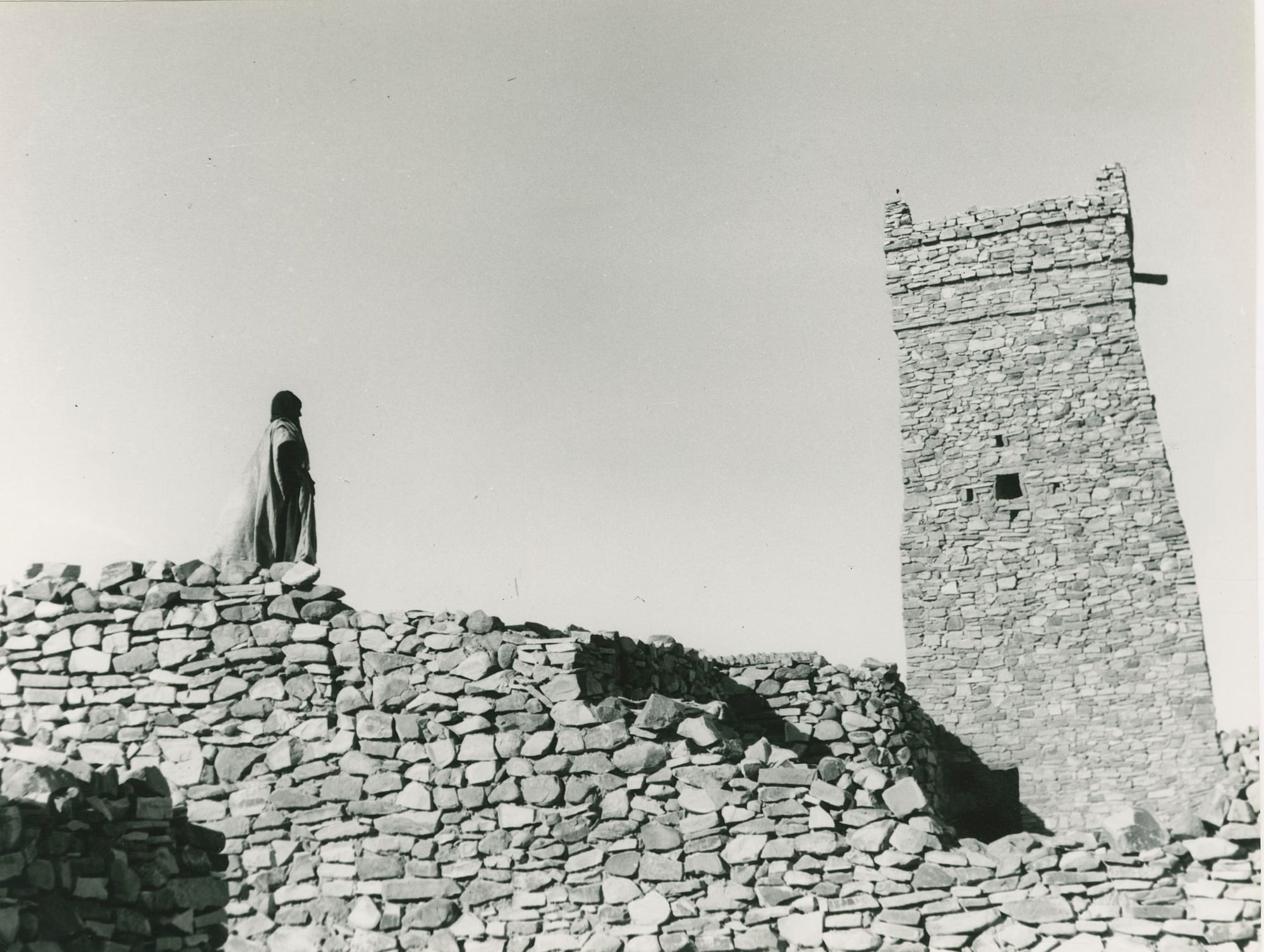
A tall dry-stone minaret rising above collapsed stone walls in the old town of Ouadane, with a robed figure standing on the ruins

The Adrar & the Desert North, Mauritania

Ouadane

The dry-stone minaret and ruined walls of Ouadane's old town, photographed in 1965. (Touring Club Italiano / Wikimedia Commons · CC BY-SA 4.0)

A small town on the edge of the Adrar plateau in Mauritania, founded in the twelfth century as a caravan halt on the salt and gold routes. Its ruined dry-stone quarter steps down a ridge above a palm grove and forms part of a UNESCO World Heritage Site, and the concentric rings of the Richat structure lie in the desert to the north-east.

Neighbourhoods

  • The ksar
    • First-time visitors
    • Historic district
    • Views over the valley

    The abandoned old town, a mass of dry-stone houses, lanes and staircases built without mortar down a steep ridge, with the old mosque and its stone minaret standing among the ruins. Parts have collapsed into rubble and parts still stand to roof height, and the whole slope looks out over the palm grove below.

    Open in Maps
  • The upper town
    • Where people live
    • Shops and transport

    The inhabited settlement on the level ground above the ruins, built of concrete and mud brick along sandy streets, with the shops, the school, the mosque in use, a few guesthouses and the yards where 4x4s are parked.

    Open in Maps
  • The palm grove
    • Quiet walks
    • Gardens

    The date gardens in the valley beneath the ksar, walled in stone and watered from wells, worked hardest at the summer harvest. They are the reason the town exists here and the one patch of green in a stony, wind-scoured landscape.

    Open in Maps

Things to do

The old town

  • The ksar of Ouadanelandmark

    The ruined dry-stone town on the ridge, inscribed in 1996 with Chinguetti, Tichitt and Oualata as the UNESCO World Heritage Site of the Ancient Ksour.

    Open in Maps
  • The old mosque and minaretlandmark

    The square stone minaret and the walls of the old Friday mosque stand among the ruins, built like the houses from flat stones laid without mortar, probably in the fifteenth century and abandoned by the nineteenth.

    Open in Maps
  • The palm grove below the ksarpark

    Walled date gardens in the valley beneath the old town, reached on foot down the slope and the best place to see how the settlement was fed.

    Open in Maps

Short trips from the town

  • Richat Structurelandmark

    Often called the Eye of Africa, a ring of concentric rock ridges roughly 40 kilometres across some 30 kilometres to the north-east, an eroded geological dome rather than an impact crater.

    Open in Maps
  • Chinguettilandmark

    The other great Adrar caravan town, about 90 kilometres south-west, known for its Friday mosque and its family manuscript libraries.

    Open in Maps

Eat and drink

Long-standing places and food districts in Ouadane. Hours, ratings and directions come from your maps app, always current.

Ouadane staples

  • Dates from the grovemarket

    Dates from the palm gardens below the ksar, eaten fresh at the summer harvest and dried or pressed for the rest of the year, and offered to visitors with tea.

    Open in Maps
  • Guesthouse kitchensrestaurant

    There is no restaurant street here; the auberges cook for their guests, usually rice or couscous with goat or camel in sauce, and dates and tea afterwards.

    Open in Maps
  • The town's shopsmarket

    A few small shops in the upper town selling bread, tea, sugar, tinned food, pasta and bottled water brought up by pickup from Atar.

    Open in Maps

Experience Ouadane

History

Ouadane was founded in the twelfth century by Berber settlers on a rocky spur at the edge of the Adrar, where wells and a palm grove could support a settlement in country otherwise bare. It became a halt and a market on the trans-Saharan routes, where caravans carrying salt from the northern mines and gold, grain, dates and enslaved people traded and reorganised before the next crossing, and it grew into a stone town of narrow lanes, storerooms and a Friday mosque, all built of flat local stone laid without mortar.

Its reputation reached the Atlantic coast. In 1487 Portuguese traders established a trading post at Ouadane, an attempt to reach the inland gold trade from the sea, and although it did not last, it marks one of the earliest European commercial ventures this far into the Sahara. The town also shared in the region's scholarly tradition, with Quranic teaching and manuscripts kept in family houses as at Chinguetti.

Decline followed the trade. Routes shifted, rival towns rose, internal conflict and the change in Atlantic commerce drained the caravan economy, and the old quarter was gradually abandoned for a newer settlement on the level ground above, leaving the ksar to collapse slowly into the slope. Ouadane, with Chinguetti, Tichitt and Oualata, was inscribed in 1996 on the UNESCO World Heritage List as the Ancient Ksour, and since then some stabilisation work has been done. The town today is small, its population reduced by migration to Atar and Nouakchott, and its visitors come mainly in the cool months.

Culture & Customs

Ouadane's culture is the Moorish culture of the desert north, Hassaniya-speaking and built on family, lineage and hospitality. A visit is not rushed: greetings run long, questions about health and relatives come before business, and the three rounds of strong sweet green tea, brewed on a charcoal stove and poured from a height to raise foam, mark its course. Guests are fed, and refusing food outright is awkward.

Like Chinguetti, the town belongs to the old tradition of desert scholarship. Families here have kept manuscripts and books of law, theology, grammar and poetry, and the memory of the mahadra, the household Quranic school, is part of local identity even though the town is now far smaller than it was. Religious practice is conservative and Sufi-influenced, and the mosque and the prayer times set the shape of the day.

The ruins are not treated as an abandoned curiosity by the people of the upper town: they are family property, ancestral ground and the reason outsiders come. Guides from the town show visitors through the lanes and explain which house belonged to whom, and this guiding, together with the guesthouses, is one of the few cash incomes available. Dress is the standard of the north — the loose daraa for men, the wrapped malahfa for women — and the Guetna, the summer date harvest, is the year's main social season.

Daily Life

Ouadane is a town of a few thousand people at most, and the inhabited part is much smaller than the ruin beside it. Households live from the date grove, small irrigated gardens, goats and camels, a handful of government posts in the school and clinic, shopkeeping, and the guiding, driving and guesthouse work that the cool-season visitors bring. A great many families have relatives in Atar or Nouakchott, and money moves back along that road.

Isolation shapes everything. Supplies arrive by pickup over rough track, so prices are higher than in Atar and stock runs out; water comes from wells and boreholes; electricity and mobile coverage exist but are not constant. Medical emergencies mean a long drive. Sand and wind work steadily on the buildings, and keeping walls and lanes clear is routine.

The day starts early, stops through the afternoon heat and revives in the evening, when people sit out, tea goes round and news travels. Summer is the date harvest, when the grove fills with families. The town's long-term problem is the same as its neighbours': young people leave, the old quarter needs more maintenance than a small population can provide, and the visitor season is vulnerable to anything that changes the security picture in the Sahara.

Food

Food in Ouadane is desert food: dates, milk, grain and meat, prepared simply and shared. The grove below the ksar produces the dates, eaten fresh through the harvest and dried or pressed into paste for the rest of the year, and a dish of them with a pot of tea is how a household receives anyone who arrives. Camel's milk and zrig, soured milk thinned with water and sweetened, are the everyday drinks where herds are close.

Cooked meals are usually rice, couscous or pasta with goat or camel in a sauce of onion and tomato, with whatever vegetables have survived the drive from Atar, served in a shared dish eaten with the right hand while seated on mats. Strips of sun-dried meat keep without refrigeration and are cooked into sauces on journeys. A whole animal roasted as méchoui marks a celebration or an important guest.

Bread is baked in the town, and wheat, sugar, tea and oil arrive by pickup. Green tea finishes every meal and most conversations: brewed strong with mint and a great deal of sugar, aerated by pouring between pot and glass from a height, and served in three rounds that take the better part of an hour and are not meant to be hurried. Alcohol is illegal in Mauritania, so tea and water are the drinks.

Planning tools

Budget

Beds and meals cost little, and guesthouses usually quote a price including dinner. The cost of Ouadane is reaching it: a 4x4 with a driver for the track from Chinguetti or Atar, fuel, and often a guide, charged by the day. A detour to the Richat adds vehicle time rather than any entry fee.

Daily Budget Midrange
USD 100–200 (better auberge, a hired 4x4 with driver and guide, a night camped in the desert)
Daily Budget Shoestring
USD 25–45 (auberge with half-board, a shared seat in a pickup, tea and dates)

Bring all the cash needed from Atar or Nouakchott; there is no bank or reliable cash machine, and guides, drivers and rooms are paid in ouguiya.

Best Time to Visit

November to February, when the days are warm and dry and the nights cold — the season when desert trips run. October and March are hotter but still practical. From April to September the heat on this exposed edge of the plateau is severe and the wind carries sand; the date harvest brings families to the grove in summer.

Suggested Number of Days

A night is enough for the ruins and the palm grove. Two or three days allow a slower look and a desert excursion, and most visits form part of a longer Adrar loop, so driving time decides the total more than the town does.

First Visit
1 day
With Surroundings
2–3 days

Transportation

Everything in the town is done on foot, and the ksar can only be walked. Beyond it there is no public transport worth the name: travellers arrive by hired 4x4 with a driver, and residents move by pickup and by shared vehicles that run to Atar when they fill. The tracks out to the Richat and north into the desert need a guide.

Use a registered operator with a driver who knows the tracks, agree the route in advance, and carry spare water, fuel and a means of calling for help.

Airport & Station Connections

Ouadane lies about 90 kilometres north-east of Chinguetti, reached on a mixture of rough road and desert track that takes several hours in a 4x4. Atar, with the region's airport and its road from Nouakchott, is where almost every trip here starts.

Walkability

The inhabited town is small and flat and takes minutes to cross. The ruined ksar below it is a steep, uneven scramble over loose stone and collapsed walls, with no railings or marked path, and is hard going in strong sun; sturdy shoes and a cool hour of the day make the difference.

Safety

The town sits on the Adrar circuit and is calm, though it is far from help: the nearest hospital is in Atar and mobile coverage is patchy once outside the settlement. The real hazards are the heat, unstable walls and loose stone in the ruins, and the open desert to the north, where governments advise against unescorted travel.

Travel with a registered operator, keep to established routes, register at checkpoints and never cross into the northern border zones. Check current official travel advice before travelling.

Climate

Saharan, arid and windy, with very large differences between day and night. Rain is rare and brief, most likely in late summer. Spring winds lift sand and can hold visibility down for days at a time.

Summer
extremely hot, commonly 40–45°C by day, with little relief at night
Winter
warm and clear, around 25–30°C by day, with cold nights near 5°C

Local Customs

A small, conservative Muslim town where modest dress is expected: loose clothing over shoulders and knees, long sleeves for women, and a head scarf that also keeps sand out. Greetings are unhurried, and green tea in three rounds accompanies any visit. Alcohol is illegal in Mauritania. Ask before photographing people or houses, and treat the ruins as a monument rather than a place to climb on freely.

During Ramadan, eat and drink out of sight in daylight; hiring a local guide for the ksar is the normal courtesy, and drivers and guides are tipped.

Common Payment Methods

The currency is the Mauritanian ouguiya (MRU), and Ouadane is a cash-only town — no bank, no dependable cash machine and no card payment. Ouguiya should be brought from Atar or Nouakchott, in small notes for shops, tea and guides.