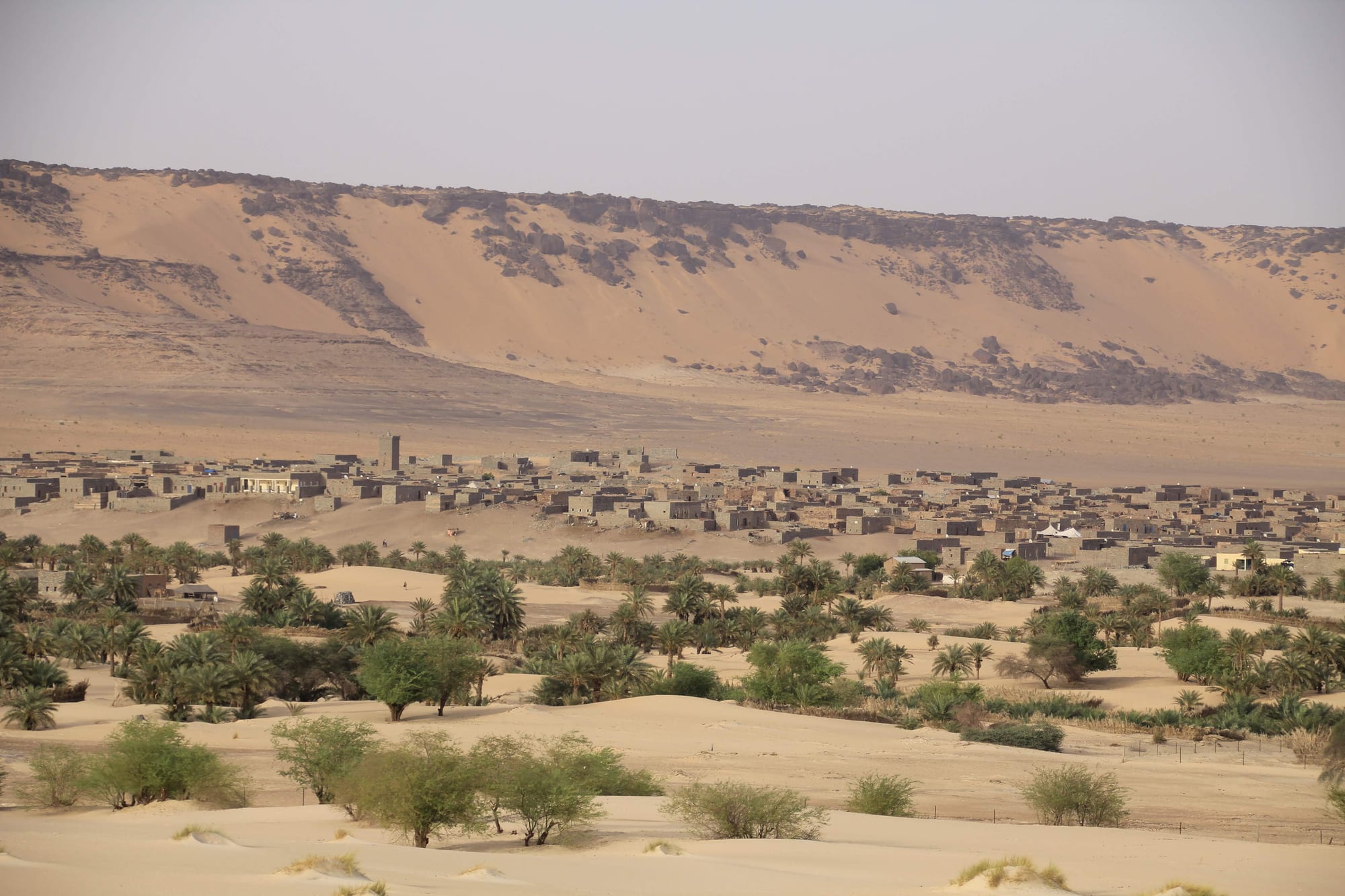
Low stone houses of Tichit spread along a sandy plain with date palms in front and a long sandstone escarpment rising behind

The Adrar & the Desert North, Mauritania

Tichit

Tichit below the Dhar Tichitt escarpment, with its date groves in the foreground. (Wilson McMakin / Wikimedia Commons · CC BY-SA 4.0)

A remote caravan town in the Tagant of south-central Mauritania, built below the sandstone cliff of the Dhar Tichitt among date groves and dunes. Its stone houses, patterned with bands of differently coloured rock, form part of a UNESCO World Heritage Site, and Neolithic village ruins line the escarpment nearby. This page is written to explain the city, not to encourage travel.

Neighbourhoods

  • The ksar
    • First-time visitors
    • Historic district
    • Stone architecture

    The old quarter of flat-roofed houses built from local stone laid without mortar, many of them decorated with bands and panels of contrasting stone around doorways and walls. Lanes are narrow and sandy, some houses are lived in and many are ruined, and the mosque stands among them.

    Open in Maps
  • The newer quarter
    • Where people live
    • Shops and transport

    The more recent houses and compounds spreading away from the old town towards the open plain, where most residents now live, along with the school, the clinic, a few shops and the ground where vehicles from Tidjikja arrive.

    Open in Maps
  • The date groves
    • Quiet walks
    • Gardens

    Palm gardens and small walled plots between the town and the dunes, fed from wells and the run-off of the escarpment. They are the town's main produce and its only shade, and the sand is never far from them.

    Open in Maps

Things to do

The old town

  • The ksar of Tichitlandmark

    The old stone town, inscribed in 1996 with Ouadane, Chinguetti and Oualata as the UNESCO World Heritage Site of the Ancient Ksour.

    Open in Maps
  • The stone houses and their banded wallslandmark

    Tichit's building style uses flat stones of different colours set in patterns around doors, niches and façades, a decorative tradition unusual in the Sahara.

    Open in Maps
  • The village museummuseum

    A small museum in the village, the one place where the town's history and the archaeology of the escarpment are set out for visitors.

    Open in Maps
  • The Friday mosquelandmark

    The town's mosque, built in the same dry-stone technique as the houses and standing at the centre of the old quarter.

    Open in Maps
  • The date groves and dunespark

    The palm gardens on the edge of town, with the sand of the Aouker pressing up against them from the south.

    Open in Maps

Out on the escarpment

  • Dhar Tichittlandmark

    The sandstone escarpment above the town, along which archaeologists have recorded some 500 stone-walled settlements built by herding and farming peoples between about 2000 and 300 BC — the oldest stone-built settlements known south of the Sahara.

    Open in Maps

Eat and drink

Long-standing places and food districts in Tichit. Hours, ratings and directions come from your maps app, always current.

Tichit staples

  • Dates from the grovesmarket

    The town's own dates, eaten fresh at the summer harvest and dried or pressed into paste through the year, and the first thing set in front of a guest with tea.

    Open in Maps
  • Household and guesthouse kitchensrestaurant

    There are no restaurants here; visitors eat what their hosts cook — usually rice or couscous with goat or camel in sauce, followed by dates and tea.

    Open in Maps
  • The town's shopsmarket

    A handful of small shops stocking flour, rice, pasta, oil, tea and sugar brought in by the occasional truck from Tidjikja.

    Open in Maps

Experience Tichit

History

Tichit stands where the Dhar Tichitt escarpment meets the sands of the Aouker, a line of springs and wells at the foot of a cliff in otherwise waterless country. The setting was occupied long before the town: along the escarpment, archaeologists have recorded hundreds of stone-walled village sites left by herding and farming peoples between roughly the second and the first millennia BC, when the Sahara was wetter, making the Dhar Tichitt one of the most important prehistoric landscapes in West Africa.

The present town is medieval, founded in the twelfth century and shaped by the caravan trade. Salt from the northern mines, dates, grain and enslaved people moved along routes that linked the Sahara with the Niger bend, and Tichit was a halt and a market on them, tied by trade and scholarship to Oualata to the east and to the Adrar towns to the north-west. Its builders developed the distinctive local architecture of flat stones laid without mortar and set in coloured patterns, a technique found in only a handful of places.

As the caravans declined the town declined with them, and drought, the collapse of herding and the pull of Nouakchott have reduced it further within living memory: houses in the old quarter have fallen in, and sand has taken gardens and lanes. Tichit was inscribed in 1996 as part of the UNESCO World Heritage Site of the Ancient Ksour of Ouadane, Chinguetti, Tichitt and Oualata, and conservation work has been attempted, though the town's remoteness makes both maintenance and visiting difficult.

Culture & Customs

Tichit's culture is Saharan and Moorish, Hassaniya-speaking, and it preserves the manners of the desert with little dilution because so few outsiders come. Time is given to greetings and to guests: a stranger is taken in, fed and given tea in three rounds, poured from a height to raise foam, and the visit is not hurried along. Refusing hospitality outright is close to an insult.

Like the other old ksour, the town belongs to a tradition of Islamic learning. Families kept manuscripts and taught in household schools, and religious authority and lineage still order social life. The mosque is the centre of the old quarter, and prayer times, not the clock, mark the day. Craft skills survive in the stone building tradition and in leather, wood and metalwork made for household use.

The year's great occasion is the Guetna, the summer date harvest, when families gather in the palm groves, eat fresh dates and stay for weeks despite the heat; it is as much a reunion as a harvest. Dress follows the national pattern, the loose daraa for men and the wrapped malahfa for women, with a head covering that also serves against the sand. Visitors are a rarity rather than an industry here, and the courtesy expected of them is simply to arrive with a local guide, dress plainly and ask before photographing anything.

Daily Life

Tichit is small — a few thousand people at most, far fewer than in its trading days — and it is losing residents steadily to Tidjikja, Nouakchott and the towns of the coast. Households live from date palms and small irrigated plots, goats and camels, a handful of government jobs in the school and the clinic, and money sent home by relatives working elsewhere. There is no industry and practically no cash trade beyond the few shops.

Isolation defines the town. Supplies arrive irregularly by truck over a long desert track, so shortages are ordinary; water comes from wells; electricity is limited, often from solar panels and generators; mobile coverage is patchy. A serious illness means a journey of many hours. Sand is the constant labour, drifting against walls, into lanes and across the gardens, and the ruined parts of the ksar grow slowly larger.

Days start before the heat, pause through the afternoon and resume in the evening, when people sit outside and tea goes round. Summer belongs to the groves and the harvest. The town's future turns on questions it cannot answer alone: whether the road improves, whether conservation money reaches the old houses, and whether enough young people stay to keep the palms and the stonework in repair.

Food

Eating in Tichit is the desert diet at its plainest: dates, milk, grain and meat. The groves supply dates all year, fresh in the harvest and dried or pressed into a paste that keeps indefinitely, and they are offered to anyone who arrives, with tea. Camel's and goat's milk, drunk fresh or soured, matter as much, and zrig — soured milk thinned with water and sweetened — is the everyday drink through the hot months.

Cooked meals are rice, couscous or pasta with goat, mutton or camel in a sauce of onion and tomato, with whatever vegetables have come in on the last truck, served in one dish and eaten with the right hand on a mat. Millet and sorghum appear in porridges and couscous-like dishes. Strips of dried meat keep for journeys and are cooked into sauces. A whole animal roasted as méchoui marks a wedding, a feast day or the arrival of an important guest.

Bread is baked at home, sometimes in hot sand, and wheat flour, oil, sugar and tea are the staples brought in from outside. Green tea, strong, very sweet and full of mint, is brewed on a small charcoal stove and served in three successive rounds over an unhurried hour; it accompanies every meal and every conversation. Alcohol is illegal in Mauritania.

Planning tools

Budget

Almost nothing in Tichit is sold to visitors, so the costs are transport and hospitality: a 4x4 with a driver and guide for the long desert route, fuel carried for the whole trip, and a payment to the household or guesthouse that puts travellers up and feeds them. Food and lodging are cheap; getting here is not.

Daily Budget Midrange
USD 100–200 (a hired 4x4 with driver and guide, full board, a night camped in the dunes)
Daily Budget Shoestring
USD 25–45 (a bed with a family or a basic guesthouse with meals, shared transport when it runs)

Bring every ouguiya needed from Nouakchott or Tidjikja — there is no bank, no cash machine and no card payment — and bring water and supplies rather than relying on the shops.

Best Time to Visit

November to February, when days are warm and nights cold, is the only comfortable season and the one in which desert journeys are made. March and October are hot. From April to September the Tagant is extremely hot and the sand winds are strong; the date harvest fills the groves with families in summer despite it.

Suggested Number of Days

A night or two is enough for the town and the escarpment. The reason for a longer stay is the journey itself, which takes days in each direction and cannot be hurried or reliably scheduled.

First Visit
1–2 days
With Surroundings
3–4 days

Transportation

There is no public transport to speak of. The town is crossed on foot, and everything beyond it is done by hired 4x4 with a driver who knows the route, or by the trucks and pickups that supply the town from Tidjikja and take passengers when they run. Camels and donkeys are still used locally.

Travel in a properly equipped vehicle with a local driver and guide, carry fuel, water and a satellite phone, and never attempt the desert tracks alone or in a single vehicle.

Airport & Station Connections

Tichit lies at the end of a long desert route east of Tidjikja, the Tagant's regional capital, roughly 250 kilometres away over sand and rough track; the drive takes a full day or more in a 4x4 and depends on conditions. Tidjikja itself is a long haul from Nouakchott. There are no scheduled flights, though an unpaved airstrip lies just outside the village.

Walkability

The town is small, flat and entirely walkable, on sand rather than pavement. The lanes of the old quarter are narrow and partly blocked by collapsed walls and drifted sand, and the groves are a few minutes away; the escarpment behind the town is a rougher walk and best done early in the day.

Safety

Tichit is a quiet, conservative town, but it is one of the most isolated inhabited places in Mauritania: there is no hospital, help is many hours away, and mobile coverage is unreliable. Most governments advise against travel to much of the east and south-east of the country, citing terrorism and kidnapping, and against unescorted desert travel, and the routes here pass through very empty country.

Travel with a registered operator, keep to established routes, register at checkpoints and never cross into the northern border zones. Check current official travel advice before travelling.

Climate

Saharan and very dry, with fierce daytime heat for much of the year and cold winter nights. What little rain falls comes in short late-summer storms, slightly more reliably here in the Tagant than further north. Spring winds carry sand for days at a time.

Summer
extremely hot, commonly 40–45°C by day, with hot nights
Winter
warm and clear by day, around 25–30°C, with cold nights near 5–10°C

Local Customs

A small, devout and conservative town where visitors are rare and noticed. Loose clothing covering shoulders and knees is expected, with long sleeves and a head scarf for women. Greetings are long, hospitality is generous and hard to refuse, and green tea is served in three rounds. Alcohol is illegal in Mauritania. Ask before photographing anyone, their house or the inside of the mosque area.

Accept the tea, take time over greetings, arrange a local guide for the ksar and the escarpment, pay hosts in cash, and during Ramadan eat and drink out of sight in daylight.

Common Payment Methods

The currency is the Mauritanian ouguiya (MRU). Tichit is entirely a cash economy: no bank, no cash machine, no cards and no mobile payment to rely on. Small notes are needed for shops, guides and hosts, and everything must be brought in advance.