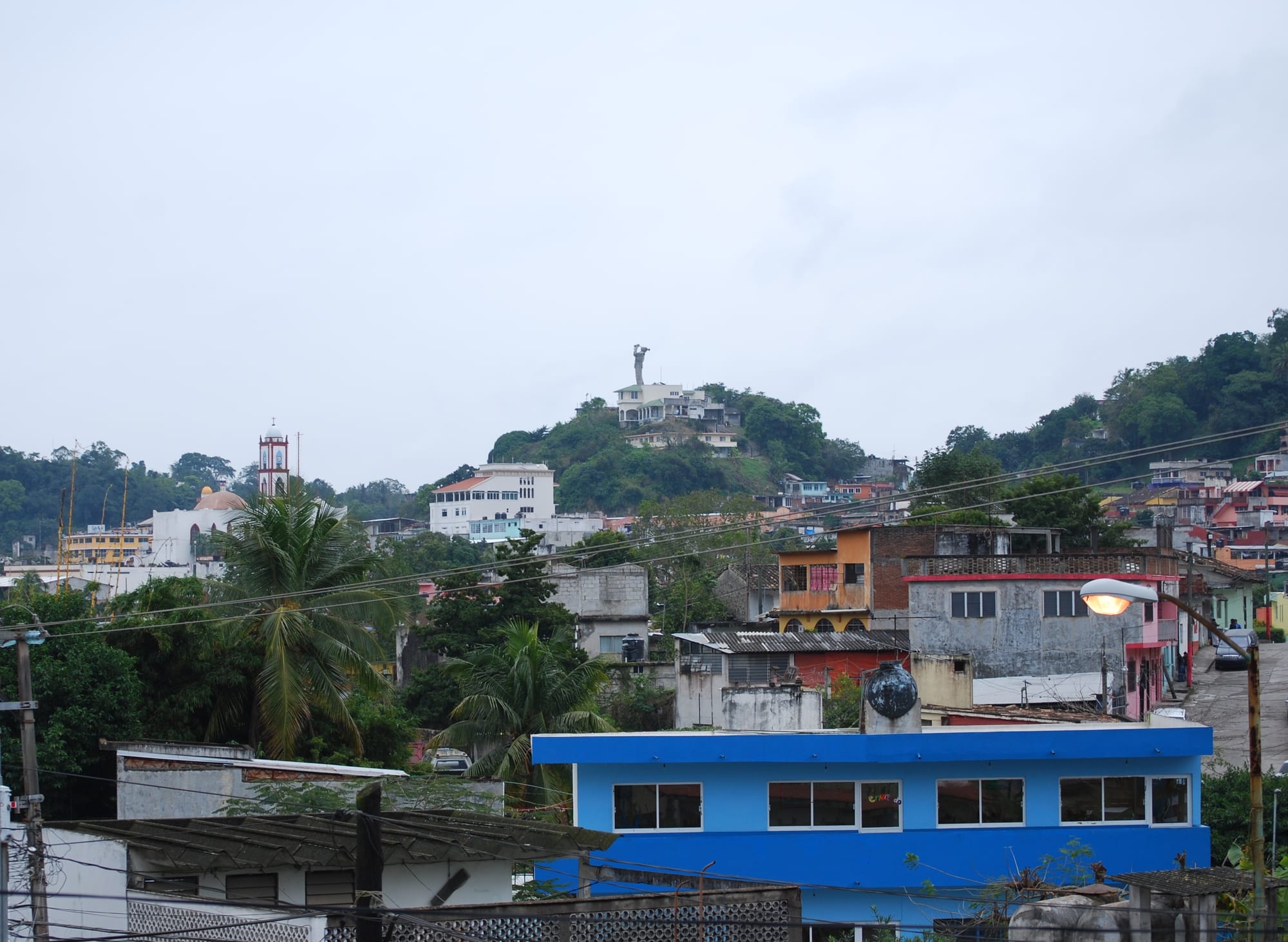
Colourful houses climbing green hills, with a church bell tower on the left and a tall statue on a hilltop in the centre

Veracruz & the Gulf, Mexico

Papantla

The centre of Papantla, with the Monument to the Voladores on its hill above the town. (AlejandroLinaresGarcia / Wikimedia Commons · CC BY-SA 4.0)

A hill town in the Sierra Papanteca of northern Veracruz, founded by the Totonacs around 1200 and still the heart of the Totonacapan region. Vanilla, native to these forests, made its fortune; today it is known for the voladores who fly from a pole beside its church, its murals and the ruins of El Tajín nearby.

Neighbourhoods

  • Centro
    • First-time visitors
    • Historic district
    • Markets

    The Spanish-style core around the tree-shaded main plaza, the Municipal Palace and the Franciscan church, whose atrium holds the voladores' pole. The Hidalgo and Juárez markets face the church, and the ADO bus station is a few blocks downhill.

    Open in Maps
  • The Volador hill
    • Viewpoints
    • Quiet and residential

    The hill in the middle of town crowned by the giant Monument to the Voladores, a lookout over the red roofs and green hills, with a mural telling the story of the ceremony and steep residential streets below.

    Open in Maps
  • Poza Rica
    • Close to public transport
    • Business travellers

    The larger oil city next door, where many long-distance bus routes change. Buses between the two run around the clock.

    Open in Maps

Things to do

The town centre

  • Church of Nuestra Señora de la Asunciónlandmark

    The Franciscan church built between 1570 and 1590, with an 1875 bell tower and a sculpted mural by Teodoro Cano García on its atrium wall showing the evolution of Totonac culture on the body of Quetzalcoatl.

    Open in Maps
  • Monument to the Voladoresviewpoint

    A giant statue of a volador on the hill in the centre of town, which serves as a lookout and carries a mural of the ceremony from the felling of the tree to the descent.

    Open in Maps
  • Main plaza and Municipal Palacelandmark

    The plaza, officially Israel C. Téllez Park, has a kiosk with a Cano García mural of the four suns of creation beneath it; the Municipal Palace facing it holds two murals, one about the Totonacs.

    Open in Maps

Museums

  • Teodoro Cano García Museummuseum

    Works by the Papantla-born artist, a disciple of Diego Rivera who made many of the town's public murals and sculptures, alongside works by some of his protégés.

    Open in Maps
  • Museo de la Ciudadmuseum

    The town museum on Pino Suárez Street, with exhibits from the pre-Hispanic, colonial and post-Independence periods.

    Open in Maps
  • Museo de las Máscarasmuseum

    A collection of more than 300 masks from Totonacapan and other parts of Mexico in the community of San Pablo, gathered by Simón Gómez Atzin.

    Open in Maps

Short trips from the town

  • El Tajínlandmark

    The Classic Veracruz city that flourished from about 600 to 1200, a UNESCO World Heritage Site since 1992, with the Pyramid of the Niches, the palaces of Tajín Chico and some 20 ballcourts; voladores perform at the site.

    Open in Maps
  • Cuyuxquihuilandmark

    A Totonac archaeological site in the Tecolutla valley, whose name means 'armadillo wood', with a ceremonial centre and a military fort.

    Open in Maps
  • Tecolutlabeach

    A beach town at the mouth of the Tecolutla River, the northern end of the Costa Esmeralda, with wetlands, estuaries and mangroves behind the shore.

    Open in Maps

Seasonal events

  • Cumbre TajínMarch, around the spring equinox

    An annual cultural festival held at El Tajín, with Totonac traditions, concerts, theatre and voladores from across Mexico and Guatemala.

  • Corpus Christi and the Xanath Festivallate May or June

    The town's main festival, with processions and Indigenous dances such as the tocotines, guaguas, negritos, santiagueros and voladores, a fair, and the Xanath Festival of Totonac culture, which also honours vanilla.

  • Day of the Dead31 October to 2 November

    Families set up altars called pachau, sometimes hung from the ceiling, decorated with palm, fruit and chocolate figures, and children go from house to house singing at night.

  • Día del Niño Perdido and the Vanilla ExpoDecember

    On the Day of the Lost Child lighted candles are set on doorframes and windowsills, and the town holds a Vanilla Expo during the month.

Eat and drink

Long-standing places and food districts in Papantla. Hours, ratings and directions come from your maps app, always current.

Papantla classics

  • Hidalgo and Juárez marketsmarket

    The town's principal markets, across from the main church, for everyday food, local produce and crafts.

    Open in Maps
  • Vanilla shops of the centreneighborhood

    Papantla vanilla has had a protected designation of origin since 2009; around the centre it is sold as pods, extract, woven figures made from the pods and xanath, the local vanilla liqueur.

    Open in Maps
  • Bakeries and fondas near the plazaneighborhood

    Small bakeries and eateries around the plaza; regional dishes to look for include zacahuil and frijoles in alchuchut.

    Open in Maps

Experience Papantla

History

The Gulf lowlands around Papantla were home to a long line of cultures, and the great city of El Tajín flourished in the hills just west of today's town. The town itself was founded around 1200 by groups of Totonacs, some of them people who had left El Tajín after its fall. Before the Spanish came it belonged to the Totonac lordships of Totonacapan, and Moctezuma II brought it into the Aztec Empire, which took cloth, chillies and maize as tribute. The forests gave cedar, chicle, cotton, cacao, honey and above all vanilla, which grows wild here.

After the conquest the Spanish refounded the town as Papantla de Santa María de la Asunción, laid out a plaza with church and government buildings, and soon shipped vanilla to Europe. Franciscans built the parish church between 1570 and 1590. In 1785 the official Diego Ruiz, searching for illegal tobacco fields, stumbled on the Pyramid of the Niches at El Tajín, which became famous through the writings of Alexander von Humboldt. During the War of Independence the guerrilla leader Serafín Olarte fought in the area until his capture and execution; the town's official name, Papantla de Olarte, honours him.

The 19th century made Papantla Mexico's leading vanilla region, but the privatisation of communal lands under Porfirio Díaz set Totonac communities against merchants and officials, and led to an uprising in 1891. Forces associated with Pancho Villa destroyed the Municipal Palace in 1915. In the 20th century the artist Teodoro Cano García covered the town with murals and sculptures celebrating Totonac culture, and in 2012 Papantla was named a Pueblo Mágico.

Culture & Customs

Papantla is the heart of Totonacapan, and Totonac language and culture remain strong. The town's best-known tradition is the Danza de los Voladores. Five men climb a pole about 30 metres high; four, tied by ropes, launch themselves and spin to the ground while the fifth stays on top, playing a flute and a small drum. Each rope is wound 13 times, making 52 circuits in all, the number of years in the Mesoamerican calendar cycle, and the four flyers represent the four directions. The ritual did not begin with the Totonacs, but it is now strongly associated with those around Papantla, and UNESCO has listed it as intangible cultural heritage. Flights take place beside the church and at El Tajín.

The dance of the guaguas is the other dance most closely linked with the town: dancers in embroidered red trousers and great circular headdresses of ribbon stamp around a wooden cross that turns vertically. Both appear at Corpus Christi, the town's main festival, first held here in the mid-16th century, alongside the Xanath Festival of Totonac culture. Cumbre Tajín, held around the spring equinox at the ruins, mixes Totonac traditions with concerts.

Day of the Dead has its own local form. Families build altars called pachau, laden with fruit, tamales, mole and chocolate figures, and it is believed the souls arrive as insects to eat the hot, fresh food. Teodoro Cano García's murals, on the church, the palace, the kiosk and the Chapel of Cristo Rey, make the town's history visible on its walls.

Daily Life

The municipality of Papantla had about 160,000 people in the 2020 census, around a third of them in the town itself and the rest in more than 300 smaller communities spread over the hills and down to the coast. About a quarter speak an Indigenous language, most of them Totonac. Most people are Catholic, with a sizeable evangelical minority.

Farming still occupies close to half the municipality's people. Corn, beans, chillies and oranges are the main crops, cattle and pigs are raised, and the packing and shipping of oranges is the main local industry. Vanilla remains the town's emblem, though buyers in the United States came to set its price. Tourism, built on El Tajín, the beaches and above all the voladores, is a growing part of the economy, and the oil city of Poza Rica next door provides work and services.

Life centres on the plaza and the markets facing the church. On Fridays couples dance danzón in the plaza, Saturdays bring live music and Sundays cultural events.

Food

Papantla's cooking belongs to the Totonac and Huasteca traditions of northern Veracruz. Local specialities include zacahuil, the huge tamale of the Huasteca, frijoles in alchuchut and tashuayahun. Corn, beans, chillies and oranges from the surrounding farms fill the Hidalgo and Juárez markets, and tamales, mole and local breads are central to festival and Day of the Dead tables.

Vanilla is the town's pride. It comes from the seed pod of an orchid, Vanilla planifolia, that climbs host trees in these forests; the pods darken soon after they are picked. The Totonacs used it for centuries as flavouring, perfume and medicine, and since 2009 "Vainilla de Papantla" has had a protected designation of origin. In the Totonac language vanilla is called xanath, the name also given to a vanilla liqueur rarely found outside the area.

Real vanilla is expensive and hard to find elsewhere in Mexico, so the pods, extract and figures of animals woven from vanilla pods sold around the centre are a favourite purchase.

Planning tools

Budget

Papantla is inexpensive, with prices set by Mexican visitors and local shoppers rather than foreign tourism. Rooms, market meals and local buses cost little; the main extras are entry and transport to El Tajín, a guide at the site and prices that rise during Cumbre Tajín and the Corpus Christi festival.

Daily Budget Midrange
USD 75–140 (mid-range hotel, sit-down meals, taxis, El Tajín with a guide)
Daily Budget Shoestring
USD 30–50 (budget hotel, market and bakery meals, local buses to El Tajín)

Rooms fill up for Cumbre Tajín in March and for Corpus Christi, so book early for those weeks.

Best Time to Visit

The drier months from about November to April are the easiest for climbing around El Tajín, though cold fronts can bring grey, windy days. Most rain falls between May and August, and September and October bring the occasional hurricane. March brings Cumbre Tajín, and Corpus Christi in late May or June is the town's own great festival.

Suggested Number of Days

One or two days cover the town and the ruins nearby. Three or four allow time for the coast and other Totonac sites; festival weeks need extra time and an early booking.

First Visit
1–2 days
With Surroundings
3–4 days

Transportation

The town is small and steep, and taxis are cheap and plentiful; shared taxis are common. Local buses to El Tajín and nearby towns leave from the centre, near the corner of 16 de Septiembre and Curato, and buses to Poza Rica run around the clock.

Locals are used to helping visitors find the right bus to El Tajín; ask in the centre.

Airport & Station Connections

Most visitors arrive by bus. Poza Rica, about 45 minutes away, is the main interchange, with frequent buses to Papantla, and from many places it is easier to change there than to find a direct bus. The nearest airport is El Tajín National Airport in Tihuatlán, which serves Poza Rica and Tuxpan with domestic flights.

Walkability

The centre is compact: the plaza, church, markets and murals are within a few minutes of each other, and the bus station is five blocks downhill. Streets are steep, and the climb to the Volador monument is short but stiff in the heat. El Tajín is out of town and needs a bus or taxi.

Safety

Safety varies enormously by state and even neighbourhood. Veracruz state saw severe organised-crime violence from around 2010, and insecurity remains a problem in parts of the state. Visitors are rarely targeted in the historic centres, museums and sites, but robbery, extortion and highway crime are real risks. Hurricanes and heavy rain are the main natural hazards.

Travel between towns by day on toll roads or first-class buses, use registered taxis, and follow local news. Check current official travel advice before travelling.

Climate

A hot, humid tropical climate in forested low hills. No figures are given for the town itself, so the temperatures below are those for the Gulf coast region as a whole. Most rain falls between May and August, and September and October bring the occasional hurricane.

Summer
hot and humid — the region's coast sees 30–35°C, with heavy rain
Winter
warm — around 20–28°C in the region, with windy, grey cold fronts called nortes

Local Customs

Papantla has strong Totonac communities, and about a quarter of the municipality's people speak an Indigenous language. The Danza de los Voladores is a ritual with deep roots, originally performed to please the gods, and the town's festivals are religious as well as cultural. Most people are Catholic. Tipping in restaurants is customary.

Treat the voladores' ceremony and church processions with respect, dress modestly in churches, and ask before photographing people.

Common Payment Methods

The currency is the Mexican peso. Cash is needed for markets, taxis, buses and small eateries; cards work mainly in larger hotels and shops. Withdraw cash at ATMs in banks in the centre or in Poza Rica.