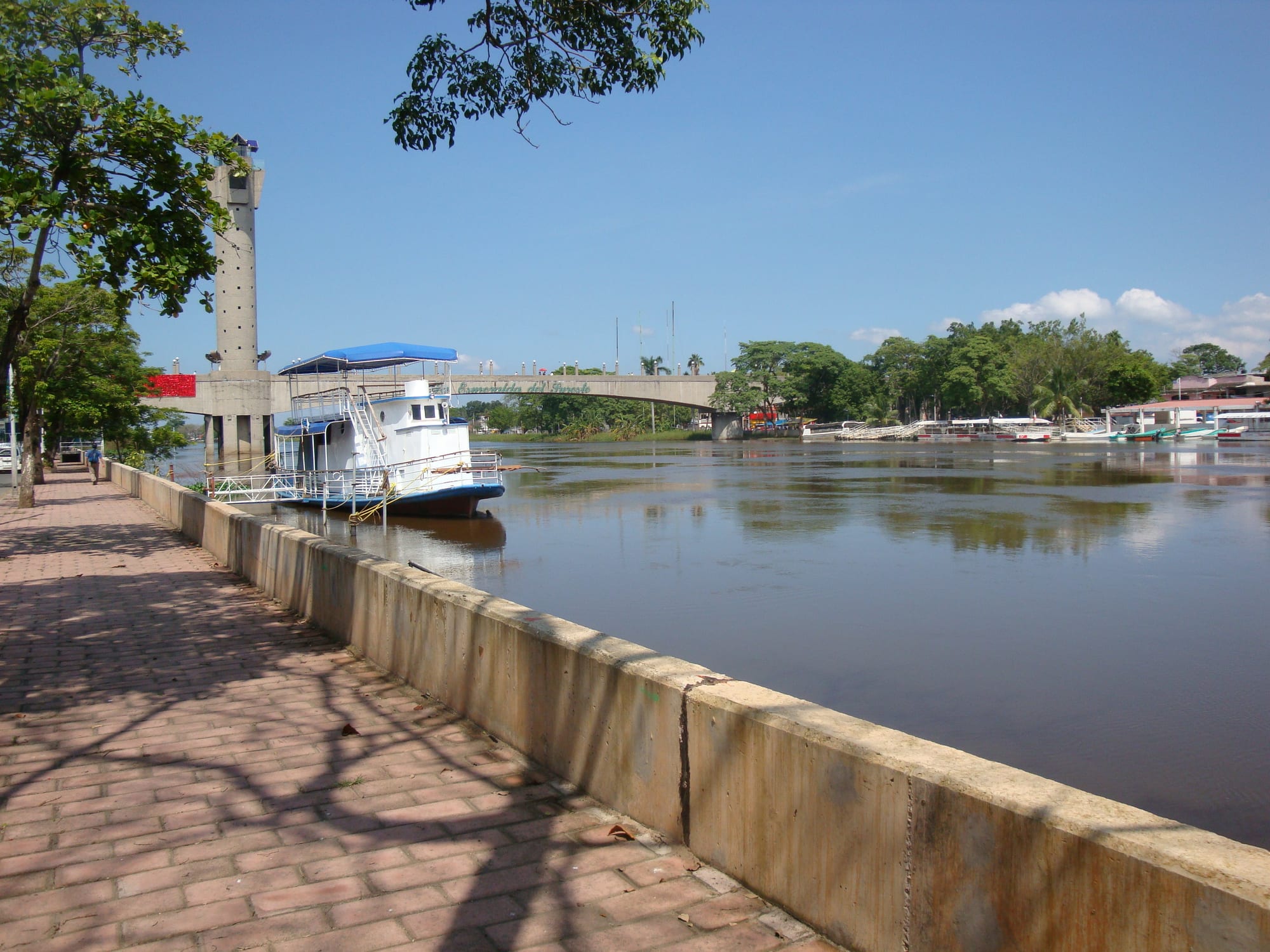
A brick riverside promenade beside the wide brown Grijalva River, with a moored boat, a concrete lookout tower and a bridge

Veracruz & the Gulf, Mexico

Villahermosa

The Grijalva River from Villahermosa's malecón, with the Torre del Caballero lookout. (Alfonsobouchot / Wikimedia Commons · CC BY-SA 4.0)

The capital of Tabasco, on low ground between the Grijalva and Carrizal rivers about 50 km inland from the Gulf. A colonial river port harried by pirates and wars, it was remade from the 1970s by oil into a sprawling modern city of lagoons, malls and office towers, with Olmec colossal heads displayed in a lakeside park.

Neighbourhoods

  • Zona Luz
    • Historic district
    • First-time visitors
    • Shopping

    The heart of the historic centre, where the oldest streets — Juárez, Lerdo, Aldama, Sáenz and Reforma — have been turned into pedestrian lanes of cafés, restaurants, shops and old houses now used as galleries and museums, including the poet Carlos Pellicer's house.

    Open in Maps
  • The Malecón
    • Riverside walks
    • Evenings

    The promenade along the left bank of the Grijalva beside the old centre, rebuilt as a park in 2018, with the Torre del Caballero lookout. The carnival parades start here.

    Open in Maps
  • Laguna de las Ilusiones and Tomás Garrido Canabal Park
    • Parks
    • Museums
    • Families

    The city's largest lagoon and the park on its shore, with lakeside walkways, an observation tower and Parque-Museo La Venta. The Musevi bridge stands beside it.

    Open in Maps
  • Tabasco 2000
    • Business travellers
    • Shopping

    The commercial and financial district in the west of the city, built in the 1980s on the strength of oil, with government offices, banks, office towers, the planetarium, a convention centre and the Galerías Tabasco mall.

    Open in Maps
  • La Choca
    • Hotels and restaurants
    • Nightlife

    A hotel and commercial zone built in the late 1990s on the old fairground of La Choca park, with apartment towers, restaurants and bars, next to the smaller Parque La Choca and its lagoon.

    Open in Maps

Things to do

Olmec and Maya heritage

  • Parque-Museo La Ventamuseum

    An open-air museum in a patch of tropical forest by the Laguna de las Ilusiones, created on the initiative of the poet Carlos Pellicer, where more than 30 Olmec monuments moved from La Venta, including colossal heads, stand among the trees, with a small zoo of regional animals.

    Open in Maps
  • Regional Museum of Anthropology Carlos Pellicer Cámaramuseum

    The city's anthropology museum, with Olmec, Maya and other Mesoamerican pieces.

    Open in Maps

The city centre

  • Villahermosa Cathedrallandmark

    The Cathedral of the Lord of Tabasco, on the site of a church of 1776; the old cathedral was closed in 1928 during the anti-religious campaign, and the present building was raised between 1945 and 1970.

    Open in Maps
  • Casa de los Azulejosmuseum

    A tiled historic house in the old centre that now holds the city's Museum of History.

    Open in Maps
  • Museviattraction

    A bridge built to mark the bicentenary of Mexican independence, beside the Laguna de las Ilusiones and Tomás Garrido Canabal Park, with a museum of regional artists and a café at the top.

    Open in Maps

Parks and the river

  • Tomás Garrido Canabal Parkpark

    A large park around the Laguna de las Ilusiones with lakeside walkways, an open-air theatre, the Mirador de las Águilas lookout and an orchid house.

    Open in Maps
  • Yumkápark

    An ecological reserve east of the city, next to the airport, which is now a zoo where animals from many parts of the world can be seen.

    Open in Maps
  • Estadio Centenario 27 de Febreroattraction

    The baseball park of the Olmecas de Tabasco, who play in the Mexican League; the season runs through the spring and summer.

    Open in Maps

Short trips from the city

  • Comalcalcolandmark

    The westernmost Maya city and the only major one built of fired brick rather than limestone, about 51 km from Villahermosa near the town of the same name and its cacao farms.

    Open in Maps
  • Pantanos de Centlapark

    Wooded coastal wetlands where the Grijalva and Usumacinta reach the sea, protected since 2006 as a biosphere reserve.

    Open in Maps
  • Palenquelandmark

    The Maya city-state in the forest of northern Chiapas, known for some of the finest Maya architecture and carving; it is about two and a half hours from Villahermosa by bus.

    Open in Maps

Seasonal events

  • Encuentro Iberoamericano de Poesía Carlos Pellicer CámaraFebruary

    An annual gathering of poets and writers from several countries, named after Tabasco's best-known poet.

  • Carnivalbefore Lent, February or March

    Parades of costumed troupes and floats along the main avenues, starting at the Malecón, with groups from Veracruz, Campeche and Yucatán.

  • Feria Tabascolate April to early May

    The state fair, counted among the most important in Mexico and drawing more than two million visitors to the Parque Tabasco fairground.

Eat and drink

Long-standing places and food districts in Villahermosa. Hours, ratings and directions come from your maps app, always current.

Villahermosa classics

  • Restaurants of the Zona Luzneighborhood

    The pedestrian streets of the old centre are lined with cafés and restaurants, a good place for pejelagarto, shrimp empanadas and Tabasco tamales.

    Open in Maps
  • Seafood restaurants of the cityrestaurant

    Fish and seafood from the rivers and the Gulf are the core of the local menu, from grilled river fish to shrimp in many forms.

    Open in Maps

Drinks

  • Horchata and aguas frescascafe

    In the heat, aguas frescas are everywhere; a well-known stand across Paseo Tabasco from the cathedral serves horchata and esquimos.

    Open in Maps
  • Pozol stallsmarket

    Pozol, the state's typical drink of maize dough and cacao, is drunk through the working day.

    Open in Maps

Experience Villahermosa

History

Spanish settlers fleeing pirate attacks on the coastal town of Santa María de la Victoria moved up the Grijalva in 1557 to a place called Tres Lomas, and on 24 June 1564 Diego de Quijada founded the town officially. In 1598 King Philip II granted it the title of Villa Hermosa de San Juan Bautista and a royal coat of arms, still the shield of Tabasco. It first became the provincial capital in 1641, but pirates kept attacking: in 1677 they drove the authorities out, and in 1711 English raiders burned the royal warehouse. Only after 1785, when Tabasco militias finally expelled them, did the town settle, and it became the capital again in 1795. Its oldest quarter grew around the hill of Esquipulas and its black Christ.

The 19th century brought war after war. Cholera killed about 2,500 people in 1833–34, civil conflicts between 1833 and 1841 left the city heavily damaged, and in 1846 and 1847 US naval forces under Matthew Perry bombarded and occupied it, until local guerrillas forced them out. French troops took it in 1863 and were driven out in 1864 after weeks of fighting.

During the Revolution the city changed hands several times, and in 1916 its name was fixed as Villahermosa. Under Governor Tomás Garrido Canabal from 1928, churches were closed and later demolished, and religious life almost disappeared for years. From the 1940s the city spread onto former farmland, grassland and forest, and with oil from the 1970s it was remade: the Tabasco 2000 district rose in the west, and the city grew over lagoons and swamps. In October 2007 Villahermosa suffered the worst flood in its recorded history, which displaced several hundred thousand people.

Culture & Customs

The poet Carlos Pellicer Cámara is Villahermosa's great cultural figure. He campaigned from 1951 to move the Olmec monuments of La Venta, threatened by oil works nearby, to Villahermosa and to set them in a forest park by the Laguna de las Ilusiones arranged as they had been found. The city's anthropology museum and the house where he lived carry his name, and each February an Ibero-American poetry gathering in his honour brings writers from several countries. The Esperanza Iris theatre is the state's most important stage, and the José María Pino Suárez library is considered one of the most important in Mexico.

The year's great event is the Feria Tabasco, among the most important fairs in the country, held at the large Parque Tabasco fairground since 1998. Carnival brings costumed troupes and floats from the Malecón through the city, with groups from neighbouring states. Baseball is followed closely: the Olmecas de Tabasco, Mexican League champions in 1993, play at the Estadio Centenario.

Religious life took a long time to recover from the Garrido years. Most people are Catholic, around a quarter Protestant, and the Cathedral of the Lord of Tabasco, finished in 1970, stands where the old church of the black Christ of Esquipulas once did.

Daily Life

In the 2020 census the city of Villahermosa had about 340,000 people and its metropolitan area about 834,000. The municipality, called Centro, takes in the city, several villas and dozens of rural communities.

Oil and gas dominate. The city is the hub of operations in southern Mexico, the "Energy City of Mexico", with the regional operations centre of the state oil company Pemex, and it hosts major petroleum conferences. Commerce follows: large national chains and malls such as Galerías Tabasco serve the whole region, and the city is one of the main commercial points between Mexico City and Cancún. Cacao, sugar cane and bananas are grown in the surrounding countryside.

Life is shaped by heat and water. Days start early and slow at midday, and evenings bring families to the Malecón, the lagoon parks and air-conditioned malls. The floods of 2007 left a deep mark: building on low and flood-prone land is now restricted, which has pushed new housing developments to the outskirts. The fortunes of the oil industry remain the other constant concern.

Food

Tabasco's cooking draws on Maya and Chontal traditions and on its rivers. Pejelagarto, the armoured tropical gar, is the emblem: grilled over charcoal or wood and served with amashito chilli, salt and lime, or shredded into empanadas and tamales. Shrimp-filled empanadas, river fish and seafood fill the menus, and turtle in blood with green plantain was long a traditional dish. Local seasonings include achiote, chipilín and banana leaves.

Tamales come in many forms: manea with pork or chicken, colado with turkey or pork, and bean tamales with pork or with momo, the local name for hoja santa. Corn and beans are the base of most meals.

Cacao has been grown in Tabasco since before the Spanish arrived, and chocolate is still drunk in preparations that have changed little since then. The everyday drink is pozol, a mix of ground maize and cacao, drunk through the working day. Horchata and other aguas frescas are sold everywhere against the heat, and the cacao farms around Comalcalco show how the bean becomes chocolate.

Planning tools

Budget

Villahermosa is a business city rather than a tourist one. Food, buses and colectivo taxis are cheap, but hotels are priced for the oil industry and conventions, and rooms are dearer during the Feria Tabasco and big conferences. Day trips to Comalcalco, the wetlands or Palenque add transport or tour costs.

Daily Budget Midrange
USD 80–160 (business hotel, restaurant meals, taxis, museum entry and a day trip)
Daily Budget Shoestring
USD 30–50 (budget hotel, market and street food, combis and shared taxis)

The Malecón, the lagoon parks, the Zona Luz and the cathedral cost nothing; Parque-Museo La Venta is the one paid sight most visitors make time for.

Best Time to Visit

December to March is the most comfortable time, when daytime temperatures drop to around 28°C. Spring and summer are very hot, and the rainy season from about June to October brings the risk of floods; the city's worst recorded flood came in October 2007. February brings the poetry gathering and Carnival.

Suggested Number of Days

One or two days are enough for the city. Three to five allow for the Maya brick city to the west, the coastal wetlands and the longer run into Chiapas; the heat makes slower days sensible.

First Visit
1–2 days
With Surroundings
3–5 days

Transportation

The city is spread out and built around fast roads, and most people use taxis, combis and minibuses. Combis follow fixed routes, with destinations written on the windscreen, along main roads such as Gregorio Méndez and 27 de Febrero. Taxis are often collective: the driver picks up other passengers going the same way, at the same fare. Highways 180, 186 and 195 meet here.

In a shared taxi the destination is given to the driver before getting in, and sitting in the front seat is advisable.

Airport & Station Connections

Villahermosa International Airport (Carlos Rovirosa Pérez), about 10 km beyond the eastern edge of town on the Macuspana highway, has domestic flights to Mexico City and other cities and handled about 1.4 million passengers in 2025. The main bus terminal, run by ADO, is on Boulevard Adolfo Ruiz Cortines, with services across the south-east and to Mexico City, about 900 km away.

Walkability

The Zona Luz is pleasant on foot, with pedestrian streets, and the Malecón and the lagoon parks are good for walking in the cooler hours. Beyond them the city is built for cars, with long distances, wide roads and intense heat, so taxis are the practical way to move between areas.

Safety

Safety varies enormously by state and even neighbourhood. Organised-crime groups are active in Tabasco. Visitors are rarely targeted in historic centres, museums and sites, but robbery, extortion and highway crime are real risks. Flooding and hurricanes are the main natural hazards, and the city's low ground floods in severe rainy seasons.

Use registered taxis or apps at night, withdraw cash inside banks or malls, travel by day on toll roads, and follow local news in the rainy season. Check current official travel advice before travelling.

Climate

A tropical monsoon climate on ground about 10 metres above sea level. Spring and summer are hot, with temperatures that can pass 40°C, and the rainy season brings heavy downpours and occasional serious floods. The short winter is still humid and warm.

Summer
very hot and humid, with temperatures that can pass 40°C and heavy rain
Winter
warm and humid — daytime temperatures fall to around 28°C

Local Customs

Most people are Catholic, with a large Protestant minority. Tabasqueños are proud of their food, their poet Carlos Pellicer and their Olmec heritage. Dress is light and casual in the heat, though business dress is common in Tabasco 2000. Tipping in restaurants is customary.

Wear long, light clothing and insect repellent at Parque-Museo La Venta and Yumká, dress modestly in churches, and ask before photographing people.

Common Payment Methods

The currency is the Mexican peso. Cards are accepted in malls, hotels and larger restaurants; taxis, combis, markets and street stalls take cash. ATMs are common, and those inside banks or malls are the safest choice.