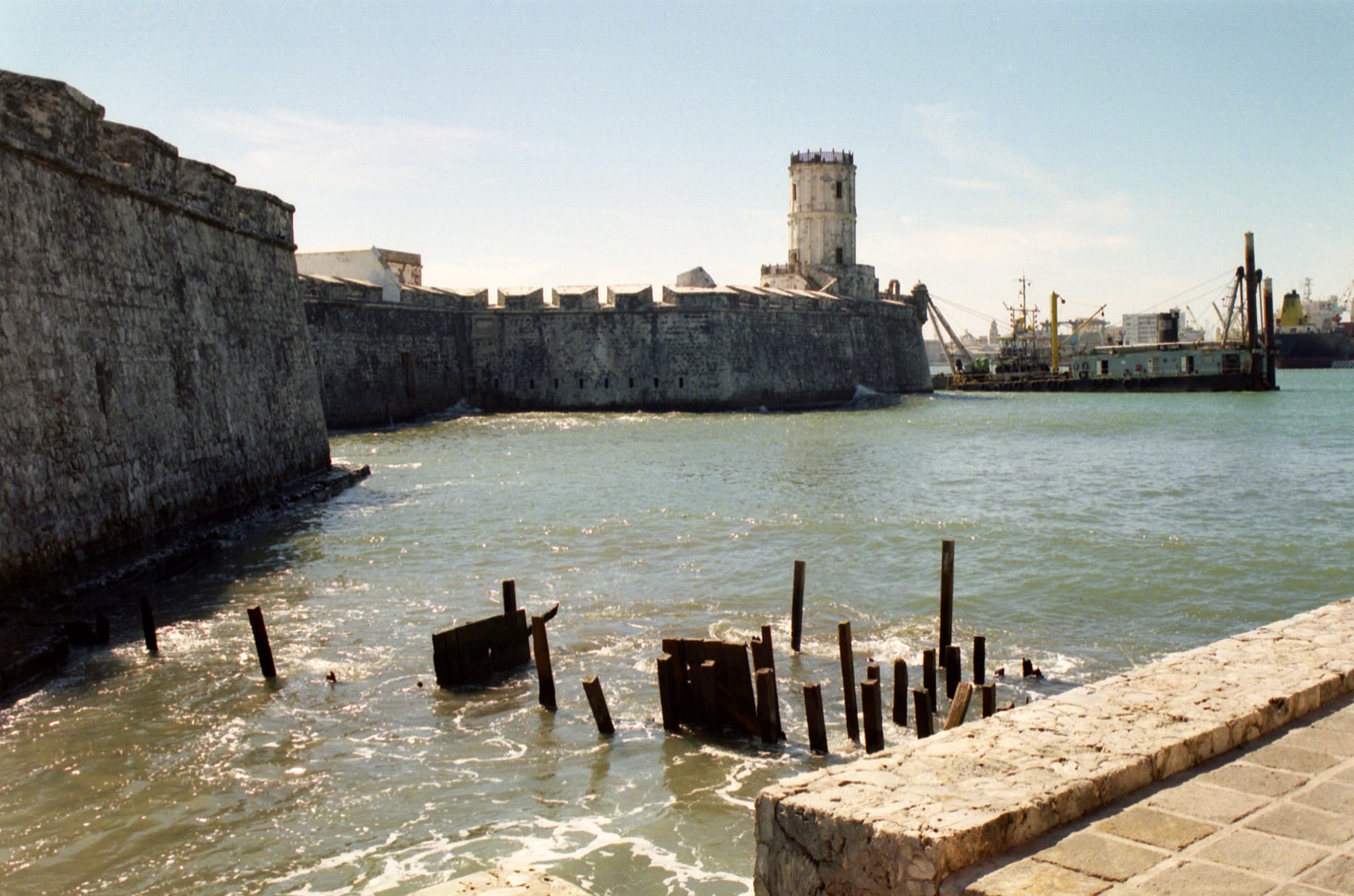
Grey stone walls and a watchtower of an old fortress rising from greenish harbour water, with ships and cranes behind

Veracruz & the Gulf, Mexico

Veracruz

The walls and watchtower of San Juan de Ulúa, the island fortress guarding the port of Veracruz. (Ken Eckert / Wikimedia Commons · CC BY-SA 4.0)

Mexico's oldest and historically most important port, on the Gulf coast 90 km south-east of Xalapa, founded by Hernán Cortés in 1519. Guarded by the island fortress of San Juan de Ulúa and invaded repeatedly, it grew rich on the Atlantic trade; today it is the country's main port for imports and exports, a city of seafront cafés, danzón and son jarocho, and Mexico's biggest Carnival.

Neighbourhoods

  • The historic centre
    • First-time visitors
    • Historic district
    • Music and nightlife

    The old walled city around the Zócalo, officially the Plaza de las Armas, with the cathedral, the 1608 Municipal Palace, the arcaded cafés and bars of Los Portales and streets of colonial and 19th-century buildings. The square is busy from morning to night, and the danzón is danced here on most evenings.

    Open in Maps
  • The port and the malecón
    • Waterfront walks
    • History

    The seafront between the centre and the harbour, with the old customs house, the old lighthouse, the former railway terminal and the crafts market, looking across the water to the cranes of the container port and the fortress of San Juan de Ulúa.

    Open in Maps
  • The beachfront
    • Beaches
    • Families

    South of the centre the malecón continues for kilometres past the Veracruz Aquarium and Playa de Hornos, Villa del Mar and Playa Martí towards Boca del Río, with hotels and flats along a breezy seafront where people walk and exercise in the evening.

    Open in Maps
  • Boca del Río
    • Upmarket
    • Best for food
    • Business travel

    The neighbouring municipality at the southern end of the city, a small port in its own right and the metropolitan area's centre for business travel and upscale hotels and restaurants, with modern towers along the coast.

    Open in Maps

Things to do

Famous landmarks

  • San Juan de Ulúalandmark

    The island fortress where Juan de Grijalva first landed in 1518, built from the 16th to the 18th century against pirates, Spain's last foothold in Mexico until 1825 and later a prison for political prisoners, with a museum since 1984.

    Open in Maps
  • Zócalolandmark

    The tree-shaded main square, where people play dominoes, sell food and cigars, play music and, on most evenings, dance the danzón.

    Open in Maps
  • Cathedral of Veracruzlandmark

    The church of Our Lady of the Assumption on the Zócalo, completed in 1731 with an octagonal cupola covered in Puebla tiles, and a cathedral only since 1963.

    Open in Maps
  • Municipal Palacelandmark

    Built for the city council in 1608 and remodelled in the 18th century, a sober Baroque building around an arcaded courtyard, with a corner tower once used to watch ships; the oldest city government building in Mexico.

    Open in Maps
  • Baluarte de Santiagomuseum

    The only surviving bastion of the nine that once guarded the walled city, now a small museum of pre-Hispanic gold jewellery found by a fisherman in the 1970s.

    Open in Maps

Museums

  • Acuario de Veracruzmuseum

    The largest aquarium in Mexico and Latin America by water volume, opened in 1992, with a reef tank known for its sharks, a shark tank and a manatee tank.

    Open in Maps
  • City Museummuseum

    The history of Veracruz in a 19th-century neoclassical building in the historic centre, built as an asylum and opened as a museum in 1970.

    Open in Maps
  • Agustín Lara House Museummuseum

    The Boca del Río house of the city's famous songwriter, with his photographs, personal belongings and a replica of the studio of his radio programme, La Hora Azul.

    Open in Maps

Waterfront, beaches and reefs

  • Malecóntrail

    The seafront promenade stretching for kilometres from the centre to the suburbs, lined with souvenir sellers near the centre and busy at night with people enjoying the sea breeze.

    Open in Maps
  • Playa Martí and Villa del Marbeach

    City beaches on the seafront between the centre and Boca del Río, near the aquarium and Playa de Hornos.

    Open in Maps

Markets

  • Mercado Hidalgomarket

    A market with sections for butchers and for fish and fresh seafood, and cheap lunch counters.

    Open in Maps

Short trips from the city

  • Veracruz Reef System National Parkpark

    A marine national park of coral reefs and small islands off the city and Antón Lizardo, with dive sites reached through operators in Veracruz and Boca del Río; May to August is the best season for diving.

    Open in Maps
  • La Antiguaattraction

    The river town where Veracruz stood from 1525 until the end of the 16th century, regarded as the first real Spanish town in Mexico.

    Open in Maps
  • Cempoalalandmark

    The ruins of a major Totonac city, the first urban settlement the Spanish saw on the mainland, whose people became Cortés's allies in 1519.

    Open in Maps

Seasonal events

  • Carnivalthe nine days before Ash Wednesday

    Held every year since 1866 and the largest Carnival in Mexico, with parades along the seafront boulevard between Boca del Río and the port; it opens with the Burning of Bad Humour and ends with the Burial of Juan Carnaval.

  • Danzón on the Zócalomost evenings, all year

    Couples dance the danzón, brought from Cuba by refugees in the 1870s, in the main square, with dance schools keeping the tradition alive.

Eat and drink

Long-standing places and food districts in Veracruz. Hours, ratings and directions come from your maps app, always current.

Veracruz classics

  • Gran Café del Portal and Café de la Parroquiacafe

    The two best-known of the coffee houses at the centre of the city's social life, where customers ask for a refill of their lechero by clinking spoons against their glasses.

    Open in Maps
  • Los Portalesneighborhood

    The arcades and pavement tables beside the Zócalo, where people drink, eat and listen to the son musicians who play around the square.

    Open in Maps

Food districts and markets

  • Mercado Hidalgomarket

    Cheap meals at the market's lunch counters, near the stalls of fish and fresh seafood.

    Open in Maps
  • Boca del Río's seafood restaurantsneighborhood

    The neighbouring town is the metropolitan area's centre for upscale restaurants, many of them serving the Gulf's seafood.

    Open in Maps

Experience Veracruz

History

The Spanish captain Juan de Grijalva landed in 1518 on the island he named San Juan de Ulúa, then a sanctuary of the god Tezcatlipoca. On Good Friday, 22 April 1519, Hernán Cortés came ashore opposite it and founded Villa Rica de la Vera Cruz, the "rich town of the True Cross", setting up a council that is counted as the first city council on the American mainland; in 1523 it became the first mainland settlement to receive a European coat of arms. The town moved in 1525 to La Antigua, and in 1600 the Crown ordered it back to its first site to curb smuggling.

As the gateway of New Spain, Veracruz shipped silver and gold to Spain and received the twice-yearly treasure fleets, and its merchants were at times wealthier than those of Mexico City. Enslaved Africans were brought in through the port. Its wealth drew pirates — Laurens de Graaf and his allies attacked it in 1683 — and the city was walled, with Ulúa built up as its fortress.

After independence, Spanish troops held Ulúa until 1825 and bombarded the city. The French attacked in the Pastry War, US forces under Winfield Scott besieged and took the city in 1847, Benito Juárez governed from here during the civil war of 1857, and French troops occupied it in the 1860s. The United States occupied the port again from April to November 1914. Its defences earned it four titles of "Heroic City". Porfirio Díaz modernised the port, its powerful unions were reorganised by 1991, and it is now Mexico's main commercial port.

Culture & Customs

Veracruz has always been a meeting point of cultures — Spanish, Indigenous and African, joined after independence by immigrants from Italy and Cuba — and that mix shows above all in its music and food. Son jarocho, the traditional music of the state, is closely associated with the city; "La Bamba", made famous by Ritchie Valens, has its roots in the son of southern Veracruz. The faster, flashier son comercial, developed in the 1940s, accompanies folk dance shows in which women in long white dresses dance with fans, and son singers can be heard on the Zócalo almost any time.

The danzón, brought from Cuba by refugees in the 1870s, was once a dance of the poor and is now danced by couples of all classes on the Zócalo on most evenings, kept alive by dance schools. The city's most famous son is the songwriter Agustín Lara, author of "María Bonita", whose house in Boca del Río is a museum.

Carnival has been held every year since 1866 and is the largest in the country, opening with the Burning of Bad Humour and closing with the Burial of Juan Carnaval. The Zócalo is busy from morning to night with music and dancing, and the naval academy, founded here in 1897, gave it a long naval tradition. Baseball and football are the most popular sports; El Águila de Veracruz plays in the Mexican Baseball League, while the old football club, the Tiburones Rojos, was disaffiliated in 2019.

Daily Life

The 2020 census counted about 538,000 people in the city of Veracruz, including the part that spreads into Boca del Río, and about 607,000 in the municipality. The port is the economy's engine: in the 20th century oil mattered most to the state, but the port has since re-emerged as the main source of work and is the principal gateway for Mexico's imports and exports, above all for the car industry. Factories in and around the city make paints, food products, plastics, petrochemicals and metals.

Automation of the docks under federal control cut 80 per cent of port jobs and brought strikes. Boca del Río, at the southern end, holds the business hotels, newer towers and upscale restaurants. Beyond the city the municipality grows maize, beans, fruit and sugar cane and raises cattle.

The day starts early in the coffee houses, where conversation over a lechero is a central part of social life. Evenings belong to the malecón, where people stroll and exercise in the sea breeze, and to the Zócalo, busy until late with music, dominoes and dancing. The wet season's afternoon storms and the winter nortes shape the year.

Food

Veracruz cooking joins indigenous staples — maize, beans, squash, chillies, tomatoes, avocados and tropical fruit such as mamey and sapote — with ingredients brought by the Spanish through the port: olive oil, garlic, capers, olives, almonds, rice and herbs such as parsley, thyme and bay. The signature dish, huachinango a la veracruzana, is red snapper cooked with tomatoes, chillies, olive oil, garlic and capers. Arroz a la tumbada is rice baked with a variety of seafood, and caldo de mariscos, a seafood soup, is reputed to cure hangovers.

Coffee houses are the heart of the city's social life, and the Gran Café del Portal and the Café de la Parroquia are the best known. Coffee comes as a lechero, espresso topped up with milk in a glass, and customers ask for more by clinking their spoons against the glass — a custom said to go back to a trolley driver who rang his bell as he approached the café, and to the regulars who tapped their glasses as his funeral passed.

For everyday food, locals eat at the lunch counters of Mercado Hidalgo, among the stalls of fish and seafood, and the restaurants of Boca del Río serve the Gulf's catch to a smarter crowd.

Planning tools

Budget

Veracruz is not a foreign-tourist resort, so prices are set by Mexican visitors and stay moderate: market meals, cafés and city buses cost little. Hotels in the historic centre are cheaper than the beachfront and Boca del Río, and rooms are dearer over Carnival, Easter, the summer holidays and Christmas.

Daily Budget Midrange
USD 75–160 (mid-range hotel on the seafront, seafood restaurants, taxis, a dive trip or a visit to the fortress and aquarium)
Daily Budget Shoestring
USD 30–50 (budget hotel in the centre, market meals and café breakfasts, city buses)

A lechero and breakfast in a traditional café and an evening of danzón on the Zócalo cost very little.

Best Time to Visit

The dry season from November to May is the most comfortable, though winters are often foggy and cloudy and the nortes, strong north winds, blow between about January and March. Carnival comes before Lent. The wet season from June to October is hotter and humid, with near-daily afternoon thunderstorms and the risk of hurricanes.

Suggested Number of Days

Two or three days cover the historic centre, the port and the seafront. Four or five allow for the reefs and the historic towns and ruins along the coast nearby, and Carnival deserves its own visit.

First Visit
2–3 days
With Surroundings
4–5 days

Transportation

City buses run along the seafront and between the centre and Boca del Río, and taxis are plentiful. The historic centre and the port area are compact enough to walk, but the city stretches for kilometres along the coast, so the beaches, the aquarium and Boca del Río are easier by bus or taxi.

Use registered taxis or ride-hailing apps, especially at night.

Airport & Station Connections

General Heriberto Jara International Airport lies about 10 km west of downtown, with flights to numerous Mexican cities and to the United States. First-class ADO buses take about five and a half hours from Mexico City's TAPO terminal and three to four from Puebla to the bus station a short distance from the centre. Xalapa, the state capital, is 90 km away.

Walkability

The historic centre is flat and easy on foot, and the walk from the Zócalo to the malecón and the port takes only a few minutes. The malecón continues for kilometres along the seafront, pleasant in the evening breeze; in the heat of the wet season, walking is best early or late in the day.

Safety

Safety varies enormously by state and even neighbourhood. Veracruz state saw severe organised-crime violence from around 2010, and insecurity remains a problem in parts of the state. Visitors are rarely targeted in the historic centres, museums and sites, but robbery, extortion and highway crime are real risks. Flooding and hurricanes are the main natural hazards: Hurricane Karl flooded the area in 2010.

Stick to the main tourist areas and busy streets after dark, travel by day on toll roads, use registered taxis or apps, and follow local news in the storm season. Check current official travel advice before travelling.

Climate

A tropical savanna climate. The wet season, June to October, brings most of the year's rain, near-daily late-afternoon thunderstorms and high humidity; July is the wettest month. The dry season, November to May, is slightly cooler but often foggy and overcast, and March is the driest month.

Summer
hot and humid — June and August have mean temperatures of about 28°C, with afternoon storms
Winter
warm and drier — January, the coolest month, has a mean of about 21°C, with fog, cloud and windy nortes

Local Customs

The jarochos, as Veracruz people are called, are known for loving the outdoors: the Zócalo is busy from morning to night with music, dominoes and dancing, and coffee houses fill from early morning. In the coffee houses a refill of lechero is requested by clinking a spoon on the glass. Tipping is customary in restaurants.

Dress modestly in the cathedral; ask before photographing dancers on the Zócalo.

Common Payment Methods

The currency is the Mexican peso. Cards are generally accepted in hotels, larger restaurants and shopping centres; cash is needed for markets, buses, cafés and street vendors.