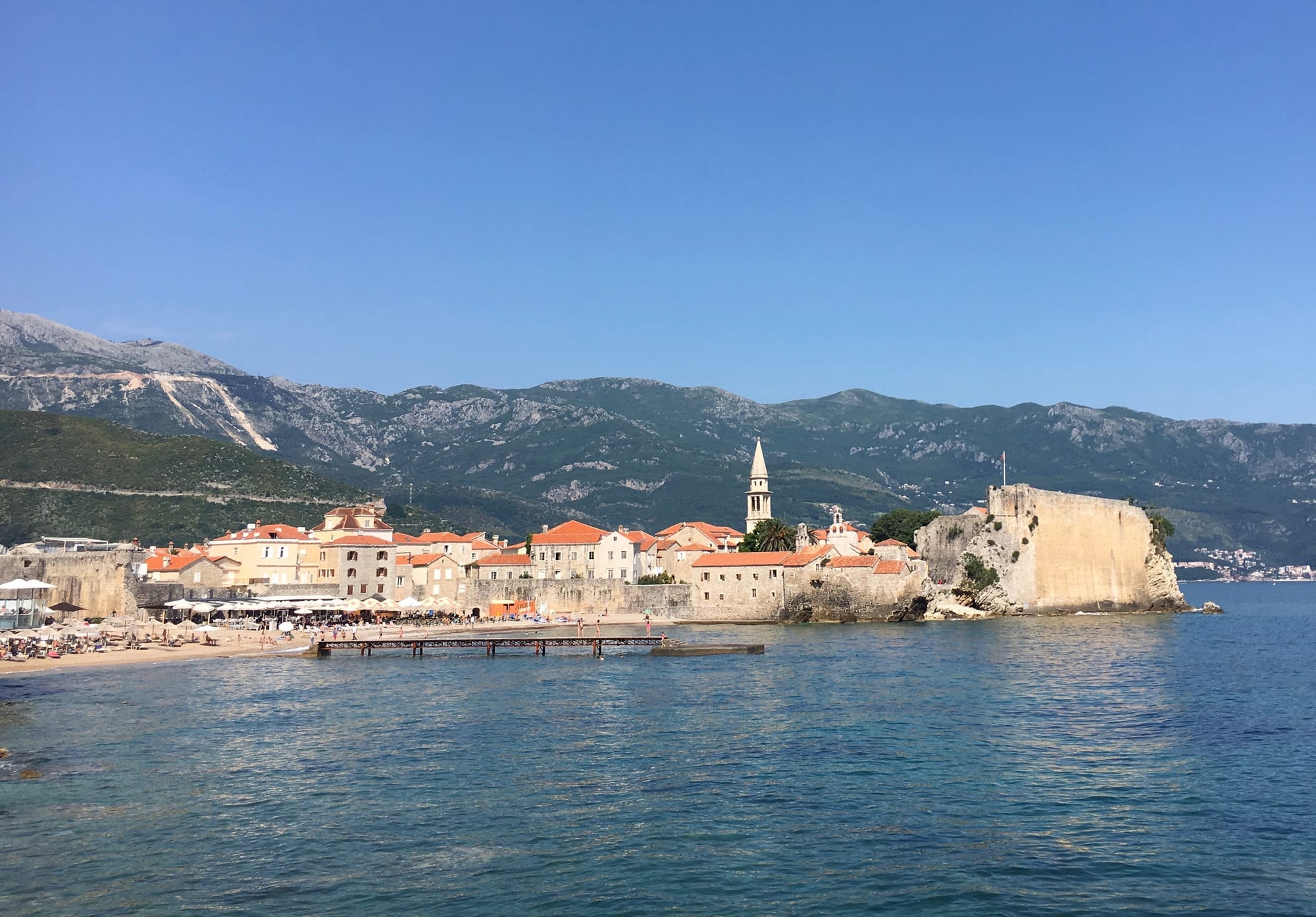
Budva's walled old town with a church bell tower and the stone citadel on the shore, below grey mountains and a clear sky

Montenegro

Budva

Budva's old town and its citadel on the peninsula, seen across the water with the mountains of the coast behind. (Dirgela / Wikimedia Commons · CC BY-SA 4.0)

The centre of Montenegro's busiest stretch of coast, the Budva Riviera — a small walled town on a rocky peninsula, around 2,500 years old and long ruled by Venice, now surrounded by beaches, hotels and fast-built apartment blocks. It is the country's most visited resort, known regionally for its summer nightlife, with the islet village of Sveti Stefan a short ride south.

Neighbourhoods

  • Old Town (Stari Grad)
    • First-time visitors
    • Historic district

    The walled town on its peninsula, entered through the Porta di Terra Ferma at the start of Njegoševa Street. Inside, the pedestrian lanes and small squares are lined with restaurants, cafés, bars and boutiques, the churches stand together on one square, and the citadel guards the southern tip.

    Open in Maps
  • Slovenska Beach and the promenade
    • Beaches
    • Nightlife

    The town's longest beach, about 1.6 km long, with the seafront promenade behind it and the planned resort hotels of the Yugoslav era between the beach and the Adriatic Highway. In summer this is where most of the town's bars and evening crowds are.

    Open in Maps
  • Rozino and the western Budva field
    • Quiet and residential
    • Close to the bus station

    The more orderly residential side of the plain behind the coast, around the civic centre with the town offices, schools, sports centre and bus station. Further east, the hillsides above the field are filled with dense, unplanned apartment building.

    Open in Maps
  • Bečići
    • Beaches
    • Families

    A small resort town just south-east of Budva, beyond the Zavala peninsula, built along a long sandy beach.

    Open in Maps

Things to do

The old town

  • Budva Citadellandmark

    The fortress at the southern tip of the old town, first known as the Castle of St Mary and given its final form under Austria-Hungary, with Austrian stone barracks and sea-facing ramparts.

    Open in Maps
  • Churches' squarelandmark

    The square north of the citadel that holds all the old town's churches — St John's of the 17th century, Santa Maria in Punta, said to date from 840, the Orthodox St Sava's and the Orthodox Holy Trinity of 1804.

    Open in Maps
  • Budva city museummuseum

    The town museum inside the walls, with permanent archaeological and ethnographic collections.

    Open in Maps

Beaches and islands

  • Mogren Beachbeach

    Budva's best-known beach, in two coves under the cliffs of Spas hill and reached from the old town by a path along the rocks.

    Open in Maps
  • Jaz Beachbeach

    A long beach west of town, with a campground and a concert and festival venue in its hinterland where major concerts have been held.

    Open in Maps
  • Sveti Nikola Islandbeach

    The island across the bay from the old town, reached by water bus, with beaches that make it a popular excursion.

    Open in Maps

Walks and viewpoints

  • Mogren Fortressviewpoint

    The ruined walls of an Austrian fort of 1860 on Spas hill above Mogren Beach, reached by a short hike from the beach, with wide views of the Budva Riviera.

    Open in Maps
  • Fort Kosmačlandmark

    The southernmost fortress of the Austro-Hungarian Empire, on the hills above Budva guarding the old road to Cetinje.

    Open in Maps

Short trips from the town

  • Sveti Stefanlandmark

    A fortified islet village about 6 km south-east, joined to the shore by a narrow strip of sand, once the centre of the Paštrovići community and now a luxury resort; the beaches beside it are pink-tinged sand.

    Open in Maps
  • Petrovacneighborhood

    A small seaside town at the southern end of the municipality, where the old mountain road from Podgorica reaches the coast.

    Open in Maps

Seasonal events

  • Budva Carnivallate April or early May

    A three-day carnival held every year since 2003, with masked parades and concerts in the old town; it marks the opening of the tourist season.

  • Theatre City (Grad Teatar)July and August

    A festival founded in 1987 that turns the whole old town into an open-air venue for theatre, music, literature and visual art.

  • Auto show at the Adriatic Fairautumn

    Montenegro's only auto show, held each year at the Adriatic Fair, the country's only specialised exhibition centre.

Eat and drink

Long-standing places and food districts in Budva. Hours, ratings and directions come from your maps app, always current.

Budva classics

  • Old town restaurantsneighborhood

    The narrow cobbled lanes inside the walls are lined with restaurants and cafés, many serving the coast's seafood — grilled or fried squid, octopus salad, mussels and black risotto with cuttlefish.

    Open in Maps
  • Seafront promenadeneighborhood

    The promenade along Slovenska Beach, the town's main street in summer, with restaurants, bars and terraces from the old town walls eastwards.

    Open in Maps

Cafés and bars

  • Old town cafés and pubscafe

    Cafés and pubs fill the small squares of the old town, quiet in the morning and busy late into the evening in summer.

    Open in Maps

Experience Budva

History

Budva claims to be one of the oldest settlements on the Adriatic coast. Legend says Cadmus, the exiled founder of Thebes, took refuge here; the written record begins in the 5th century BC, an Illyrian site gained a Greek trading post in the 6th century BC, and Rome took the area in the 2nd century BC. Saracens sacked the town in 841, and through the early Middle Ages it passed between Doclean, Serbian and Zetan rulers; around 1200 it became the seat of a Catholic diocese that lasted until 1828.

Venice ruled the town, as Budua, from 1420 to 1797 and gave it its walls, built against the Ottomans, who held it only briefly in 1572–73. Venetian was the language of most of its people until the early 19th century. Austria followed Venice, with short Montenegrin-Russian and French interludes during the Napoleonic wars, and held Budva from 1814 to 1918, building Fort Kosmač on the hills above. The town then joined Yugoslavia, was annexed by Italy in 1941 and freed on 22 November 1944.

On 15 April 1979 an earthquake devastated much of the old town; rebuilding took until 1987, and the buildings were restored to their original form. Tourism had already pushed the town out onto the Budva field, and after Montenegrin independence in 2006 Budva became the country's main tourist destination. Since 2022 it has been a centre for Ukrainian, Russian and Turkish newcomers, and its population has risen sharply.

Culture & Customs

Budva's reputation is as a beach and party town rather than a place for sightseeing — unlike Kotor or Dubrovnik. It is known regionally as the nightlife capital of the eastern Adriatic: discotheques appeared in the 1980s, open-air clubs spread along the promenade in the 1990s, and the old town and seafront are now full of bars. Jaz Beach became a concert venue with a Rolling Stones show in 2007 that drew around 35,000 people, twice the population of the town, and Madonna played there in 2008.

The cultural calendar runs alongside the clubs. Theatre City, founded in 1987, fills the old town every July and August, and the carnival, held since 2003, opens the season in spring; Budva and Kotor hosted the World Carnival City Congress in 2009. The memorial home of the writer and politician Stefan Mitrov Ljubiša, a native of the town, and the town museum keep local history in view. Budva was home to Zeta Film, Montenegro's main film company in the Yugoslav era, and the 1964 film The Long Ships was shot here — its large cracked prop bell still stands outside the walls.

Sport is local and loyal: the volleyball and handball clubs play at the Mediterranean sports centre, KK Mogren is the basketball team, and VK Budva competes in water polo, a common sport all along this coast.

Daily Life

The town had about 17,500 inhabitants at the 2023 census, and the wider municipality includes Bečići, Sveti Stefan and Petrovac. Tourism is the economy: in 2013 Budva alone accounted for almost half of Montenegro's tourist visits and overnight stays. Hotels, apartments, restaurants and boat trips employ much of the town, and luxury yachts fill the marina beside the old town in summer.

That success has had a cost. Since the late 1980s demand for property, fuelled in large part by Russian capital, has turned almost every empty plot on the Budva field and the hills around it into building sites, producing high-rise blocks, narrow streets, and chronic shortages of parking. The word "Budvanizacija" — Budvanization — is used in the region for this kind of chaotic, unplanned growth. Local politics has been turbulent, and several mayors since independence have been arrested; Nikola Jovanović took office in 2025.

The year has two speeds: crowded, loud summers when the promenade is busy until late, and quiet winters when residents have the old town largely to themselves.

Food

Budva eats like the rest of the Montenegrin coast — Mediterranean, with a strong Italian influence and plenty of seafood. Grilled or fried squid, octopus salad, prawns, mussels, tuna and black risotto made with cuttlefish are the standard dishes in the restaurants of the old town and along the promenade.

From the mountains inland come njeguški pršut, the smoked ham of the village of Njeguši on Mount Lovćen and a classic of the Montenegrin breakfast table, and njeguški sir, a cheese kept in oil. Montenegrin wines, above all the red Vranac, and rakija, the fruit brandy, are poured everywhere.

Much of the town's eating is shaped by the season: beach bars and terraces along the promenade in summer, and in the old town's narrow lanes restaurants and cafés that stay busy from lunch until late in the evening. Along the promenade, fast-food stands sell barbecue, gyros, pancakes, slices of pizza and ice cream.

Planning tools

Budget

Budva is the most popular resort in Montenegro, and prices for rooms and food are well above those of the less popular resorts. They peak in July and August, when parking near the old town is also scarce and costly. Boat trips from the harbour are expensive.

Daily Budget Midrange
USD 100–220 (hotel or apartment, seafood dinners, a boat trip or a hire car)
Daily Budget Shoestring
USD 45–85 (hostel bed or private room, bakeries and grills, local buses)

Staying in a quieter resort nearby and coming in by bus avoids the town's highest summer prices.

Best Time to Visit

The season opens with the carnival in late April or early May and peaks in July and August, when the beaches and promenade are crowded, the theatre festival fills the old town and the nightlife is at its height. June and September are warm and less crowded. Winter is cooler and wetter.

Suggested Number of Days

The old town itself is small, so two or three days covers it along with time on the beaches. Allow four to six days to use Budva as a base for the rest of the riviera and the Bay of Kotor.

First Visit
2–3 days
With Surroundings
4–6 days

Transportation

The central part of Budva is small and most people walk. In summer, shuttle buses run from outside the old town to Jaz Beach, Sveti Stefan and Petrovac, and tourist boats leave the harbour for Sveti Nikola and the beaches along the coast. Taxis are plentiful; licensed taxis can also be booked through the MonteGO app.

Summer traffic is heavily congested and parking near the old town is almost impossible; leave the car outside the centre.

Airport & Station Connections

Tivat Airport is about 20 km away, with year-round flights and many seasonal charters in summer; Podgorica Airport is about 65 km away, and Dubrovnik's airport in Croatia, about 80 km away, is also used. The bus station, about 20 minutes' walk from the old town, has frequent services along the coast to Kotor and Herceg Novi and long-distance buses to neighbouring countries. In summer a fast ferry links Budva with Dubrovnik.

Walkability

The important part of Budva covers about two square kilometres, and the seafront promenade crosses the town in around twenty minutes on foot. The old town is entirely pedestrian. Away from the sea, the newer districts have an irregular grid of narrow streets with few pavements.

Safety

Montenegro is a safe country for visitors, with low levels of violent crime. In Budva the practical concerns are summer crowds on the beaches and promenade, late-night noise around the clubs, heavy traffic, and taxis that overcharge.

Take a metered taxi with a visible rate card, or agree the fare first, and watch the traffic on the busy coastal road. Check current official travel advice before travelling.

Climate

Budva has a hot-summer Mediterranean climate: long, hot, dry summers and mild, wetter winters.

Summer
hot and mostly dry — further down the coast at Bar, summer highs are around 27–28°C
Winter
mild and rainy — at Bar, January averages a high of about 12°C and a low of about 4°C

Local Customs

Budva is a resort first: beachwear is normal on the sand and the promenade, while the old town's churches are working places of worship where modest dress and quiet are expected. Some nightclubs on the promenade use go-go dancers to draw customers, which some families find off-putting.

Swimwear belongs on the beach rather than in the old town's churches; the town's Orthodox and Catholic churches stand side by side and both are in use.

Common Payment Methods

The currency is the euro. Cash machines are scarce inside the old town but plentiful outside its walls.