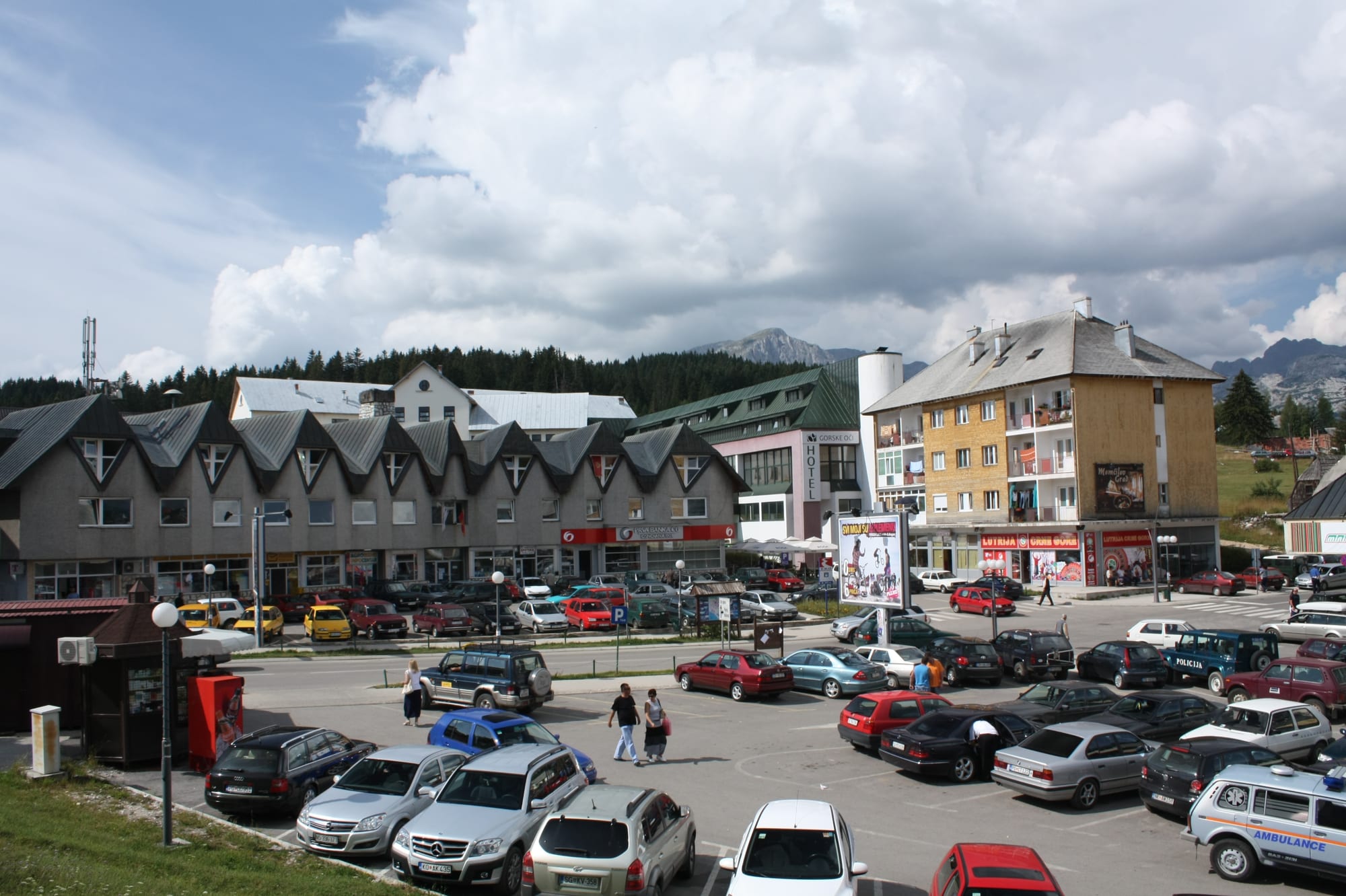
Žabljak's main square with steep-roofed buildings and parked cars, pine forest and a rocky peak of Durmitor behind

Montenegro

Žabljak

The main square of Žabljak, with the forests and peaks of Durmitor rising behind the town. (Mercy / Wikimedia Commons · CC BY-SA 3.0)

A small mountain town at about 1,450 metres in northern Montenegro, the highest town in the Balkans and the base for Durmitor National Park. A 19th-century market town burnt in the Second World War and rebuilt as the country's centre for mountain tourism, it fills with skiers in winter and with hikers and rafters heading for the Black Lake and the Tara canyon in summer.

Neighbourhoods

  • Town centre
    • First-time visitors
    • Close to the bus station

    The compact centre around the main square, with the bus station, shops, cafés and a handful of restaurants. Everything here is within a short walk, and the old Church of the Holy Transfiguration of 1862 survives from the town's earliest years.

    Open in Maps
  • The Black Lake side
    • Hiking
    • Nature

    The edge of town facing the national park, a few kilometres from the Black Lake, where the trails to the lake and the higher peaks begin.

    Open in Maps
  • Pošćenski Kraj and the ski slopes
    • Skiing
    • Winter sports

    The village at the foot of Savin Kuk, where the chairlift starts; in winter the town's ski slopes at Savin Kuk, Štuoc and Javorovača are reached from the roads around it, some only by car.

    Open in Maps

Things to do

Durmitor National Park

  • Black Lake (Crno jezero)park

    The largest of Durmitor's 18 glacial lakes, about 3 km from town at 1,416 metres, with a path around it and its smaller neighbour, Malo jezero.

    Open in Maps
  • Durmitorpark

    The massif of the Dinaric Alps that gives its name to the national park, founded in 1952 and a World Heritage Site since 1980.

    Open in Maps
  • Bobotov Kuktrail

    At 2,523 metres the highest peak of Durmitor, first climbed in 1883; the walk out takes about four to five hours before a final scramble to just below the peak.

    Open in Maps
  • Ice Cave (Ledena pećina)trail

    A cave on the mountain, reached by one of the hiking trails that fork from the Black Lake.

    Open in Maps

Viewpoints and winter sports

  • Savin Kukviewpoint

    A 2,313-metre peak with a chairlift from the edge of town, the main ski slope in winter and, near its top, the spring of Savina Voda, linked by legend to Saint Sava.

    Open in Maps
  • Ćurevacviewpoint

    A mountain peak near town known as a good point for panoramic views over the mountains.

    Open in Maps
  • Durmitor Ringtrail

    A scenic mountain road loop around part of the Durmitor massif, one of Montenegro's official Panoramic Roads.

    Open in Maps

The Tara canyon

  • Tara River Canyonpark

    The deepest canyon in continental Europe, about 1,300 metres deep, and a rafting route, with half-day and one-day trips on the river.

    Open in Maps
  • Đurđevića Tara Bridgelandmark

    A concrete arch bridge high above the Tara River, one of the sights of the rafting trip down the canyon.

    Open in Maps

Seasonal events

  • Ilindan pilgrimage to Savina Voda2 August

    On St Elijah's Day pilgrims climb Savin Kuk, on foot or by chairlift, to collect water from the spring of Savina Voda, believed to have healing properties.

Eat and drink

Long-standing places and food districts in Žabljak. Hours, ratings and directions come from your maps app, always current.

Žabljak classics

  • Town restaurantsneighborhood

    Žabljak's few restaurants serve the national highland food — cornmeal dishes with kajmak, lamb, freshwater trout and local cheeses. They are small and can be busy, and the hearty dishes take time to prepare.

    Open in Maps
  • Cafés of the main squarecafe

    The cafés around the main square serve coffee and rakija, the local grape brandy.

    Open in Maps

Experience Žabljak

History

The first Slavic name of the place was Varezina voda, probably for a strong spring of drinking water that made settlement possible; later it was called Hanovi, because caravans rested here. An Ottoman register of 1582 lists 28 Christian and 36 Muslim households. In 1862 the Church of the Holy Transfiguration was built to mark a Montenegrin victory over the Ottomans, and the modern name dates from 1870, when work began on a school, a church and a captain's house on a single day. By the 1880s Žabljak was a market town with shops and cafés and had become the administrative centre of the area.

Almost all the original buildings were destroyed in the Balkan Wars; only the old church remains. Between the wars its landscape already drew visitors from across Yugoslavia and from abroad, especially Italy. During the Second World War the town was burnt to its foundations.

After the war Žabljak was rebuilt and became Montenegro's main centre for mountain tourism and winter sports. Durmitor National Park was founded around it in 1952 and listed as a World Heritage Site in 1980. The town once had Montenegro's only ski-jumping hill, long since closed. Since 2010, the rebuilt road to Risan has brought the coast within about two hours' drive.

Culture & Customs

Life in Žabljak is shaped by altitude. At about 1,450 metres it is the highest town in the Balkans, and its identity rests on the mountain: on Durmitor's glacial lakes — the "eyes of the mountain" — and its peaks, and on the shepherds' summer pastures of the high plateau. Hikers on the longer routes can still meet a shepherd at the katun on the plateau of Lokvice, selling drinks carried up the mountain.

The town is mixed in identity: at the 2011 census just over half of its people declared themselves Montenegrin and over a third Serb. Religious tradition runs through the mountain year. Savin Kuk takes its name from Saint Sava, founder of the Serbian Orthodox Church, who by local tradition retreated to Durmitor to pray, and every year on Ilindan, St Elijah's Day, pilgrims climb to the spring of Savina Voda below its summit to collect water believed to heal.

Winter brings a different crowd. Snowboarding has become popular on Durmitor's slopes, with gatherings and competitions held there, while in summer the town is a base for climbers, mountain bikers and rafting groups bound for the Tara. Mountaineering has a long history here: the first organised climbing group came from Zagreb in 1926, and the first winter ascent of one of the peaks was made in 1931.

Daily Life

The town had about 1,700 inhabitants at the 2011 census, and the whole municipality about 3,600. Žabljak lives mainly on tourism — skiing in winter, and hiking, mountaineering, cycling and rafting in summer — with guesthouses, apartments, small restaurants, guiding and transport its main businesses.

Distance shapes daily life. The nearest railway station is at Mojkovac, 71 km away, and the nearest international airport, at Podgorica, about 170 km. Poor roads have long held back the town's growth as a mountain resort, though they have improved in recent years. The main road link runs to Mojkovac and the E65, the trunk route between the coast, Podgorica and the north, and minibuses to Nikšić and Podgorica are the town's public transport to the outside world.

In town, a handful of restaurants and cafés serve residents and visitors alike, local travel agencies organise rafting trips on the Tara, and in winter the ski slopes at Savin Kuk and Štuoc set the rhythm of the day.

The year swings between two seasons — a snowy winter of skiers and a short, busy summer — with quieter months between, when the town returns to its residents.

Food

Žabljak eats the food of Montenegro's northern highlands, which is hearty and quite unlike the Italian-influenced coast. Cornmeal is the base of many dishes: cicvara, stewed cornmeal with kajmak — salted and compressed fresh cream — and kačamak, a polenta with buttered potato and kajmak, served with cold milk, buttermilk or yoghurt. Kuvani brav, boiled lamb, and freshwater trout are among the main courses.

Dairy is at the heart of it. Alongside kajmak there are many cheeses — Pljevaljski sir, a salted aged cow's-milk cheese, and cheeses made from unboiled milk — as well as buttermilk, yoghurt and homemade sour cream. Among the pies are zeljanica with green herbs, and others made by "crowding" or "casting" the dough. Burek is the most popular fast food in the country.

For something sweet there are priganice, fritters served with honey, cheese or jam. Turkish coffee is almost unavoidable at any visit, and the spirit is rakija, above all grape brandy, lozovača.

Planning tools

Budget

The northern mountains are much cheaper than the coast, and Žabljak's guesthouses, apartments and simple restaurants keep costs low. The main extras are small lift and viewpoint fees, rafting trips on the Tara, ski passes in winter, and a car or taxi to reach the trailheads and slopes.

Daily Budget Midrange
USD 95–200 (hotel or apartment, restaurant meals, a rafting trip or ski pass, a hire car)
Daily Budget Shoestring
USD 40–75 (hostel or private room, grills and bakeries, walking from town)

A taxi is a sensible option for two or more people, since bus timetables are not always convenient; rafting trips are best booked a day ahead.

Best Time to Visit

Summer is the season for hiking, the lakes and rafting, when the snow has melted from the high trails. Winter is the ski season — snow covers Durmitor's slopes for about 120 days a year — and the town is Montenegro's main winter resort. Outside summer, snow can lie on the higher paths, and spring and autumn are quiet.

Suggested Number of Days

A day or two is enough for the lake and a look at the canyon. Hikers, climbers, rafters and skiers usually stay three to five days, and the weather on the mountain can add a spare day.

First Visit
1–2 days
With Surroundings
3–5 days

Transportation

The town is small and everything in it is within walking distance, and some of the lakes can be reached only on foot. The chairlifts, ski slopes and the canyon viewpoints lie further out and are reached by car or taxi. Bicycles can be hired, though the trails around the Black Lake are rocky and hilly.

The mountain roads are narrow and winding and are snow-covered in winter; drivers who do not know them should take extra care or leave the driving to someone who does.

Airport & Station Connections

Podgorica Airport is about 170 km away, roughly two hours or more by road; Dubrovnik is another option. Minibuses run to Nikšić and Podgorica from the central bus station, and buses also link the town with Pljevlja, Kotor and Belgrade. The nearest railway station is at Mojkovac on the Belgrade–Bar line, 71 km away, with no bus connection. By car the main route is from Mojkovac; another runs through Šavnik and Nikšić, and since the Risan road was rebuilt in 2010 the coast is about two hours away.

Walkability

Žabljak itself is easy on foot, and the walk out to the Black Lake and around it is the most popular short hike. The higher routes — to Bobotov Kuk, the Ice Cave or across the ridges — are long, steep mountain walks that need proper boots, and outside summer they may be under snow.

Safety

Montenegro is a safe country for visitors, with low levels of violent crime. Around Žabljak the risks come from the mountains: changing weather, snow on the high trails outside summer, long hikes over rough ground, and narrow, winding roads that are snow-covered in winter.

Start long hikes early, carry water and warm layers, keep to marked routes, and drive the mountain roads slowly. Check current official travel advice before travelling.

Climate

Žabljak has a humid continental climate, with mild summers and cold winters, and precipitation is very high all year. Snow lies on Durmitor's slopes for about 120 days a year.

Summer
mild, with frequent rain — lower down in Nikšić, the July average is about 20°C
Winter
cold and snowy, with a long snow season that supports skiing — in Nikšić, lower down, the January average is about 2°C

Local Customs

Žabljak is a small highland town whose people identify mostly as Montenegrin or Serbian. Turkish coffee is part of almost any visit, and rakija, above all grape brandy, is the local spirit. On St Elijah's Day, in early August, pilgrims climb Savin Kuk to the spring of Savina Voda.

Churches and the pilgrimage spring are sacred places; modest dress and quiet are expected. In the national park, keep to the trails.

Common Payment Methods

The currency is the euro. Žabljak is a small town with a handful of restaurants and cafés, and some sights, lifts and rural stops charge small fees, so carrying cash is sensible.