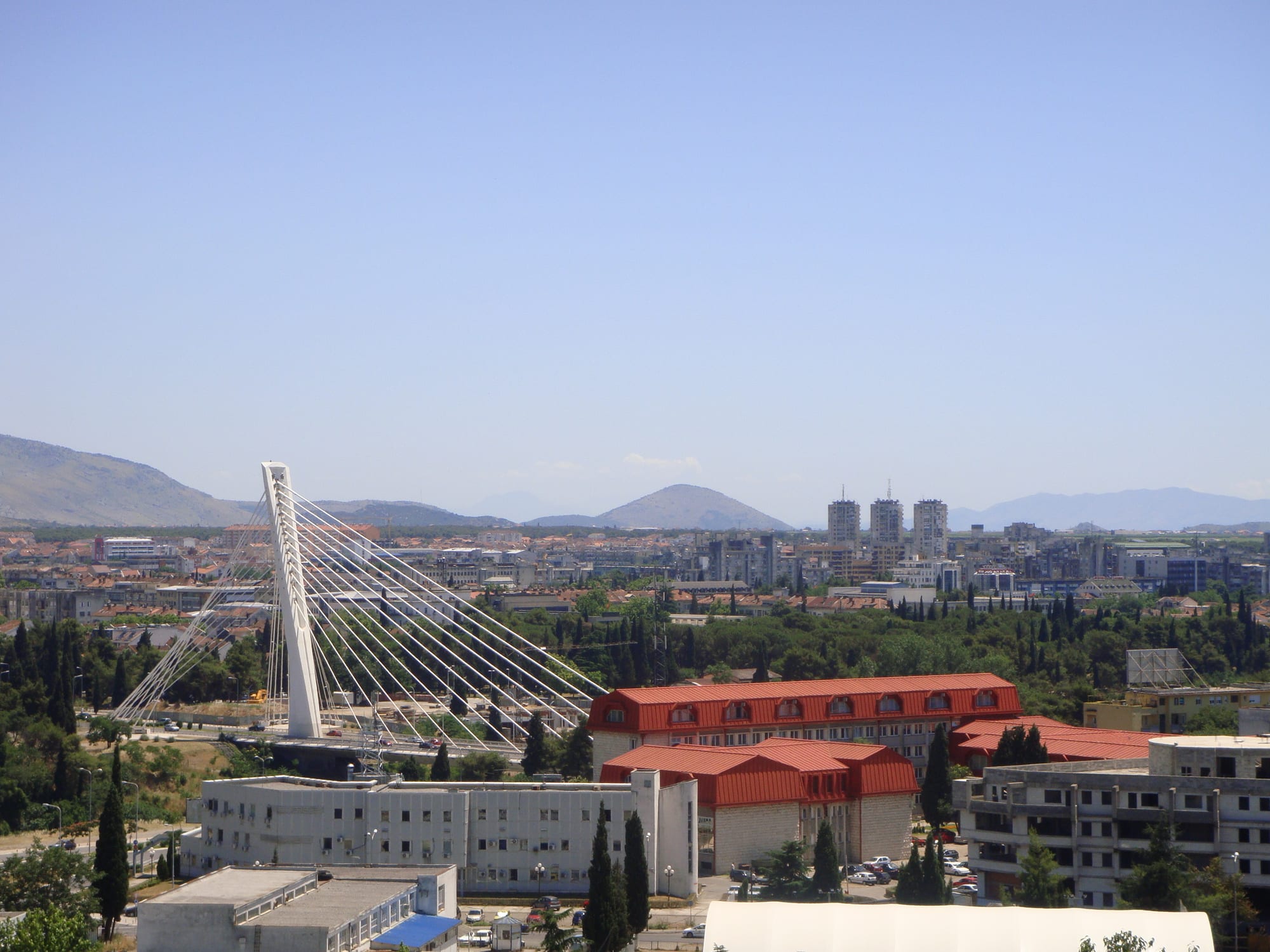
The white cable-stayed Millennium Bridge in Podgorica, with red-roofed buildings, trees and the city's towers below hazy hills

Montenegro

Podgorica

Podgorica and the Millennium Bridge over the Morača, seen from the hill of Malo brdo. (ines lukic / Wikimedia Commons · CC BY 3.0)

Montenegro's capital and largest city, on a flat plain where the Ribnica meets the Morača, a short way north of Lake Skadar. An Ottoman fortress town that joined Montenegro in 1878, it was heavily bombed in the Second World War and rebuilt as Titograd, the Yugoslav republic's capital. Today it is a modern, green, café-loving city with a small Ottoman quarter and a hot summer climate.

Neighbourhoods

  • Nova Varoš (city centre)
    • First-time visitors
    • Cafés
    • Close to public transport

    The 'New Town' laid out after 1878 below Gorica hill on a grid of wide streets around a large central square, Independence Square. Its pedestrian streets, including Njegoševa and Hercegovačka, are lined with cafés, restaurants and shops, and have been the centre of the city ever since they were built.

    Open in Maps
  • Stara Varoš and Drač
    • Historic district
    • Ottoman heritage

    The Ottoman core of the city between the 15th and 19th centuries, on the left bank of the Ribnica. Much was destroyed in the Second World War, but a network of narrow winding streets survives with the clock tower, two mosques and the ruins of the Ribnica fortress.

    Open in Maps
  • Preko Morače and Roman Square
    • Nightlife
    • Shopping
    • Business district

    The districts across the Morača, built up in the Yugoslav era with residential blocks, and the new business quarter around Roman Square (Rimski trg) and the Cetinjski put boulevard. The square is the city's favourite meeting point, with many of its trendiest cafés and restaurants.

    Open in Maps
  • Konik
    • Local life
    • Architecture

    A residential neighbourhood of the city, home to the Catholic Church of the Holy Heart of Jesus, built in 1966 in a striking brutalist style.

    Open in Maps

Things to do

Famous landmarks

  • Clock Tower (Sahat kula)landmark

    One of the very few Ottoman structures left in the city, standing on Bećir Beg Osmanagić square in Stara Varoš.

    Open in Maps
  • Ribnica Fortresslandmark

    The ruins of the Ottoman fortress at the meeting of the Ribnica and Morača rivers, in the old town.

    Open in Maps
  • Millennium Bridgelandmark

    A white cable-stayed road bridge over the Morača, opened in 2005 and one of the city's modern landmarks.

    Open in Maps
  • Moscow Bridgelandmark

    A pedestrian bridge over the Morača, opened in 2008.

    Open in Maps
  • Independence Squarelandmark

    The central square of Nova Varoš, rebuilt and renamed in 2006, the year of independence.

    Open in Maps

Churches

  • Cathedral of the Resurrection of Christlandmark

    The large Orthodox cathedral completed in 2013 after twenty years of construction.

    Open in Maps
  • Church of St Georgelandmark

    An old church on the slopes of Gorica hill, the hill that gave the city its name, with 17th-century frescoes.

    Open in Maps
  • Church of the Holy Heart of Jesuslandmark

    The main Catholic church of the city, in Konik, built in 1966 and known for its unusual brutalist architecture.

    Open in Maps

Museums and culture

  • Podgorica City Museummuseum

    The city museum, founded in 1950, with archaeological, ethnographic, historical and cultural-historical collections.

    Open in Maps
  • Podgorica Royal Palacemuseum

    The palace King Nikola built for his son Prince Mirko, in the city's largest park, part of the Petrović complex, now an exhibition space of the Museum of Contemporary Art of Montenegro.

    Open in Maps
  • Montenegrin National Theatreattraction

    The country's leading theatre, founded in 1953; its building burnt down in 1989 and reopened, rebuilt, in 1997.

    Open in Maps

Parks, rivers and sport

  • Gorica hillpark

    The cypress-covered hill above the city centre that gave Podgorica — 'under the hill' — its name, and one of the residents' favourite places for a walk or a picnic.

    Open in Maps
  • Skalineviewpoint

    Steps down to the point where the Ribnica flows into the Morača, by an old Ottoman bridge over the Ribnica and the ruins of the medieval town.

    Open in Maps
  • Podgorica City Stadiumattraction

    The stadium below Gorica hill, home ground of Montenegro's national football team and of FK Budućnost.

    Open in Maps

Short trips from the city

  • Doclealandmark

    The ruins of the Illyrian, Roman and Byzantine city of Doclea, about three kilometres north of Podgorica, home town of the mother of the emperor Diocletian.

    Open in Maps
  • Medunlandmark

    A village 13 km north-east of the city with the remains of the ancient fortified town of Medeon and a memorial museum in the house where Marko Miljanov lived.

    Open in Maps
  • Dajbabe Monasterylandmark

    A Serbian Orthodox monastery set in a cave in Dajbabe hill, above the Zeta valley near the city.

    Open in Maps
  • Lake Skadarpark

    The largest lake in the Balkans, shared with Albania, whose Montenegrin part is a national park; it lies about 15 km south of the city and is a favourite picnic spot for residents.

    Open in Maps
  • Ostrog Monasterylandmark

    A Serbian Orthodox monastery set high in an almost vertical cliff near Danilovgrad, the most visited pilgrimage site of the Serbian Orthodox Church.

    Open in Maps
  • Cetinjeneighborhood

    The former royal capital to the west, which keeps much of the country's national cultural heritage and the official residence of the president.

    Open in Maps

Seasonal events

  • Podgorica Cultural Summersummer

    A season of cultural events organised by the city's Budo Tomović Cultural-Informational Centre.

  • DEUS – December Arts SceneDecember

    A winter arts programme run by the Budo Tomović Cultural-Informational Centre.

Eat and drink

Long-standing places and food districts in Podgorica. Hours, ratings and directions come from your maps app, always current.

Podgorica classics

  • Grills across the cityneighborhood

    Grilled meat (roštilj) is the city's everyday food — ćevapi, ražnjići and above all pljeskavica, served in a local form of hamburger and the most popular fast food in Podgorica.

    Open in Maps
  • Šipčanik wine cellarrestaurant

    One of the cellars of Plantaže, the wine producer whose vineyard at Ćemovsko polje outside the city is the largest in one piece in Europe; it is one of two Plantaže cellars that are tourist attractions.

    Open in Maps

Cafés and bars

  • Njegoševa Streetneighborhood

    The pedestrian street in the city centre with dozens of cafés, where sitting over an espresso is the city's favourite way to spend a summer day.

    Open in Maps
  • Roman Square (Rimski trg)neighborhood

    The square in the new part of town, surrounded by many of the trendiest cafés and restaurants and a favourite meeting point for residents.

    Open in Maps

Experience Podgorica

History

People have lived here since the late Stone Age. In the Iron Age the area belonged to the Illyrian Labeates and Docleatae, and some three kilometres north of today's city stood the Roman town of Doclea, home town of the mother of the emperor Diocletian. In the Middle Ages the town on the site was known as Ribnica; the name Podgorica — "under the hill", after the small Gorica hill above the centre — first appears in 1326 in a court document in the archives of Kotor. It prospered on the trade road between Ragusa (Dubrovnik) and Serbia.

The Ottomans took the town in 1474, built a large fortress in 1479 and made Podgorica their main military bastion in the region, with towers, gates and ramparts; for four centuries it was an Ottoman town of the Shkodër region. After the Montenegrin-Ottoman war, the Congress of Berlin awarded it to Montenegro in 1878, when more than 8,000 Orthodox, Catholic and Muslim residents lived there. A new town, Nova Varoš, rose on the right bank of the Ribnica, and by the First World War Podgorica was the largest city of the Kingdom of Montenegro. In 1918 the Podgorica Assembly ended Montenegrin statehood and merged the country into the new South Slav kingdom.

The city was bombed more than 80 times in the Second World War and was liberated on 19 December 1944. Renamed Titograd, it became the capital of Socialist Montenegro, gained factories, an aluminium plant in 1969 and a university in 1974, and grew about sevenfold in three decades. It took back the name Podgorica after a referendum in 1992, was struck by NATO airstrikes in 1999, and became the capital of independent Montenegro in 2006.

Culture & Customs

Podgorica is the country's cultural and media centre, though much of its historic heritage remains in the old royal capital, Cetinje. The Montenegrin National Theatre, founded in 1953, is the most important stage in the country; the City Theatre includes children's and puppet theatres; and the Budo Tomović Cultural-Informational Centre runs Podgorica Cultural Summer, the FIAT international alternative theatre festival and the December arts programme DEUS. The national broadcaster RTCG and all of Montenegro's daily newspapers are based here.

Sport is a passion, with football and basketball far ahead of the rest. Budućnost — "the future" — is the city's leading club across several sports: its basketball team has had success in regional and European competitions, and the football club gave a start to Predrag Mijatović and Dejan Savićević, both born in the city. Chess is popular too, and the Podgorica Marathon and the Morača River jumps draw international competitors.

The city is religiously mixed. Most residents are Orthodox, but there are sizeable Muslim and Catholic communities, and the new Orthodox cathedral, the mosques of the old town and the brutalist Catholic church in Konik reflect that history. Above all, though, Podgorica is known for its café culture: an espresso at a pavement table is the city's favourite pastime.

Daily Life

About 180,000 people live in the city — by far the largest in Montenegro, and home to a large share of the country's population — and the wider area of the former municipality, including Tuzi and Zeta, which became separate municipalities in 2018 and 2022, has about 210,000. Most residents identify as Montenegrin or Serb.

Podgorica is the country's economic engine as well as its seat of government. The heavy industries of the Yugoslav era — aluminium, tobacco, engineering — mostly collapsed in the 1990s under sanctions and the loss of their markets, though the winery Plantaže survived. Government, banking, the stock exchange, telecoms, the media and the national airline now dominate, along with the University of Montenegro and the Academy of Sciences and Arts. An ongoing construction boom, fed partly by expatriate communities, has turned an old industrial zone along the Cetinjski put boulevard into a busy new district.

City politics changed in 2023, when Olivera Injac of the Europe Now movement became the first mayor in a quarter of a century not from the Democratic Party of Socialists; Saša Mujović, also of Europe Now, has been mayor since December 2024. Daily life is shaped by the climate: hot summers send residents to the cafés in the evening, to the Morača river to swim and to Lake Skadar or the hills at weekends.

Food

Podgorica eats like inland Montenegro, with influences that arrived over centuries from the Levant and Turkey. Grilled meat, roštilj, is the everyday food — ćevapi, ražnjići and pljeskavica, which is served in a local form of hamburger and is the city's most popular fast food. Burek, a filled pastry, is the most popular fast food in the country.

Lake Skadar, just south of the city, supplies carp, both smoked and fresh, and ukljeva, small fish that are smoked and dried. Highland dishes reach the city too: kačamak, a polenta with buttered potato and kajmak, and cicvara, stewed cornmeal with kajmak, a salted and compressed fresh cream.

Wine is a local product. Plantaže, whose vineyard on the Ćemovsko plain just outside the city covers more than 2,000 hectares and is the largest in one piece in Europe, is the most awarded winery in Montenegro, and two of its cellars, Šipčanik and Stari podrum, are visitor attractions. Coffee completes the picture: espresso in the cafés, and Turkish coffee at home, almost unavoidable at any visit.

Planning tools

Budget

Podgorica is a working capital rather than a resort. Taxis within the city are inexpensive; the main costs are rooms and day trips by car.

Daily Budget Midrange
USD 100–210 (hotel, restaurant dinners, taxis, a hire car for day trips)
Daily Budget Shoestring
USD 45–80 (hostel or private room, grills and bakeries, city buses)

Taxis at the airport often quote a high flat rate; a metered taxi from the centre back to the airport costs much less.

Best Time to Visit

Spring and autumn are the most comfortable seasons. Summer is very hot, with highs around 34°C, though it is also the season of open-air bars, river swimming and the cultural summer programme. Winters are mild but wet, with occasional cold northerly winds and rare snow.

Suggested Number of Days

The city itself needs a day or two. Because the coast, the lakes and the mountains are all within easy reach by road, Podgorica works well as a base, and three to five days allows for trips out in several directions.

First Visit
1–2 days
With Surroundings
3–5 days

Transportation

The centre and the Preko Morače district are walkable, and city buses cover the rest, with tickets bought from the driver. Taxis are plentiful — more than twenty companies operate, with stands across the city — and fares within the city are low; licensed taxis can also be booked through apps such as MonteGO.

The city is the hub of the country's roads, and new motorway sections reach north to Kolašin.

Airport & Station Connections

Podgorica Airport, on the Zeta plain about 11 km south of the centre, is the country's main international gateway, with year-round flights to major European hubs. A shuttle bus runs to the main bus station, and taxis wait outside the terminal; a small station near the airport is on the railway to Bar. The railway station is on the Belgrade–Bar line with a branch to Nikšić, and the main bus station stands next to it.

Walkability

Podgorica is flat and of medium size, and anyone staying in the centre or in Preko Morače can reach the main sights on foot. The pedestrian streets of Nova Varoš and the bridges over the Morača make for easy walks, and Stara Varoš is a short way from the main square. The summer heat is the main obstacle to walking in July and August.

Safety

Montenegro is a safe country for visitors, with low levels of violent crime. In Podgorica the practical concerns are taxi drivers at the airport who overcharge, extreme summer heat, and traffic on the city's busy roads.

Agree a taxi fare before leaving the airport, carry water and avoid the midday sun in high summer. Check current official travel advice before travelling.

Climate

Podgorica sits between a humid subtropical and a hot-summer Mediterranean climate. Mount Rumija shields it from the sea, so its summers are among the hottest in the region, and with about 1,659 mm of rain a year it is the wettest capital in Europe. The temperature passes 25°C on about 135 days a year.

Summer
very hot — highs are around 34°C, and the record is 44.8°C, set in August 2007
Winter
mild but wet, with an occasional strong northerly wind; snow is rare, though 58 cm fell in February 2012, and the lowest temperature on record is −9.7°C

Local Customs

Café life is the heart of the city's social life: sitting over an espresso with friends is the favourite pastime. Most residents are Orthodox Christians, with sizeable Muslim and Catholic communities, and the city's churches and mosques are working places of worship where modest dress is expected. Open-air bars must turn off their music at one in the morning, when the crowds move on to clubs.

Club playlists often mix international hits with folk music from the former Yugoslav countries. Agreeing taxi fares in advance is normal practice across Montenegro.

Common Payment Methods

The currency is the euro. Cash machines are widespread in the city centre and the new part of town, and upscale shops and restaurants usually take major credit and debit cards. City bus tickets are bought from the driver, so small change is useful.