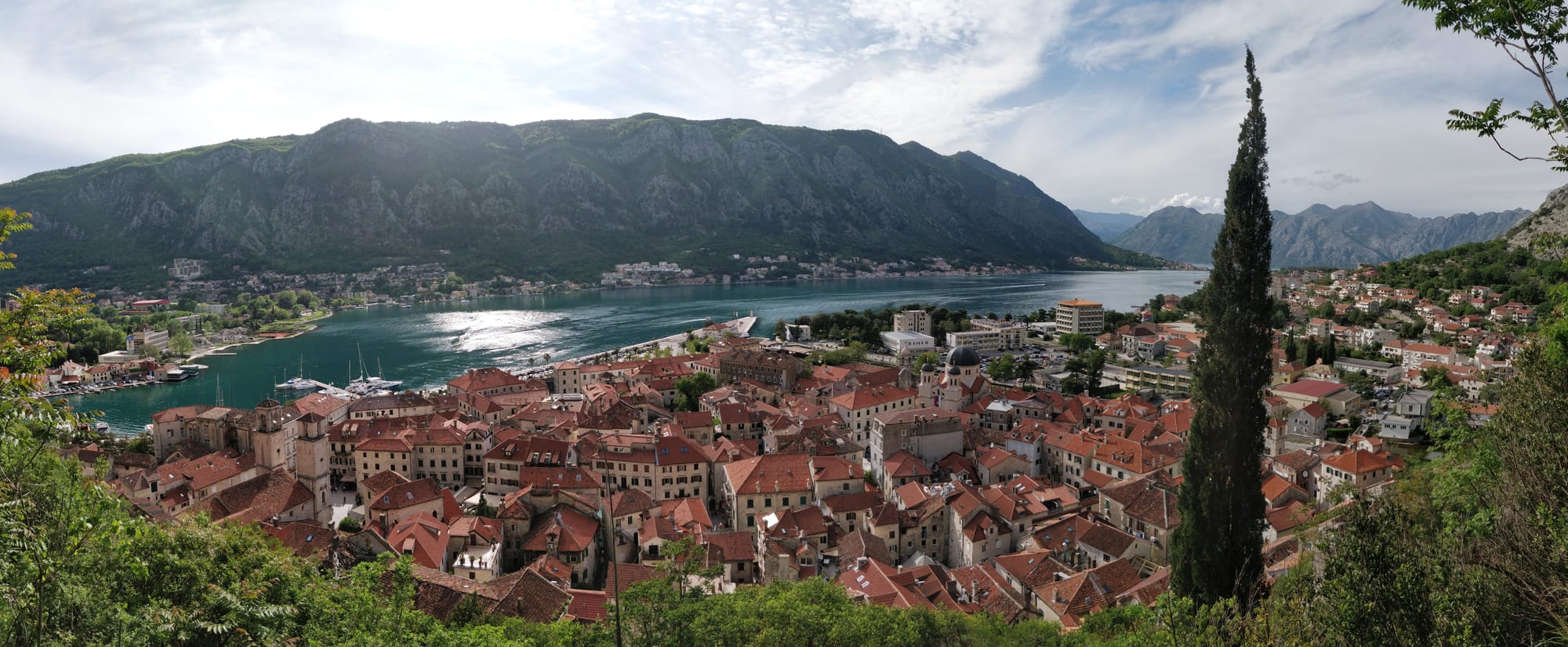
Red-tiled roofs of Kotor's old town below green slopes, with the blue bay and a long grey mountain ridge beyond

Montenegro

Kotor

Kotor's walled old town and the inner Bay of Kotor, seen from the slope above the town. (Jaakko Luttinen / Wikimedia Commons · CC BY-SA 4.0)

A walled port at the secluded inner end of the Bay of Kotor, under limestone cliffs that rise almost straight from the water. Four centuries of Venetian rule shaped its stone lanes, churches and the fortifications that climb the mountain behind it; today the old town is a UNESCO-listed sight, a cruise port and the centre of a small bayside municipality.

Neighbourhoods

  • Old Town (Stari Grad)
    • First-time visitors
    • Historic district

    The car-free walled town, entered by the Sea Gate, the River Gate or the Gurdić Gate, with the clock tower just inside the main gate. Its lanes have no ordinary street names, and the squares are known by the churches at their centres; cafés fill the squares in the shade of the walls.

    Open in Maps
  • Dobrota
    • Quiet and residential
    • Waterfront

    Administratively a separate settlement, but in practice most of Kotor's residential area, stretching north along the shore of the bay. A bayside promenade lined with cafés and restaurants runs through it.

    Open in Maps
  • Škaljari
    • Local life
    • Quiet and residential

    The part of the urban area just south of the old town, on the road towards Budva. It is a working part of town rather than a sight.

    Open in Maps
  • Prčanj
    • Quiet and residential
    • Historic seafaring village

    A small town across the inner bay from Dobrota, about five kilometres west of Kotor, which was for centuries one of the important seafaring centres of the southern Adriatic. Local buses run along the shore through it towards Tivat.

    Open in Maps

Things to do

Famous landmarks

  • Fortifications of Kotorlandmark

    Ramparts, gates, bastions and towers that protect the town and climb the cliffs behind it to the fortress of San Giovanni, part of a UNESCO listing of Venetian defence works since 2017.

    Open in Maps
  • Kotor Cathedrallandmark

    The Romanesque Cathedral of Saint Tryphon, consecrated in 1166 and rebuilt after earthquakes, seat of the Catholic diocese that covers the whole bay.

    Open in Maps
  • Church of St. Nicholaslandmark

    The largest Orthodox church in the old town, built between 1902 and 1909 on the site of an earlier church destroyed by fire.

    Open in Maps
  • Church of St. Lukelandmark

    A small church of 1195, from the reign of Stefan Nemanja, mixing Byzantine and Gothic forms; it now belongs to the Serbian Orthodox Church.

    Open in Maps

Museums

  • Maritime Museummuseum

    Three floors of photographs, uniforms, weapons, paintings and ship models telling the seafaring story of the Boka.

    Open in Maps
  • Aquarium Bokamuseum

    Montenegro's only public aquarium, opened in 2021 by the University of Montenegro's Institute for Marine Biology, showing species from local waters.

    Open in Maps

Walks and viewpoints

  • The climb to San Giovannitrail

    About 1,350 steps zigzag up inside the walls from the old town to the ruined castle of San Giovanni, with the whole inner bay in view from the top.

    Open in Maps
  • Church of Our Lady of Remedylandmark

    A 16th-century church built by survivors of the plague, standing about halfway up the path to the fortress.

    Open in Maps
  • Kotor–Lovćen cable carattraction

    A cable car opened in 2024 that climbs from the coast to Lovćen National Park in about eleven minutes, looking down over the bay.

    Open in Maps

Short trips from the town

  • Perastneighborhood

    A small baroque town a few kilometres north-west along the bay, facing two islets.

    Open in Maps
  • Our Lady of the Rockslandmark

    An artificial islet off Perast, built up over centuries by seamen dropping rocks and sunken ships, with a church and museum; boats run out to it from Perast and from outside Kotor's main gate.

    Open in Maps
  • Mausoleum of Njegošlandmark

    The tomb of the prince-bishop and poet Petar II Petrović-Njegoš on Jezerski Vrh, one of the two peaks of Mount Lovćen above the bay, designed by Ivan Meštrović.

    Open in Maps

Seasonal events

  • Kotor Carnivalsummer

    The town's carnival, with an international summer edition that is one of Kotor's main summer events; in 2009 Kotor co-hosted the congress of the Federation of European Carnival Cities.

  • Bokeljska noćsummer

    The 'Boka Night', one of Kotor's summer celebrations on the bay.

  • Fašinada22 July, at sunset

    In nearby Perast, a procession of boats carries rocks out to Our Lady of the Rocks and drops them into the sea, keeping up the custom that built the islet.

Eat and drink

Long-standing places and food districts in Kotor. Hours, ratings and directions come from your maps app, always current.

Kotor classics

  • Kotor marketmarket

    The large produce market just outside the city walls, the place to find njeguški pršut, the smoked ham of the village of Njeguši on Lovćen, and njeguški sir, a cheese kept in oil.

    Open in Maps
  • Seafood in the old townneighborhood

    Restaurants inside the walls serve the coast's seafood — grilled or fried squid, octopus salad, prawns, mussels and black risotto made with cuttlefish.

    Open in Maps

Cafés and bars

  • Old town caféscafe

    Espresso in the shade of the medieval walls is the old town's main pastime, and the café tables on the squares fill quickly on sunny days.

    Open in Maps
  • Dobrota promenadeneighborhood

    Cafés and restaurants line the bayside promenade that runs north from the old town through Dobrota, many of them with tables by the water.

    Open in Maps

Experience Kotor

History

A settlement stood here in Illyrian times, and the town is first recorded in 168 BC; under Rome it was Ascrivium, part of the province of Dalmatia. The emperor Justinian built a fortress above it in 535, Saracen raiders plundered it in 840, and in the 10th century the defences were pushed up towards the peak of Saint Ivan. Its people were Romance-speaking — the Dalmatian language was still spoken here until the 11th century — and the modern name probably comes from the Byzantine Dekatera. Stefan Nemanja took the town in 1185, and under the Serbian rulers it kept its own statute and institutions and grew into a trading port that rivalled Ragusa (Dubrovnik).

After passing between Hungary, Venice and Bosnia, Kotor placed itself under Venetian protection in 1420 and stayed Venetian until 1797. Those centuries gave it its architecture and the walls that climb the mountain; they also brought Ottoman sieges in 1538 and 1657, plague in 1572 and earthquakes in 1563 and 1667 that nearly destroyed it. Austrian, Russian, French and British forces followed one another during the Napoleonic wars — British sailors hauled guns up the mountain to force the French garrison to surrender in 1814 — and the Congress of Vienna returned the town, as Cattaro, to Austria.

Under Austria-Hungary the bay became a main naval base, and in February 1918 sailors mutinied there. After the First World War the town became part of Yugoslavia and officially Kotor; Italy annexed it from 1941 to 1943. Since the early 2000s tourism, much of it from cruise ships, has transformed the town.

Culture & Customs

Kotor has always faced two ways. Its old Italian-speaking community, dominant until the 19th century, has almost gone, but the town is still the seat of the Catholic bishops of the bay, and Catholic and Orthodox churches stand a few lanes apart inside the walls; at the 2011 census most of the municipality's people were Orthodox and about one in eight Catholic. The Venetian stone lion that once stood over the main gate was replaced after the socialist revolution by the emblem of Yugoslavia, which is still there.

Summer is the season of public life: the summer carnival and Bokeljska noć draw crowds to the waterfront, and Kotor co-hosted the World Carnival City Congress in 2009. The Kotor Festival of Theatre for Children, founded in 1993 near the place where the first play for children in the Balkans was staged in 1829, has received the European Festivals Association's EFFE label. The town's many cats have become its unofficial symbol, with a cat museum, cat shops and a Cats' Square, and residents leave out food and water for them.

Water polo is the passion. Primorac Kotor won the LEN Champions League in 2009 and another local club, VA Cattaro, the LEN Euro Cup in 2010, while the football club FK Bokelj plays at the Stadion pod Vrmcem.

Daily Life

The town proper covers only the walled old town and has fewer than 1,400 residents. Close to 13,000 people live in the wider urban area, which runs along the shore through Dobrota and Škaljari, and the whole municipality — including Perast, Risan and the villages around the bay — had about 22,000 at the 2023 census.

Tourism dominates the economy. The town received more than 250,000 tourists in 2019, many arriving by cruise ship. The old town lives on its cafés, restaurants, boutiques and guided groups, while most residents' homes and the bus station lie outside the walls.

Recent years have added new draws: the University of Montenegro's Institute for Marine Biology opened the country's only public aquarium here in 2021, and since 2024 a cable car has linked the coast with Lovćen National Park. The season shapes the year — a crowded summer of ships and festivals, then a quieter, very wet winter.

Food

Kotor eats like the rest of the Boka: Mediterranean, with a clear Italian influence, built around the sea. Grilled or fried squid, octopus salad, prawns, mussels, tuna and black risotto made with cuttlefish are the coast's standard seafood dishes, served in restaurants inside the walls and along the waterfront.

From the mountain behind the town come njeguški pršut, the smoked ham of the village of Njeguši on Lovćen, and njeguški sir, a cheese kept in oil — two of the best-known products of Montenegrin cooking. Both are sold at the large produce market just outside the city walls, which also has fresh vegetables and fruit.

To drink there are Montenegrin wines, above all the red Vranac and the white Krstač, the beer Nikšićko, and rakija, the fruit brandy, especially grape loza. Coffee is part of the day's rhythm: espresso is drunk slowly at café tables on the old town's squares, in the shade of the walls.

Planning tools

Budget

Kotor's prices follow the season and the cruise ships: rooms and restaurant tables in and around the old town cost most in high summer, and fall outside it. Private apartments and rooms are common. The fortress climb and the boat trips to the islets are the main paid extras.

Daily Budget Midrange
USD 100–220 (hotel or apartment near the old town, seafood dinners, the fortress walk, a boat trip)
Daily Budget Shoestring
USD 45–85 (hostel bed or private room, market food and bakery snacks, local buses)

Taking the local bus to Perast and a water taxi from there to the islets costs less than a tour boat from Kotor.

Best Time to Visit

Late spring and early autumn are warm enough for the bay and quieter than high summer, when cruise ships and coach groups crowd the old town by day. Summer brings the carnival and the town's festivals. Winter is mild but very wet: the mountains around the bay make it one of the rainiest places in Europe.

Suggested Number of Days

The walled town itself can be seen in a day, but a night or two allows the old town without the day crowds. Allow three to five days to use Kotor as a base for the rest of the bay and the mountain behind it.

First Visit
1–2 days
With Surroundings
3–5 days

Transportation

The old town is closed to cars. Small local buses run along the shore through Dobrota to Perast and, in the other direction, through Muo and Prčanj to Tivat, stopping at any stop on the way. Neither Uber nor Bolt operates in Kotor; licensed taxis can be called through local apps, and it is wise to agree the fare first.

Parking near the old town is scarce and tow trucks target tourists' cars; leave the car further out and walk in.

Airport & Station Connections

Tivat Airport, about 8 km away, is the nearest airport; Podgorica Airport, with flights throughout the year, is the alternative, and Dubrovnik's airport in Croatia is also used. The bus station is a five-minute walk from the old town, with frequent buses along the coast to Budva and Herceg Novi and regular services to Podgorica. By road, the Vrmac Tunnel links Kotor with the coastal highway; drivers from Croatia can cut the trip around the bay with the Kamenari ferry.

Walkability

Kotor is small and everything is within walking distance. Inside the walls the lanes form a maze with no ordinary street names, so people give directions by the nearest church square or gate. The bayside promenade makes for an easy walk north to Dobrota. The climb to San Giovanni is steep, on stone steps, and suits only reasonably fit walkers.

Safety

Montenegro is a safe country for visitors, with low levels of violent crime. In Kotor the practical concerns are crowding in the old town when cruise ships are in, unmetered taxis that overcharge, and the steep, sometimes broken steps of the fortress path.

Agree a taxi fare before setting off, carry water and wear proper shoes for the fortress climb, and keep the ticket stub until leaving the walls. Check current official travel advice before travelling.

Climate

The bay has a Mediterranean climate, but the high mountains that wall it in make it one of the wettest inhabited areas in Europe. The warm, humid jugo wind from the south brings heavy rain, and after storms waterfalls appear on the cliffs around the bay.

Summer
warm to hot and mostly dry — in nearby Herceg Novi the average temperature from May to September is about 25°C
Winter
mild and very wet, with heavy rain carried in on the jugo wind — further down the coast at Bar, January averages a high of about 12°C and a low of about 4°C

Local Customs

Kotor is a town of two Christian traditions: most residents are Orthodox, a smaller share Catholic, and the Catholic bishop of the whole bay sits at the cathedral. Churches of both are working places of worship, so modest dress and quiet are expected inside. English is widely spoken by waiting and hotel staff.

Tipping is not expected; rounding up the bill is the usual gesture. The town's many cats are cared for by residents, who leave out food and water for them.

Common Payment Methods

The currency is the euro. There are plenty of banks and cash machines in the old town, but not every restaurant or shop takes cards, so some cash is useful. Banks close on Sundays and holidays.