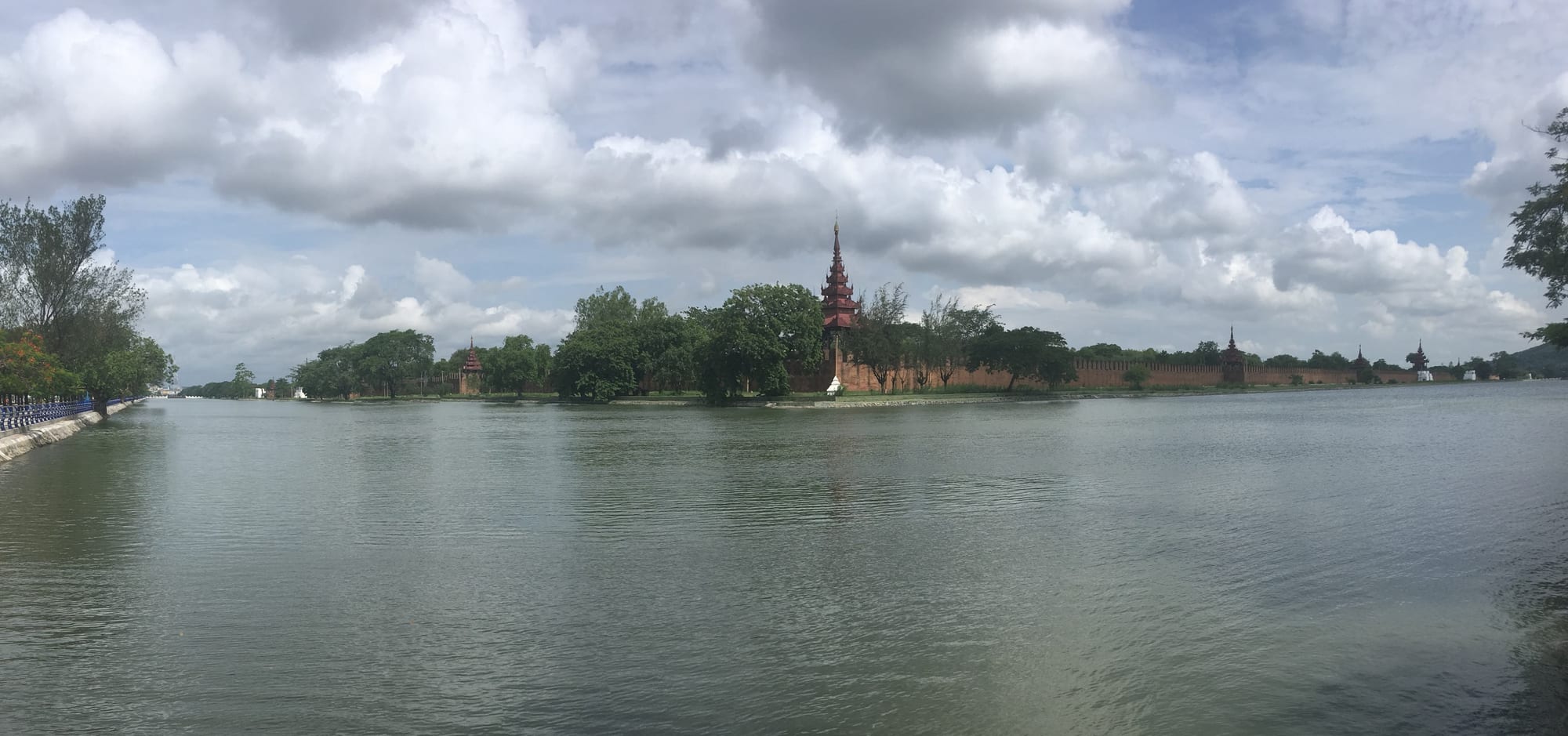
A wide moat of green water in front of long red palace walls with trees and a tiered wooden gate tower behind

Yangon, Mandalay & Central Myanmar, Myanmar

Mandalay

The moat and walls of the Mandalay Palace compound. (Christophe95 / Wikimedia Commons · CC BY-SA 4.0)

The last royal capital of Burma, founded beside the Ayeyarwady in 1857 and laid out as a grid around a moated palace beneath Mandalay Hill. It remains the centre of Upper Myanmar, of Buddhist scholarship and of crafts such as gold leaf, wood carving and silk weaving. This page is written to explain the city, not to encourage travel.

Neighbourhoods

  • Chanayethazan and the palace quarter
    • First-time visitors
    • Historic district
    • Markets

    The central township between the palace moat and the river, holding Zegyo Market, the main shopping streets, hotels and the numbered grid that gives addresses such as 78th Street. Everything in the old centre is a short drive from here.

    Open in Maps
  • Aungmyethazan
    • Temples
    • Crafts
    • Views

    The northern township under Mandalay Hill, with the Kuthodaw and Sandamuni pagodas, the Shwenandaw teak monastery and the gold-leaf and stone-carving workshops on the roads leading out of town.

    Open in Maps
  • Chanmyathazi
    • Pilgrimage
    • Local life

    The southern township, home to the Mahamuni Pagoda and its revered Buddha image, surrounded by workshops making bronze images, marble Buddhas and gold leaf, and by dense residential streets.

    Open in Maps
  • Maha Aungmye
    • Quiet and residential
    • Best for food

    A busy residential district east of the centre with markets, teashops and small restaurants, more everyday than any part of the city visitors usually see.

    Open in Maps
  • Amarapura
    • Historic district
    • Sunsets
    • Crafts

    A former royal capital absorbed into the southern edge of the city, known for the U Bein teak bridge across Taungthaman Lake, the large Mahagandayon monastery and silk weaving workshops producing acheik patterns.

    Open in Maps

Things to do

The royal city

  • Mandalay Palacelandmark

    The square walled compound of King Mindon's capital, about two kilometres on each side inside a broad moat; the timber palace burned in 1945, the buildings inside are reconstructions begun in 1989, and the earthquake of March 2025 damaged parts of the compound.

    Open in Maps
  • Mandalay Hillviewpoint

    The hill of about 240 metres north of the palace, climbed by covered stairways past shrines to the Sutaungpyei Pagoda, with a view over the city and the river.

    Open in Maps
  • Kuthodaw Pagodalandmark

    A pagoda surrounded by 729 white shrines, each holding a marble slab inscribed with the Buddhist canon, often called the world's largest book.

    Open in Maps
  • Sandamuni Pagodalandmark

    A neighbouring complex of white shrines, raised by King Mindon in 1874 as a memorial to his murdered brother Kanaung, holding an iron Buddha image cast in 1802 and brought here from Amarapura.

    Open in Maps
  • Shwenandaw Monasterylandmark

    A teak monastery covered in carving, moved out of the palace by King Thibaw in 1878 and the only major wooden building of the royal city to survive.

    Open in Maps
  • Atumashi Monasterylandmark

    A large stuccoed monastery of 1857 beside Shwenandaw, destroyed by fire in 1890 and rebuilt in the 1990s on the original terraces.

    Open in Maps

Pagodas and pilgrimage

  • Mahamuni Buddha Templelandmark

    The city's most revered shrine, holding a bronze Buddha image brought from Rakhine in 1784, thickened over generations by gold leaf pressed on by male pilgrims and washed at dawn each morning by monks; the temple was significantly damaged in the earthquake of March 2025.

    Open in Maps
  • Mingun Pahtodawgyilandmark

    The unfinished base of a colossal stupa across the river at Mingun, begun in 1790 and split by earthquake cracks.

    Open in Maps
  • Mingun Belllandmark

    A bronze bell of about 90 tonnes cast for the Mingun stupa, among the largest ringing bells in the world.

    Open in Maps
  • Hsinbyume Pagodalandmark

    A white pagoda of 1816 at Mingun built in terraces of wavy balustrades to represent the mountain ranges around Mount Meru; most of the structure collapsed in the earthquake of March 2025.

    Open in Maps

The old capitals nearby

  • U Bein Bridgelandmark

    A footbridge of about 1.2 kilometres on teak posts across shallow Taungthaman Lake at Amarapura, built in the mid-19th century from timbers of the abandoned palace at Inwa.

    Open in Maps
  • Mahagandayon Monasterylandmark

    A large teaching monastery at Amarapura where hundreds of monks file to their single main meal before noon, watched by visitors from the edge of the courtyard.

    Open in Maps
  • Inwaneighborhood

    The capital of successive kingdoms from the 14th century, now farmland scattered with a leaning brick watchtower and the Bagaya teak monastery; the brick Maha Aungmye Bonzan monastery was destroyed in the earthquake of March 2025.

    Open in Maps
  • Sagaingneighborhood

    A town of monasteries, nunneries and white-and-gold stupas covering hills across the river, a centre of meditation and monastic retreat.

    Open in Maps
  • Ava Bridgelandmark

    Built by the British in 1934 across the Ayeyarwady between Inwa and Sagaing, destroyed by the retreating British army in the Second World War and rebuilt in 1954, it collapsed into the river in the earthquake of March 2025.

    Open in Maps

Markets, crafts and getting around

  • Zegyo Marketmarket

    The oldest and largest market in the city, selling produce, textiles, jade and household goods in the streets around it.

    Open in Maps
  • Gold leaf and stone-carving workshopsattraction

    Workshops around the Mahamuni Pagoda where gold is beaten into leaf by hand and marble Buddha images are carved and polished in open-fronted sheds.

    Open in Maps
  • Mandalay International Airporttransit hub

    The city's airport, about 35 kilometres south of the centre, completed in 1999 with a long runway and served by domestic and some regional flights.

    Open in Maps

Seasonal events

  • Thingyanmid-April

    The Burmese new year water festival, when stages line the moat road and the city closes for several days in the hottest weeks of the year.

  • Taungbyone nat festivalWagaung, August

    A spirit festival held in a village north of the city, drawing very large crowds, mediums, music and offerings to the Taungbyone brother nats.

  • ThadingyutOctober

    The festival of lights ending Buddhist Lent, when pagodas, monasteries and houses across the city are lit with candles and lamps.

  • Mahamuni Pagoda festivalTabaung, February or March

    The annual festival at the city's most revered shrine, with offerings, stalls and processions filling the surrounding streets.

Eat and drink

Long-standing places and food districts in Mandalay. Hours, ratings and directions come from your maps app, always current.

Mandalay classics

  • Mandalay mee shayrestaurant

    Round rice noodles served with a pork or chicken sauce, bean sprouts and a sharp dressing of pickled vegetables, a dish the city claims as its own.

    Open in Maps
  • Nan gyi thokerestaurant

    A salad of thick rice noodles tossed with chicken curry, toasted chickpea flour, fried onion and lime, also known here as Mandalay mont di.

    Open in Maps
  • Teashopscafe

    Sweet strong milk tea, free green tea and plates of fritters, samosas and steamed buns at low tables; Mandalay's teashops have a reputation across the country.

    Open in Maps

Markets and food streets

  • Zegyo Marketmarket

    Produce, dried goods, pickles and snack stalls in and around the city's central market, busiest in the early morning.

    Open in Maps
  • 19th Street night stallsneighborhood

    Barbecue and beer stalls that set out tables on the pavements of the city grid after dark, grilling skewers of meat, fish and vegetables to order.

    Open in Maps
  • Chinese restaurants of the centreneighborhood

    The city's long-standing Chinese community, reinforced by trade with Yunnan, supports noodle houses, hotpot restaurants and roast meat shops through the central townships.

    Open in Maps

Experience Mandalay

History

Mandalay is young for a Burmese city. In 1857 King Mindon, ruling a kingdom reduced by two wars with Britain, ordered a new capital built at the foot of Mandalay Hill, fulfilling a prophecy that a great city would rise there in the 2,400th year after the Buddha. The court moved from Amarapura in 1859, carrying timber buildings with it, and the new city was laid out as a square of walls and moat about two kilometres on each side, with a grid of streets around it. Mindon also convened the Fifth Buddhist Council, whose recension of the canon was carved onto the marble slabs at the Kuthodaw Pagoda.

The royal city lasted less than thirty years. In 1885, in the Third Anglo-Burmese War, British forces took Mandalay, and King Thibaw and Queen Supayalat were exiled to India; the palace became a colonial garrison known as Fort Dufferin. Mandalay remained the cultural capital and the great Buddhist centre of the country, with monasteries, printing houses and craft workshops, and it grew as a trading city with large Chinese and Indian communities.

The Second World War was devastating: bombing in 1942 and the fighting of 1945 burned the wooden palace to the ground and destroyed much of the centre. The palace buildings visible today are reconstructions from the 1990s. In the decades after independence the city expanded, a fire in 1984 destroyed thousands of houses, and from the late 1980s migration and investment from China reshaped its commerce. Mandalay took part in the protests that followed the coup of February 2021, and the earthquake of March 2025 caused heavy damage across the city and the surrounding region.

Culture & Customs

Mandalay regards itself as the keeper of Burmese classical culture, and the claim is grounded in what its workshops still do. Gold is beaten into tissue-thin leaf by hand in sheds near the Mahamuni Pagoda for pilgrims to press onto Buddha images; marble from quarries south of the city is carved into statues along a whole road of workshops; wood carvers, bronze casters, tapestry embroiderers and silk weavers at Amarapura producing the wave-patterned acheik cloth all work in traditions that served the royal court.

It is also the country's Buddhist centre of gravity. Monasteries in the city and on the hills at Sagaing across the river house thousands of monks and nuns, and Mandalay's monastic schools train teachers and scholars for the whole country. The Mahamuni image draws pilgrims from everywhere, and its early morning face-washing is attended daily.

Performance traditions survive here more strongly than elsewhere: marionette theatre, zat pwe all-night stage shows mixing dance, comedy and music, and classical song and orchestra. The nat spirit cult is close at hand, with the Taungbyone festival north of the city drawing huge crowds each August. Mandalay is also a border-trade city with a long-established Chinese population and newer arrivals from Yunnan, a mixture that shapes its business life, its food and, at times, local tensions.

Daily Life

Mandalay has well over a million residents and is the second city of the country, the hub of Upper Myanmar. People live mostly in low houses and shophouses on the numbered grid, with newer suburbs spreading east and south towards the airport road. Addresses are given by street numbers and corners, which makes the city easy to navigate and hard to romanticise.

Its economy is trade, crafts and agriculture's processing: the jade and gem markets, timber and rice, the border trade with China that comes down the road from Muse, and workshops in gold, marble, bronze, silk and wood. Motorcycle repair, construction and small manufacturing employ many, and tourism, once significant, has largely collapsed since 2021.

The day starts before dawn with alms rounds and market deliveries, and slows after midday when the heat becomes hard. Teashops fill in the late afternoon. Since the coup, life has been shaped by long power cuts, rising prices, fuel shortages, checkpoints and the flight of young people from conscription. The earthquake of March 2025 added damaged buildings, displaced families and repair work to a city already under strain, and its effects remain visible in the streets and on the monuments.

Food

Mandalay's cooking belongs to the dry zone and to Upper Myanmar, built on groundnut and sesame oil, pulses, and wheat and rice noodles rather than the fish soups of the delta. The city's signature dishes are noodle ones. Mee shay pairs round rice noodles with a pork or chicken sauce, bean sprouts and a sharp, pickled dressing. Nan gyi thoke, also called Mandalay mont di, is a salad of thick rice noodles tossed with chicken curry, toasted chickpea flour, fried onion and lime, eaten for breakfast as often as for lunch.

Burmese curries here are cooked slowly in oil with plenty of onion, garlic and turmeric and served with rice, a clear soup, boiled vegetables and ngapi-based relish. Laphet thoke, the fermented tea-leaf salad, is on every table, and Shan-style dishes from the hills to the east — rice noodles in a light pork or tomato broth, and sticky fermented rice salads — are widely sold. The Chinese presence brings noodle houses, hotpot and roast meats, particularly in the central townships.

Teashops are the heart of daily eating: sweet, strong milk tea served with fried snacks, samosas, steamed buns or palata bread, and free green tea alongside. Toddy palm jaggery, tamarind sweets and fried banana appear as snacks, and in the hot season street vendors sell falooda and shaved ice with syrup and jelly. Evening brings barbecue stalls onto the pavements, where skewers are picked from trays and grilled over charcoal.

Planning tools

Budget

Mandalay is cheaper than Yangon, with plenty of modest hotels and guesthouses built for a tourist trade that has largely gone. Food and local transport cost little; hired cars, guides, entry fees and the combined archaeological ticket for the old capitals are the main extras. Inflation and multiple exchange rates make prices unpredictable.

Daily Budget Midrange
USD 70–160 (hotel, restaurants, a driver or guide, a domestic flight)
Daily Budget Shoestring
USD 25–45 (guesthouse, teashops and street food, shared pick-ups and buses)

Bring clean US dollar notes, as foreign cards and ATMs generally do not work, and expect entry fees to be payable in cash.

Best Time to Visit

November to February, when the dry zone is warm by day and cool in the early morning. March to May is severe, often above 40°C, and the monsoon from June to October is lighter here than in Yangon but humid. Thingyan in April is loudest in Mandalay but falls in the hottest weeks. Any visit must be weighed against official travel advice.

Suggested Number of Days

Two or three days cover the city itself at a pace that allows for the heat. Four or five take in the former royal capitals and the monastery hills across the river. Traffic, power cuts and river crossings slow any plan.

First Visit
2–3 days
With Surroundings
4–5 days

Transportation

The city is laid out on a numbered grid, which makes directions simple. Motorcycle taxis, ride-hailing apps, trishaws and taxis are the usual ways to move; shared pick-up trucks run set routes, and cars with drivers are hired by the day for trips to the old capitals. Unlike Yangon, motorcycles are everywhere, and traffic is dense in the centre.

Agree fares before setting off, allow extra time for fuel shortages and checkpoints, and expect river crossings to depend on small ferries.

Airport & Station Connections

Mandalay International Airport lies about 35 kilometres south of the centre, roughly 45 minutes to an hour by road, with domestic flights and some regional services. The expressway and the railway run south to Naypyidaw and Yangon, eight to ten hours by road, and roads lead east towards Shan State and north up the river valley. Checkpoints, fuel shortages and cancellations make journeys unpredictable.

Walkability

Within the grid, walking works for a few blocks at a time: pavements are uneven and often occupied, and the heat is punishing from late morning. The palace moat measures about two kilometres on each side, so a circuit of it is a long walk, and the climb up Mandalay Hill is a genuine ascent of covered stairs. Most journeys across the city are made on two wheels.

Safety

Most governments advise against all or all-but-essential travel to Myanmar, and this region is not an exception. Mandalay has checkpoints, surveillance, arbitrary arrests and occasional bombings, fighting affects parts of the surrounding countryside, and the March 2025 earthquake left heavy damage in and around the city. Power cuts, internet restrictions and fuel shortages are routine, and conscription affects local residents.

Do not travel against official advice, avoid photographing soldiers, checkpoints or government buildings, and keep in contact with the relevant embassy in Yangon. Keep away from damaged buildings, avoid political conversations, and carry a torch for blackouts. Check current official travel advice before travelling.

Climate

A hot dry-zone climate in the rain shadow of the Rakhine hills, with three seasons: cool and dry, very hot, and a moderate monsoon. Rainfall is far lower than in the delta and the air is often dusty.

Summer
very hot, regularly 38–42°C in April and May; the monsoon from June to October brings warm, humid days and intermittent heavy rain
Winter
warm and dry, about 28–32°C by day, with mornings around 13–17°C

Local Customs

Mandalay considers itself the guardian of Burmese tradition and is more conservative than Yangon. Shoes and socks come off at pagodas and monasteries, shoulders and knees are covered, and monks are given precedence. At the Mahamuni image only men may approach to apply gold leaf. The longyi is normal dress for both men and women.

Ask before photographing people, monks or worshippers, never photograph soldiers or official buildings, and avoid touching anyone's head or pointing the feet towards a Buddha image.

Common Payment Methods

The currency is the kyat. Foreign cards and international ATM networks generally do not work, so visitors carry clean, recent US dollar notes and change them as needed at varying rates. Hotels may quote in dollars, while markets, transport and entry fees are paid in kyat, which means carrying thick bundles of notes.