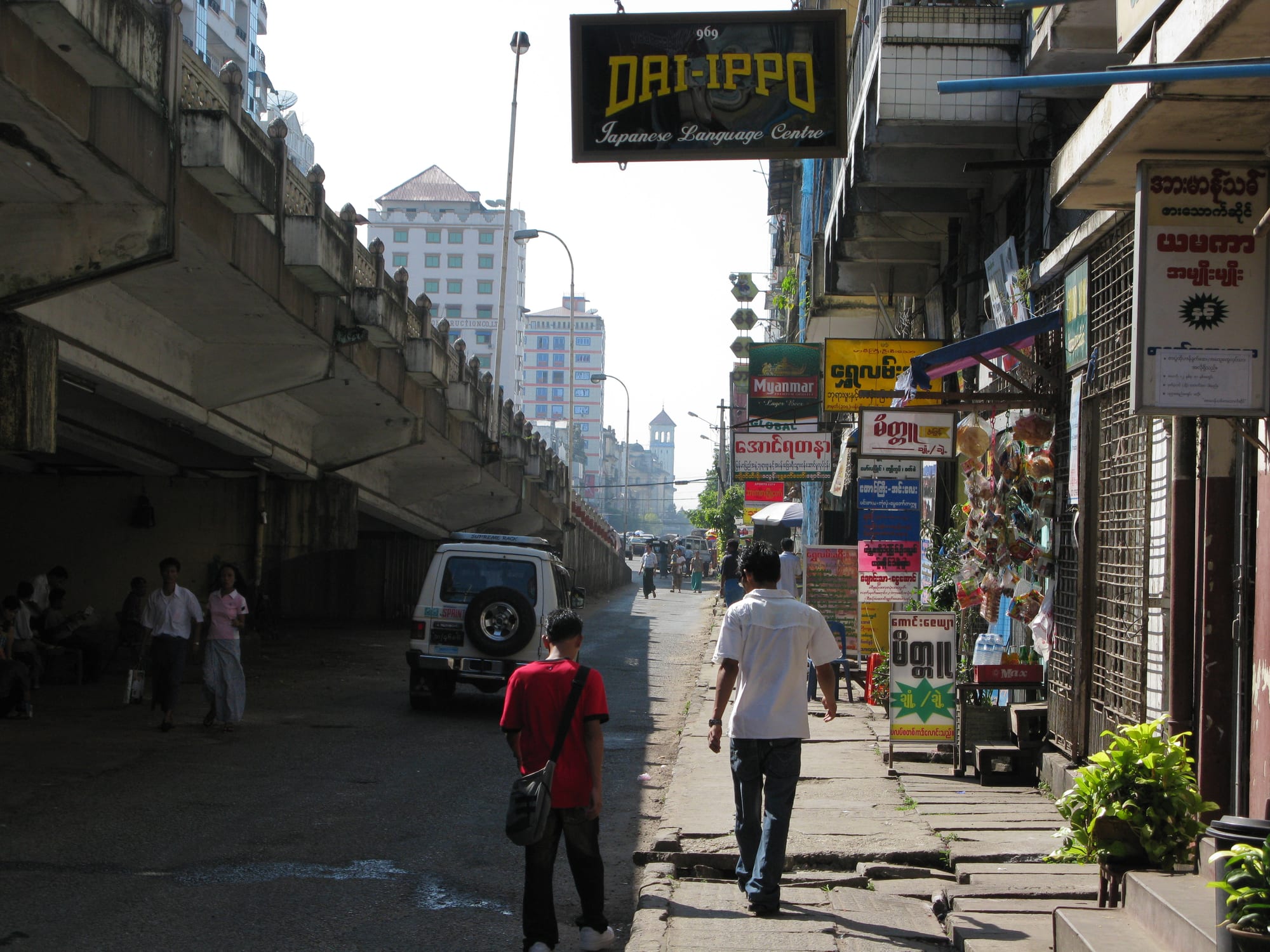
A downtown Yangon pavement lined with shop signs in Burmese script, pedestrians walking beside a raised concrete overpass

Yangon, Mandalay & Central Myanmar, Myanmar

Yangon

A street of shops and signboards in downtown Yangon. (Vyacheslav Argenberg / Wikimedia Commons · CC BY 4.0)

Myanmar's largest city and its commercial centre, on the Yangon River at the edge of the Ayeyarwady delta. The gilded Shwedagon Pagoda stands on a hill above a downtown grid of colonial-era offices and shophouses, markets and Chinese, Indian and Burmese quarters, ringed by a slow circular railway. This page is written to explain the city, not to encourage travel.

Neighbourhoods

  • Kyauktada and the downtown grid
    • First-time visitors
    • Historic district
    • Close to public transport

    The colonial-era core laid out by the British on a grid between the river and the railway, with the Secretariat, City Hall, banks and merchant houses along Pansodan Street and the Sule Pagoda at its centre. Much of the city's older hotel stock is here.

    Open in Maps
  • Latha and Chinatown
    • Best for food
    • Nightlife
    • Street markets

    The Chinese quarter west of the centre, where 19th Street fills with grills and plastic stools in the evening and daytime stalls sell fruit, noodles and offerings. Temples, clan houses and shophouses crowd blocks that are among the busiest in Myanmar.

    Open in Maps
  • Pabedan
    • Shopping
    • Markets

    The downtown township around Bogyoke Aung San Market, with jewellery, textile and hardware streets, small Hindu and Chinese temples, and rows of decaying shophouses with balcony gardens and pulley baskets lowered to the pavement.

    Open in Maps
  • Bahan
    • Temples
    • Quiet and residential
    • Upmarket stays

    The green township north of downtown that holds the Shwedagon Pagoda, Kandawgyi Lake and the embassy villas of Golden Valley. Hotels, restaurants and galleries are spread along leafy roads, and the pagoda platform is a short walk from most of them.

    Open in Maps
  • Botataung
    • Riverside
    • Local life

    The eastern edge of downtown along the Yangon River, named after its riverside pagoda, with jetties, the ferry to Dala, warehouses and a working waterfront that sees few visitors.

    Open in Maps
  • Sanchaung
    • Best for food
    • Local life
    • Cafés

    A dense residential township north-west of downtown, popular with younger residents for its teashops, noodle stalls, cheap restaurants and small cafés along Sanchaung and Baho roads.

    Open in Maps

Things to do

Pagodas and temples

  • Shwedagon Pagodalandmark

    The country's most sacred Buddhist site, a gilded stupa about 100 metres tall on Singuttara Hill, surrounded by a marble terrace of shrines, bells and pavilions.

    Open in Maps
  • Sule Pagodalandmark

    An octagonal gilded stupa standing in a traffic roundabout at the centre of the downtown grid, used by the British as the point from which the city was laid out.

    Open in Maps
  • Botataung Pagodalandmark

    A riverside pagoda rebuilt after wartime bombing, unusual for the mirrored passage that visitors walk through inside the stupa itself.

    Open in Maps
  • Chaukhtatgyi Buddha Templelandmark

    A shed-like hall in Bahan sheltering a reclining Buddha 66 metres long, among the largest images in Myanmar, its soles marked with sacred symbols.

    Open in Maps
  • Musmeah Yeshua Synagoguelandmark

    A synagogue of the 1890s in Pabedan, built by Baghdadi Jewish traders and kept by the few families who remain of a once substantial community.

    Open in Maps
  • St Mary's Cathedrallandmark

    The red-brick Roman Catholic cathedral completed in 1899, the seat of the archbishop of Yangon.

    Open in Maps

Colonial-era downtown

  • The Secretariatlandmark

    The vast Victorian brick complex where the colonial government sat and where Aung San and members of his cabinet were assassinated in July 1947.

    Open in Maps
  • Yangon City Halllandmark

    A 1930s civic building beside the Sule Pagoda that blends European form with Burmese tiered roofs and peacock reliefs.

    Open in Maps
  • Maha Bandula Parkpark

    The square opposite City Hall, with the Independence Monument at its centre, used as a lunchtime park by downtown workers.

    Open in Maps
  • Pansodan Streetneighborhood

    The street of banks, colonnades and pavement booksellers that runs from the river to the High Court, lined with some of the city's best-preserved colonial-era facades.

    Open in Maps
  • The Strand Hotellandmark

    A riverside hotel opened in 1901 and later owned by the Sarkies brothers, a landmark of the colonial waterfront and long a fixture of travellers' accounts of Burma.

    Open in Maps

Museums

  • National Museum of Myanmarmuseum

    The country's main museum, whose centrepiece is the Lion Throne of the last Burmese kings, alongside regalia, manuscripts and ethnographic galleries.

    Open in Maps
  • Bogyoke Aung San Museummuseum

    The Bahan house where the independence leader Aung San lived with his family, kept largely as it was in the 1940s.

    Open in Maps
  • Taukkyan War Cemeteryattraction

    A Commonwealth war cemetery about 25 kilometres north of the centre, with more than 6,000 Second World War graves and memorial pillars naming over 27,000 missing of the Burma campaign.

    Open in Maps

Lakes, markets and the river

  • Kandawgyi Lakepark

    An artificial lake in Bahan with a wooden lakeside walkway, gardens and views of the Shwedagon reflected in the water.

    Open in Maps
  • Karaweiklandmark

    A concrete barge built in the shape of a royal bird-headed barge on Kandawgyi Lake, finished in 1974 and used as a hall and restaurant.

    Open in Maps
  • Inya Lakepark

    The larger lake to the north, edged by parks, the university campuses and the villas of the wealthy, and long associated with student politics.

    Open in Maps
  • Bogyoke Aung San Marketmarket

    A covered market of 1926 on cobbled lanes, selling lacquerware, textiles, gems and handicrafts under its arcades, still known to many as Scott Market.

    Open in Maps
  • Thiri Mingalar Marketmarket

    One of the country's largest wholesale markets, opened in 2010 north-west of the centre, handling produce from the delta and busiest long before dawn.

    Open in Maps
  • Dalaneighborhood

    The township across the Yangon River, reached by a short passenger ferry from Pansodan jetty, with low wooden houses, trishaws and a rural feel minutes from downtown.

    Open in Maps

Getting around and out

  • Yangon Circular Railwaytransit hub

    A slow loop line of about 45 kilometres around the city and its outskirts, used by commuters and market traders, taking roughly three hours for the full circuit.

    Open in Maps
  • Yangon Central Railway Stationtransit hub

    The main station just north of downtown, rebuilt in 1954 with tiered Burmese roofs, and the hub of the national rail network.

    Open in Maps
  • Thanlyinneighborhood

    A port town across the Bago River east of the city, once the Portuguese-run port of Syriam, with the hilltop Kyaik Khauk Pagoda and ruined church walls.

    Open in Maps
  • Twanteneighborhood

    A delta town roughly 25 kilometres west, reached by canal or road, known for its potteries turning out water jars and for the Shwesandaw Pagoda.

    Open in Maps

Seasonal events

  • Thingyanmid-April

    The Burmese new year water festival, when stages and hoses line the main roads and much of the city closes for several days.

  • Shwedagon Pagoda festivalTabaung, February or March

    The country's largest pagoda festival, running from the new moon to the full moon of Tabaung, with all-night offerings, food stalls and crowds of pilgrims on the platform.

  • ThadingyutOctober

    The festival of lights at the end of Buddhist Lent, when houses, pagodas and streets are lit with candles and lamps and elders are paid respect.

  • TazaungdaingNovember

    The lighting festival of the following month, marked by robe-weaving competitions through the night at the Shwedagon.

Eat and drink

Long-standing places and food districts in Yangon. Hours, ratings and directions come from your maps app, always current.

Yangon classics

  • Mohinga stallsrestaurant

    The fish and rice-noodle soup thickened with toasted rice flour and banana stem, eaten at dawn from pavement stalls and small shops across the city.

    Open in Maps
  • Teashopscafe

    Low stools, sweet milk tea and plates of fried snacks, palata flatbread or steamed buns; the teashop is the city's social institution and a place to sit for hours.

    Open in Maps
  • Dan bauk housesrestaurant

    Burmese-Indian biryani of spiced chicken or mutton with fragrant rice, sold from large pans in Muslim-run shops around the downtown streets.

    Open in Maps

Food districts and markets

  • 19th Street, Chinatownneighborhood

    A block of barbecue grills and beer stations in Latha that fills with tables after dark, with skewers chosen from trays and grilled to order.

    Open in Maps
  • Anawrahta Road's Indian quarterneighborhood

    Samosa stalls, biryani shops, sweet counters and street snacks in the blocks around the mosques and Hindu temples west of Sule Pagoda.

    Open in Maps
  • Bogyoke Aung San Marketmarket

    Tea, snack and noodle counters tucked between the craft and textile stalls of the colonial-era covered market.

    Open in Maps

Experience Yangon

History

Yangon began as Dagon, a small Mon settlement around the hill where the Shwedagon Pagoda stood, its origins lost in legend and its stupa enlarged by successive rulers. In 1755 the Konbaung king Alaungpaya took the town in his campaign against the Mon kingdom of Hanthawaddy and renamed it Yangon, "end of strife". It grew as a river port, with trade and a mixed population of Burmese, Mon, Armenian, Indian and Chinese merchants, but it remained secondary to the royal capitals upriver.

The British occupied the town in the First Anglo-Burmese War and took it permanently in 1852, in the second; the military engineers Fraser and Montgomerie then laid out a new grid between the Yangon River and the ridge, with wide avenues, a port and a railway. As Rangoon it became the capital of British Burma and one of the busiest ports in Asia, with a population in which immigrants from India were for a time the largest group, and it acquired the brick and stucco offices, banks, churches, mosques and synagogue that still line the centre. Japanese occupation and Allied bombing in the Second World War damaged the city heavily.

Independence came in 1948, and in July 1947 the assassination of Aung San and eight of his ministers took place inside the Secretariat. After 1962 the country's isolation slowed construction and left the old downtown largely intact, though decayed. Uprisings centred on the city in 1988 and again in 2007, Cyclone Nargis struck the delta and the city in 2008, and in 2005 the government moved the capital to Naypyidaw. After the coup of February 2021 Yangon saw mass protests that were put down with lethal force, and much of the international business arrival of the 2010s has since withdrawn.

Culture & Customs

Yangon is the country's most mixed city and knows it. Within a few downtown blocks stand Buddhist pagodas, Sunni mosques, Hindu temples, Chinese clan houses, Baptist and Catholic churches and a synagogue, the legacy of a port that drew traders and labourers from across the Bay of Bengal and southern China. Burmese is the common language, but Hokkien, Cantonese, Tamil, Hindi and Urdu are heard, and the food, festivals and family names of the city reflect the same mixture.

Buddhist practice sets the shape of the year. Monks collect alms at dawn, families make merit at the Shwedagon on sabbath days and full moons, and the great festivals — Thingyan's water throwing in April, the lights of Thadingyut in October and Tazaungdaing in November — are observed across the city. Astrology, nat spirit shrines and offerings sit comfortably alongside temple Buddhism.

Culturally the city has long been the country's most outward-looking: its university produced the politics of the independence movement and of later uprisings, its publishers and bookstalls on Pansodan Street kept a literary tradition alive under censorship, and its music, film and art scenes are the largest in Myanmar. Manners are gentle and indirect, voices are kept low, disagreements are avoided in public, and politeness towards elders and monks is expected. The younger generation that filled the streets in 2021 gave the city a reputation for defiance it has not lost.

Daily Life

Around five million people live in Yangon Region's urban area, making it several times larger than any other city in the country. The old downtown is densely packed into shophouses, where families live above shops on floors reached by narrow stairs and send down baskets on strings for deliveries. Most residents, though, live in the outer townships — North and South Dagon, Hlaing Tharyar, Shwepyithar and others — built up from resettlement schemes and industrial estates, and commute long distances by bus.

The economy is trade, services and manufacturing: the port on the Yangon River, garment factories in the industrial zones, banks and offices downtown, wholesale markets and a very large informal sector of stalls, workshops and street vendors. Since 2021 many foreign firms have left, the kyat has weakened sharply, and jobs and incomes have become less secure.

Days begin early, with alms rounds, mohinga stalls and markets before the heat. Offices and shops keep to the middle of the day; teashops fill in the late afternoon, and street food and grills take over in the evening. Long power cuts are part of the routine, with generators and batteries running shops and homes, and internet restrictions and rising prices shape what people can do. Flooding in the monsoon and heavy traffic are the everyday frustrations.

Food

Mohinga is the city's breakfast and the country's best-known dish: rice noodles in a fish soup thickened with toasted rice flour and chopped banana stem, finished with boiled egg, coriander, lime and crisp fritters. It is sold from pavement stalls, carried through the streets on shoulder poles and eaten early. Ohn no khauk swe, wheat noodles in a coconut-milk chicken broth, is the lunchtime counterpart, and laphet thoke, a salad of fermented tea leaves with fried beans, peanuts, sesame and garlic, appears at almost every meal.

The Indian inheritance is strong. Dan bauk, the local biryani, is cooked in vast pans in the Muslim-run shops of the downtown streets; palata, a flaky griddle bread, is eaten with pea curry; samosas are chopped into a soupy salad called samusa thoke. Chinese food is equally embedded, from noodle soups and roast duck to the evening grills of 19th Street, where skewers of meat, fish, vegetables and offal are picked from trays and cooked over charcoal.

Burmese curries, or hin, are cooked slowly in oil until it separates, and come with rice, a clear soup, boiled vegetables and a pungent relish based on ngapi, fermented fish or shrimp paste. Sweet milk tea in the teashops is the everyday drink, with plain green tea served free alongside; falooda, a milky drink with jelly and ice cream, is a hot-season favourite, and street stalls sell coconut rice, sticky rice sweets and mont lin ma yar, small rice-flour dumplings cooked in a dimpled pan.

Planning tools

Budget

Yangon has always been the most expensive place in the country, and its hotels were built for a tourist trade that has largely gone. Since 2021 the weak kyat, inflation and multiple exchange rates make prices unpredictable: street food and local transport cost very little, while hotels, imported goods and anything paid in dollars can cost far more than expected.

Daily Budget Midrange
USD 70–160 (hotel, restaurants, a driver or guide, a domestic flight)
Daily Budget Shoestring
USD 25–45 (guesthouse, teashops and street food, buses and shared taxis)

Bring clean, unmarked US dollar notes, as foreign cards and ATMs generally do not work, and remember that official fees reach the authorities.

Best Time to Visit

In climate terms, November to February, when the air is dry and cooler and the evenings are comfortable. March to May is hot and heavy, and the monsoon from about June to October brings very heavy rain to Yangon, more than most of the country. Any visit must be weighed against official travel advice and the wider situation.

Suggested Number of Days

Two or three days are enough for the downtown grid, the pagodas and the markets at an unhurried pace. Four or five allow the delta towns and other places outside the city. Heat, traffic and the need to rest in the middle of the day slow everything down.

First Visit
2–3 days
With Surroundings
4–5 days

Transportation

Yangon has no metro or tram. Buses of the city network run on numbered routes, cheap but crowded and signed in Burmese; ride-hailing apps and taxis are how most visitors move, and fares are usually agreed or set in the app. The circular railway loops the city slowly. Motorcycles have long been banned in most of the city, and traffic in the centre is heavy.

Allow far longer than the distance suggests at rush hour, carry small kyat notes for buses and ferries, and expect fuel shortages and power cuts to affect services.

Airport & Station Connections

Yangon International Airport at Mingaladon lies about 15 kilometres north of downtown, roughly 45 minutes by taxi in normal traffic and longer at peak times; it handles most international flights and domestic services. The expressway and railway to Naypyidaw and Mandalay run north from the city, taking eight to ten hours by road. Checkpoints, fuel shortages and cancellations make overland and domestic travel unpredictable.

Walkability

The downtown grid is the most walkable part of any large Myanmar city: streets are short, numbered and flat, and the distance from the river to the railway is a matter of blocks. Pavements are broken and often occupied by stalls, crossings are few and the heat and humidity are draining, so walking works in the early morning and evening. Bahan and the lakes are too far apart to cover on foot.

Safety

Most governments advise against all or all-but-essential travel to Myanmar, and Yangon is not an exception. The city has checkpoints, surveillance, arbitrary arrests and occasional bombings, and a night-time curfew has been in force at various times. Street crime is comparatively low, but power cuts, internet restrictions and sudden closures of roads or services are routine, and conscription affects local residents. The March 2025 earthquake, which left heavy damage around Mandalay and Naypyidaw, caused only minor damage in Yangon but cut power and telephone lines for a time.

Do not travel against official advice, avoid photographing soldiers, checkpoints or government buildings, and keep in contact with the relevant embassy in Yangon. Avoid political conversations and demonstrations, keep copies of documents, and carry a torch for blackouts. Check current official travel advice before travelling.

Climate

A tropical monsoon climate: hot all year, with a dry season from November to February, an intense hot season from March to May, and a long, very wet monsoon from about June to October.

Summer
hot and humid, typically 32–38°C before the rains, with heavy monsoon downpours and flooded streets from June to October
Winter
warm and dry, about 25–32°C by day with cooler nights, the most comfortable months

Local Customs

Shoes and socks come off before entering any pagoda platform or temple building, and shoulders and knees should be covered. Many people wear the longyi, a wrapped sarong, including in offices. Thanaka paste on the face is common. Monks are greeted with respect and women avoid touching them or handing things to them directly. Tipping is not traditional but small sums are appreciated.

Ask before photographing people, never photograph soldiers, police or official buildings, avoid touching anyone's head or pointing feet at a Buddha image, and keep political opinions private in public places.

Common Payment Methods

The currency is the kyat. Foreign cards and international ATM networks generally do not work, so visitors bring US dollars in cash — clean, unfolded, recent notes — and change them as needed; exchange rates vary widely. Hotels may quote in dollars. Most spending, from taxis to markets, is in kyat notes, and large purchases mean carrying thick bundles.