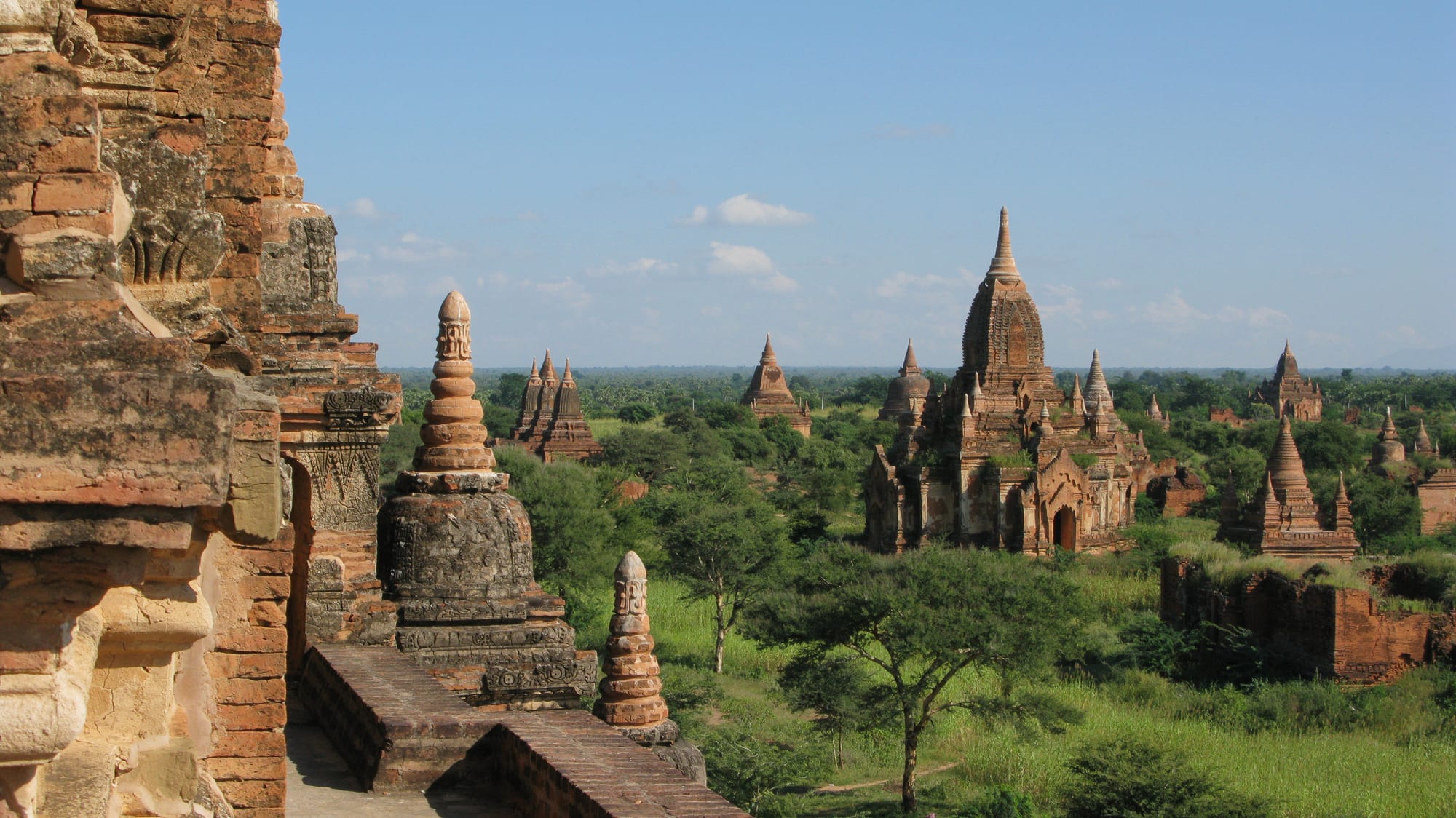
Brick stupas and a tiered temple spire rising from green scrub and trees across a flat plain under a blue sky

Yangon, Mandalay & Central Myanmar, Myanmar

Bagan

Brick temples and stupas on the plain at Old Bagan. (Vyacheslav Argenberg / Wikimedia Commons · CC BY 4.0)

A dry plain on the east bank of the Ayeyarwady in central Myanmar, scattered with thousands of brick temples, stupas and monasteries built between the 11th and 13th centuries by the kings of the Pagan kingdom. The site was inscribed as a UNESCO World Heritage Site in 2019. This page is written to explain the place, not to encourage travel.

Neighbourhoods

  • Old Bagan
    • First-time visitors
    • Historic district
    • Riverside

    The walled area beside the river at the heart of the archaeological zone, containing the greatest concentration of major temples, the archaeological museum and the old city gate. Villagers were moved out to New Bagan and the area is closed to permanent dwellings, though a small number of hotels and restaurants remain within or just outside the walls.

    Open in Maps
  • Nyaung-U
    • Best for food
    • Budget stays
    • Close to public transport

    The market town at the northern end of the plain, with the airport, the bus station, the daily market and the gilded Shwezigon Pagoda. Guesthouses, teashops and cheap restaurants cluster along its main streets, making it the practical base.

    Open in Maps
  • New Bagan
    • Quiet and residential
    • Mid-range stays

    A settlement laid out south of the old walls for the families relocated from Old Bagan, with a grid of streets, hotels, restaurants and shops and temples on its outskirts.

    Open in Maps
  • Myinkaba
    • Crafts
    • Temples

    A village between Old and New Bagan known for lacquerware workshops, where bamboo frames are layered, dried and incised by hand, and for a group of early temples including Manuha and Nanpaya.

    Open in Maps

Things to do

The great temples

  • Ananda Templelandmark

    A whitewashed temple of 1105 on a Greek-cross plan, with four standing Buddha images facing the cardinal directions and a gilded spire, widely regarded as Bagan's finest.

    Open in Maps
  • Thatbyinnyu Templelandmark

    The tallest temple on the plain, built in the mid-12th century under Alaungsithu, rising in receding terraces to 66 metres at the pinnacle.

    Open in Maps
  • Dhammayangyi Templelandmark

    The most massive temple in Bagan, a pyramid of fine brickwork begun by King Narathu in the 1160s and never completed, with several passages bricked up.

    Open in Maps
  • Sulamani Templelandmark

    A two-storey temple of 1183 known for its carved stucco work and for the mural paintings, many of them later, that cover its inner corridors.

    Open in Maps
  • Htilominlo Templelandmark

    A tall brick temple of the early 13th century beside the Nyaung-U road, with elaborate stucco mouldings and glazed plaques.

    Open in Maps
  • Gawdawpalin Templelandmark

    One of the largest temples in Old Bagan, close to the river, damaged in the earthquake of 1975 and rebuilt afterwards.

    Open in Maps

Pagodas and riverside shrines

  • Shwezigon Pagodalandmark

    The gilded bell-shaped stupa at Nyaung-U, begun by Anawrahta and finished by Kyansittha, the prototype for later Burmese pagodas and a working pilgrimage site.

    Open in Maps
  • Bupayalandmark

    A bulbous gilded stupa on a terrace above the Ayeyarwady, rebuilt after the 1975 earthquake, with a wide view along the river.

    Open in Maps
  • Dhammayazika Pagodalandmark

    A circular five-sided pagoda of 1196 in fields south-east of the main cluster, quieter than the central temples.

    Open in Maps
  • Manuha Templelandmark

    A temple at Myinkaba holding oversized seated and reclining Buddha images wedged tightly into their chambers, traditionally linked to the captive Mon king Manuha.

    Open in Maps

Museums, crafts and the river

  • Bagan Archaeological Museummuseum

    A large state museum in Old Bagan displaying inscriptions, sculpture, mural copies and finds from the plain.

    Open in Maps
  • Myinkaba lacquer workshopsattraction

    Family workshops in Myinkaba village where bamboo and horsehair frames are coated with lacquer, polished and engraved, a craft associated with Bagan for centuries.

    Open in Maps

Beyond the plain

  • Mount Popaviewpoint

    A dormant volcano south-east of Bagan, home of the Mahagiri nats, with a Buddhist monastery on the summit of the sheer volcanic plug of Taung Kalat beside it.

    Open in Maps

Seasonal events

  • Ananda Pagoda FestivalPyatho, December or January

    The week-long pagoda festival of the Ananda Temple, when bullock carts camp around it and thousands of pilgrims, traders and monks fill the grounds for days.

  • Thingyanmid-April

    The Burmese new year water festival, marked in Nyaung-U and New Bagan during the hottest weeks of the year.

  • ThadingyutOctober

    The festival of lights at the end of Buddhist Lent, when temples and houses across the villages are lit with candles and lamps.

Eat and drink

Long-standing places and food districts in Bagan. Hours, ratings and directions come from your maps app, always current.

Bagan classics

  • Dry-zone curries and saladsrestaurant

    Burmese curries cooked in peanut or sesame oil with rice, a clear soup and side dishes, alongside laphet thoke, the fermented tea-leaf salad eaten across the country.

    Open in Maps
  • Palm toddy and jaggeryrestaurant

    Sap tapped from toddy palms on the plain is boiled into lumps of palm sugar eaten as a sweet, or left to ferment into a mild, cloudy toddy.

    Open in Maps
  • Tamarind sweetsmarket

    Tamarind pulp rolled with sugar into soft flakes and sticks, a speciality of the dry zone sold in the markets and roadside stalls around Bagan.

    Open in Maps

Where to eat

  • Nyaung-U market and main streetmarket

    The daily produce market and the restaurants and teashops of the surrounding streets, the busiest eating area in the Bagan area.

    Open in Maps
  • New Bagan restaurantsneighborhood

    A grid of small Burmese, Chinese and Indian restaurants and juice bars serving the hotels on the southern side of the archaeological zone.

    Open in Maps

Experience Bagan

History

Bagan was the capital of the first kingdom to unite the Ayeyarwady valley. Settlements existed on the plain from the 9th century, but the decisive figure was Anawrahta, who came to the throne in 1044, extended his rule over the Mon country to the south and the northern uplands, and made Theravada Buddhism the religion of the state. Tradition holds that he carried off the Mon king Manuha, his scholars and craftsmen from Thaton, and with them the styles that shaped Bagan's architecture. His successors — Kyansittha, Alaungsithu, Narapatisithu and others — ruled a prosperous kingdom watered by irrigation works upstream.

Merit-making drove the building. Kings, queens, ministers, monks and wealthy families endowed temples, stupas, monasteries and libraries, each foundation an act of merit recorded in stone inscriptions, many of them in the Mon and early Burmese scripts that give the language its earliest written record. Estimates suggest more than ten thousand religious structures once stood on the plain; about 2,200 temples and pagodas survive. The kingdom weakened in the 13th century as tax-free religious estates swallowed royal revenue, and Mongol campaigns in the 1280s broke its power. The court moved away and the city declined into a group of villages among its own monuments.

The temples were never abandoned as places of worship, and repairs continued for centuries. A severe earthquake in July 1975 damaged many structures, and another in August 2016 damaged nearly 400. Reconstruction from the 1990s, much of it criticised for inaccurate rebuilding, delayed World Heritage listing, which finally came in 2019. The villagers of Old Bagan were relocated to the new settlement south of the walls, and the old town is closed to permanent dwellings. Another major earthquake struck central Myanmar in March 2025.

Culture & Customs

Bagan is a living pilgrimage site rather than an archaeological park. Families come from across the country to the Shwezigon and the Ananda to make offerings, gild images with squares of gold leaf, light candles and pour water over Buddha statues; monks and nuns collect alms in the villages each morning; and novices are ordained in processions with music and painted faces. The rhythm of the Buddhist calendar, with its full-moon observances and Lent, governs the year far more than the tourist season ever did.

Alongside temple Buddhism runs the older nat cult, strongest in this part of the country. Mount Popa, visible from the plain on clear days, is the home of the Mahagiri nats, and shrines to them stand at the entrance to many villages and in corners of the temples themselves. Spirit mediums, astrologers and offerings of coconuts and bananas are ordinary parts of religious life here.

Craft is the other half of Bagan's identity. Lacquerware has been made here for centuries: bamboo or horsehair frames are built, coated with layers of lacquer that dry in underground cellars, then polished and incised with fine designs in red, black, green and yellow. Workshops cluster in Myinkaba and New Bagan, and sand painting, woodcarving and palm-sugar making are village trades too. People here are used to visitors and to explaining their monuments, and the collapse of tourism since 2021 has been felt in every guesthouse, workshop and horse-cart stand.

Daily Life

The Bagan area takes in Nyaung-U town, which has a population of about 48,000 and is the administrative centre of its township, along with New Bagan and the villages of the plain. Most residents live in low brick and timber houses in villages set among the temples, with the school, the monastery and the market as the fixed points of the day.

Farming is the base of the economy: groundnuts, sesame, pulses, millet and cotton grown on dry fields, with toddy palms tapped for sugar and drink, and goats and cattle grazed on the scrub. Irrigation from the Ayeyarwady supports vegetable plots along the bank. Tourism, which once employed thousands as guides, drivers, hotel staff, balloon crews and stallholders, has largely collapsed since 2021, and many families have returned to farming or moved away for work.

Days begin before dawn, when the air is cool and the market at Nyaung-U is at its busiest, and slow to a stop in the early afternoon heat. Power cuts lasting many hours are routine, with generators and solar panels filling the gaps, and water supply is a constant concern in the dry season. The war has not centred on the plain itself, but checkpoints, fuel shortages, conscription and rising prices shape life here as elsewhere in central Myanmar.

Food

Bagan eats the food of the dry zone, which differs from the fish-based cooking of the delta. Groundnut and sesame oil, grown in the surrounding fields, carry most dishes; pulses, beans and gram flour appear in soups, fritters and salads; and goat and chicken are more common than river fish, though the Ayeyarwady supplies some. A Burmese meal is a curry cooked slowly in oil until it separates, served with rice, a clear soup, boiled vegetables and a relish based on ngapi, fermented fish or shrimp paste.

Laphet thoke, the fermented tea-leaf salad mixed with fried beans, peanuts, sesame, garlic and dried shrimp, is eaten here as everywhere in the country, and noodle dishes from further north, including salads of thick rice noodles with chicken curry and toasted chickpea flour, are sold in the teashops. Breakfast is usually mohinga, the fish and rice-noodle soup, or fried rice with tea.

The toddy palm is the emblem of the region. Its sap is boiled down into lumps of palm jaggery, eaten as a sweet after meals and sold in the markets, and fermented into a mild palm toddy drunk fresh in village stands. Tamarind grows in the same fields and is rolled with sugar into chewy flakes, a Bagan speciality carried home by visitors. Sweet, strong milk tea is drunk through the day, with free green tea alongside it.

Planning tools

Budget

Hotels around Bagan were built for a tourist boom that ended after 2021, and many now stand largely empty; rooms are inexpensive by regional standards, while the archaeological zone fee, transport and guides add to the total. Prices are unpredictable because of inflation and multiple exchange rates, and the zone ticket is paid to the authorities.

Daily Budget Midrange
USD 70–160 (hotel, restaurants, a driver or guide, a domestic flight)
Daily Budget Shoestring
USD 25–45 (guesthouse in Nyaung-U, teashops and street food, a hired e-bike)

Bring clean US dollar notes, as cards and foreign ATMs generally do not work, and budget for the archaeological zone fee on arrival.

Best Time to Visit

November to February, when the dry zone is warm rather than scorching and mornings are cool and clear. March to May is severe, regularly above 40°C, and the monsoon from June to October is lighter here than in the south but turns the sandy tracks to mud. Any visit must be weighed against official travel advice.

Suggested Number of Days

Two or three days are enough to see the plain at a steady pace, with the middle of the day spent out of the heat. A further day allows the surrounding countryside and river towns. Distances between temple clusters are short but the sun sets the pace.

First Visit
2–3 days
With Surroundings
3–4 days

Transportation

Electric bikes hired by the day are the usual way to cross the plain, with bicycles, horse carts and taxis or hired cars with drivers as alternatives. Sandy tracks link the temples away from the paved roads and are hard going after rain. Nyaung-U, Old Bagan and New Bagan lie several kilometres apart along one main road.

Carry water, ride in daylight since tracks are unlit and unsigned, and expect fuel shortages and power cuts to affect charging and transport.

Airport & Station Connections

Nyaung-U Airport sits at the northern edge of the plain and handles domestic flights when services are running. The road from Mandalay takes around four to five hours and from Yangon far longer; buses use the expressway and the Bagan–Nyaung-U road. River boats between Mandalay and Bagan once carried many visitors. Checkpoints, cancellations and fuel shortages make all overland journeys unpredictable.

Walkability

Individual temple groups are easily walked between, and the lanes of Nyaung-U, Myinkaba and New Bagan are small enough to cover on foot. The archaeological zone as a whole is far too large to walk, stretching over about 100 square kilometres of open, shadeless plain, so nearly everyone rides or drives between clusters. Sand, heat and loose brick steps make sturdy shoes useful.

Safety

Most governments advise against all or all-but-essential travel to Myanmar, and central Myanmar is not an exception. Checkpoints, arbitrary arrests and fighting in parts of the surrounding countryside affect movement in the region, and power cuts and internet restrictions are routine. The March 2025 earthquake left heavy damage around Mandalay and Naypyidaw. Climbing on temples is prohibited, and heat, dehydration and snakes in the scrub are practical risks.

Do not travel against official advice, avoid photographing soldiers, checkpoints or government buildings, and keep in contact with the relevant embassy in Yangon. Do not climb on the monuments, carry water and a torch, and keep to established routes. Check current official travel advice before travelling.

Climate

Bagan lies in the dry zone, in the rain shadow of the Rakhine hills, so rainfall is low and the hot season is severe. Skies are clear for much of the year and mornings in the cool season can be genuinely cold.

Summer
very hot, commonly 38–42°C in April and May, with dust and haze; monsoon rain from June to October is sporadic
Winter
warm and dry, about 28–32°C by day, with mornings that can drop to around 12–15°C

Local Customs

Every temple on the plain is a religious site, not a ruin: shoes and socks come off at the entrance, shoulders and knees are covered, and offerings and images are treated with respect. Climbing on stupas and terraces is forbidden. The longyi is everyday dress, and thanaka paste is worn on the face against the sun.

Ask before photographing people or worshippers, never pose in front of a Buddha image or point the feet towards one, and buy lacquerware directly from workshops where possible.

Common Payment Methods

The currency is the kyat, and foreign cards and international ATM networks generally do not work, so visitors bring clean US dollars in cash and change them as needed. Hotels may quote in dollars, while markets, e-bike hire, restaurants and the zone fee are handled in cash, and rates vary widely between sources.