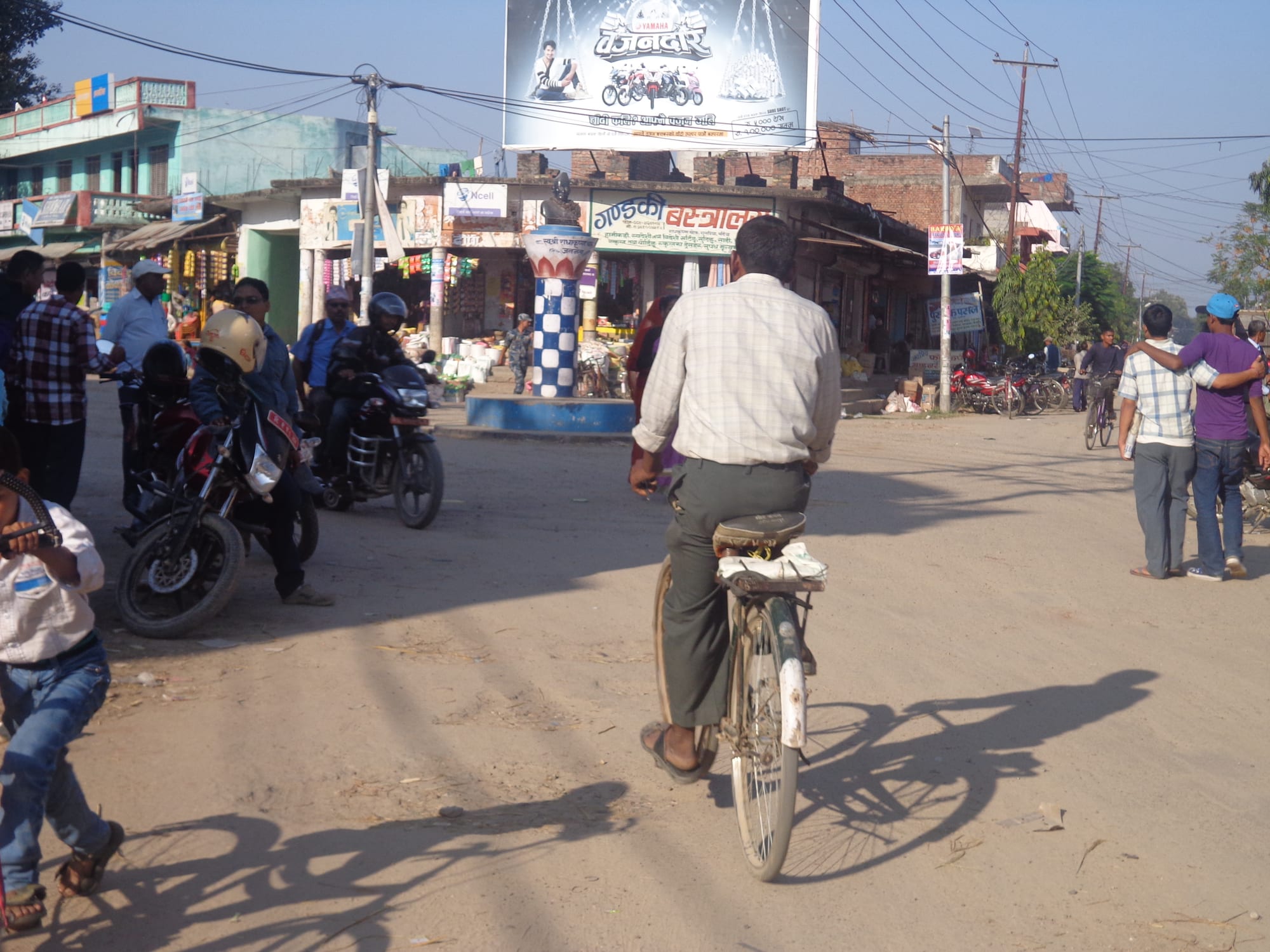
A dusty market crossroads lined with low shops and stalls, with motorcycles, cyclists and shoppers in the morning sun

Lumbini, Bardia & the West, Nepal

Gulariya

The market area at Radha Krishna Chowk in Gulariya, Bardiya district. (Manjesh.world / Wikimedia Commons · CC BY-SA 3.0)

The administrative centre of Bardiya district, a flat market town on the western Terai a short distance north of the Indian border. It grew as farmland was cleared and settled after malaria control in the mid-20th century, and today it is the district's offices, bazaar and bus stands, and the road gateway to Bardiya National Park and its tigers, rhinos and river dolphins.

Neighbourhoods

  • The bazaar and the chowks
    • First-time visitors
    • Markets
    • Local life

    The grid of low shopfronts around the main crossroads, where cloth, grain, hardware and vegetable traders work side by side. Motorcycles, rickshaws and bicycles fill the streets in the morning, and the pace drops sharply in the heat of the afternoon.

    Open in Maps
  • The district offices
    • Practical stops
    • Close to public transport

    The quarter of government buildings, the district court, banks, the hospital and the main bus park, spread along wider roads on the edge of the bazaar. Most of the town's hotels are here or close by.

    Open in Maps
  • Thakurdwara and the park edge
    • Wildlife
    • Lodges
    • Quiet and residential

    The scattered settlement at the headquarters of Bardiya National Park, roughly an hour by road, where most lodges and guides are based. Tharu villages, mud-walled houses and fields of rice run right up to the forest boundary.

    Open in Maps

Things to do

The national park

  • Bardiya National Parkpark

    The largest national park in the Terai, a block of sal forest, grassland and riverbank north-west of the town, known for Bengal tigers, one-horned rhinoceros, wild elephants, swamp deer and more than 400 recorded bird species.

    Open in Maps
  • Thakurdwaraneighborhood

    The village at the park headquarters where jeep drives, guided walks and rafting trips begin, with a small visitor centre and a cluster of family-run lodges.

    Open in Maps
  • Karnali Riverattraction

    Nepal's longest river, which splits into braided channels along the western edge of the park; its Geruwa branch is one of the few stretches where Ganges river dolphins are still seen.

    Open in Maps
  • Babai Riverattraction

    The river that rises in the inner valleys and cuts through the eastern half of the park, with gharial and mugger crocodiles on its sandbanks.

    Open in Maps

Town and temples

  • Gulariya bazaarmarket

    The daily market at the centre of town, strongest in the early morning, selling vegetables, rice, lentils, spices, cloth and farm tools from the surrounding villages.

    Open in Maps
  • Kotahi and Baglamukhi templeslandmark

    The town's best-known Hindu shrines, busy with worshippers on festival days; the Bed Byash Batika temple to Krishna and Radha is another of the local places of worship.

    Open in Maps

Short trips

  • Tharu villages of Bardiyaneighborhood

    Settlements of long mud-and-thatch houses with painted walls between the town and the park, where many families run homestays and keep their own dialect, dress and festivals.

    Open in Maps
  • Nepalgunjneighborhood

    The main city of the western Terai, about two hours east, with the regional airport, the border crossing to India and the biggest markets in this part of Nepal.

    Open in Maps
  • Katarniaghat Wildlife Sanctuarypark

    The Indian forest reserve immediately across the border, joined to Bardiya by the Karnali floodplain and part of the same corridor used by tigers and elephants.

    Open in Maps

Seasonal events

  • Maghimid-January

    The Tharu new year and the most important festival of the western Terai, celebrated with feasting, fish and pork dishes, dancing and gatherings at which village leaders are chosen for the year.

  • DashainSeptember or October

    The long national festival of the goddess Durga, when the bazaar fills with people buying clothes and goats and families return to their villages.

  • TiharOctober or November

    The festival of lights, with oil lamps and marigolds along the shopfronts and groups singing from house to house.

  • HoliMarch

    The spring festival of colour, marked strongly across the Terai with coloured powder, water and street music.

Eat and drink

Long-standing places and food districts in Gulariya. Hours, ratings and directions come from your maps app, always current.

Terai and Tharu classics

  • Daal bhaat and Terai thalirestaurant

    Rice with lentils, a seasonal vegetable, greens and a fiery chutney, the meal served in eateries around the bazaar and bus park.

    Open in Maps
  • Tharu village cookingrestaurant

    Homestays and village kitchens serve dhikri, steamed rice-flour dumplings, ghonghi, river snails in a spiced broth, river fish, and chutneys ground with chilli and mustard oil.

    Open in Maps

Markets and street food

  • Gulariya bazaar stallsmarket

    Morning stalls for vegetables, curd, puffed rice and seasonal fruit, with samosa, pakora and jalebi fried at the roadside and tea boiled with milk and sugar.

    Open in Maps

Experience Gulariya

History

This corner of the western Terai was forest and grassland for most of its history, worked by Tharu communities who farmed clearings along the rivers and had a long resistance to malaria, which kept outsiders away. Politically it changed hands twice in the 19th century: the far-western plains were ceded to British India after the war of 1814–16, and a block of districts including Bardiya was returned to Nepal in 1860 as a reward for help during the Indian Rebellion of 1857. The returned territory became known as the Naya Muluk, the "new country", and the state granted large holdings in it to landlords from the hills.

The decisive change came in the middle of the 20th century, when malaria control opened the Terai to settlement. Families moved down from the hills in large numbers, forest was cleared for rice and sugarcane, and market towns grew at the road junctions. Gulariya, near the southern border, became the administrative centre of Bardiya district, gathering offices, a court, a hospital, schools and a bus park, and its bazaar served both the new farms and the older Tharu villages.

The last fifty years have been harder than the growth suggests. Many Tharu families lost land to incoming owners and were bound into kamaiya bonded labour, a system the government abolished in 2000, leaving thousands of freed households needing land and work. Bardiya was among the districts worst affected by the Maoist insurgency of 1996–2006 and has one of the country's highest numbers of unresolved wartime disappearances. Floods on the Karnali and Babai have repeatedly damaged villages and roads. Alongside this, the wildlife reserve gazetted to the north-west in 1976, and made a national park in 1988, has turned the district into a destination for wildlife travel.

Culture & Customs

Bardiya is one of the strongholds of Tharu culture. The Dangaura Tharu, who moved into the district from the Dang valley, keep their own language, dress and ritual year, and their villages of long mud-walled houses with steep thatched roofs, often painted around the doors, are the characteristic landscape between the town and the park. Maghi in mid-January is their new year and the biggest festival of the western Terai, a time for feasting, dancing and village meetings that choose the headmen who organise irrigation, paths and communal work for the year to come.

The town itself is mixed. Hill migrants brought Nepali, the festivals of Dashain and Tihar and the caste patterns of the middle hills; Awadhi-speaking families and a Muslim community trade in the bazaar; and proximity to Uttar Pradesh shapes music, film-watching, clothing and food. Holi and Chhath, the Terai festival honouring the sun by river and pond, are both observed here.

Manners are those of the plains: greetings with palms together, shoes left at the door, modest dress, and hospitality offered as tea first. Shamanic healers, the gurau, still have a role in Tharu villages alongside clinics. Visitors are welcomed with real curiosity in a district that sees few of them outside the park lodges, but photographing people, houses and rituals without asking is resented.

Daily Life

About 68,000 people live in Gulariya municipality, most of them in farming wards rather than the bazaar itself, and the district around it is overwhelmingly rural. The town works as Bardiya's service centre: district administration, courts, banks, the hospital, secondary schools and a campus, and the market where villages buy and sell.

Agriculture carries the economy — rice above all, with wheat, mustard, lentils, sugarcane and vegetables, and buffalo, goats and poultry. Landholdings are small and many households depend on labour on other people's fields. Remittances from work in India and the Gulf are a mainstay, and seasonal migration across the open border is a normal part of the year. Tourism reaches only the western edge of the district, where lodges, guides, drivers and homestays around Thakurdwara employ a growing number of families.

The day starts before dawn and pauses in the afternoon heat; the bazaar is busiest early in the morning and again after five. Power cuts, dust, and the annual fear of flooding shape practical life, and winter fog can close the roads for hours. The issues people raise are land rights for freed kamaiya families, jobs for young people who would otherwise leave, river control, and the damage crop-raiding elephants and rhinos do to farms near the park.

Food

Gulariya eats like the western Terai. Daal bhaat is the foundation: rice with lentils, a seasonal vegetable such as potato and cauliflower or mustard greens, and a chutney of chilli, tomato and mustard oil sharp enough to carry a whole plate. Roti and paratha appear at breakfast, and the influence of Uttar Pradesh across the border is everywhere in the frying pans — samosa, pakora, puri with potato curry, and jalebi coiled into hot syrup.

Tharu cooking is the district's distinctive tradition. Dhikri, dumplings of rice flour shaped by hand and steamed, are eaten with chutney and made in quantity at festivals; ghonghi, river snails simmered in a spiced broth and sucked from the shell, are a delicacy; and fish and crab from the rivers and paddy channels, crab chutney, and wild greens are village staples. Pork and duck appear at Maghi, and bagiya, steamed rice-and-lentil dumplings, are made for feasts.

Sweet shops sell milk-based barfi, rasbari and thick sweetened curd, and the drinks are tea boiled with milk and sugar, lassi and sugarcane juice in the hot months. Jaand, a home-brewed rice beer, and raksi, distilled from grain, are part of Tharu hospitality and festivals, though they are not generally sold in the bazaar.

Planning tools

Budget

Gulariya is one of the cheaper places to stay in Nepal. Hotels in the town are plain and inexpensive, and meals cost very little. The real spending happens in the park: entry permits, a licensed guide, jeep drives and lodge accommodation at Thakurdwara, all of which are still modest by international standards.

Daily Budget Midrange
USD 40–90 (a jungle lodge with guided walks, park permits, private jeep transfers)
Daily Budget Shoestring
USD 10–20 (basic hotel in town, daal bhaat, local buses)

Carry cash: there are ATMs in Gulariya but not at the park edge, and lodges and guides usually expect rupees.

Best Time to Visit

October to April is the season. Wildlife viewing is at its best from February to April, once the tall elephant grass has been cut and animals gather at shrinking water, though April is already very hot. Winter days are mild with foggy mornings. The monsoon from June to September brings heavy rain, high rivers, leeches and flooding, and many park activities stop.

Suggested Number of Days

The town itself takes an afternoon. Most visits are built around the national park, where three or four days give a realistic chance of good wildlife sightings and time for the villages and rivers nearby.

First Visit
1–2 days
With Surroundings
3–4 days

Transportation

Gulariya is small enough to walk, and cycle rickshaws and shared auto-rickshaws cover the rest for very little. Buses and jeeps leave the bus park for Nepalgunj, Kohalpur and the East–West Highway, and local buses and hired jeeps run west to Thakurdwara and the park. Motorcycles are the usual family transport, and bicycles are widely used.

Transport to the park edge is easiest in the morning; ask a hotel or lodge to arrange a jeep rather than relying on late buses.

Airport & Station Connections

Nepalgunj, about two hours east, has the nearest airport, with daily flights from Kathmandu, and is the main transfer point. By road the town is reached from the East–West Highway, with long overnight buses from Kathmandu and Pokhara taking most of a day, and shorter runs from Nepalgunj and Kohalpur. The Indian border is close, and travellers also arrive overland from Uttar Pradesh.

Walkability

The bazaar and offices are flat, close together and easy to cover on foot, with rickshaws for anything further. Pavements are patchy, roads are dusty in the dry months and muddy in the monsoon, and motorcycle traffic is constant at the crossroads. Walking is comfortable early and late but hard going in the middle of the day for much of the year.

Safety

Gulariya is a quiet town with little crime beyond occasional theft at bus stands and in crowds. The serious risks are outside it: wild animals in and around the park, where rhinos, elephants and tigers cause injuries to people every year; the heat and strong sun of the Terai; mosquito-borne illness; and monsoon flooding along the Karnali and Babai.

Walk in the national park only with a licensed guide and follow instructions about distance and standing still, drink treated water, use repellent at dusk, and avoid river crossings and flooded roads in the monsoon. Check current official travel advice before travelling.

Climate

A subtropical lowland climate on the plains, with three clear seasons: a mild, foggy winter, an intensely hot spring, and a humid monsoon from June to September that delivers almost all the year's rain.

Summer
very hot then humid — commonly above 35°C in April and May before the monsoon, with heavy rain and high rivers afterwards
Winter
mild days and cold, foggy mornings — roughly 8–24°C, with fog that can delay buses and flights

Local Customs

Bardiya is Tharu country, with hill migrants, Madhesi families and a Muslim community in and around the town. Dress is modest, greetings are made with palms together and a namaste, and shoes come off at temple steps and at the door of a house. Village homestays have their own conventions about the kitchen and the household shrine, which hosts explain.

Ask before photographing people, painted house walls or festivals; dress with shoulders and knees covered; and keep to muted clothing and quiet voices on park walks.

Common Payment Methods

The currency is the Nepalese rupee and this is very much a cash economy. Banks and ATMs are in Gulariya and in Nepalgunj, but machines can run out at weekends and holidays; lodges at the park edge, guides, jeeps and stalls take cash, and card payment is rare. Indian rupees circulate near the border, though large notes are not accepted.