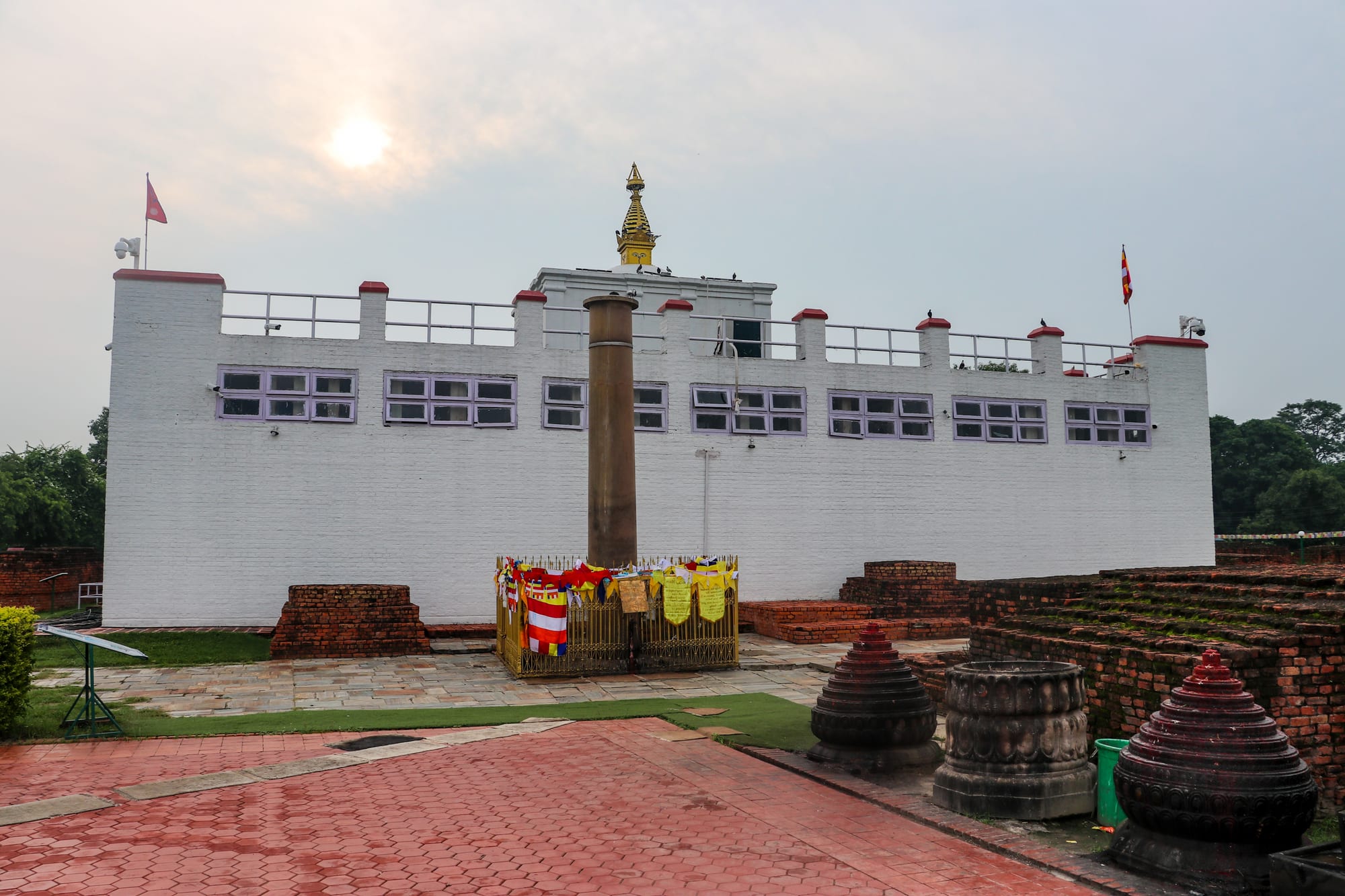
A low white temple building behind a weathered stone pillar hung with prayer flags, with excavated brick foundations in front

Lumbini, Bardia & the West, Nepal

Lumbini

The Maya Devi Temple and the pillar of Ashoka in the sacred garden at Lumbini. (Shadow Ayush / Wikimedia Commons · CC BY-SA 4.0)

A small town on the plains of Rupandehi district built around the garden where, by Buddhist tradition, the Buddha was born. The site holds the Maya Devi Temple, an inscribed pillar set up by the emperor Ashoka and excavated brick foundations, and is surrounded by a planned monastic park in which Buddhist countries and communities have built their own temples.

Neighbourhoods

  • The sacred garden
    • First-time visitors
    • Pilgrimage
    • Quiet

    The walled southern end of the site, where the Maya Devi Temple, the Ashoka pillar, the Puskarini pond and the excavated brick remains of old shrines and stupas stand under a large pipal tree. Shoes come off at the boundary and the whole area is walked barefoot or in socks.

    Open in Maps
  • The monastic zone
    • Architecture
    • Walks
    • Photography

    The long planned park north of the garden, divided by a central canal into an eastern half of Theravada monasteries and a western half of Mahayana and Vajrayana ones. Each is built in the style of the country that paid for it, and the distances between them are covered on foot, by bicycle or by rickshaw.

    Open in Maps
  • Lumbini Bazaar and Buddha Chowk
    • Budget stays
    • Local life
    • Transport

    The working settlement outside the eastern gate, with guesthouses, shops, tea stalls and the stands where buses and shared jeeps stop. It is where most inexpensive rooms and everyday meals are found.

    Open in Maps
  • Siddharthanagar
    • Hotels
    • Onward travel
    • Restaurants

    Also called Bhairahawa, the nearest sizeable town, roughly 25 kilometres east on the Indian border road, with the region's airport, a wider choice of hotels and restaurants, and the crossing to Sonauli in India.

    Open in Maps

Things to do

The sacred garden

  • Maya Devi Templelandmark

    The white shrine built over the excavated remains of earlier temples, sheltering a marker stone that identifies the spot of the birth and a worn relief of the nativity scene.

    Open in Maps
  • The Ashoka pillarlandmark

    A sandstone column raised beside the temple by the Mauryan emperor Ashoka in the 3rd century BC, whose inscription records his visit and names the place as the Buddha's birthplace; its rediscovery in 1896 identified the site.

    Open in Maps
  • Puskarinilandmark

    The rectangular stepped pond beside the temple, traditionally the bathing tank used before the birth, now edged in brick and reflecting the pipal tree and its prayer flags.

    Open in Maps

The monastic zone

  • World Peace Pagodalandmark

    A white stupa built by Japanese Buddhists at the northern end of the master plan's central axis, about three kilometres from the sacred garden, with gilded Buddha figures facing the four directions.

    Open in Maps
  • The international monasteriesattraction

    Dozens of temples and monasteries built by Buddhist countries and communities — among them Thai, Myanmar, Sri Lankan, German, Korean and Chinese foundations — each in its own national architecture along the two sides of the canal.

    Open in Maps
  • Lumbini Museummuseum

    A museum in the cultural centre at the northern end of the site, with material relating to the Buddha's life and to the archaeology of the plain, beside the Lumbini International Research Institute.

    Open in Maps

Short trips on the plain

  • Tilaurakotattraction

    Excavated ramparts, gateways and street foundations of a walled town about 27 kilometres west, widely identified with Kapilavastu, where the Buddha is said to have spent his early life.

    Open in Maps
  • Ramagrama stupalandmark

    An earthen mound east of Lumbini, held to be the only original relic stupa of the Buddha never opened and rebuilt.

    Open in Maps
  • Devdahaattraction

    A group of mounds and excavation sites east of Lumbini, identified in tradition as the maternal home of the Buddha's mother and the capital of the Koliya people.

    Open in Maps
  • Siddharthanagarneighborhood

    The border town of Bhairahawa, the commercial centre of the district and the site of Gautam Buddha International Airport.

    Open in Maps

Seasonal events

  • Buddha JayantiApril or May, at the full moon

    The birthday of the Buddha and the site's biggest day of the year, when pilgrims from across Asia fill the sacred garden for processions, chanting and lamp lighting.

  • Ashadha PurnimaJuly, at the full moon

    The full moon marking the Buddha's first sermon, observed with teaching and ceremonies in the Theravada monasteries as the monsoon retreat begins.

Eat and drink

Long-standing places and food districts in Lumbini. Hours, ratings and directions come from your maps app, always current.

Lumbini classics

  • Daal bhaat and Terai thalirestaurant

    Rice, lentils, a seasonal vegetable, greens and pickle, served in guesthouses and small eateries, often in an all-vegetarian version for pilgrims.

    Open in Maps
  • Samosa, jalebi and sweetscafe

    The snack culture of the plains is shared with neighbouring India — fried samosa and pakora, syrup-soaked jalebi, milk sweets and sweet tea boiled with spices.

    Open in Maps

Food streets and markets

  • Lumbini Bazaarneighborhood

    The row of tea stalls, sweet shops and simple kitchens outside the eastern gate, serving pilgrims, drivers and residents.

    Open in Maps
  • Siddharthanagar restaurantsneighborhood

    The wider choice of the border town, with Nepali, north Indian and Chinese-style cooking, and the tandoori grills and vegetarian thalis common along the frontier.

    Open in Maps

Experience Lumbini

History

The garden at Lumbini is described in Buddhist tradition as the place where Queen Maya Devi, travelling to her family home, gave birth to Siddhartha Gautama in about the 6th or 5th century BC. Its documented history begins with the Mauryan emperor Ashoka, who came on pilgrimage in the 3rd century BC and set up a stone pillar whose Brahmi inscription states that the Buddha was born there and records that he reduced the village's taxes. The Chinese pilgrims Faxian and Xuanzang described the site in the 5th and 7th centuries AD, by which time parts of it were already ruined.

Lumbini then slipped out of memory for centuries and was swallowed by the forest and the farmland of the Terai. In 1896 the archaeologist Alois Anton Führer and the Nepali governor Khadga Shumsher Rana identified the buried pillar, and the inscription fixed the location of the birthplace. Excavation since then has exposed the brick foundations of a sequence of shrines beneath the Maya Devi Temple, votive stupas and a monastic quarter, and the marker stone that the earliest structures were built around.

Modern Lumbini was shaped by a plan. From the 1960s an international effort was mounted to develop the site, and the United Nations Development Programme paid for the preparation of a master plan, drawn by the Japanese architect Kenzō Tange and completed in 1978, that set out a long rectangular park with the sacred garden at one end, a monastic zone divided by a central canal in the middle and a new village at the other. The complex was inscribed as a UNESCO World Heritage Site in 1997, and construction of national monasteries has continued ever since.

Culture & Customs

Lumbini is an international place in a rural district. Monks, nuns and lay pilgrims come from Sri Lanka, Thailand, Myanmar, Cambodia, Vietnam, Korea, Japan, China, Tibet, Bhutan and above all India, and the monastic zone is effectively a museum of living Buddhist architecture: Theravada temples with steep gilded roofs on one side of the canal, Tibetan and East Asian ones with painted courtyards on the other. Each keeps its own liturgy, language and calendar, so chanting in half a dozen traditions can be heard on the same afternoon.

The resident population is mostly Hindu and Muslim farming families of the Terai, speaking Nepali, Awadhi and Bhojpuri, alongside Tharu communities. Hindus also revere the Buddha, and the birthplace draws Hindu visitors as well as Buddhist ones. The result is an unusual mixture: local village life, Nepali officialdom and an international religious community sharing a single small settlement.

Behaviour inside the protected zone is more formal than elsewhere in Nepal. Visitors walk barefoot in the sacred garden, keep quiet near the temple where groups meditate, and circle stupas clockwise. Meditation courses and retreats are offered by several monasteries, and some accept guests who follow their rules on silence, dress and diet. Outside the gates, ordinary Terai customs apply, with greetings made palms together and modest dress expected.

Daily Life

The settlement itself is small: a few thousand people live in Lumbini village and the hamlets beside the monastic zone, within a municipality that is otherwise farmland. Siddharthanagar, about 25 kilometres east, is the district's commercial and administrative centre, and Butwal further north is the regional market city, so anything beyond basic shopping, banking or medical care means a journey.

Two economies run side by side. One is agricultural — rice, wheat, sugarcane, mustard and lentils on the flat, irrigated land, with buffalo and goats — and follows the monsoon. The other is pilgrimage: guesthouses, hotels, tea stalls, souvenir and offering stalls, rickshaw and cart drivers, guides, and construction and maintenance work on the monasteries and the park. The airport at Bhairahawa, opened to international flights in 2022, was built in the hope of bringing Buddhist pilgrims directly to the region.

Daily life follows the heat. Work and worship happen early, the middle of the day is slow, and the site fills again in the late afternoon and at dusk when the lamps are lit. Fog in winter and heavy rain in the monsoon both disrupt travel. Local concerns include air quality on the plains, groundwater and the preservation of the archaeological remains, employment for young people, and how much of the money pilgrimage brings stays in the surrounding villages.

Food

Food around Lumbini is that of the western Terai, close to the cooking of neighbouring Uttar Pradesh. Daal bhaat — rice with lentils, a seasonal vegetable, greens and pickle — is eaten twice a day, and roti or paratha often replaces rice at breakfast. Because of the pilgrims, a great deal of what is served near the site is vegetarian, and many guesthouses cook without onion or garlic for visitors keeping monastic diets.

The snack tradition is shared across the border: samosa and pakora fried in the morning, chana and spiced chickpeas, puri with potato curry, and sweets such as jalebi pulled hot from the syrup, barfi, rasbari and thick sweetened curd. Tea is boiled with milk, sugar and sometimes cardamom or ginger and drunk through the day at stalls near the gates. Lassi and sugarcane juice are the summer drinks.

Tharu cooking is the plain's older tradition, found in villages around the district: ghonghi, river snails cooked in spiced broth; dhikri, hand-shaped steamed rice-flour dumplings; river fish; and fiery chutneys ground with chilli and mustard oil. Momo, chow mein and thukpa, brought by migration from the hills and the mountains, are on almost every menu, and monastery kitchens add Thai, Burmese, Korean and Tibetan dishes to the range of food cooked in this one small place.

Planning tools

Budget

Lumbini is inexpensive. Guesthouses in the bazaar and simple rooms run by some monasteries cost little, meals are cheap, and the only fixed costs are the entry fee for the sacred garden and transport around the site by rickshaw, electric cart or hired bicycle. Comfortable hotels are concentrated near the eastern gate and in Siddharthanagar.

Daily Budget Midrange
USD 40–90 (a hotel near the site, restaurant meals, a guide, private jeep to Tilaurakot)
Daily Budget Shoestring
USD 10–20 (guesthouse in the bazaar, daal bhaat, a hired bicycle, local buses)

Carry small notes for the entry fee, rickshaws and tea stalls; card payment is limited to the larger hotels.

Best Time to Visit

October to March is the comfortable season on this part of the Terai, with warm days and cool, sometimes foggy, mornings. April and May are very hot before the monsoon, which runs from June to September and brings heavy rain and humidity, although the gardens are at their greenest then. Buddha Jayanti in spring is the busiest time of the year.

Suggested Number of Days

One full day covers the sacred garden and a good part of the monastic zone; a second allows a slower pace and the excavated sites on the surrounding plain. Pilgrims and meditation visitors often stay longer at one of the monasteries.

First Visit
1–2 days
With Surroundings
2–3 days

Transportation

The protected site is closed to ordinary traffic, and visitors move through it on foot, by hired bicycle, by cycle rickshaw or on the electric carts that shuttle along the central axis; the distance from the garden to the peace pagoda is about three kilometres. Outside the gates, buses and shared jeeps run to Siddharthanagar, Butwal and the border, and taxis and private jeeps can be hired for the day.

A bicycle is the easiest way to see the monastic zone, and an early start avoids the worst of the midday heat.

Airport & Station Connections

Gautam Buddha International Airport at Bhairahawa, about 25 kilometres east, has domestic flights from Kathmandu and was upgraded for international flights in 2022, although international services from it have been limited; the drive from it takes roughly half an hour. Tourist and local buses run from Kathmandu, Pokhara and Chitwan, taking most of a day, and the Indian border crossing at Sonauli, a short drive from Siddharthanagar, is a common overland route from Uttar Pradesh.

Walkability

The sacred garden is compact and entirely walked, barefoot or in socks inside its boundary. The monastic zone is another matter: it is a planned park several kilometres long, with wide paths, little shade in places and long gaps between monasteries, so many visitors cycle or take a rickshaw. Paths are flat and paved or gravelled, and the heat rather than the terrain is the limiting factor.

Safety

Lumbini is a calm, heavily visited religious site with little crime beyond occasional petty theft in crowds and around bus stands. The genuine risks are the heat and strong sun before the monsoon, mosquitoes and the water-borne illnesses common on the plains, and traffic on the border road. Monsoon rain can flood low ground and slow road travel.

Drink treated or bottled water, cover up and rest in the middle of the day in spring, use mosquito repellent at dusk, and keep valuables close in festival crowds. Check current official travel advice before travelling.

Climate

A subtropical Terai climate on flat, low-lying land near the Indian border. It runs from cool, foggy winter mornings through an intensely hot spring to a humid monsoon, with the most settled weather from late autumn to early spring.

Summer
very hot then humid — often above 35°C before the monsoon breaks in June, with heavy rain into September
Winter
mild days and cold, foggy mornings — roughly 8–24°C, with fog sometimes delaying flights and road travel

Local Customs

This is a place of pilgrimage first. Shoes are removed at the entrance to the sacred garden and inside the monasteries, shoulders and knees should be covered, and silence is expected around the Maya Devi Temple, where groups sit and chant. Walking clockwise around stupas and shrines is normal practice, and the pipal tree and the marker stone are not touched.

Ask before photographing monks, pilgrims or meditation sessions, do not photograph inside shrine rooms where notices forbid it, avoid pointing the soles of the feet towards images of the Buddha, and note that alcohol and meat are unwelcome inside the protected zone.

Common Payment Methods

The currency is the Nepalese rupee, and Lumbini is a cash economy. ATMs are available in the bazaar and more plentiful in Siddharthanagar, but machines can be empty; hotels near the site may take cards, while rickshaws, stalls and the entry gate do not. Indian rupees circulate informally near the border, though large Indian notes are not accepted.