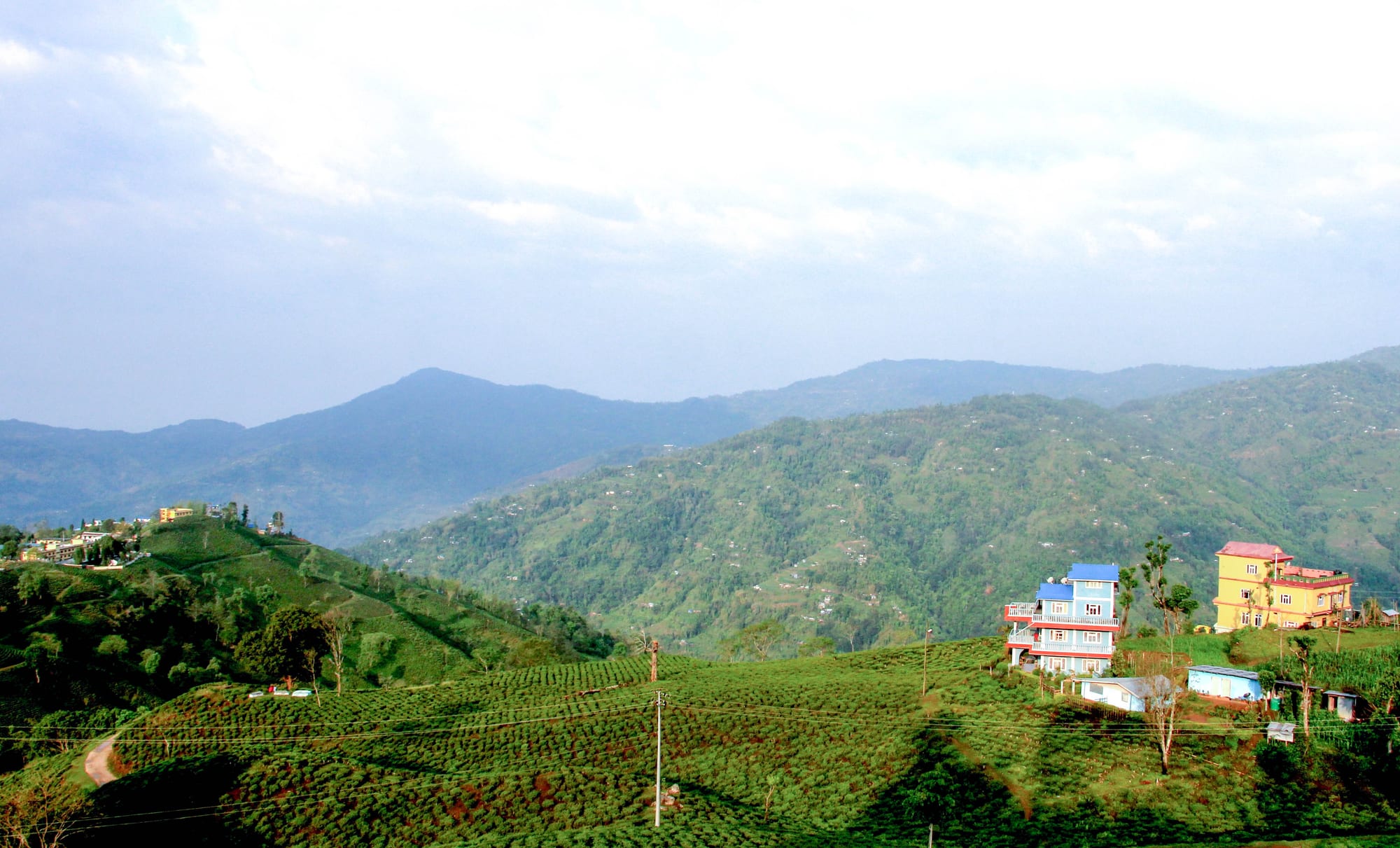
Rows of clipped tea bushes covering rounded hills, with a few houses on a ridge and blue mountain ranges behind

Everest & Eastern Nepal, Nepal

Ilam

Tea gardens on the hills around Ilam in far-eastern Nepal. (Ranjit Mukhiya / Wikimedia Commons · CC BY-SA 4.0)

A hill town in far-eastern Nepal, close to the Indian border and about 1,200 metres up, set among the tea gardens that give the district its name in Nepali households. Ilam grew as a bazaar and a tea-growing centre in the nineteenth century, and it is now a quiet base for walks through plantations, dairy villages and cardamom slopes with Kangchenjunga on the horizon.

Neighbourhoods

  • Ilam Bazaar
    • First-time visitors
    • Markets
    • Close to public transport

    The old core of the town on a spur above the Mai valley, a compact grid of shops, lodges, tea traders and the bus park. Wooden-fronted buildings survive among concrete ones, and the streets are busiest in the early morning and at dusk.

    Open in Maps
  • The tea estate slopes
    • Walks
    • Quiet and residential

    The hillsides immediately below and around the town, planted with tea since the 1860s and crossed by dirt tracks and footpaths. Pickers work the rows in the growing season, and collection points and drying sheds stand among the bushes.

    Open in Maps
  • The upper ridge
    • Viewpoints
    • Quiet and residential

    The lanes climbing above the bazaar towards viewpoints and the district offices, with guesthouses, schools and small temples. On clear mornings in autumn and winter the snows of Kangchenjunga appear to the north-east from here.

    Open in Maps
  • Fikkal and the highway junction
    • Local life
    • Markets

    A roadside town on the ridge east of Ilam where the road from the plains meets the route to the border. It holds a large weekly haat that draws traders from the surrounding hills and from across the Indian frontier.

    Open in Maps

Things to do

In and around the town

  • Ilam's tea gardensattraction

    Terraced plantations wrapping the hills around the town, the oldest in the country after the Ilam Tea Estate was laid out in the 1860s, with paths between the rows and smallholdings selling green leaf to nearby factories.

    Open in Maps
  • Mai Pokhariattraction

    A forest lake about 15 kilometres north of the town at some 2,100 metres, a Ramsar wetland since 2008 and a pilgrimage place for Hindus and Buddhists, ringed by oak and rhododendron woods and a botanical garden.

    Open in Maps
  • Ilam bazaar marketmarket

    The town's shops and stalls, where tea, large cardamom, ginger, dairy products and broom grass from the surrounding hills are traded.

    Open in Maps

Short trips from the town

  • Kanyamattraction

    A wide sweep of tea gardens beside the highway near Fikkal, known as the queen of eastern Nepal and a favourite of Nepali visitors.

    Open in Maps
  • Singalila National Parkpark

    The Indian park along the ridge east of Ilam, protecting rhododendron and oak forest and known for red panda and Himalayan birds.

    Open in Maps
  • Sandakphuviewpoint

    At 3,636 metres the highest point of the Singalila ridge and of West Bengal, on the Nepal–India border, walked for a panorama that takes in Kangchenjunga and, in clear conditions, Everest, Lhotse and Makalu.

    Open in Maps

Seasonal events

  • DashainSeptember or October

    Nepal's longest festival, when families return to the hill villages, swings are put up and the bazaar closes for days of visiting and feasting.

  • TiharOctober or November

    The festival of lights, marked with oil lamps, marigold garlands, honoured crows, dogs and cows, and groups singing bhailo and deusi from house to house.

  • Ubhauli and UdhauliApril or May, and November or December

    The two Kirat festivals of the farming year, danced as sakela by Rai communities in large circles to drums and cymbals.

  • Maghe Sankrantimid-January

    The midwinter festival, with ritual bathing, sesame sweets, yam and ghee eaten in hill households across the east.

Eat and drink

Long-standing places and food districts in Ilam. Hours, ratings and directions come from your maps app, always current.

Ilam staples

  • Tea shops around the bazaarcafe

    Small shops pouring the local orthodox and CTC teas, usually milky and sweet, alongside fried snacks; loose leaf from the district's gardens is sold by weight nearby.

    Open in Maps
  • Ilam's dairies and chhurpimarket

    The hills around the town are dairy country, and shops sell local cheese and chhurpi, the hard, chewy dried curd chewed for hours as a snack.

    Open in Maps
  • Eating houses on the main streetrestaurant

    Bhojanalaya kitchens serving daal bhaat with gundruk and bamboo-shoot pickle, momo dumplings, thukpa and buffalo sukuti to traders and bus passengers.

    Open in Maps

Experience Ilam

History

Ilam's name comes from Limbu words usually glossed as "twisting road", and the country around it was part of Limbuwan, the Limbu chiefdoms of far-eastern Nepal that were absorbed into the Gorkha state in the 1770s. The settlement grew as a bazaar on a trading route between the hills and the plains, and as an administrative centre for one of the most remote districts of the kingdom, a month's walk from Kathmandu but only a few days from the markets of Bengal.

Tea made its name. Planting began in the 1860s, shortly after the first estates were laid out in Darjeeling on the other side of the ridge, and the Ilam Tea Estate became Nepal's first commercial garden. For a century production stayed small and was bound up with the Rana administration; a state body, the Nepal Tea Development Corporation, was set up in 1966, and its plantations and factories were privatised in 1997, after which thousands of smallholders began planting their own bushes and selling green leaf to private factories. The district now produces the greater part of Nepal's orthodox tea, much of it sold through India.

The twentieth century brought a road, a district headquarters and schools, and also long-running emigration: Ilam families have supplied soldiers to the British and Indian armies and workers to the Gulf and Malaysia. Nepal's political upheavals reached the hills as elsewhere — the Maoist conflict from 1996 to 2006, the end of the monarchy in 2008, and the federal reorganisation that made the east into Koshi Province. Tourism arrived slowly, driven at first by Nepali visitors coming to see the tea gardens for themselves.

Culture & Customs

The district is ethnically mixed even by Nepali standards. Limbu and Rai communities, whose Kirat religion centres on the oral Mundhum, ancestor worship and the spirits of land and forest, live alongside Brahmin and Chhetri households, Newar traders in the bazaar, Tamang, Magar, Sherpa and Lepcha families and a long-settled population with ties across the border in Darjeeling and Sikkim. Nepali is the shared language; Limbu, Rai languages and Nepal Bhasa are heard at home.

Festivals follow both calendars. Dashain and Tihar empty the bazaar as families gather in the villages, while the Kirat Ubhauli and Udhauli mark the start and end of the farming year and are danced as sakela, a circle dance to drum and cymbal that imitates the movements of ploughing and harvest. The Limbu chyabrung drum and the dhaan naach, a paddy dance performed by linked lines of young men and women, belong to this corner of the country.

Ilam is also culturally close to Darjeeling, and that shows in its tea shops, its music and its taste for Nepali-language writing from across the border. The town has produced writers and singers out of proportion to its size, and local identity rests on three things: tea, the cardamom and dairy economy of the hills, and the view of Kangchenjunga that appears on clear winter mornings.

Daily Life

About 50,000 people live in Ilam Municipality, a few thousand of them in the bazaar itself and the rest in surrounding wards of farms and tea gardens. The town is the administrative and market centre of the district: government offices, a hospital, a campus of the national university system, banks, tea traders and the bus park that links the hills to the plains.

The economy is agricultural and export-facing. Tea is the best-known crop, grown both on estates and by smallholders who sell green leaf to factories, and it is joined by large cardamom, of which Nepal is the world's leading producer, ginger, broom grass, potatoes, milk and cheese. Money also arrives from relatives working in India, the Gulf and Malaysia, and from army pensions.

Days begin early, with milk and leaf collection, school runs and the first jeeps down the hill. The weekly haats in Fikkal and other roadside towns are social occasions as much as markets. The persistent problems are the state of the hill roads, landslides in the monsoon, young people leaving for the plains and abroad, and the price paid for green leaf, which has caused repeated disputes between smallholders and factories. Nepali domestic tourism, drawn by the tea country, has become a small but steady source of income.

Food

Tea is the obvious starting point. Ilam produces orthodox leaf, hand-processed in the style of Darjeeling and sold as loose leaf, alongside the stronger CTC tea that goes into everyday cups. In homes and shops it is usually drunk as chiya, boiled with milk, sugar and often ginger or cardamom, while the finer orthodox grades are largely exported and can be bought at the gardens and in bazaar shops.

The hill kitchen is otherwise Nepali with eastern additions. Daal bhaat is the daily meal, rice with lentils, seasonal vegetables and pickle, often with gundruk, fermented leafy greens, dried and cooked into a sour soup, and tama, fermented bamboo shoot. Dhido, a stiff porridge of millet or maize, is eaten with meat or greens in the villages. Kinema, fermented soybeans with a strong smell, is a Rai and Limbu speciality cooked as a thick curry, and sukuti, dried buffalo or goat meat, is fried with chilli and onion.

Dairy shapes the local snack list: the hills make cheese and chhurpi, the hard smoked curd chewed slowly, or a softer version cooked with vegetables. Momo and thukpa are everywhere, reflecting the Tibetan and Himalayan influence. Tongba, fermented millet in a wooden pot topped with hot water and sipped through a bamboo straw, is the Limbu drink of the east, along with local raksi distilled at home.

Planning tools

Budget

Ilam is one of the cheaper places to travel in Nepal. Guesthouses in the bazaar and homestays on the tea estates cost little, meals are local prices, and buses and shared jeeps are inexpensive. The main costs are the long journey in from the plains or from Kathmandu and hiring a jeep for the tea villages and viewpoints, which is worth sharing.

Daily Budget Midrange
USD 50–130 (a comfortable hotel or resort, restaurant meals and a car with driver for the tea country)
Daily Budget Shoestring
USD 15–20 (guesthouse or homestay, daal bhaat and tea, local buses)

Carry cash: the bazaar has banks and machines but the villages and homestays in the tea hills do not.

Best Time to Visit

October to December brings the clearest skies, the best chance of seeing Kangchenjunga and the end of the tea harvest. March to May is warm and green with the first flushes being picked and rhododendrons in flower at Mai Pokhari. The monsoon from June to September is very wet, with mist, leeches and landslides on the hill roads, though the gardens are at their greenest.

Suggested Number of Days

A night or two covers the town and the nearest tea slopes. Three or four days allow the outlying gardens, the border villages and the ridge viewpoints, and longer if walking rather than driving between them. Weather decides how much of the mountain view is on offer.

First Visit
1–2 days
With Surroundings
3–4 days

Transportation

Buses and shared jeeps climb to Ilam from Birtamod and Charali in the plains, a winding road of several hours, and continue to Fikkal, Pashupatinagar and Taplejung. Within the town everything is walkable; beyond it, shared jeeps run between villages and a hired vehicle is the usual way to reach the tea gardens and viewpoints.

Travel the hill roads in daylight, and expect delays or diversions after heavy monsoon rain.

Airport & Station Connections

The nearest airports are Bhadrapur, down in the plains to the south with flights from Kathmandu, and Biratnagar further west. From Bhadrapur or Birtamod the road climbs for three to four hours. Buses run overnight from Kathmandu, a journey of roughly 14 to 16 hours, and the Indian border crossing at Kakarbhitta is a common entry point for travellers arriving from Darjeeling or Siliguri.

Walkability

The bazaar is small and easily walked, though every street is on a slope and the climbs are steep. Footpaths lead directly from the town into the tea gardens, which is the pleasure of the place. Pavements are patchy, traffic on the through road is constant, and paths are slippery in the monsoon.

Safety

Crime against visitors is rare and the town is relaxed. The practical risks are road related: narrow cliff-edge hill roads, night driving and landslides during the monsoon. Leeches are common in wet weather, mist can close in quickly on ridge walks, and medical facilities are basic, with serious cases sent to Birtamod or Biratnagar.

Use daytime buses or jeeps, check road conditions after rain, and carry warm clothing for the evenings even in the warm months. Check current official travel advice before travelling.

Climate

A mild subtropical hill climate, cooler than the plains below and very wet in summer, as the east of Nepal catches the most rain in the country. Mist is frequent, and the clearest mountain views come on cold mornings after the monsoon ends.

Summer
warm and very wet, roughly 20–27°C from June to August, with cloud, heavy rain and leeches on the paths
Winter
cool and often clear, roughly 5–18°C from December to February, with cold nights and morning fog in the valleys

Local Customs

The hills around Ilam are shared by Rai, Limbu, Brahmin, Chhetri, Newar, Tamang and Lepcha communities, and both Hindu and Kirat practice are common. Shoes come off at temple and house doors, the right hand is used for eating and giving, and food once tasted is considered jutho and not shared. Tipping is not expected outside tourist hotels, and a greeting of namaste with hands together is standard.

Ask before photographing tea pickers at work or entering a plantation, much of which is private land, and dress modestly in villages and at Mai Pokhari.

Common Payment Methods

The currency is the Nepalese rupee. Banks and cash machines are in the bazaar, and hotels and larger shops may take cards, but homestays, jeeps, tea stalls and village shops are cash only. Indian rupees circulate informally near the border, though large Indian notes are not accepted in Nepal.