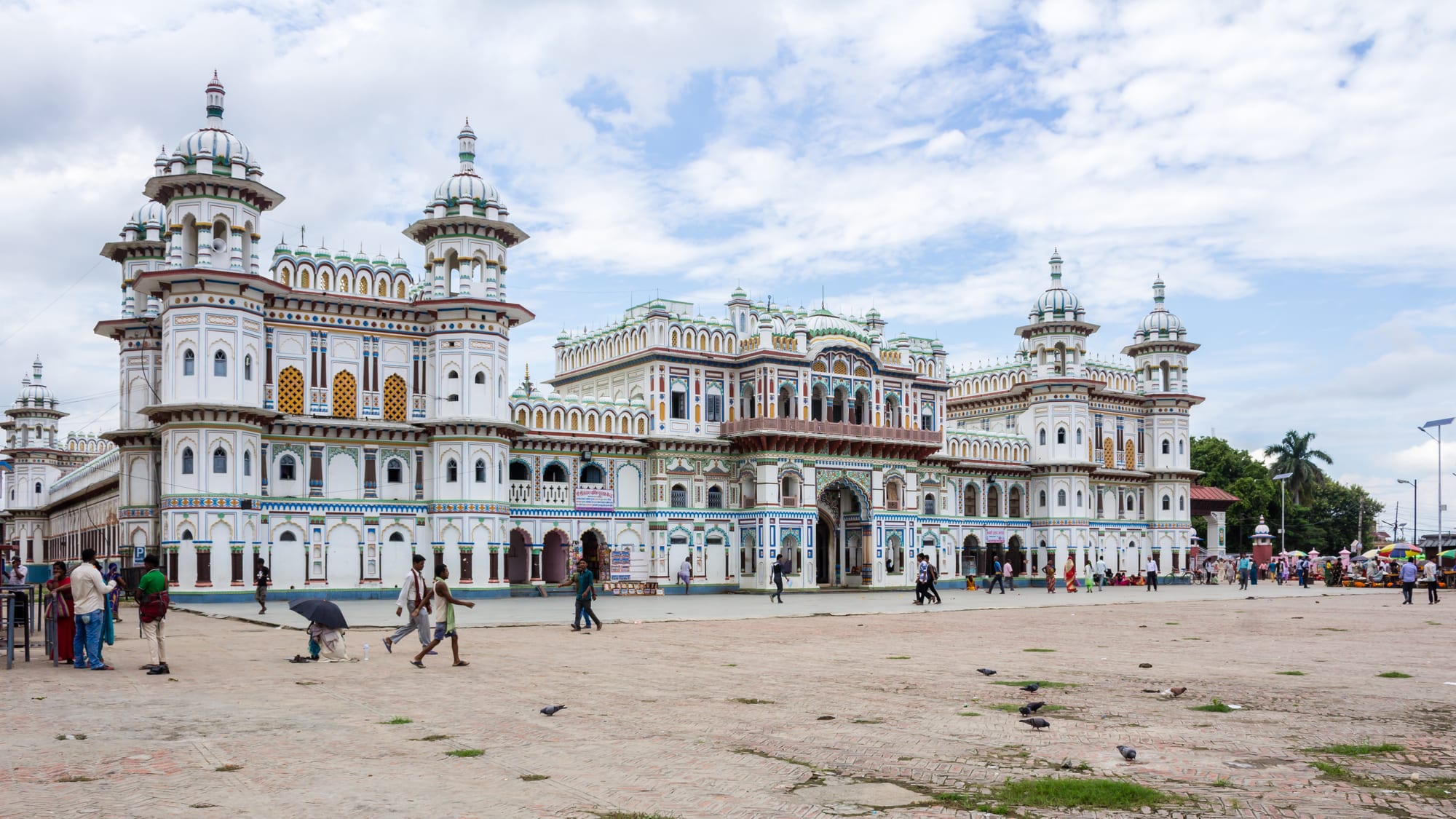
The white and pastel Janaki Mandir with its domes, arcades and corner towers rising above an open paved square with people crossing it

Kathmandu & Central Nepal, Nepal

Janakpur

The Janaki Mandir, the temple at the centre of Janakpur. (Bijay chaurasia / Wikimedia Commons · CC BY-SA 4.0)

A pilgrimage city on the flat Terai plain of southern Nepal, close to the Indian border and the capital of Madhesh Province. Hindu tradition identifies it with the kingdom of Videha and the birthplace of Sita, and the white, domed Janaki Mandir of 1910 stands at its centre among sacred ponds, temples and the Maithili-speaking markets of the plains.

Neighbourhoods

  • The Janaki Mandir quarter
    • First-time visitors
    • Pilgrims
    • Markets

    The centre of the city, where the temple faces a wide paved square ringed by stalls selling garlands, bangles, sindoor and sweets. Pilgrim lodges, small hotels and the busiest shopping lanes are all within a few minutes' walk.

    Open in Maps
  • The pond quarters
    • Historic district
    • Quiet and residential

    Janakpur is built around dozens of tanks, and the neighbourhoods take their names and shape from them. Steps lead down to the water at Dhanush Sagar and Ganga Sagar near the centre, with shrines on the banks and bathing at festival times.

    Open in Maps
  • The bazaar and station area
    • Local life
    • Close to transport

    North-east of the temple, the working city of cloth shops, grain and hardware traders, tea stalls and rickshaw stands around the old railway line to the Indian border. It is loud, flat and commercial rather than devotional.

    Open in Maps
  • The outskirts and Ramanand Chowk
    • Quiet and residential
    • Close to transport

    Newer housing, colleges, provincial government offices and the road junctions towards the airport and the East–West Highway. Hotels here are newer and further from the noise of the centre.

    Open in Maps

Things to do

Temples and sacred ponds

  • Janaki Mandirlandmark

    The city's great white temple of stone and marble, completed in 1910 by Vrisha Bhanu, queen of Orchha in central India, dedicated to Sita and the focus of pilgrimage here.

    Open in Maps
  • Ram Mandirlandmark

    A temple to Rama in the traditional Nepalese pagoda style, first built in the 17th century by Chaturbhuj Giri and rebuilt in 1782 by the Gorkhali general Amar Singh Thapa; one of the oldest temples in the city.

    Open in Maps
  • Dhanush Sagar and Ganga Sagarlandmark

    Two linked sacred tanks beside the centre, with stone steps, shrines and bathing at festivals; pilgrims circle them as part of visiting the city.

    Open in Maps

The city and its crafts

  • Janakpur railway stationtransit hub

    A station on the line that links the city with Jaynagar across the Indian border, which at its reopening in 2022 was the only passenger railway operating in Nepal.

    Open in Maps
  • Mithila paintingattraction

    The bright figurative painting tradition of the Mithila region, made by women on walls and now on paper and cloth, sold in workshops and centres around the city.

    Open in Maps

Short trips from the city

  • Dhanushadhamlandmark

    A pilgrimage site north-east of the city where a piece of stone is venerated as a fragment of the bow broken by Rama in the Ramayana.

    Open in Maps
  • Koshi Tappu Wildlife Reservepark

    A Ramsar wetland on the Koshi river east of Janakpur, known for the last wild water buffalo in Nepal and for large numbers of migratory birds.

    Open in Maps

Seasonal events

  • Vivaha PanchamiNovember or December

    The city's largest festival, marking the marriage of Rama and Sita, when a wedding procession arrives from Ayodhya in India and hundreds of thousands of pilgrims fill the temple quarter.

  • Ram NavamiMarch or April

    The birthday of Rama, celebrated with processions, readings from the Ramayana and crowds at the Janaki Mandir.

  • ChhathOctober or November

    Offerings made to the setting and rising sun from the steps of the city's ponds, one of the defining festivals of the Terai and Mithila.

  • HoliMarch

    The spring festival of colours, marked across the Terai with coloured powder, water and music through the streets.

  • Mithila Madhya ParikramaFebruary or March

    A pilgrim circuit through the villages and shrines of Mithila on both sides of the border, walked over about a fortnight and ending at the Janaki Mandir on the day of Holi.

Eat and drink

Long-standing places and food districts in Janakpur. Hours, ratings and directions come from your maps app, always current.

Mithila cooking

  • Maithili thalirestaurant

    Rice, lentils, vegetables cooked in mustard oil, fried bari, greens and a sour pickle, often with river fish, served in simple dining rooms around the temple and bazaar.

    Open in Maps
  • Litti chokharestaurant

    Baked wheat balls stuffed with roasted gram flour, eaten with a mash of roasted aubergine, tomato and potato — a dish shared with the plains of Bihar across the border.

    Open in Maps

Markets and sweets

  • The temple-square stallsmarket

    Stalls around the temple sell flower garlands, sweets and offerings alongside snacks for pilgrims — samosas, jalebi, puffed rice and cups of sweet milk tea.

    Open in Maps
  • The bazaar sweet shopsmarket

    The old market streets are known for milk sweets — thickened-milk peda, khurma and curd sold in clay pots — which pilgrims buy in quantity at festival times.

    Open in Maps

Experience Janakpur

History

Janakpur's identity rests on the Ramayana. Hindu tradition places here the capital of Videha, the kingdom of King Janaka, and makes it the home of his daughter Sita and the setting of the contest in which Rama strung and broke Shiva's bow to win her hand. The region, Mithila, was a centre of learning in the first millennium BCE, associated with the philosophical debates recorded in the Upanishads and later with Sanskrit and Maithili scholarship under the Karnat and Oiniwar rulers of Mithila.

No archaeological evidence has been found for an ancient city here: accounts from ascetics, pandits and bards place the founding of Janakpur in the early 18th century, after saints of the Ramanandi and other orders identified the site with Janaka's city. The temples and tanks that define the city largely date from that time onwards, and until the 1950s Janakpur was a cluster of hamlets working land held by the monasteries. Its best-known building, the Janaki Mandir, was completed in 1910 with money given by Vrisha Bhanu, queen of Orchha in central India, a great temple of stone and marble whose domes and arcades belong to north India rather than to Nepal.

Under Nepal's kings the town was a district centre in a region whose trade, language and family ties ran south into Bihar. A narrow-gauge railway to Jaynagar, opened in 1937 to carry freight and later passengers, connected it to the Indian network. After 2008 the Madhesi movements pressed for representation and provincial autonomy for the plains; the 2015 constitution created a province of the central plains, and in January 2022 its assembly adopted the name Madhesh and declared Janakpur the capital. The railway, closed in 2014 for conversion to broad gauge, reopened in 2022.

Culture & Customs

Janakpur is the cultural capital of Mithila, and Maithili — a language with its own literature, script tradition and a poetic canon running back to the poet Vidyapati — is what people speak at home and in the market. Nepali is the language of government and school, Hindi widely understood, and the border with Bihar is a line on a map rather than a cultural boundary.

Its best-known art form is Mithila painting, made by women who traditionally decorated the walls and floors of houses for weddings and festivals with figures of gods, fish, peacocks, lotuses and geometric borders in bright natural colours. From the 1960s the paintings moved onto paper and cloth for sale, and workshops and cooperatives around Janakpur have given many women an income and a public voice; the style is known internationally, and is shared with Madhubani in India.

Religion is the city's daily business. Sadhus in the orange of the Ramanandi order, pilgrim groups from India, temple musicians and priests keep the temples busy year round, and the ritual calendar peaks at Vivaha Panchami, when the marriage of Rama and Sita is re-enacted and a groom's procession arrives from Ayodhya. Chhath draws whole neighbourhoods to the ponds before dawn. Social life remains conservative: caste and community matter in marriage, dowry practices are a live public argument, and women in the older quarters are often seen in sarees with a covered head, even as the city's colleges fill with students in jeans.

Daily Life

About 195,000 people live in Janakpur, which has been the capital of Madhesh Province since 2022, giving it provincial ministries, offices and the politics that come with them. The surrounding Dhanusha district is flat, intensively farmed land growing rice, wheat, sugarcane, mustard and pulses, and much of the city's trade is in agricultural produce, cloth, hardware and religious goods.

The other pillars of the economy are pilgrimage, which supports lodges, priests, stalls and transport, and migration: large numbers of young men from the district work in India, the Gulf states and Malaysia, and the money they send back pays for houses, schooling and weddings. There is little industry beyond food processing and small workshops, and youth unemployment is a constant subject.

The day begins early, with temple bells, tea shops opening before sunrise and vegetables coming in from the villages by cycle and cart. Heat empties the streets in the middle of the day from April onwards, and the evening brings people back out to the pond steps and the bazaar. Rickshaws thread between motorbikes, cattle and stalls; power cuts and water supply remain unreliable in parts of the city; and monsoon flooding regularly puts low-lying wards under water. Cross-border movement to Jaynagar for shopping, medical care and family visits is routine.

Food

Janakpur eats as Mithila does, which is to say close to the food of Bihar across the border. The everyday meal is rice with daal, a vegetable curry cooked in pungent mustard oil, greens such as saag, and a sour pickle, often with fried bari, small dried lentil dumplings, and a piece of river fish, which Maithil Brahmins eat and which is regarded as auspicious at weddings.

Litti chokha is the dish visitors are most often told to try: balls of wheat dough stuffed with roasted gram flour and spices, baked over coals and crushed with a mash of roasted aubergine, tomato and potato. Chura, beaten rice, is eaten with curd and jaggery, and at Chhath households make thekua, a hard, sweet, deep-fried wheat biscuit offered to the sun. Kadhi bari, dumplings in a spiced yoghurt gravy, and tarua, vegetables fried in gram-flour batter, appear at feasts.

Sweets carry much of the city's reputation, because pilgrims buy them as offerings and as gifts to take home: peda made from thickened milk, khurma, laddu, and curd set in unglazed clay pots. Stalls around the temple square sell samosas, jalebi, chaat and puffed-rice mixtures through the day, with sweet, milky tea, and sugarcane juice and green coconut appear on carts in the hot months. Mangoes and litchis from the surrounding orchards come in from May.

Planning tools

Budget

Janakpur is one of the cheapest cities in Nepal for a visitor. Pilgrim lodges and simple hotels around the temple cost very little, meals are inexpensive, and there is no entry charge at the main temple. Prices for rooms rise sharply at Vivaha Panchami and other festivals, when the city fills beyond its capacity.

Daily Budget Midrange
USD 45–100 (better hotel on the outskirts, restaurant meals, a car with driver, a flight in from Kathmandu)
Daily Budget Shoestring
USD 15–25 (pilgrim lodge or budget hotel, thali meals, rickshaws and local buses)

Book well ahead for the days around Vivaha Panchami, when rooms across the city are taken.

Best Time to Visit

October to March is the comfortable season on the plains, with dry, warm days and cool nights; November and December bring both Chhath and Vivaha Panchami, the city at its busiest and most striking. Winter mornings are often thick with fog, which delays flights and buses. April and May are very hot, and the monsoon from June to September is humid with heavy rain and local flooding.

Suggested Number of Days

A day or two is enough at an unhurried pace. Longer stays suit visitors with an interest in the region's crafts and the villages around the city, or anyone here for a festival, when everything takes longer.

First Visit
1–2 days
With Surroundings
2–3 days

Transportation

The city is flat and small enough for cycle rickshaws, which are the usual way to move around, along with battery-powered auto-rickshaws and taxis. Buses leave for Kathmandu, Birgunj and the eastern Terai from the bus park, and the railway to Jaynagar in India runs from the station on the edge of the centre.

Agree the fare with a rickshaw driver before setting off, and expect slow going through the bazaar at festival times.

Airport & Station Connections

Janakpur Airport, just outside the centre, has short flights from Kathmandu, though winter fog causes cancellations. Buses from Kathmandu take roughly seven to nine hours over the hills and along the East–West Highway. The Indian border at Jaynagar is close to the south, reached by road or by the passenger train that runs from the city.

Walkability

The centre is flat and compact, and the temple, the main ponds and the bazaar are all within about 20 minutes on foot of each other. Walking is slowed by traffic, rickshaws, cattle and stalls rather than by distance, pavements are patchy, and the heat from April to June makes midday walking hard work.

Safety

Janakpur is generally safe for visitors, and crime against them is uncommon. The everyday risks are traffic, crowd crush at festivals, heat and mosquitoes, and occasional strikes or political demonstrations in Madhesh Province that close roads and shops at short notice. Monsoon flooding affects low-lying parts of the city and the roads around it.

Keep valuables close in festival crowds, drink treated or bottled water, use mosquito protection, and check whether a strike is called before planning road travel. Check current official travel advice before travelling.

Climate

A hot, humid lowland climate on the Gangetic plain, with a long dry winter, an intense pre-monsoon build-up and a heavy summer monsoon.

Summer
very hot and humid, often 35–40°C before the rains, with downpours and high humidity from June to September
Winter
mild days and cold, foggy mornings, roughly 8–25°C between December and February

Local Customs

This is a conservative Maithili-speaking city where religious observance shapes the day. Shoes are removed before entering temples, leather items are left outside, and modest dress covering shoulders and knees is expected, particularly for women near the shrines. Alcohol is not part of public life around the temple quarter. Nepali is understood, but Maithili is the language of the streets.

Ask before photographing worshippers, priests or women at home painting Mithila designs, and follow the queue discipline that temple staff set during festivals.

Common Payment Methods

The currency is the Nepalese rupee, and this is very much a cash city: rickshaws, stalls, lodges and sweet shops all expect notes. ATMs are available around the centre and on the main roads, and larger hotels take cards. Indian rupees circulate informally because of the border trade, though large Indian notes are often refused.