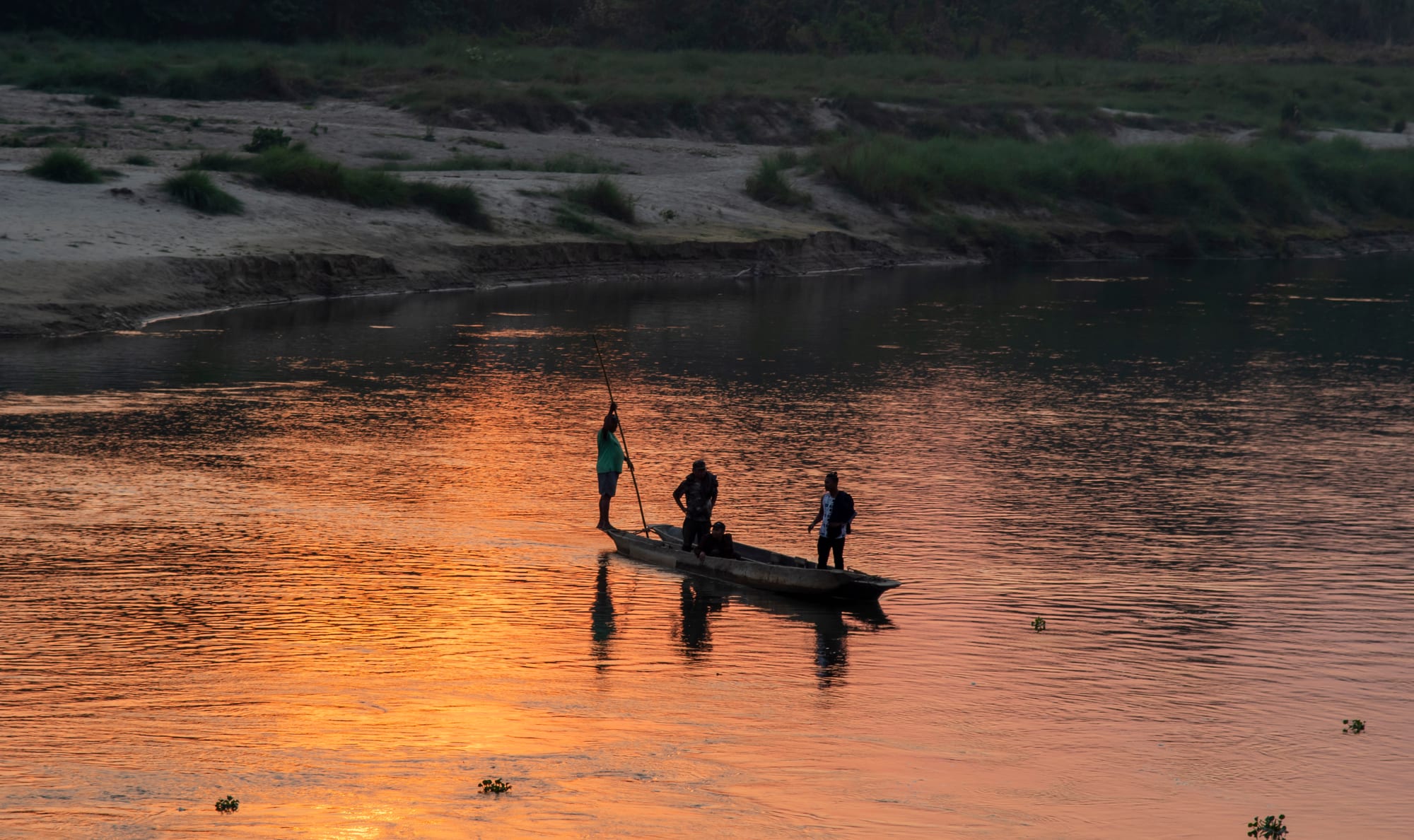
A long wooden dugout canoe being poled across the wide Rapti river at sunset, with orange light reflected on the water and sandbanks behind

Kathmandu & Central Nepal, Nepal

Sauraha

A dugout canoe crossing the Rapti river at Sauraha, on the edge of Chitwan National Park. (Supradai / Wikimedia Commons · CC BY 4.0)

A small village on the north bank of the Rapti river in the lowland Terai, facing the sal forest and grassland of Chitwan National Park. Once a farming settlement on the edge of a royal hunting reserve, it has become Nepal's main base for wildlife watching, with lodges, guides and canoe landings strung along a single sandy road to the water.

Neighbourhoods

  • The main road and the riverfront
    • First-time visitors
    • Sunset views
    • Best for food

    The single road that runs down to the Rapti, lined with lodges, guide offices, souvenir shops and restaurants, ending at the bank where canoes are pulled up. People gather on the sand in the late afternoon to watch the sun go down over the park.

    Open in Maps
  • Bachhauli and the village lanes
    • Local life
    • Quiet and residential

    The farming village behind the tourist strip, part of Ratnanagar municipality, with mud-walled Tharu houses, mustard and rice fields and buffalo on the tracks. Homestays and smaller guesthouses sit among the fields.

    Open in Maps
  • The eastern lodge belt
    • Quiet and residential
    • Birdwatching

    Larger lodges and resorts set in gardens along the river east of the centre, some with their own stretch of bank. It is quieter than the main road and closer to the community forest, though further from the shops.

    Open in Maps

Things to do

The park and the river

  • Chitwan National Parkpark

    Nepal's first national park and a UNESCO World Heritage Site, protecting sal forest, riverine grassland and the country's main population of greater one-horned rhinoceros, along with Bengal tigers, sloth bears, gaur and more than 500 bird species.

    Open in Maps
  • Rapti Riverattraction

    The river forming the park's northern boundary at Sauraha, crossed by dugout canoe and used for wildlife watching, with gharial and mugger crocodiles on the sandbanks.

    Open in Maps
  • Beeshazar Talattraction

    A system of oxbow lakes in the park's buffer zone, a Ramsar site since 2003 and rich in birdlife, reached from the road towards Bharatpur.

    Open in Maps

Short trips from the village

  • Parsa National Parkpark

    The adjoining protected area to the east, drier and much less visited, with sal forest, elephants and tigers moving between the two parks.

    Open in Maps
  • Bharatpurneighborhood

    The nearest city, about 15 kilometres north-west, with the regional airport, hospitals, markets and the bus links to Kathmandu and Pokhara.

    Open in Maps
  • Devghatlandmark

    A Hindu pilgrimage settlement at the confluence of the Kali Gandaki and Trishuli rivers, north-west of the park, with temples, ashrams and cremation ghats.

    Open in Maps

Seasonal events

  • MaghiJanuary

    The Tharu new year, marked with feasting, dancing, visits between households and, traditionally, decisions about the year's work.

  • DashainSeptember or October

    Nepal's longest festival, when the village slows down, families gather and lodge staff return to their home districts.

  • TiharOctober or November

    The festival of lights, with lamps and marigolds on village houses and groups going door to door singing at night.

  • HoliMarch

    The spring festival of colours, with coloured powder and water through the village lanes.

Eat and drink

Long-standing places and food districts in Sauraha. Hours, ratings and directions come from your maps app, always current.

Tharu and Nepali cooking

  • Tharu kitchensrestaurant

    Local dishes served in village homestays and a few restaurants — ghonghi, river snails simmered in a spiced broth and sucked from the shell, dhikri, steamed rice-flour dumplings, and fiery chutneys ground on stone.

    Open in Maps
  • Daal bhaatrestaurant

    Rice, lentils, vegetable curry and pickle, the standard meal in every lodge and roadside kitchen, often with river fish in the Terai version.

    Open in Maps

Along the main road

  • The riverfront restaurantsneighborhood

    Open-sided restaurants and bars at the bottom of the main road, serving Nepali food, momos and Western dishes to lodge guests, busiest around sunset.

    Open in Maps
  • Village tea shopscafe

    Small shops in the lanes behind the strip selling milk tea, samosas, sel roti and sweets to farmers and guides through the day.

    Open in Maps

Experience Sauraha

History

The Chitwan valley was for centuries a place people avoided. Dense sal forest and grassland along the Rapti and Narayani rivers carried malaria so severe that the hill population regarded the inner Terai as deadly for much of the year, and it was the Tharu, long resident here and with a degree of inherited resistance, who farmed and fished its edges. The forest suited the rulers in Kathmandu: from the 19th century the Rana prime ministers kept Chitwan as a private hunting reserve, bringing viceroys and royal guests on elephant-back shoots that killed tigers and rhinos in large numbers.

Malaria control in the 1950s and 1960s, backed by international programmes, changed everything. Settlers came down from the hills, cleared forest for rice and mustard, and the valley's population multiplied within a generation; rhino numbers collapsed under the pressure of poaching and lost habitat. In response a protected area was declared, and in 1973 Chitwan became Nepal's first national park, with an army presence to guard it. It was inscribed as a UNESCO World Heritage Site in 1984.

Sauraha, a small farming settlement of the Bachhauli area on the north bank of the Rapti, happened to sit at a convenient crossing point opposite the park. Lodges and guide services grew along its road from the 1980s as wildlife tourism developed, slowly at first and then quickly. Community forests on the village side were handed to local user groups, and buffer-zone rules directed a share of park income back to the villages. The conflict of the Maoist years and later crises interrupted the trade more than once, and anti-poaching patrols, first raised when rhino numbers fell to a few dozen, remain central to the park's management.

Culture & Customs

The older culture here is Tharu. Their villages are built of mud and timber with long ridged roofs, the outer walls sometimes decorated with patterns pressed into the clay, and grain stored in woven bins inside. Tharu families traditionally fished the rivers, gathered from the forest and farmed rice, and their calendar peaks at Maghi in January, the new year, with feasting, visits and dancing. The stick dance, performed in lines to drums with the sticks struck together, is the best known of several dances now shown to visitors as well as at village celebrations.

Since the 1960s the valley has also become mixed. Brahmin, Chhetri, Gurung, Magar and Newar families came down from the hills and brought their festivals with them, so Dashain, Tihar and Holi are all kept here, and the village looks towards Bharatpur for schools, hospitals and politics. Nepali is the common language, Tharu the household one in many homes.

Tourism has shaped manners in the village. Guiding is a respected local profession, often passed between relatives, and many guides are naturalists with long experience of the park. Elephants, once central to both the royal hunts and early tourism, are now a subject of debate: riding has fallen away as visitors and operators turn to jeeps, walks and canoes, and captive-elephant welfare is discussed openly. Visitors are a normal part of village life, but the settlements behind the strip remain conservative, and people dress and behave accordingly.

Daily Life

Sauraha is a village of a few thousand people within Ratnanagar municipality, and the surrounding Chitwan district is one of the most densely settled parts of the Terai, with Bharatpur — one of Nepal's larger cities — as its centre. Two economies run side by side here: farming, with rice in the monsoon, mustard, maize and vegetables in the dry months, and buffalo kept for milk; and tourism, which employs guides, drivers, cooks, cleaners and boatmen, mostly from the surrounding villages.

The day starts before dawn, because that is when wildlife moves and when the fields are cool. Jeeps and walking groups leave at first light, return by mid-morning, and the village is quiet through the hot middle of the day; activity picks up again in the late afternoon, when canoes go out and people walk to the riverbank for sunset. Lodges fill in the October-to-March season and much of the village works short hours in the monsoon, when some businesses close.

Living beside a national park has costs. Rhinos and deer raid crops, elephants damage houses, and people are killed or injured in encounters in most years; buffer-zone committees run electric fences, compensation schemes and community forests to manage it. Electricity, mobile coverage and a good road link have all arrived in recent decades, and many households also depend on money sent home by relatives working in the Gulf, Malaysia or India.

Food

Everyday eating is daal bhaat: rice with lentil soup, a seasonal vegetable curry, greens and pickle, eaten twice a day and served in every lodge and roadside kitchen. On the Terai the pickles are hot, mustard oil is the usual cooking fat, and river fish appears often.

Tharu cooking is the local specialism and worth seeking out. Ghonghi, freshwater snails cooked in a spiced broth and sucked straight from the shell, is its best-known dish; dhikri are steamed rice-flour dumplings, sometimes shaped by hand into long twists, eaten with chutney; sidhara and sukuti use dried fish and dried meat pounded with spices. Chutneys ground with chilli, garlic, tomato and sesame on a stone slab accompany almost everything, and the traditional home-brewed rice beer is made for festivals.

Visitor food in the village follows Nepal's tourist pattern: momos, chow mein, fried rice, curries, and Western dishes at the riverfront restaurants. Tea shops in the lanes sell milk tea, samosas and pakauda, and sel roti, the sweet fried rice-flour ring, appears around festivals. The Terai's summer fruit — mangoes, litchis and jackfruit — is sold by the roadside, and sugarcane juice is pressed on carts at Tandi Bazaar and along the highway.

Planning tools

Budget

Sauraha is one of the cheaper places in Nepal to sleep and eat, but the park is a fixed cost: foreign visitors pay a daily national park entry permit, and activities such as jeep drives, canoe trips and guided walks are charged separately or bundled into lodge packages. Guides must be hired for anything inside the park.

Daily Budget Midrange
USD 45–100 (river-view lodge, restaurant meals, a package of park permits, jeep drive and guided walk)
Daily Budget Shoestring
USD 15–25 (guesthouse or homestay, daal bhaat, a shared jeep or canoe trip, tourist bus in)

Compare what a lodge package includes — permit, guide, jeep or canoe — against booking each activity separately through a licensed guide.

Best Time to Visit

October to March is the main season, with dry days, mild temperatures and good wildlife watching. February to April is the best time to see animals: the tall elephant grass is cut and burned in the dry season and sightlines open up, though April heat builds quickly. The monsoon from June to September is hot, humid and leech-ridden, and some park routes close as rivers rise.

Suggested Number of Days

Most visitors stay two or three nights, which allows for both an early morning and a late afternoon in the park. A longer stay suits birdwatchers and anyone wanting to spend time in the villages rather than only in the park.

First Visit
2–3 days
With Surroundings
3–4 days

Transportation

The village is small enough to walk, and bicycles are rented everywhere. Jeeps run wildlife drives inside the park, dugout canoes cross the Rapti and drift downstream, and shared jeeps and buses connect the village with Bharatpur and the East–West Highway. Anything inside the park must be done with a licensed guide.

Cycling on the roads around the village is easy and flat, but the tracks turn to mud in the monsoon.

Airport & Station Connections

Tourist buses run daily from Kathmandu and Pokhara to Sauraha in roughly five to seven hours, dropping passengers on the edge of the village. The nearest airport is at Bharatpur, about 20 to 30 minutes away by road, with short flights from Kathmandu. Drivers from the East–West Highway turn off at Tandi Bazaar, a few kilometres north.

Walkability

The village itself is entirely walkable — the main road from the bus stop to the riverbank takes about 15 minutes — and the surrounding lanes and fields are flat and quiet. There are few pavements and the road is dusty or muddy by season. Walking into the park is only permitted with a licensed guide.

Safety

Sauraha is a safe village with very little crime, and the real risks are wild animals. Rhinos graze on the community-forest edges and sometimes cross into the village at night, and elephants, sloth bears and, occasionally, tigers are present in the area; people are injured in encounters most years. Crocodiles live in the Rapti, and the river runs high and fast in the monsoon.

Keep a wide distance from rhinos and elephants, never walk alone near the riverbank or forest after dark, use a torch at night, and follow the guide's instructions in the park. Check current official travel advice before travelling.

Climate

Subtropical lowland climate on the Terai plain, roughly 200 metres above sea level, with a hot pre-monsoon build-up, a heavy summer monsoon and a cool, foggy winter.

Summer
hot and humid, often 35–40°C before the rains, with heavy monsoon downpours from June to September
Winter
mild sunny days and cold, foggy mornings, roughly 8–25°C

Local Customs

The area is largely Tharu, with their own language, dress and house style, alongside hill communities who settled after malaria was eradicated. Village life is conservative: modest clothing away from lodge grounds is expected, and swimming in the river is not a local habit and is dangerous. Shoes come off indoors and at shrines.

Ask before photographing people, their houses or Tharu dances; tipping guides, drivers and lodge staff is customary, and elephant rides are avoided by many visitors on welfare grounds.

Common Payment Methods

The currency is the Nepalese rupee, and cash runs the village. Lodges and larger agencies may take cards, sometimes with a surcharge, but guides, small restaurants, shops and bicycle rentals do not. There are ATMs in the village and more reliable ones in Bharatpur, and park permits are paid in cash.