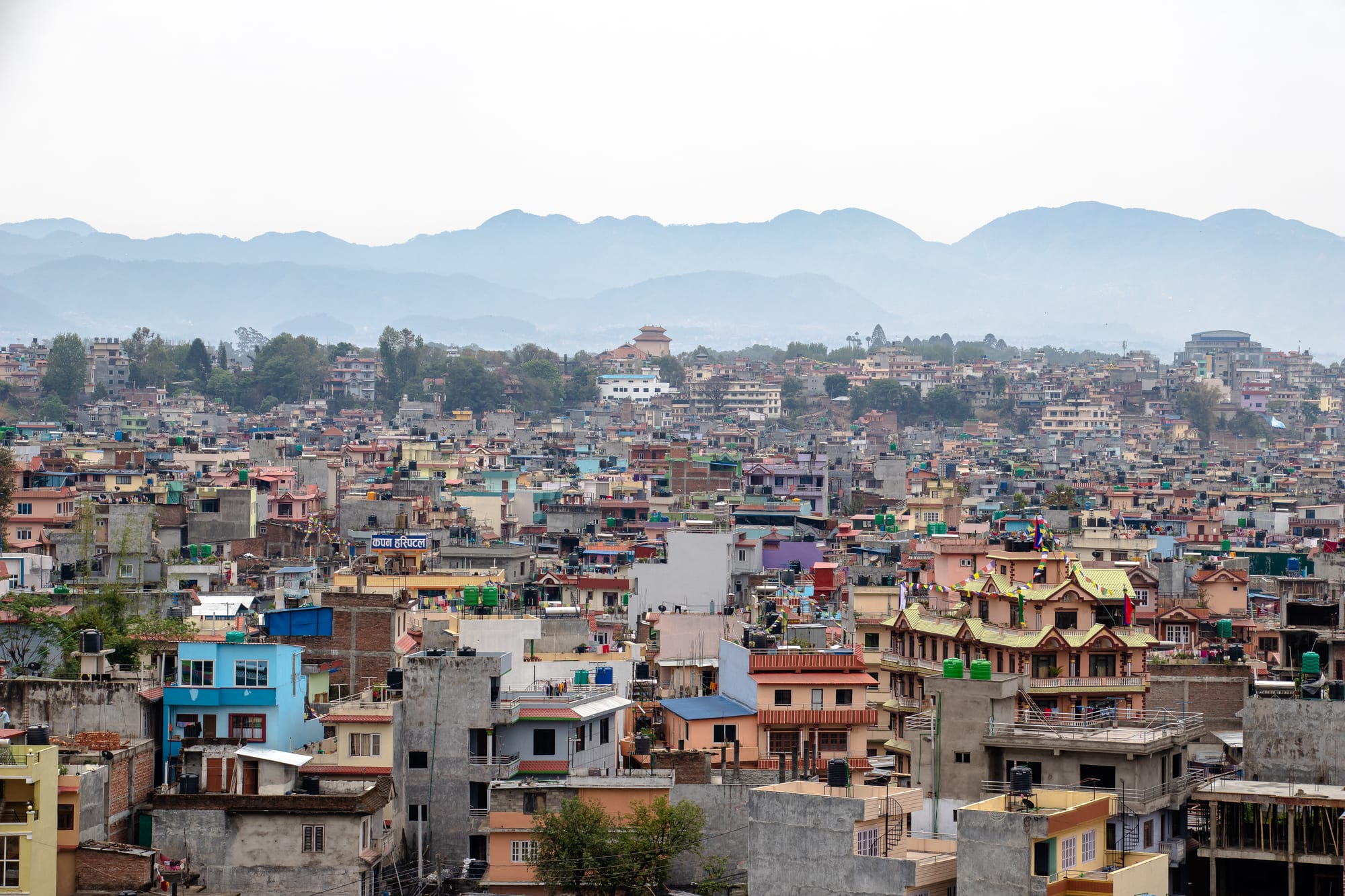
Densely packed pastel-coloured houses and rooftops of Kathmandu filling a valley, with hazy blue ridges behind

Kathmandu & Central Nepal, Nepal

Kathmandu

Kathmandu's rooftops spreading across the valley floor towards the surrounding hills. (Bijay Chaurasia / Wikimedia Commons · CC BY-SA 4.0)

Nepal's capital and largest city, spread across a bowl-shaped valley at about 1,400 metres in the Himalayan foothills. A Malla royal capital of pagoda temples and carved brick courtyards, it grew after 1950 into a crowded modern city of traffic, concrete and building sites, where Hindu and Buddhist shrines still stand at almost every street corner and trekkers gather in Thamel.

Neighbourhoods

  • Thamel
    • First-time visitors
    • Trekking gear and agencies
    • Nightlife

    The tourist quarter north-west of the old city, a grid of narrow lanes packed with guesthouses, trekking-equipment shops, bookshops, bars and restaurants. Most visitors sleep here, and the trekking agencies and permit runners work from the same streets. It is noisy, commercial and easy to navigate on foot.

    Open in Maps
  • The old bazaars around Asan and Indra Chowk
    • Local life
    • Markets
    • Historic district

    The trading heart of the old city, where six lanes meet at Asan and spice, cloth, bead and brassware sellers fill the ground floors of Newar houses. Shrines and sunken water spouts sit in the middle of the crowds, and the streets run on towards Durbar Square.

    Open in Maps
  • Durbar Marg and Kantipath
    • Hotels and restaurants
    • Close to transport

    The broad avenue running south from the former royal palace, lined with airline offices, banks, larger hotels and some of the city's more expensive restaurants. It is the closest Kathmandu has to a formal downtown, and quieter than Thamel a few minutes away.

    Open in Maps
  • Boudha
    • Buddhist culture
    • Quiet and residential
    • Best for food

    The Tibetan Buddhist quarter in the north-east, built in rings around the great white stupa. Monasteries, thangka workshops and Tibetan restaurants surround it, and pilgrims circle the dome at dawn and dusk. It feels calmer and more self-contained than the centre.

    Open in Maps
  • Lazimpat
    • Quiet and residential
    • Embassies and hotels

    A leafy diplomatic district north of the palace, with embassies, older hotels, cafés and shops set back from the road. It is a short walk or taxi ride from Thamel and popular with long-staying foreign residents.

    Open in Maps
  • Patan
    • Arts and culture
    • Historic district
    • Cafés

    The old city of Lalitpur, across the Bagmati river and now joined to Kathmandu by continuous building. Its Durbar Square, museum and courtyards hold the valley's finest metalwork and woodcarving, and the Jhamsikhel area south of it is known for cafés and restaurants.

    Open in Maps

Things to do

Temples and stupas

  • Kathmandu Durbar Squarelandmark

    The old royal palace complex of Hanuman Dhoka with dozens of temples around it, a UNESCO World Heritage Site and the ceremonial centre of the city.

    Open in Maps
  • Swayambhunathlandmark

    An ancient stupa on a wooded hill west of the centre, reached by a long stairway, with painted eyes on its tower, resident monkeys and a wide view over the valley.

    Open in Maps
  • Boudhanathlandmark

    One of the largest stupas in the world, the focus of Tibetan Buddhist life in Nepal, circled clockwise by pilgrims turning prayer wheels.

    Open in Maps
  • Pashupatinath Templelandmark

    One of Hinduism's holiest sites, on the Bagmati river, with cremation ghats on the bank and sadhus in the surrounding compound; non-Hindus may not enter the temple itself and see it from across the water.

    Open in Maps
  • Kumari Gharlandmark

    The carved brick house on Durbar Square where the Kumari, a young girl worshipped as a living goddess, appears at a window above the courtyard.

    Open in Maps
  • Budhanilkantha Templelandmark

    On the northern edge of the valley, a large stone image of Vishnu reclining on a bed of serpents in a water tank, carved from a single block.

    Open in Maps

Museums and palaces

  • Narayanhiti Palace Museummuseum

    The royal palace until the monarchy was abolished in 2008, now a museum; the site of the 2001 massacre of the royal family.

    Open in Maps
  • National Museum of Nepalmuseum

    The country's oldest museum, at Chhauni near Swayambhunath, with galleries of sculpture, Buddhist art, weapons and natural history.

    Open in Maps
  • Garden of Dreamspark

    A restored early 20th-century neo-classical garden of pavilions, ponds and lawns beside Thamel, built by a Rana field marshal.

    Open in Maps
  • Patan Museummuseum

    In a wing of the old palace on Patan Durbar Square, a well-regarded collection of Hindu and Buddhist bronzes explaining the valley's religious art.

    Open in Maps

Walks and viewpoints

  • Shivapuri Nagarjun National Parkpark

    Forested hills wrapping the northern side of the valley, with walking trails to Shivapuri peak, at 2,732 metres, and the Nagi Gompa hermitage.

    Open in Maps
  • Kopan Monasteryattraction

    A Tibetan Buddhist monastery on a hill above Boudha, known internationally for its meditation courses, with views back over the city.

    Open in Maps
  • Rani Pokharilandmark

    A large 17th-century artificial pond in the centre of the city with a white shrine on an island, rebuilt after earthquake damage.

    Open in Maps

Squares and streets of the old city

  • Patan Durbar Squarelandmark

    The most harmonious of the valley's three royal squares, across the river in Lalitpur, with the Krishna Mandir in carved stone and the old palace courtyards.

    Open in Maps
  • Golden Templelandmark

    A gilded Buddhist monastery courtyard in the lanes of Patan, founded in the 12th century and still run by local families.

    Open in Maps
  • Indra Chowkmarket

    A busy junction in the old bazaar where bead sellers, cloth merchants and the Akash Bhairab temple sit above the crowds.

    Open in Maps
  • Asonmarket

    The city's main spice and grain market, a six-way crossroads that has been a trading point on the route to Tibet for centuries.

    Open in Maps

Short trips from the city

  • Bhaktapurneighborhood

    The best-preserved of the three Malla cities, about 13 kilometres east, with brick squares, the five-roofed Nyatapola temple and working potters' yards.

    Open in Maps
  • Changu Narayanlandmark

    A hilltop temple north of Bhaktapur, one of the oldest in the valley, with Licchavi-era stone sculpture and a 5th-century inscription.

    Open in Maps
  • Nagarkotviewpoint

    A ridge village on the eastern rim at about 2,200 metres, visited for sunrise views along the Himalayan range.

    Open in Maps
  • Dakshinkalilandmark

    A temple to the goddess Kali in a gorge south of the valley, where animals are sacrificed to the goddess, above all during Dashain.

    Open in Maps

Seasonal events

  • Indra JatraSeptember

    The city's great street festival, when the Kumari is pulled around the old quarters in a chariot and masked dances are performed on Durbar Square.

  • DashainSeptember or October

    Nepal's longest festival, a fortnight of family gatherings, temple offerings and animal sacrifice, when much of Kathmandu empties for ancestral villages.

  • TiharOctober or November

    The festival of lights, when oil lamps and marigold garlands cover doorways and crows, dogs and cows are honoured on successive days.

  • Buddha JayantiApril or May

    The Buddha's birthday, marked with processions and butter lamps at Swayambhunath and Boudhanath.

  • Gai JatraAugust or September

    A Newar festival for the year's dead, with cow processions, costumed children and satirical performances in the old city.

  • LosarFebruary or March

    Tibetan new year, celebrated most visibly at Boudhanath with masked dances, new prayer flags and crowds of Tibetan and Sherpa families.

Eat and drink

Long-standing places and food districts in Kathmandu. Hours, ratings and directions come from your maps app, always current.

Kathmandu classics

  • Momorestaurant

    Steamed or fried dumplings filled with buffalo, chicken or vegetables and served with a tomato and sesame sauce, sold everywhere from street stalls to sit-down restaurants.

    Open in Maps
  • Newar diningrestaurant

    Beaten rice with grilled buffalo choila, lentil patties and black soybeans, eaten in old-city bhojanalaya rooms and in restaurants around Patan.

    Open in Maps
  • Daal bhaatrestaurant

    Rice with lentil soup, curried vegetables and pickle, the standard Nepali meal, refilled until diners stop eating.

    Open in Maps

Food districts and markets

  • Asan marketmarket

    The old city's spice, grain and vegetable market, with sacks of chillies and lentils, sweet shops and juice stalls around the crossroads.

    Open in Maps
  • Thamelneighborhood

    The largest concentration of restaurants in the country, running from Nepali and Newar kitchens to Tibetan, Indian, Korean and Italian cooking, with rooftop bars and live-music venues.

    Open in Maps
  • Boudhaneighborhood

    Tibetan and Himalayan food around the stupa — thukpa noodle soup, thenthuk, butter tea and sweet milk tea in rooftop cafés looking onto the dome.

    Open in Maps
  • Jhamsikhelneighborhood

    A street of cafés, bakeries and restaurants in southern Patan, popular with the city's foreign residents and younger Nepalis.

    Open in Maps

Experience Kathmandu

History

Settlement in the Kathmandu Valley is ancient, and the Licchavi kings who ruled from about the 5th century left stone inscriptions, water spouts and temples that still stand. The city itself takes its name from Kasthamandap, a wooden pavilion beside Durbar Square said to have been built from the timber of a single tree; it collapsed in the 2015 earthquake and has since been rebuilt. Its position mattered: Kathmandu sat on the trade route between the Gangetic plain and Tibet, and the customs and carrying trade paid for its temples.

Under the Malla dynasty the valley split into three rival kingdoms, Kathmandu, Patan and Bhaktapur, whose kings spent the 17th and 18th centuries competing in architecture. Most of what fills Kathmandu's Durbar Square — the palace of Hanuman Dhoka, the Taleju temple, the house of the Kumari — dates from that contest. In 1768 Prithvi Narayan Shah of Gorkha took the city during the Indra Jatra festival, and Kathmandu became the capital of a unified Nepal.

From 1846 the Rana family ruled as hereditary prime ministers, keeping the kings as figureheads and the country largely closed; they built white neo-classical palaces around the old city. The Ranas fell in 1951, the country opened, and the population grew quickly as migrants arrived from the hills. Kathmandu was the stage for the people's movements of 1990 and 2006, the 2001 palace massacre and the abolition of the monarchy in 2008. The earthquake of April 2015 killed thousands in the valley and brought down temples and towers, including the Dharahara; rebuilding has reshaped much of the historic centre.

Culture & Customs

Kathmandu is the historic city of the Newars, and their culture still sets its shape: courtyard houses around a shrine, carved wooden windows, guilds of metal-casters and woodcarvers, and the guthi trusts that maintain temples and fund festivals. Nepal Bhasa is spoken alongside Nepali, and Newar ritual is woven into the street plan, with stone spouts, chaitya shrines and processional routes running through the oldest quarters.

Hinduism and Buddhism are practised side by side and often by the same families. Deities are shared, the Kumari is worshipped by both communities, and the calendar is crowded enough that it is unusual to spend a week in the city without meeting a procession. Indra Jatra fills Durbar Square with masked dancers, Gai Jatra turns mourning into satire, and Dashain and Tihar empty the offices for days.

Since 1951 the city has also become the meeting point for the whole country. Tamang, Sherpa, Tharu, Madhesi and Tibetan communities all have neighbourhoods and restaurants here; Boudha is the centre of Tibetan exile life in Nepal, with its monasteries and thangka schools. A young urban culture has grown alongside the old one, with Nepali rock and hip hop, film, bookshops, literary festivals and a large art scene, much of it working in the space between traditional craft and contemporary practice. Manners remain formal: elders are greeted first, feet are kept away from people and shrines, and the left hand is not used to give or receive.

Daily Life

About 850,000 people live in Kathmandu proper, and the valley as a whole holds several million across the merged cities of Kathmandu, Lalitpur and Bhaktapur. Growth has been fast and largely unplanned: rice fields on the valley floor have become concrete housing within a generation, and the city now runs up the surrounding slopes. Water supply, waste and the Bagmati river's pollution are long-running problems, as is the winter haze produced by traffic, brick kilns and dust.

The economy is built on government and its agencies, banking, NGOs and development organisations, tourism and the trekking trade, plus carpet and handicraft workshops and a growing technology and outsourcing sector. Remittances from Nepalis working in the Gulf, Malaysia, India and elsewhere support many households and much of the building work. Office hours start early, and the working week runs Sunday to Friday.

Days begin before dawn with temple visits, bell ringing and milk tea; by mid-morning traffic is solid on the ring road and the main arteries. Middle-class families live in new blocks in areas such as Baneshwor, Chabahil and the ring-road suburbs, while the old city's courtyard houses hold long-settled Newar families and a great many small shops. Political demonstrations and strikes are part of the city's routine, and the protests of September 2025, which damaged government buildings and forced the prime minister to resign, were felt across the city.

Food

Momos are the city's universal food: dumplings of minced buffalo, chicken or vegetables, steamed or fried and dipped in a spiced tomato and sesame achar, eaten at office lunch breaks and late at night. The everyday meal is daal bhaat — rice, lentil soup, seasonal vegetable curry, greens and pickle, with meat on some days — served on a steel plate and refilled without charge.

The valley's own cuisine is Newar, and it is eaten in small dining rooms in the old city and at family feasts. It is built around baji, beaten rice, with choila, buffalo meat grilled over straw and dressed with mustard oil and chilli; wo, fried lentil patties; sanya khuna, a fish aspic; bhutan and other spiced offal; and roasted black soybeans. Kwati, a soup of nine sprouted beans, is eaten at the festival of Janai Purnima, and yomari, rice-flour dumplings filled with molasses and sesame, belong to midwinter. Aila, a home-distilled spirit, and thwon, rice beer, accompany them.

Tibetan food is easy to find, especially around Boudha, where thukpa noodle soup, thenthuk and butter tea are standard, and Indian, Chinese and Korean restaurants are common. Bakeries and cafés multiplied with tourism, and Nepali coffee from the hills has a following. Street food runs to sel roti, a sweet rice-flour ring fried in oil, chatpate and panipuri from carts, and the sweet shops of Asan sell milk-based sweets, especially at festival time. Juju dhau, the sweet clay-pot yoghurt of Bhaktapur, is sold in the city too.

Planning tools

Budget

Kathmandu is inexpensive by international standards, and the main costs are the hotel and the separate foreigners' entry fees charged at each of the valley's heritage sites. Thamel has dormitories and simple guesthouses; Durbar Marg, Lazimpat and Boudha have comfortable hotels. Trekking gear, permits and agency fees are the other large item for anyone heading into the mountains.

Daily Budget Midrange
USD 45–100 (boutique or business hotel, restaurant meals, site entry fees, taxis and ride-hailing)
Daily Budget Shoestring
USD 15–25 (Thamel guesthouse, daal bhaat and momos, local buses and shared taxis)

Carry small rupee notes for temple entry fees and taxis, and agree a taxi fare before setting off or use a ride-hailing app.

Best Time to Visit

October and November are the clearest and most festive months, with dry air, mountain views from the valley rim and Dashain and Tihar falling in the season. March and April are warm and green, with spring festivals. Winter days are sunny but mornings are cold and hazy, and the monsoon from June to September brings heavy afternoon rain and muddy streets.

Suggested Number of Days

Three or four days covers the city itself. Allow five to seven to include the rest of the valley. Traffic makes short distances slow, so most visitors get through less in a day than the map suggests.

First Visit
3–4 days
With Surroundings
5–7 days

Transportation

Taxis and ride-hailing apps are the usual way to move around, along with cheap and very crowded microbuses and minibuses on fixed routes. There is no metro or tram, and traffic in the centre is slow and congested. Many visitors walk within the old city and Thamel and take a taxi between districts. Motorbikes dominate the roads, and cycle rickshaws still work the old bazaar lanes.

Air pollution can be heavy in the dry winter months, when many residents wear masks in traffic.

Airport & Station Connections

Tribhuvan International Airport, Nepal's main gateway, is a few kilometres east of the centre — usually 30 to 60 minutes by taxi depending on traffic. Flights arrive from India, the Gulf, South-East Asia and China, and domestic flights fan out to Pokhara, Lukla, Bharatpur and the Terai. Long-distance and tourist buses run from the city to Pokhara, Chitwan and the Indian border crossings.

Walkability

The old city, Thamel, Durbar Square and the bazaar lanes are best seen on foot and are close together, but walking is hard work: pavements are broken or missing, traffic pushes into every gap, and dust is heavy in the dry season. Boudha, Swayambhunath and Patan are each a taxi ride from the centre, though pleasant to walk around once there.

Safety

Kathmandu is generally safe for visitors, and violent crime against them is rare. The practical risks are road traffic, air pollution, pickpockets and bag-snatching in crowded parts of Thamel and the bazaars, and occasional strikes or street protests that close roads at short notice. The valley lies in a major earthquake zone, as the 2015 earthquake showed.

Keep valuables out of sight in crowded lanes, avoid political demonstrations, and check where the exits are in older buildings. Check current official travel advice before travelling.

Climate

The valley sits at about 1,400 metres, which gives it a milder climate than the plains below. Winters are sunny by day and cold at night, spring is warm and dusty, and the summer monsoon from June to September brings most of the year's rain.

Summer
warm and wet, typically 20–30°C, with heavy afternoon and evening rain from June to September
Winter
cold mornings and mild sunny afternoons, roughly 2–20°C, with fog and haze and no snow on the valley floor

Local Customs

Shoes are removed before entering temples and homes, and leather items are not taken into some Hindu shrines. Stupas and shrines are walked around clockwise. Non-Hindus may not enter the temple at Pashupatinath, and see it from across the river. Modest dress is expected at religious sites, and public displays of affection are uncommon. Greetings are made with palms together and the word namaste; the right hand is used for eating and giving.

Ask before photographing people, cremations at Pashupatinath or monks at prayer; tipping is not obligatory but is usual for guides, porters and in tourist restaurants.

Common Payment Methods

The currency is the Nepalese rupee. Cash is used for most everyday purchases, and small notes are needed for taxis, temple fees and markets. ATMs are common in Thamel, Durbar Marg and Lazimpat but usually charge a fee and have low withdrawal limits. Hotels, larger restaurants and trekking agencies take cards; small shops and street food do not. Indian rupees are accepted in some places, though large denominations are not.