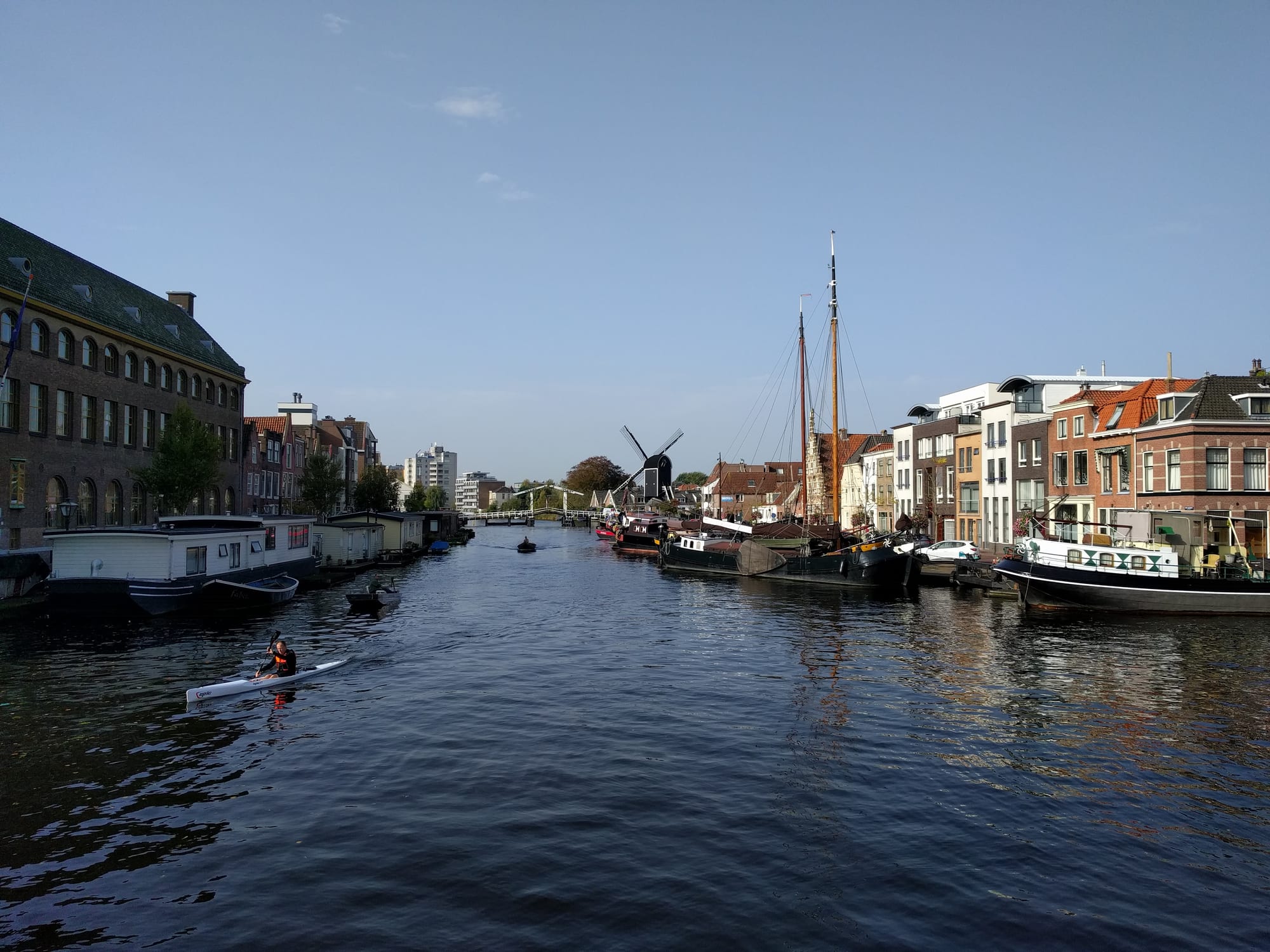
A wide canal lined with houseboats and old sailing barges, a black windmill and a drawbridge in the distance

Rotterdam, The Hague & South Holland, Netherlands

Leiden

The Kort Galgewater in Leiden, where the canals meet, with a windmill and bridge beyond. (Rudolphous / Wikimedia Commons · CC BY-SA 4.0)

A university city on the Oude Rijn between The Hague and Amsterdam, home since 1575 to the oldest university in the Netherlands. A Golden Age cloth town and Rembrandt's birthplace, it keeps one of the largest 17th-century centres in the country, with canals, almshouse courtyards, national museums of antiquities and natural history, and a large student population.

Neighbourhoods

  • Historic centre and the Breestraat
    • First-time visitors
    • Shopping
    • Historic district

    The heart of the old town between the two arms of the Rhine, along the Breestraat with the City Hall's Renaissance façade and the Gemeenlandshuis van Rijnland. The Burcht on its mound, the Hooglandse Kerk and the streets between the Oude and Nieuwe Rijn are close by, and many of the city's 35 hofjes hide behind its façades.

    Open in Maps
  • Rapenburg and the university quarter
    • Architecture
    • Museums
    • Students

    The city's best-known canal, where the Academy Building of the university stands with the Hortus Botanicus behind it. Golden Age mansions line the water, the Pieterskerk lies in the lanes nearby, and a cultural festival takes over the canal in late August.

    Open in Maps
  • Galgewater and the west side
    • Canals
    • Photography
    • Quiet walks

    The western edge of the old town where the canals recombine, with a windmill, the Morspoort city gate, a small park and a wooden bridge, by the Weddesteeg.

    Open in Maps
  • Leidse Hout
    • Parks
    • Families
    • Quiet and residential

    A public park about 1.5 kilometres north-west of the centre on the border with Oegstgeest, opened in 1931, with a tea house, a deer park and a music pavilion.

    Open in Maps

Things to do

Museums

  • Rijksmuseum van Oudhedenmuseum

    The national archaeological museum, focused on ancient Egypt, the Near East, Greece, Etruria and Rome and the early Netherlands; an original Egyptian temple, the Temple of Taffeh, stands in its central hall.

    Open in Maps
  • Naturalis Biodiversity Centermuseum

    The national museum of natural history and biodiversity research centre, with a collection of about 42 million specimens, named European Museum of the Year in 2021.

    Open in Maps
  • Museum De Lakenhalmuseum

    The city museum of fine art and history, founded in 1874, with early works by Rembrandt, Lucas van Leyden's Last Judgement and classics of De Stijl, the movement founded in Leiden.

    Open in Maps
  • Rijksmuseum Boerhaavemuseum

    The museum of the history of science and medicine in a former convent, with a reconstructed anatomical theatre and the apparatus with which Heike Kamerlingh Onnes first liquefied helium.

    Open in Maps
  • Wereldmuseum Leidenmuseum

    The ethnographic museum long known as Museum Volkenkunde, now part of the National Museum of World Cultures, whose origins lie partly in the objects Philipp Franz von Siebold brought back from Japan.

    Open in Maps
  • Japan Museum SieboldHuismuseum

    A house on the Rapenburg displaying the maps, plants, animals, tools and art that Siebold collected in Japan in 1823–29.

    Open in Maps
  • Museum De Valkmuseum

    A tower mill of 1743, a municipal museum since 1966 and grinding grain again since 2000.

    Open in Maps

Historic landmarks

  • Burcht van Leidenlandmark

    An 11th-century shell keep on an earthen mound where the Oude and Nieuwe Rijn meet, now a public park.

    Open in Maps
  • Pieterskerklandmark

    The late-Gothic church of the Pilgrim Fathers, where their pastor John Robinson is buried, along with the physician Herman Boerhaave, the painter Jan Steen and the scientist Willebrord Snellius.

    Open in Maps
  • Hooglandse Kerklandmark

    The brick Gothic church of St Pancras, mostly 15th-century, with a monument to Pieter van der Werff, the mayor who led the city through the 1574 siege.

    Open in Maps
  • Zijlpoortlandmark

    A classical city gate of 1667 by Willem van der Helm, one of the two survivors of the old fortifications, with the Morspoort on the other side of town.

    Open in Maps
  • Pilgrim Museum Leidenmuseum

    A small museum devoted to the Pilgrims, the English religious refugees who lived in Leiden before sailing to America in 1620; long housed in a medieval house by the Hooglandse Kerk, it is now at Kloksteeg 16a.

    Open in Maps
  • Wall poemsattraction

    More than 110 poems in many languages painted on the outside walls of buildings across the city since 1992.

    Open in Maps

Gardens, parks and canals

  • Hortus Botanicus Leidenpark

    The oldest botanical garden in the Netherlands, founded by the university in the 1590s behind the Academy Building, where the botanist Carolus Clusius was appointed prefect.

    Open in Maps
  • Canal boat toursattraction

    Only Amsterdam has more water inside its old centre, and round trips by boat leave from the Beestenmarkt between the station and the centre.

    Open in Maps

Short trips from the city

  • Keukenhofpark

    One of the world's largest flower gardens, at Lisse in the bulb-growing region, reached in season by bus from Leiden station.

    Open in Maps
  • Kagerplassenpark

    A small lake system just north-east of the city, popular for boating, watersports, fishing, camping and walking among windmills and pastures.

    Open in Maps
  • Katwijk aan Zeebeach

    A North Sea resort at the mouth of the Oude Rijn.

    Open in Maps

Seasonal events

  • Leidse JazzweekJanuary, from the third Wednesday

    An annual week of jazz in the city.

  • Lakenfeestenearly July

    An annual summer festival in the city centre.

  • Rapenburgfestivallast weekend of August

    A cultural festival around the Rapenburg canal, centred on the Rapenburg concert.

  • 3 October Festival2–3 October

    The city's biggest festival, marking the end of the Spanish siege of 1574 with parades, historical re-enactments, a funfair, a hutspot feast and free herring and white bread on the morning of the 3rd.

Eat and drink

Long-standing places and food districts in Leiden. Hours, ratings and directions come from your maps app, always current.

Leiden classics

  • Herring and white breadmarket

    Haring en wittebrood, the food that relieved the besieged city in 1574, eaten above all on 3 October, when it is handed out free at the Waag to registered residents.

    Open in Maps
  • Hutspotrestaurant

    A mash of boiled potatoes, carrots and onions, eaten in Leiden as part of the 3 October festivities.

    Open in Maps

Food districts and markets

  • City-centre marketmarket

    The weekly market in the old centre, held on Wednesdays and Saturdays.

    Open in Maps
  • Beestenmarktneighborhood

    A square between the station and the centre where canal boats leave and cafés make the wait comfortable.

    Open in Maps
  • Old centre barsneighborhood

    Thanks to its large student population, the historic centre is never short of bars and cafés.

    Open in Maps

Experience Leiden

History

Leiden grew around an artificial mound, the Burcht, where the Old and New Rhine meet; a wooden fortress was built on it in the 11th century, and the settlement was called Leithon, after a Germanic word for canal. In the Hook and Cod wars it fell in 1420 after a two-month siege by John of Bavaria. By the end of the 15th century its broadcloth weavers made it an important industrial town, and printing and publishing followed, led later by the Elzevir family.

The city sided with the Dutch Revolt in 1572 and was besieged by Spanish forces from May to October 1574. About a third of its 15,000 people died before the dykes were cut and rebel ships sailed over the flooded land with food; during the siege paper taken from prayer books was stamped as emergency money. William of Orange rewarded Leiden with a university in 1575. Flemish refugees then revived the textile trade, the population climbed to around 70,000 by about 1670, and Leiden became the second city of Holland. The English Pilgrims lived here for more than a decade before leaving in 1620 for Delfshaven and America.

From the late 17th century the textile industry declined and the city shrank, which left much of its 16th- and 17th-century centre intact. On 12 January 1807 a boat loaded with gunpowder exploded in the middle of town, killing 151 people; the empty site later became the Van der Werff park. Railways arrived in 1842–43, Johan Rudolf Thorbecke drafted the Dutch constitution in his Leiden house in 1848, and the city expanded beyond its moats from the 1890s. Allied bombing in the Second World War destroyed the area around the station.

Culture & Customs

The university shapes everything. Leiden calls itself the City of Discoveries: Snell's law of refraction and the Leyden jar were developed here, Herman Boerhaave pioneered modern medical teaching in the early 18th century, Heike Kamerlingh Onnes first liquefied helium in 1908, and Albert Einstein spent time at the university. Its alumni include members of the royal family and ten prime ministers, and around 35,000 students at the university and the city's college of applied sciences give the streets a young, international feel.

Leiden is also a painters' city. Rembrandt was born and educated here, and Lucas van Leyden, Jan van Goyen, Jan Steen, Gerard Dou and Frans van Mieris were among its other painters; in the 20th century the De Stijl movement was founded in Leiden by Theo van Doesburg. A project begun in 1992 has painted more than 110 poems in many languages on the city's walls.

The great local celebration is 3 Oktober, marking the relief of 1574, observed since the 1500s. Over two or three days the city holds parades, historical re-enactments and a funfair; a hutspot feast is part of the festivities, and at dawn on the 3rd herring and white bread are handed out at the Waag. The Pilgrim connection gives American visitors a reason to seek out the Pieterskerk, where the Pilgrims' pastor John Robinson is buried.

Daily Life

The municipality had about 130,000 inhabitants at the start of 2026, but the city is joined to the suburbs of Oegstgeest, Leiderdorp, Voorschoten and Zoeterwoude in a built-up area of about 215,000. Of all Dutch cities above 100,000 people, Leiden has by far the smallest area, which makes it dense and compact, and the old centre has been extensively renovated since 2000.

Knowledge is the main industry, centred on Leiden University and the Leiden University Medical Center, and the Leiden Bio Science Park on the city's edge houses the university's science departments. The city also hosts Eurotransplant, which allocates donor organs across seven European countries, and the headquarters of Airbus, and it serves as the shopping centre for the surrounding towns.

Daily rhythms follow the academic year, with students cycling between scattered university buildings in the old centre and filling the bars. Leiden Centraal, one of the busiest stations in the country, handled about 83,000 passengers a day in 2019, many of them students who live elsewhere. Markets fill the centre on Wednesdays and Saturdays.

Food

Leiden's signature foods come from its siege. When the city was relieved on 3 October 1574, the supplies brought in were mostly herring and white bread — haring en wittebrood — and the pairing is still eaten in celebration every year. Hutspot, a mash of boiled potatoes, carrots and onions, is linked by tradition to the stew found in the abandoned Spanish camp and is eaten as part of the 3 October celebrations; the dish is also found in Indonesian cooking, a legacy of colonial ties.

The city also gave its name to a cheese. Leidse kaas, or Leyden, is a semi-hard cow's-milk cheese flavoured with cumin and caraway seeds, made on farms and in factories and historically in the Leiden area; round and flat like Gouda, it is the most common of the Netherlands' cumin cheeses.

Everyday eating follows the student city. The old centre is never short of bars and cafés, the Wednesday and Saturday markets sell produce in the centre, and the cafés around the Beestenmarkt serve passengers waiting for canal boats.

Planning tools

Budget

Leiden is cheaper than Amsterdam and a good base for the bulb fields, the coast and the cities of the Randstad. Hotel prices rise in the spring bulb season. Students keep plenty of cheap cafés and snack bars in business, and the national museums are the main entrance costs.

Daily Budget Midrange
USD 170–300 (mid-range hotel, restaurant dinners, museum entries, a canal tour)
Daily Budget Shoestring
USD 80–130 (hostel, market food and snack bars, trains and a hire bike)

Book rooms early for the spring bulb season, when Leiden is a common base for Keukenhof.

Best Time to Visit

Spring brings the bulb season, when the fields north of the city flower and Keukenhof opens. Summer suits the canals, boat trips and terraces, with the Lakenfeesten in July and the Rapenburgfestival in late August. Early October has the 3 October festival, crowded and loud. Winter is quiet, with the jazz week in January.

Suggested Number of Days

One or two days give time for the old centre, a museum or two and the canals. Three or four allow trips to the bulb fields, the lakes and the coast, and spring and the festival dates call for booking ahead.

First Visit
1–2 days
With Surroundings
3–4 days

Transportation

Leiden has three railway stations — Leiden Centraal, Lammenschans and De Vink — with Centraal one of the country's busiest. Local buses run by Qbuzz serve the city and the surrounding towns. The compact centre is best explored on foot or by bike, and boats can be hired to see the city from the water, though mooring is restricted.

Tap in and out with a contactless card on trains and buses, and watch for cyclists everywhere in the old centre.

Airport & Station Connections

Schiphol airport is about 31 kilometres to the north-east, around a quarter of an hour by direct train to Leiden Centraal. Trains from The Hague take 10–15 minutes, and Amsterdam, about 40 kilometres away, and Rotterdam are also on direct lines. The centre is a short walk from Centraal station.

Walkability

The historic centre is compact, flat and laced with canals, and almost everything of interest — the museums, churches, the Burcht, the Hortus and the hofjes — is within a short walk. Streets are shared with many cyclists, and the quiet lanes between the Oude and Nieuwe Rijn are the pleasantest for walking.

Safety

The Netherlands is very safe, with low violent crime. Leiden is a calm student city, and the 3 October festival brings big, noisy crowds.

Lock bikes securely, keep valuables close during festivals, and watch for cyclists in the narrow streets. Check current official travel advice before travelling.

Climate

A temperate oceanic climate, like that of all the Dutch coast, with rain spread through the year. Spring and early summer tend to be drier and sunnier, while autumn and winter are cloudier and wetter.

Summer
mild to warm; in nearby Rotterdam the thermometer passes 30°C on about four days a summer
Winter
cool and damp; in nearby Rotterdam nights can drop below −5°C for short spells, mostly in easterly winds

Local Customs

Leiden is a city of students and scholars, proud of its university and its motto, City of Discoveries. The relief of the 1574 siege is the great local tradition, celebrated every 3 October with herring, white bread and hutspot. Tipping is not necessary but appreciated; rounding up or 5–10 per cent on a larger bill is common.

The legal age for buying alcohol is 18, and smoking is banned inside bars and restaurants. Many hofjes are private homes, so keep voices down in their courtyards.

Common Payment Methods

The currency is the euro. Mastercard and Visa cards are widely accepted, and a growing number of shops do not take cash at all, though some stores block credit cards issued in the EU, and a few have had trouble with cards issued outside the European Economic Area, so carry a second way to pay.