💰 Budget
Rotterdam is cheaper than Amsterdam and has a wide choice of design-led and budget hotels, which makes it a common base for South Holland. Prices rise for big events such as the marathon, North Sea Jazz and major concerts at Ahoy. Markets, the Markthal stalls and snack bars keep food costs down.
- Daily Budget Midrange
- USD 170–300 (mid-range hotel, restaurant dinners, museum entries, harbour tour)
- Daily Budget Shoestring
- USD 80–130 (hostel, market and snack-bar food, metro, tram and a hire bike)
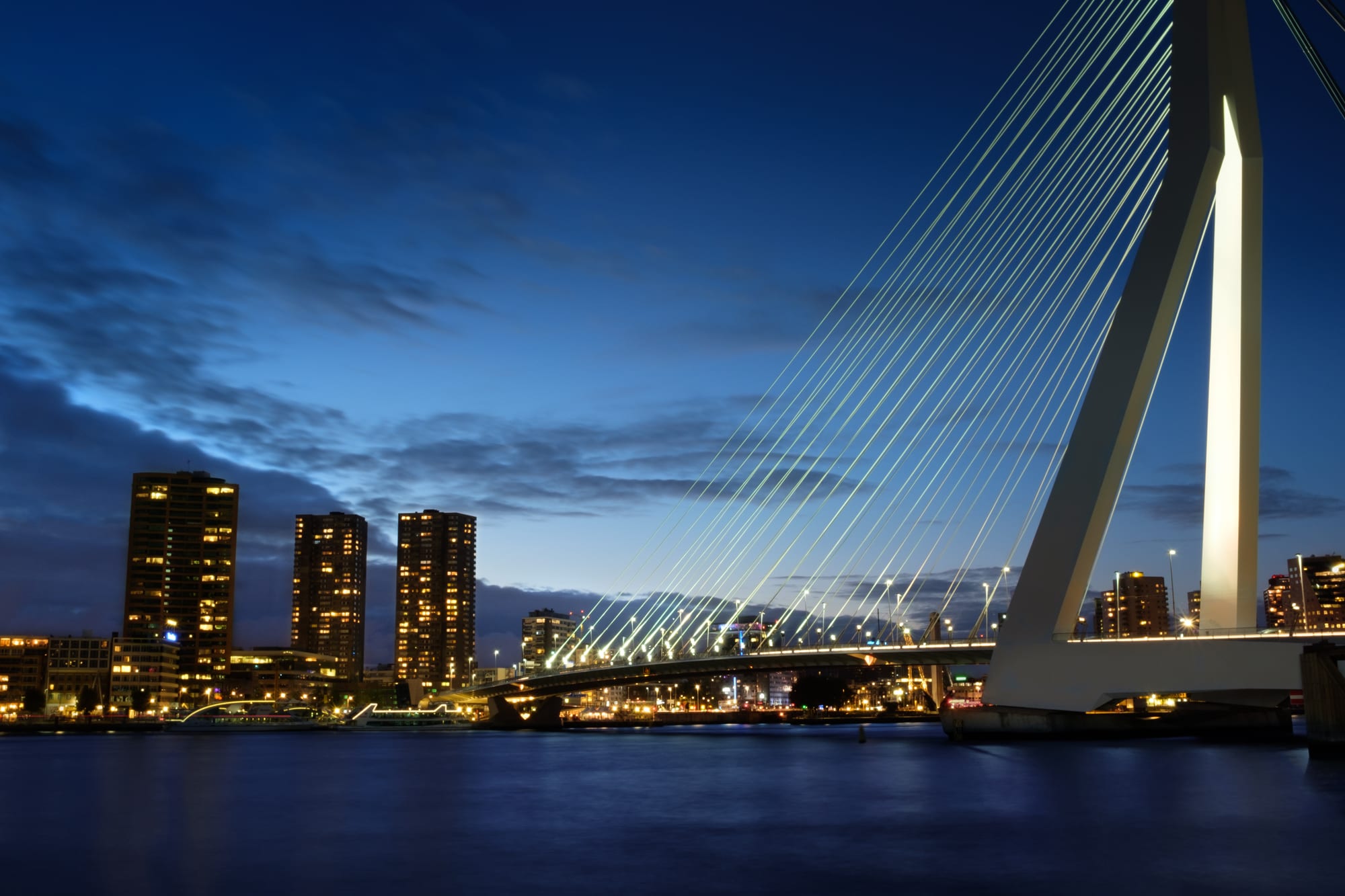
Many of the architectural sights — the Erasmus Bridge, the Cube Houses from outside, the Markthal and the Wilhelminapier waterfront — cost nothing to see.
📅 Best Time to Visit
Late spring and summer are the liveliest time, with the marathon in April, North Sea Jazz in July, the summer festivals and café terraces along the water. September brings the World Port Days. Spring and early summer are usually the driest and sunniest months. Winter is grey, but the film festival fills the city in late January and the museums are quiet.
⏳ Suggested Number of Days
Two or three days cover the centre, the waterfront and a museum or two. Four or five allow trips to the windmills, nearby towns or the coast. The city is spread out on both banks of the river, so the metro, tram or a bike saves time.
- First Visit
- 2–3 days
- With Surroundings
- 4–5 days
🚆 Transportation
Rotterdam opened the first metro in the Netherlands in 1968, and its network, with 70 stations, is the largest in the Benelux; trams and buses fill in the gaps, all run mainly by the city operator RET and paid by tapping in and out with a contactless card. Waterbuses run on the river to Dordrecht and Kinderdijk, and the city is flat and well supplied with cycle lanes.
Tap in and out with a contactless card on all trains, trams and metros, and use the waterbus for a river trip to Kinderdijk.
🛬 Airport & Station Connections
Rotterdam Centraal, rebuilt and reopened in 2014, has fast trains to Amsterdam, The Hague, Schiphol and international destinations. Amsterdam Airport Schiphol, about 58 kilometres away, is the airport most visitors use, with direct trains to Centraal. The smaller Rotterdam The Hague Airport lies about 5.5 kilometres north-north-west of the city with European flights. Ferries from Harwich in England arrive at Hook of Holland, within the city's boundaries.
🚶 Walkability
The centre is compact and flat: Centraal station to the Erasmus Bridge is a straight walk down the Coolsingel, and the Markthal, Cube Houses and Oude Haven sit together. Wide post-war roads and open spaces make some walks feel long, and the districts beyond the centre — Delfshaven, Kralingen and the south bank — are easier by metro, tram or bike.
🛡️ Safety
The Netherlands is very safe, with low violent crime. Pickpocketing occurs around Rotterdam Centraal, in busy shopping streets, at markets and on trams and trains.
Watch bags at stations and markets, lock bikes securely to a fixed object, and swim only at lifeguarded beaches at Hook of Holland. Check current official travel advice before travelling.
🌦️ Climate
A temperate oceanic climate, like that of all the Dutch coast. Spring and early summer are relatively dry and sunny, while autumn and winter are cloudier with more frequent rain. The centre is warmer than its surroundings.
- Summer
- mild to warm, with occasional hot days — the thermometer passes 30°C on about four days a summer
- Winter
- cool, with frequent cold days; nights can drop below −5°C for short spells, mostly in easterly winds
🤝 Local Customs
Rotterdammers are known for directness and for valuing work over talk, summed up in sayings such as "Money is earned in Rotterdam, distributed in The Hague and spent in Amsterdam". Football loyalty to Feyenoord runs deep, and the rivalry with Ajax is serious enough that away fans are kept out of matches. Tipping is not necessary but appreciated; rounding up or 5–10 per cent on a larger bill is common.
The legal age for buying alcohol is 18, and smoking is banned inside bars and restaurants. Never walk in the red cycle lanes.
💳 Common Payment Methods
The currency is the euro. Mastercard and Visa cards are widely accepted, and a growing number of shops do not take cash at all, though some stores block credit cards issued in the EU, and a few have had trouble with cards issued outside the European Economic Area, so carry a second way to pay.