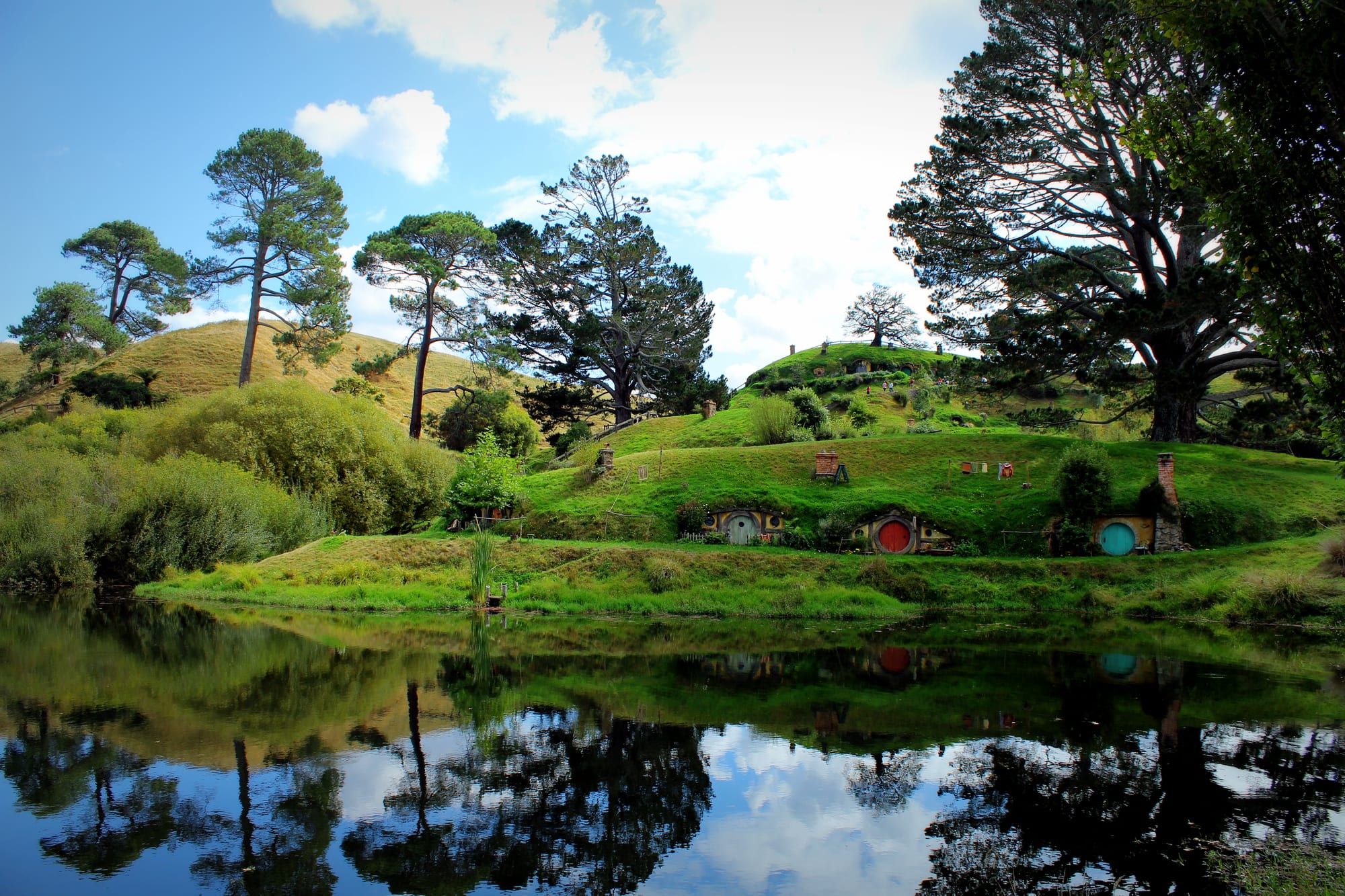
Round coloured doors set into grassy hills above a still pond, with tall pines and a blue sky reflected in the water

Rotorua, Waikato & the Bay of Plenty, New Zealand

Matamata

Hobbit holes above the lake at the Hobbiton Movie Set on farmland near Matamata. (Jackie.lck / Wikimedia Commons · CC BY 2.0)

A Waikato farming town of about 9,500 people below the Kaimai Range, built on drained swampland turned into dairy pasture and on thoroughbred breeding and training. Since the Lord of the Rings films were made on a sheep farm nearby, the Hobbiton movie set has made the town one of the North Island's busier stops.

Neighbourhoods

  • Town centre and the main street
    • First-time visitors
    • Best for food
    • Shops and services

    The wide main street and the few blocks around it hold the shops, cafés, bakeries, pubs and motels, along with the information centre. It is flat, compact and busiest in the middle of the day when tour coaches pass through.

    Open in Maps
  • Buckland Road and the Hinuera countryside
    • Farm stays
    • Quiet and residential
    • Close to Hobbiton

    Rolling sheep and dairy country west of the town, where the movie set stands on a working farm. Accommodation here is farm stays, cottages and lodges among paddocks and shelter belts, with no shops and dark, quiet nights.

    Open in Maps
  • Okauia and the Kaimai foothills
    • Hot springs
    • Walks
    • Quiet and residential

    The valley running north-east towards the range, with thermal pools at Opal Springs, campgrounds, and roads to the tracks up to Wairere Falls and into the Kaimai forest. Farms and a handful of lodges make up the settlement.

    Open in Maps
  • Te Aroha
    • Hot springs
    • Historic district
    • Budget stays

    A small spa town about half an hour north, at the foot of a forested mountain, with the Edwardian spa buildings of the Te Aroha Domain, a soda-water geyser and tracks up Mount Te Aroha. It works as an alternative base with more of its own character.

    Open in Maps

Things to do

The film set and town landmarks

  • Hobbiton Movie Setattraction

    The Shire built on the Alexander family's farm for the Lord of the Rings films and rebuilt in permanent materials in 2010 for The Hobbit, with hobbit holes, gardens and the Green Dragon Inn, seen on guided tours that began in 2002.

    Open in Maps
  • Firth Towerlandmark

    A castellated tower of unreinforced concrete built in 1882 by the landowner Josiah Firth as part of his Matamata estate house, one of the earliest concrete structures in the country, now the centre of a museum with relocated colonial buildings.

    Open in Maps
  • Matamata Racecourseattraction

    A racing venue at the edge of town, in a district that breeds and trains a large share of New Zealand's thoroughbreds.

    Open in Maps
  • Matamata Airport and the soaring centreattraction

    A grass airfield at Waharoa, nine kilometres north of the town, formed in 1942 and used by the Matamata Soaring Centre for gliding and light flying.

    Open in Maps

Walks, water and hot springs

  • Wairere Fallsattraction

    The highest waterfall in the North Island, dropping 153 metres in two steps over the Kaimai escarpment north-east of the town, reached by a steep bush track to a lower lookout or the top.

    Open in Maps
  • Kaimai Rangeviewpoint

    The forested ridge that separates the Waikato from the Bay of Plenty, crossed by tramping tracks that in places follow old bush tramlines, and rising to Mount Te Aroha at 953 metres.

    Open in Maps
  • Opal Hot Springsattraction

    Hot springs on the west bank of the Waihou River at Okauia, a few kilometres from the town, opened for bathing in Firth's day and now a pool complex and campground.

    Open in Maps

Short trips from the town

  • Te Waihou Walkway and the Blue Springtrail

    A riverside path south of the town leading to a spring of exceptionally clear water that is the source of about 70 per cent of New Zealand's bottled water.

    Open in Maps
  • Tīrauneighborhood

    A village at a state highway junction to the south, characterised by artworks made from corrugated iron, including an information centre shaped like a giant dog and a neighbouring sheep, and known for its vintage and collectables shops.

    Open in Maps
  • Lake Karapiroattraction

    A hydro lake formed in 1947 by damming the Waikato River west of the town, one of New Zealand's two premier rowing venues, which hosted the world rowing championships in 1978 and 2010.

    Open in Maps
  • Cambridgeneighborhood

    A town on the Waikato River known as the town of trees and champions, also a centre of thoroughbred studs, with a cycling velodrome opened in 2014.

    Open in Maps

Seasonal events

  • Matamata race meetingsthrough the year

    Race days at the local track, when the district's training stables put their horses in front of a home crowd.

  • Gliding seasonsummer

    Summer brings pilots to the airfield at Waharoa, where the Matamata Soaring Centre flies gliders.

  • Summer holidayslate December to January

    The busiest period for the movie set, the hot pools and the walking tracks, when accommodation in and around the town fills up.

Eat and drink

Long-standing places and food districts in Matamata. Hours, ratings and directions come from your maps app, always current.

Matamata classics

  • The Green Dragon Inn at Hobbitonrestaurant

    A full-size reconstruction of the Shire's inn on the film set, opened in 2012, serving drinks and hosting banquets, reached as part of a tour.

    Open in Maps

Food streets

  • The town centreneighborhood

    Bakeries with pies and sandwiches, cafés doing brunch and coffee, Chinese and Indian kitchens, takeaways and two or three pubs along the main street.

    Open in Maps
  • Farm gates and roadside stallsmarket

    Honesty boxes and small stalls on the rural roads around the town sell eggs, honey, avocados, sweetcorn and seasonal fruit from the surrounding farms.

    Open in Maps

Experience Matamata

History

The Matamata district was long settled by Ngāti Hauā and related hapū of the Waikato, on fertile land between the Waihou River and the Kaimai Range. Its best-known figure is Wiremu Tamihana Tarapipipi Te Waharoa, the Ngāti Hauā leader known as the kingmaker for his part in the Māori King Movement, which raised Pōtatau Te Wherowhero as the first Māori King, and later for favouring negotiation during the fighting in the Waikato.

The European town began with one man's estate. The Auckland merchant Josiah Firth leased a large block here in 1865, after negotiating with Wiremu Tamihana, cleared and drained swamp, planted pasture and grain, and worked to make the Waihou navigable for river craft. In 1882 he built a castellated tower of concrete, an experimental material at the time, as part of his house; it still stands as Firth Tower. Firth's venture eventually failed, and by 1904 the Crown had taken over the estate and subdivided it into dairy units. Drainage, refrigeration and cooperative dairy factories turned the plains into some of the country's most productive farmland, and a service town grew along the main street.

In the 20th century the district added horses: studs and training stables spread across the free-draining soils around the town, making Matamata a centre of New Zealand thoroughbred racing. The most public change came when Peter Jackson saw the Alexander family's farm on Buckland Road from the air in 1998 and chose it as the Shire for his Lord of the Rings films. Open for tours since 2002 and rebuilt permanently in 2010 for The Hobbit, it has made a quiet farming town internationally recognisable.

Culture & Customs

Three cultures share the town. The oldest is Māori: Ngāti Hauā marae in the district, the memory of Wiremu Tamihana, and a continuing presence in local schools, sport and district affairs. The second is farming, which sets the rhythm of the year and the conversation — milk payouts, feed, the weather — and shows itself in A&P-show culture, dog trials, rugby clubs and volunteer fire brigades.

The third is horse racing. A large share of the country's thoroughbreds are bred or trained within a short drive, stables employ riders, farriers and trainers, and the town's mornings include strings of horses working. Sale and race days matter locally in a way that outsiders often miss, and the industry ties the town to Cambridge and to Australian racing.

Over all this sits the film business. Matamata leans into it: a "Welcome to Hobbiton" sign stands on the main road, and a significant number of residents work in tours, hospitality and transport serving visitors who come for a few hours. Locals are used to international crowds and generally friendly about it, though the gap between a quiet dairy town and a global film attraction is a standing local joke. Gliding gives the town one more identity, with the soaring centre flying from the airfield at Waharoa.

Daily Life

About 9,500 people live in Matamata, in a district of about 39,000 that also includes Morrinsville and Te Aroha. The town is compact, mostly single-storey, and surrounded immediately by farmland, so the countryside is a few minutes from any front door.

Dairying underpins the economy, with milk processed at plants in the wider Waikato, alongside beef, sheep, maize and horticulture. The thoroughbred industry is the second employer, and tourism the third, concentrated on the film set and rising steadily since it opened for tours. Engineering, transport and farm-servicing businesses fill the industrial edges of the town, and some residents commute to Hamilton or over the range to Tauranga.

Daily life runs early, on farm time: stock work and stable work before dawn, school buses on country roads, the main street busy at lunchtime and quiet by evening. Shopping for anything substantial means Hamilton or Tauranga. Local issues are those of much of rural New Zealand — the cost and availability of housing, staffing for farms and tourism, water quality in the Waihou catchment and the effect of intensive dairying on it, and how much a small town should build around a single attraction.

Food

Matamata eats what the Waikato produces. Dairy is everywhere in the form of milk, butter, cream and cheese; beef and lamb come off the surrounding hills; and the plains grow maize, sweetcorn, avocados and berries, sold from farm gates and roadside stalls in season. The town's own food is the New Zealand small-town canon: bakery pies, filled rolls, fish and chips, a café brunch of eggs and sourdough, pub steaks and roasts, and takeaway Chinese and Indian.

The film set has added a curiosity. The rebuilt Green Dragon Inn has served drinks to visitors since 2012, and banquet-style dinners are staged in the Shire, which is the closest thing the district has to a signature meal for visitors.

Māori food traditions remain part of community life: hāngī cooked in earth ovens for gatherings at marae and fundraisers, rēwena bread raised with a potato starter, and freshwater eel and watercress from the Waihou and its drains. Nearby towns fill in the rest — the Bay of Plenty's kiwifruit and avocados arrive over the Kaimai, Te Aroha has its mineral water, and craft breweries and cheese makers scattered across the Waikato sell at markets in Cambridge, Tirau and Hamilton.

Planning tools

Budget

Matamata is an inexpensive town with one expensive attraction: tours of the movie set are ticketed per person and are the main planned cost of most visits, with dinner banquets and combined transport from Auckland or Rotorua costing considerably more. Motels and farm stays are moderate and cheaper than Rotorua or Taupō, and the walks, the town itself and the Kaimai tracks cost nothing.

Daily Budget Midrange
USD 150–260 (motel or farm-stay room, the movie set tour, restaurant meals, a hire car)
Daily Budget Shoestring
USD 55–100 (campsite or hostel bed, self-catering, bush walks and the hot pools)

Tours of the movie set run to set departure times and book out in summer and over holidays, so a place is worth securing in advance; staying in the town is much cheaper than arriving on a packaged day trip.

Best Time to Visit

October to April is warmest and driest, and the farm country and gardens look their best in spring, when lambs are in the paddocks. Summer is busy with tour groups and gliding. Autumn is settled and quieter. Winter is cool, wet and often foggy on the plains, though the set is open and the tracks to Wairere Falls and the hot pools are less crowded.

Suggested Number of Days

A day covers the town and the film set, and many people come for only a few hours between Auckland and Rotorua. Two or three days allow the waterfall and Kaimai walks, the hot pools and the neighbouring towns. Weather on the range and tour availability decide the difference.

First Visit
1 day
With Surroundings
2–3 days

Transportation

A car is the usual way to travel here. There is no urban bus network; regional coaches call at the town, and shuttles connect it with the movie set, Rotorua and Hamilton. Distances are short — the set is about ten kilometres out of town — but rural roads have no footpaths. Cyclists use the quiet country roads.

Farm machinery, stock trucks and horse floats are common on the district's roads, and morning fog can be dense on the plains in autumn and winter.

Airport & Station Connections

Matamata is about 165 kilometres south-east of Auckland, a little over two hours by road, and roughly 65 kilometres from both Hamilton and Rotorua, under an hour from each. Tauranga is about 75 kilometres away over the Kaimai range. Coaches and tour buses serve the town daily, and the nearest airports with scheduled flights are Hamilton, Rotorua and Tauranga. There is no passenger rail service.

Walkability

The town centre is flat and can be crossed on foot in a few minutes, with the shops, cafés and motels in one stretch. Firth Tower is a short ride or a long walk from the centre, and the film set, the hot pools and the waterfall tracks all need a vehicle. Out in the countryside there are no pavements and verges are narrow.

Safety

A quiet rural town with little crime beyond occasional theft from parked cars at trailheads. The real risks are on the tracks and the roads: the climb to Wairere Falls is steep, slippery and has unfenced drops at the lookouts, the Kaimai Range holds cloud and rain, and country roads are narrow and used by farm traffic.

Wear proper footwear on the waterfall and range tracks, keep children away from the lookouts' edges, take a wind and rain layer into the hills, and leave valuables out of sight at car parks. Check current official travel advice before travelling.

Climate

A mild, humid temperate climate on the Waikato plains, wetter as the land rises towards the Kaimai Range. Summer is December to February, winter June to August. Rain falls throughout the year and morning fog is common in the cooler months.

Summer
warm and humid — days usually in the low to mid 20s °C, with showers and thunderstorms over the ranges
Winter
cool and damp — days around 13–15 °C, night frosts on the flats, and low cloud on the hills

Local Customs

Small-town New Zealand manners: first names, casual dress, a nod or a wave on a country road, and no expectation of tipping. This is Ngāti Hauā country, and the district's history is bound to Wiremu Tamihana and the Kīngitanga, so Māori place names and marae are treated with respect. Farmland is private property: gates, stock and crops are not to be disturbed, and access tracks are used only where they are signposted.

Ask before photographing people, leave gates as they were found, keep dogs away from stock, and note that alcohol cannot be bought under 18.

Common Payment Methods

The currency is the New Zealand dollar. Cards and contactless payment, including the EFTPOS system, are accepted by nearly all businesses, and ATMs are on the main street. A little cash is handy for roadside stalls and honesty boxes in the countryside.